
How Much Does a CPAP Machine Cost?
Updated on | Written by Alec Pow
This article was researched using 14 sources. See our methodology and corrections policy.
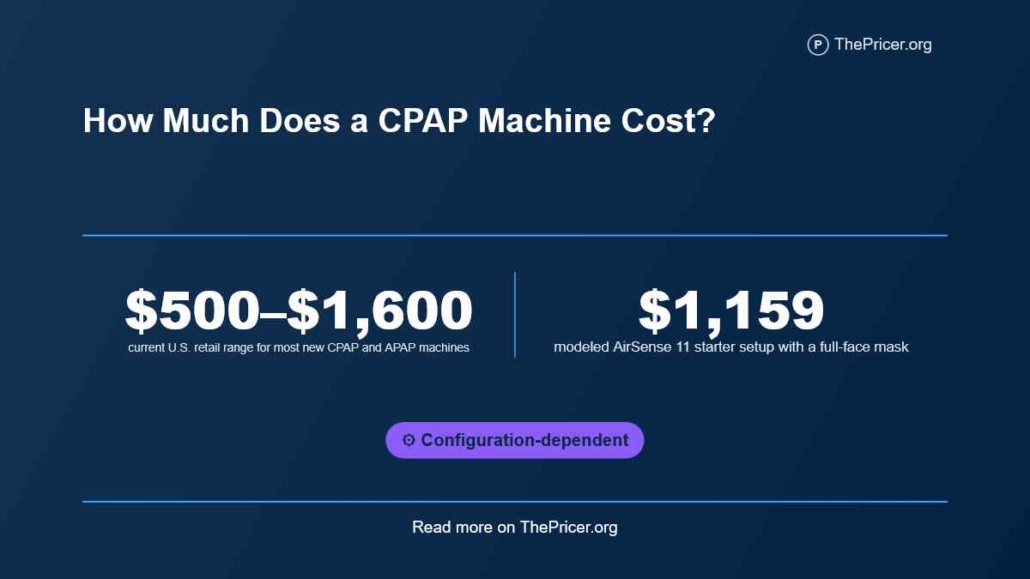
Current U.S. consumer pricing puts new CPAP machines around $500 to $1,000, APAP machines around $600 to $1,600, travel CPAP units around $500 to $1,000, and bilevel PAP machines around $1,700 to $3,000, according to a current CPAP cost review. Those ranges cover the device category, not the full first setup. A mask and later replacement parts can raise the amount paid over time.
The biggest billing difference appears when insurance is involved. Coverage can use a rental pathway rather than a direct retail purchase, so the sticker price is not the same as the patient’s out-of-pocket cost. Cash buyers face a different calculation because they can compare complete machine and supply prices directly.
Article Highlights
Jump to sections
- Most new CPAP and APAP machines cost about $500 to $1,600 (at $30 per hour, earning that amount would take about 0.4 to 1.3 full-time workweeks, before taxes), while bilevel PAP machines often cost $1,700 to $3,000.
- Current retail examples include the ResMed AirSense 11 at $1,004, AirMini at $919, and AirCurve 11 VAuto at $1,796.
- An illustrative AirSense 11 starter setup with a full-face mask totals $1,159 before tax.
- A selected replacement-parts scenario totals $412 per year before filters and tax.
- Medicare can cover a 12-week CPAP trial and then pays for the machine through a 13-month rental structure.
- CMS uses a five-year reasonable useful lifetime for PAP devices before ordinary replacement rules change.
How Much Does a CPAP Machine Cost?
The broad ranges hide very different products. Fixed CPAP delivers one prescribed pressure. APAP changes pressure within a prescribed range as breathing changes during sleep. Bilevel PAP provides different inspiratory and expiratory pressures and belongs to a more expensive device class. Those pressure modes are not interchangeable price tiers, so the relevant comparison starts with the type of PAP device named in the prescription.
Current retail listings also show that feature labels do not form neat price tiers. A travel unit can cost almost as much as a full-size home machine, while a bilevel device can cost hundreds more. Humidification, data connectivity, travel size, pressure mode, included tubing, and mask compatibility all affect what the buyer gets for the price.
The machine is only one cost. A complete purchase needs a compatible mask, and some setups need different tubing or mask connectors. Home machines may include integrated humidification and standard tubing. Travel models can use separate setup packs or waterless humidification. Comparing machine-only prices without checking the box contents can understate the usable setup cost by a meaningful amount on the first purchase.
Current Machine Prices by Type
A current retail PAP machine listing shows the ResMed AirSense 11 AutoSet at $1,004 (about 4.2 full-time workdays at $30 per hour), ResMed AirMini at $919, Transcend Micro at $829, and ResMed AirCurve 11 VAuto at $1,796. These are cash retail prices from one seller and can move with promotions.
| Current device example | Retail price | Device type |
|---|---|---|
| ResMed AirSense 11 AutoSet | $1,004 | Home APAP/CPAP |
| ResMed AirMini AutoSet | $919 | Travel APAP |
| Transcend Micro 510 | $829 | Travel APAP |
| ResMed AirCurve 11 VAuto | $1,796 | Bilevel PAP |
The table exposes two useful gaps. The AirMini costs only $85 less than the AirSense 11, so smaller size does not mean a low-price machine. The AirCurve 11 VAuto costs $792 more than the AirSense 11 in this same retailer sample. Those differences describe these four offers, not a national markup between PAP categories.
The exact device should follow the prescribed therapy type rather than the cheapest row. The retail market contains fixed-pressure, auto-adjusting, travel, and bilevel models with different capabilities. The same mask also does not fit every travel system without the proper setup components. Some machines include humidification and tubing that another offer prices separately.
What a Complete Starter Setup Costs
ResMed’s AirSense 11 package details say the machine includes the humidifier tub, SlimLine tubing, power supply, travel bag, and standard filter, but not a CPAP mask. That means a buyer does not need to add a separate humidifier or standard hose just to create a basic bedside setup.

Current ResMed retail parts prices list an AirFit F20 full-face mask at $155 (about 5.2 hours of work at $30 per hour), a replacement F20 cushion at $54, F20 headgear at $34, SlimLine tubing at $35, ClimateLineAir heated tubing at $46, and an AirSense 11 replacement water chamber at $29.
Using the current AirSense 11 machine price of $1,004 and the $155 F20 mask gives an illustrative starter setup of $1,159 before tax. The machine already includes standard tubing and its humidifier tub, so adding those items again would double count equipment. A buyer who wants heated tubing could add the optional $46 tube later.
The diagnostic path is separate. A sleep study, clinician visit, and prescription can create their own charges and should not be added to every equipment total without evidence. Readers comparing another sleep-apnea treatment path can review current Inspire treatment costs separately.
Supply Costs and Five-Year Ownership
Recurring supply spending depends on which parts wear out and how often they are replaced. Current CPAP replacement guidance places many cushions at one to three months, tubing at three to six months, headgear at several months, and humidifier chambers around six months. Actual wear and insurer reimbursement schedules can differ.
A selected annual scenario can use the F20 prices already listed. Four cushions at $54 each cost $216. Two headgear replacements at $34 each cost $68. Two standard ResMed tubes at $35 each cost $70, and two water chambers at $29 each cost $58. That totals $412 before filters, tax, or a complete-mask replacement.
Extend that chosen pattern across five years and replacement supplies total $2,060. Add the initial $1,159 machine-and-mask setup and the five-year scenario reaches $3,219 before filters, tax, insurance reimbursements, repairs, or a replacement machine. This is a ThePricer scenario built from current retail inputs, not an observed national five-year average.
The calculation shows why a one-time machine price understates long-run ownership. A person who replaces parts less often can spend less, while a person using more frequent insurer-approved replacements can cycle through more supplies. The mask system chosen also changes the recurring part prices.
Medicare CPAP Coverage
Medicare Part B uses a structured rental pathway. The current Medicare CPAP rules allow a 12-week trial for eligible people diagnosed with obstructive sleep apnea. Continued coverage can follow when the required follow-up occurs and the medical record documents that coverage conditions are met and therapy is helping.
After the Part B deductible, a beneficiary usually pays 20% of the Medicare-approved amount when the DME supplier accepts assignment. Medicare pays the supplier to rent the CPAP machine for 13 continuous months while the beneficiary keeps using it. After those 13 rental months, the beneficiary owns the machine. Covered masks, tubing, and related supplies can have separate Medicare-approved amounts.
Supplier status can change the cash flow. Medicare warns that a non-participating DME supplier or one that does not accept assignment can charge more. For rented equipment, a supplier that will not accept assignment for every rental month can require the patient to pay the full cost upfront and wait for Medicare reimbursement of the covered portion.
This makes Medicare rental different from a short-term consumer rental. It is part of the coverage structure and can last more than a year. The patient’s exact dollar amount depends on the approved rental amount, deductible status, supplier participation, and other coverage.
Insurance, Cash Purchase
Commercial insurance does not have one national CPAP coverage percentage. A plan may apply a DME deductible, coinsurance, rental requirement, prior authorization, network restriction, compliance rule, or contracted supplier requirement. A person with a high deductible can face a larger bill than a cash shopper, while another plan can make DME coverage much cheaper.
That is why the old claim of a typical insured out-of-pocket total of $150 to $500 should not control the budget. The useful comparison is the insurer’s allowed amount and patient responsibility versus the current cash price for the same device and included supplies. A plan’s replacement allowance also matters because recurring masks and parts can become a large share of multi-year cost.
Prescription rules remain part of the purchase. The AirSense 11 offer described earlier is prescription-only, and paying cash does not turn prescribed PAP equipment into an ordinary appliance. A cash buyer can compare retail prices, but the machine and pressure mode still need to match the clinical order.
Device price should not decide the therapy type. Readers comparing airway surgery can review tonsil removal costs or SARPE surgery costs as separate treatment-path expenses rather than substitutes chosen from a price list.
Travel, Battery, and Cleaning
Travel CPAP can require extra compatibility spending. A current AirMini setup-pack listing prices the compatible P10 mask pack at $165. Using the AirMini price listed earlier, the machine plus that compatible mask pack totals $1,084 before tax.
Off-grid power can raise the travel total again. A 2026 current battery review lists the Zopec Explore Mini at $349, with the price checked September 14, 2026. Add that optional battery to the $1,084 AirMini and P10 setup and the travel scenario reaches $1,433. A battery is not mandatory for ordinary wall-power use, and battery runtime changes with pressure and humidification use.
Cleaning is another place where unnecessary spending can enter the budget. The FDA says ozone and UV cleaners have not been authorized for cleaning, disinfecting, or sanitizing CPAP devices and accessories. ResMed’s user instructions call for water and mild dishwashing liquid for routine AirSense 11 cleaning.
A dedicated electronic sanitizer should not be treated as a required ownership cost. Travel batteries, mask setup packs, and extra carrying accessories belong in the budget only when the user’s travel pattern actually needs them.
Replacement, Recalls
CMS uses a five-year reasonable useful lifetime for PAP devices. Its PAP replacement rules allow earlier replacement for loss, theft, or irreparable damage tied to a specific incident. After five years, Medicare can cover replacement when the treating practitioner documents continued use and benefit without requiring a new sleep test or another trial period.
Philips Respironics also needs current context. The FDA’s current Philips recall page says a 2024 federal consent decree restricts, with limited exceptions, production and sale of new CPAP and BiPAP devices at several Philips facilities until specified requirements are met. Old advice to seek refurbished Philips machines directly from the manufacturer should not be treated as a standard savings route.
Makes sense if
- You compare the same prescribed device type and package contents.
- You price the mask and recurring parts with the machine.
- You check Medicare or private-insurance supplier rules before choosing cash purchase or DME billing.
- You add travel accessories only when you need their function.
Does not make sense if
- You compare a bilevel machine with a standard CPAP only because one has a higher price.
- You assume every insurance plan pays 80% of the same retail total.
- You buy a travel machine expecting every mask, adapter, and battery to be included.
- You add an ozone or UV sanitizer as though it were required equipment.
Answers to Common Questions
How much does a CPAP machine cost without insurance?
Most new CPAP and APAP machines fall around $500 to $1,600. Current named examples include travel machines below $1,000 and a ResMed AirSense 11 at $1,004, while bilevel devices can cost much more.
How much does a complete CPAP setup cost?
An illustrative current AirSense 11 setup with a $1,004 machine and $155 full-face mask totals $1,159 before tax. The machine package includes standard tubing and its humidifier tub.
Does Medicare buy or rent a CPAP machine?
For eligible coverage, Medicare uses a 13-month rental structure. After 13 continuous rental months, the beneficiary owns the machine.
How often does Medicare replace a CPAP machine?
CMS uses a five-year reasonable useful lifetime for PAP devices. Replacement rules differ when a device is lost, stolen, irreparably damaged, or reaches the end of that five-year period.
Do you need an expensive CPAP cleaner?
No electronic sanitizer is a standard required purchase. The FDA says ozone and UV CPAP cleaning devices are not authorized for CPAP cleaning, and manufacturers provide ordinary cleaning instructions for their equipment.
Disclosure: Educational content, not medical advice. Pricing varies by provider, location, and insurance. Confirm eligibility, coverage, and out-of-pocket costs with a licensed clinician and your insurer. See our methodology and corrections policy.