
How Much Does a Cyclops Missile Interceptor Cost?
Published on | Written by Alec Pow
This article was researched using 9 sources. See our methodology and corrections policy.
Long Wall’s Cyclops missile interceptor has no publicly announced production unit price, but an illustrative cost scenario of $7.6 million to $15.2 million per missile would place it at 25%–50% of the Congressional Budget Office’s $30.4 million benchmark for an SM-3 Block IIA interceptor.
This range is a comparative financial scenario, not a manufacturer quotation or official target. Long Wall says Cyclops is designed to cost a fraction of existing midcourse interceptors, without publishing a specific percentage.
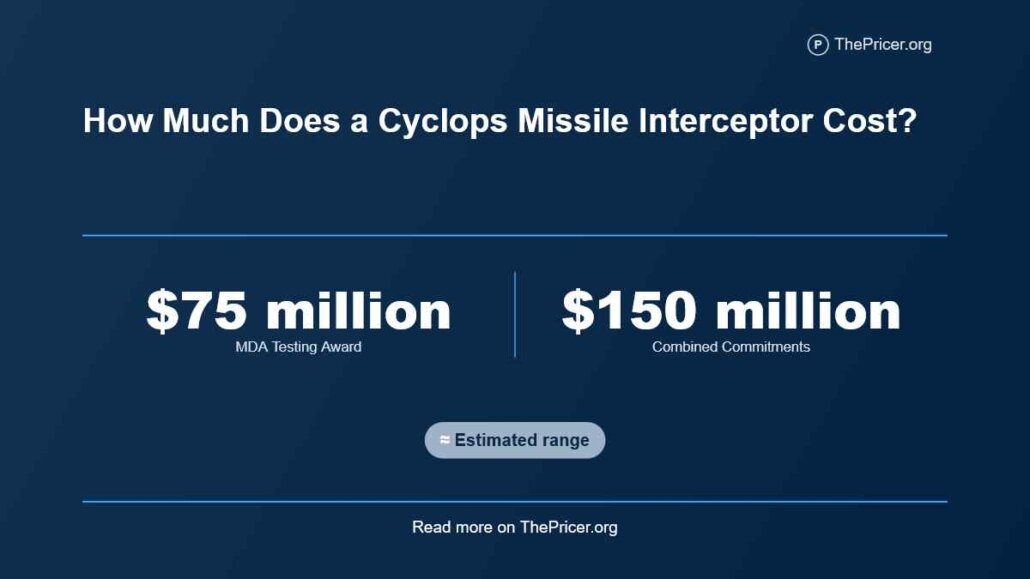
On October 22, 2026, Long Wall announced a $75 million Missile Defense Agency award to complete Cyclops flight testing. The California manufacturer committed another $75 million in private development spending during the program, creating a combined $150 million investment commitment. That funding covers development and testing, not the purchase of a defined number of operational missiles.
Article Highlights
Jump to sections
- Cyclops has no confirmed production price; a modeled $7.6M–$15.2M range represents 25%–50% of an SM-3 Block IIA benchmark, not a published offer.
- The Missile Defense Agency announced a $75 million Cyclops flight-testing award on October 22, 2026.
- Long Wall committed another $75 million of its own funding, bringing announced new program commitments to $150 million.
- An SM-3 Block IIA costs approximately $30.4 million in CBO’s 2026-dollar model, while a future Next-Generation Interceptor is modeled at $120 million.
- Long Wall says its existing facilities could produce more than 100 Cyclops rounds annually at full utilization, although actual production has not been demonstrated at that rate.
- Cyclops is intended for exoatmospheric midcourse missile defense, not ordinary short-range counter-drone interception.
How Much Does a Cyclops Missile Interceptor Cost?
The strongest financial evidence comes from the prices of existing interceptors that address similar ballistic missile threats.
In its September 2026 national missile defense testimony, the Congressional Budget Office estimated approximately $30.4 million per SM-3 Block IIA interceptor in 2026 dollars.
Cyclops is designed for midcourse interception, meaning it attempts to destroy an incoming missile or warhead after launch and before the final descent toward its target.
Because the SM-3 Block IIA also performs exoatmospheric interception, it provides a more relevant financial reference than a small counter-drone missile.
Long Wall has described its ambition as delivering midcourse interceptors at a fraction of legacy costs. The company has not defined the precise price reduction.
To make that ambition measurable without treating it as a confirmed offer, consider three hypothetical production scenarios:
| Scenario | Modeled Cyclops cost | Compared with SM-3 Block IIA |
|---|---|---|
| Aggressive cost reduction | $7.6 million | 25% of benchmark |
| Intermediate reduction | $10.64 million | 35% of benchmark |
| More conservative reduction | $15.2 million | 50% of benchmark |
| SM-3 Block IIA reference | $30.4 million | 100% of benchmark |
| Future NGI reference | $120 million | Different interceptor class and mission |
These calculations illustrate possible affordability outcomes. They are not forecasts, and none establishes the price Long Wall will offer the government.
The NGI comparison is particularly sensitive because that missile is designed for strategic homeland defense against intercontinental ballistic missiles. Cyclops is intended to address a broad midcourse threat set, but equivalent capability has not been demonstrated.
The New $75 Million Contract
Long Wall’s October 22 announcement confirmed an award of $75 million from the Missile Defense Agency for Cyclops flight testing.
The company simultaneously committed to spending an additional $75 million of private capital on development during the award period.
That gives the project $150 million in announced government and company commitments associated with this phase.
The arrangement does not establish a government purchase of 75, 100, or 150 operational missiles.
Breaking Defense’s October 22 investigation confirms that the award supports the testing and development of Cyclops, which Long Wall had previously funded independently.
The spending may support test vehicles, flight operations, engineering, production-process improvements, and the broader development effort.
How those funds will be divided among individual activities has not been publicly itemized.
Dividing $75 million by a hypothetical number of missiles would therefore produce an invented unit price.
Similarly, the combined $150 million commitment is not necessarily an additional amount on top of all earlier privately financed work. Long Wall has already spent capital developing Cyclops since 2024.
What Makes Cyclops Different?
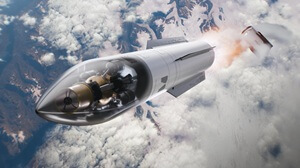
Cyclops is being developed as a surface-launched interceptor that engages missile threats outside Earth’s atmosphere.
It uses a liquid-fueled booster and an exoatmospheric kill vehicle intended to destroy incoming targets through direct kinetic impact.
Its proposed target set includes medium- and intermediate-range ballistic missiles, intercontinental ballistic missiles, and certain advanced maneuvering threats.
According to Tectonic Defense’s December 2025 interview with Long Wall founder Dan Piemont, the company designed the system around mass production rather than modifying an older interceptor platform.
The company also describes containerized launch arrangements that could support deployment from land or suitable maritime platforms.
These design objectives could make deployment more flexible than systems requiring large permanent launch installations.
However, a containerized missile launcher still needs detection, tracking, command-and-control, communications, and operational integration to become a functioning missile-defense system.
Cyclops is not an operational substitute for every established system simply because both are designed to intercept missiles outside the atmosphere.
Long Wall Plan
Long Wall began as ABL Space Systems, developing launch vehicles and associated production infrastructure before shifting toward missile defense in 2025.
The company’s December 2025 original Cyclops launch statement describes using existing industrial capacity, additive manufacturing, commercial machinery, and integrated production processes.
Rather than building an entirely new factory before producing development hardware, Long Wall intends to reuse and adapt facilities and tooling already available.
Its production capabilities include CNC machining, 3D printing, electronics assembly, welding, environmental testing, engine testing, and vehicle integration.
The company stated that its facilities could support production of more than 100 Cyclops rounds annually if fully utilized.
That figure describes potential capacity, not completed annual deliveries or an existing government order.
In addition, Long Wall is using its RSX liquid-fueled vehicle for testing and target missions, seeking to reduce reliance on expensive externally supplied test opportunities.
Long Wall’s earlier industry coverage also describes the company’s emphasis on commercially available technology and manufacturing methods.
These approaches may reduce engineering and supplier expenses. Their actual effect on unit cost will become clearer only after production contracts establish quantities, hardware configurations, and accepted deliveries.
Cyclops vs Existing Interceptors
Midcourse interceptors are among the most expensive categories of defensive missiles because they must reach extreme altitudes and precisely engage fast-moving targets.
The Missile Defense Advocacy Alliance’s interceptor comparison lists approximately $27.9 million for the SM-3 Block IIA, $90 million for the Ground-Based Interceptor, and $111 million for the Next-Generation Interceptor.
These figures differ somewhat from CBO’s newer 2026-dollar estimates because of modeling assumptions, procurement scope, and reference periods.
For readers comparing actual naval procurement, ThePricer’s SM-3 missile cost guide documents recent Block IB prices between approximately $12.5 million and $18.3 million, and Block IIA prices around $28.7 million in a fiscal 2025 procurement lot.
These are stronger comparisons for Cyclops than inexpensive short-range interceptors, though they still do not establish equal performance.
ThePricer’s THAAD cost guide covers interceptors costing approximately $12 million–$15 million. THAAD is primarily designed for terminal-phase interception, making it a useful cost reference but a different operational category.
At the lower end, X-Bow’s Buckler was introduced with a price target below $100,000, while X-Bow also secured an approximately $11 million contract to develop and test a separate interceptor.
The latter amount is a testing contract, not a missile unit price, and neither program should be assumed equivalent to Cyclops.
A Cyclops Battery
Missile purchase costs exclude the broader infrastructure needed to detect and stop an incoming threat.
A complete defensive installation may include radar, fire-control equipment, communications networks, launch containers, transport assets, power systems, trained personnel, maintenance, and reload stocks.
CBO’s May 2026 missile-defense assessment provides a useful benchmark for that distinction.
Its hypothetical Aegis Ashore installation would cost nearly $4 billion to acquire and approximately $170 million annually to operate.
The modeled installation includes expensive sensors, interceptors, launch equipment, and related infrastructure, not merely the missiles themselves.
Cyclops is designed around a different architecture, so those amounts are not a Cyclops battery estimate.
They demonstrate that a lower-cost interceptor does not necessarily produce the same percentage reduction in total deployment spending.
If missile hardware represents only part of the procurement budget, reducing that component leaves the other expenses largely intact unless the overall system design changes too.
For broader context, our missile-defense interception cost guide examines the expense of firing multiple interceptors and replenishing the inventory.
100 Cyclops Missiles
A hypothetical 100-missile procurement illustrates the financial significance of Long Wall’s affordability goal.
Using the three previously defined scenarios:
- 100 missiles at $7.6 million: $760 million
- 100 missiles at $10.64 million: $1.064 billion
- 100 missiles at $15.2 million: $1.52 billion
- 100 SM-3 Block IIA missiles at $30.4 million: $3.04 billion
Compared with that SM-3 benchmark, the three Cyclops scenarios would suggest potential missile-only expenditure differences of $2.28 billion, $1.976 billion, and $1.52 billion, respectively.
These are mathematical scenarios, not actual Pentagon savings. They assume comparable procurement quantities and deliberately exclude testing, support equipment, and differences in operational effectiveness.
A further question is how many defensive shots are necessary for each incoming threat.
If an engagement requires two interceptors, the modeled missile expense ranges from $15.2 million to $30.4 million, based on the same hypothetical prices.
But no publicly demonstrated Cyclops interception probability supports assigning a specific number of missiles to every attack.
Even a low unit price loses much of its financial advantage if the system must routinely fire more rounds than an established alternative to achieve the same defensive result.
Why Production Volume Matters
 A cheaper missile is useful to the military only if manufacturers can also build enough of them.
Long Wall’s emphasis on mass production comes amid concern about ammunition shortages and the time required to replenish advanced interceptor inventories.
A September 2026 CSIS analysis documents the Pentagon’s growing interest in lower-cost weapons and industrial production capacity.
It discusses separate government initiatives seeking interceptors priced below approximately $750,000–$1 million for certain missions.
Those prices should not be assigned to Cyclops: its exoatmospheric midcourse mission has substantially different requirements from many shorter-range defensive systems.
Long Wall’s existing industrial capacity could provide advantages if development succeeds and orders increase.
However, production rates depend on suppliers, component testing, acceptance standards, and whether the company can manufacture the complete missile at a consistent cost.
In its October 2026 examination of emerging interceptors, Defense News described other programs targeting dramatically lower prices while still working toward verified ballistic interception.
The pattern is important: a manufacturer’s low target price and its ability to provide an operational, repeatably manufactured weapon are separate milestones.
Will Cyclops Join Golden Dome?
Cyclops is being developed for missions relevant to U.S. homeland and regional ballistic missile defense.
The federal government’s Golden Dome initiative has increased attention on ways to expand interceptor inventories while reducing acquisition costs.
However, the newly announced Cyclops testing award does not itself establish that the missile has been selected for operational Golden Dome deployment.
CBO’s September 2026 assessment estimates that a notional nationwide missile-defense architecture could cost approximately $1.2 trillion to develop, deploy, and operate over 20 years.
That estimate is for CBO’s modeled architecture, not an approved final Golden Dome procurement budget.
A successful, lower-cost midcourse interceptor could affect some of those future expenditures if adopted in large quantities.
The actual contribution depends on demonstrated performance, missile compatibility, required launch and tracking infrastructure, and the quantity eventually purchased.
The financial case for Cyclops strengthens if:
- Flight tests validate its intended interception performance.
- Long Wall can manufacture complete rounds at substantially lower prices than legacy midcourse interceptors.
- Government orders sustain production volume.
- Launch and sensor integration avoids significant additional infrastructure expense.
Its price advantage becomes less certain if:
- Development changes require more expensive propulsion, guidance, or kill-vehicle components.
- Production quantities remain small.
- Testing or manufacturing difficulties increase development costs.
- Operational limitations require more defensive shots or additional systems to achieve comparable protection.
Answers to Common Questions
How much does one Cyclops interceptor missile cost?
Long Wall has not announced a production price. A hypothetical cost at 25%–50% of CBO’s $30.4 million SM-3 Block IIA benchmark would be $7.6 million–$15.2 million, but that is not a verified Cyclops quotation.
Did the Pentagon buy $75 million worth of Cyclops missiles?
No. The October 22, 2026 award provides $75 million for testing and development. It does not disclose an order for operational missiles.
How much money is being invested in Cyclops?
The newly announced program commitments total $150 million: $75 million from the Missile Defense Agency and another $75 million from Long Wall during the award period. The company also previously invested private capital.
Is Cyclops cheaper than the SM-3 missile?
Long Wall intends it to be substantially cheaper, but no completed production purchase has established the actual difference. SM-3 Block IIA currently has procurement benchmarks around $28 million–$30 million.
Who makes the Cyclops interceptor?
Cyclops is developed by Long Wall, a California defense manufacturer that previously operated as ABL Space Systems. The company announced Cyclops in December 2025 and received its new flight-testing award in October 2026.
Disclosure: Educational content, not financial advice. Prices reflect public information as of the dates cited and can change. Confirm current rates, fees, taxes, and terms with official sources before purchasing. See our methodology and corrections policy.