
How Much Does a Data Center Backup Generator Cost?
Published on | Written by Alec Pow
This article was researched using 12 sources. See our methodology and corrections policy.
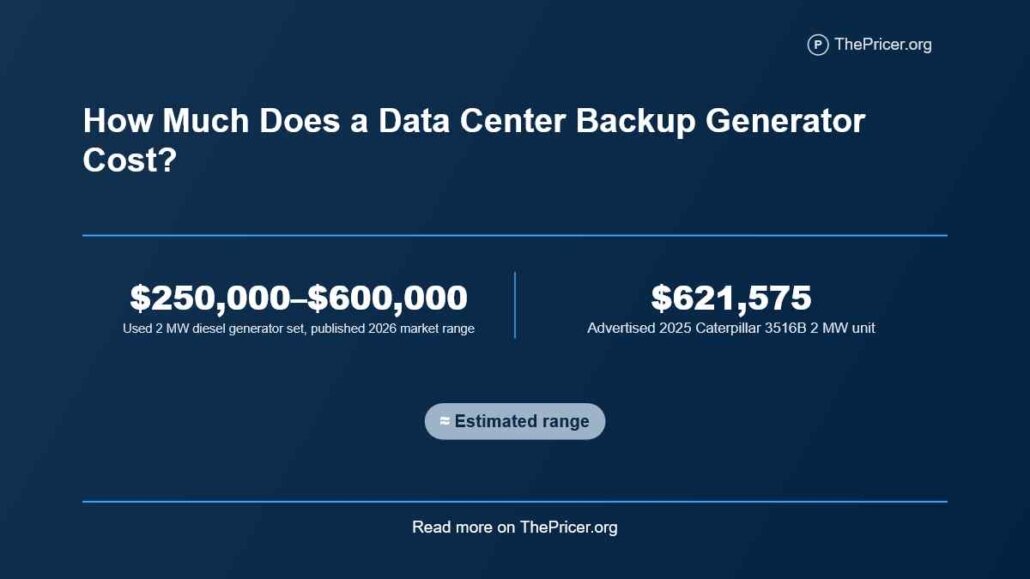
A data center backup generator can cost approximately $250,000 to $600,000 for a used 2-megawatt diesel generator set, while a newer or more specialized unit may cost substantially more. A complete installed backup-power plant can run into millions of dollars once redundant generators, electrical switchgear, fuel storage, exhaust systems, construction and commissioning are included.
There is no reliable universal installed price per megawatt. A supplier may quote only the generator set, while a contractor’s price may cover an operational system capable of carrying critical server and cooling loads during an outage. Those are different purchases.
For a U.S. data center planning a new installation in 2026, the most useful starting point is the number of megawatts that must remain powered, the number of generators needed for redundancy and the equipment included in the project price.
Article Highlights
Jump to sections
- A used 2 MW diesel generator has a published 2026 market range of approximately $250,000 to $600,000 per set.
- A listed 2025 Caterpillar 3516B 2 MW unit was advertised for $621,575, excluding the wider installed plant.
- A historical Department of Energy study used diesel-generator capital costs of approximately $800 to $1,100 per kW for smaller backup applications, not a current data center turnkey quote.
- Redundancy can require buying three 2 MW generators to protect a 4 MW load under an N+1 design.
- Fuel storage, switchgear, emissions controls and electrical integration can materially increase the installed total.
- A generator’s standby rating is not automatically interchangeable with its continuous-duty rating.
How Much Does a Data Center Backup Generator Cost?
Large data centers commonly use diesel generator sets rated in the 1,000 to 3,000 kW range. Mission-critical generator pricing guidance describes this capacity range and cites an older Cummins screening figure of at least $350 per kW for a basic indoor standby configuration, before contractor markup and installation.
That historical figure is a minimum equipment-budget reference, not a dependable 2026 purchase price. The actual equipment market provides a more useful check.
Powerhouse Systems’ September 2026 used 2 MW generator assessment places complete used sets at approximately $250,000 to $600,000, with many clean units between $300,000 and $450,000. The figures reflect the seller’s reported market experience rather than a representative survey of all U.S. transactions.
Another supplier, USP&E, advertised a 2025 Caterpillar 3516B rated at 2 MW for $621,575 per unit in its generator inventory listing. The listing described a zero-hour machine but contained inconsistent new-versus-used labels. Buyers should confirm condition, certification, warranty and availability before relying on the price.
| Generator or project scope | Published price reference | What it includes |
|---|---|---|
| Used 2 MW diesel set | $250,000–$600,000 | Secondary-market equipment |
| Selected used 2 MW sets | $300,000–$450,000 | Seller-reported common range |
| Listed 2025 Cat 3516B, 2 MW | $621,575 | Advertised individual generator |
| Historical diesel capital benchmark | $800–$1,100/kW | Smaller backup-system study, not data center turnkey |
| Installed multi-generator plant | Project-specific quotation | Generators, distribution, fuel, construction and testing |
The Department of Energy backup-power analysis provides the historical capital benchmark in the table. Its application and equipment sizes differ from a modern hyperscale data center, so multiplying that figure across a large facility would not produce a verified turnkey budget.
How Many Generators Are Needed?
Generator count depends on the electrical load and the resilience architecture. A facility protecting 4 MW of critical load does not necessarily need only 4 MW of generator nameplate capacity.
With two 2 MW generators, the system has 4 MW of nominal capacity but cannot support the full load if one generator becomes unavailable. An N+1 arrangement adds another 2 MW unit, bringing installed generator capacity to 6 MW while preserving 4 MW of nominal capacity after one unit fails.
The Uptime Institute’s Tier definitions distinguish concurrently maintainable Tier III facilities from fault-tolerant Tier IV facilities. Neither classification can be achieved simply by buying an extra generator. Electrical distribution paths, maintainability and other systems must satisfy the relevant design requirements.
An Uptime Institute modular design example illustrates a 1.2 MW data hall using two 2 MW standby generators in its electrical design. The example demonstrates why protected IT load, supporting loads and generator nameplate capacity must be considered separately.
Generator ratings require attention too. Caterpillar’s 3516C generator specifications distinguish standby ratings from prime-power ratings. A model marketed at 2,000 kW standby should not automatically be treated as a 2,000 kW continuous generator.
What Installation Adds
A data center generator set is only one component of a functioning emergency power plant. The installation must deliver electrical power safely, coordinate with the UPS system and provide the fuel and controls required during an extended outage.
Major project components can include paralleling switchgear, transfer equipment, distribution transformers, breakers, cables, fuel tanks, pumps, day tanks, exhaust treatment, noise attenuation, concrete foundations, security barriers and commissioning.
A September 2026 data center backup-power cost analysis warns against treating generator equipment cost as a complete installed price. It cites a historical generator-equipment benchmark of approximately $600,000 per MW, while distinguishing that from the much broader cost of power infrastructure.
Electrical distribution can be a major separate expense. A 2026 switchgear cost review identifies protection relays, controls, breakers, busway, testing and commissioning as items that may sit outside a basic equipment quote.
One contractor may include the paralleling controls and switchgear in a single price. Another may quote only the generator and its factory accessories. The lower number is not necessarily the cheaper project.
The difference between commercial and residential installations is substantial. The cost of a household standby generator involves similar basic categories, but data center systems require much larger equipment and a different approach to redundancy and electrical integration.
A 4 MW Data Center Example
Consider a hypothetical U.S. data center requiring 4 MW of emergency generator capacity after the loss of any one generator. Assume three compatible 2 MW diesel sets arranged as N+1, with sufficient electrical distribution capacity to carry the protected load.
For the generator equipment, use the reported $300,000 to $450,000 clean-used-unit range established earlier. Three sets therefore cost approximately $900,000 to $1.35 million before installation.
To illustrate the full budget, assume the project team receives the following separate allowances. These are hypothetical engineering-budget inputs, not supplier quotes or measured industry averages.
| Project component | Illustrative allowance |
|---|---|
| Three used 2 MW generator sets | $1,125,000 |
| Paralleling switchgear and controls | $500,000 |
| Fuel storage and distribution | $220,000 |
| Foundations, electrical installation and exhaust | $420,000 |
| Engineering, permits and commissioning | $180,000 |
| Illustrative subtotal | $2,445,000 |
Adding a hypothetical 15% contingency of $366,750 produces a planning total of $2,811,750. The result is approximately $703 per protected kW, based on 4,000 kW of supported load.
Using the 6,000 kW of installed generator nameplate capacity instead produces approximately $469 per installed kW. Both calculations describe the same hypothetical project. The denominator changes the reported unit cost by 50%.
This is a useful warning when comparing vendor budgets. A quote expressed per installed generator MW can appear substantially cheaper than one expressed per MW of protected data center load, even if the total expenditure is identical.
The illustration excludes land acquisition, major utility upgrades, financing, a separate UPS installation and unusual site remediation. A project requiring those items would need a broader budget.
Fuel Storage and Running Costs
Backup generators consume fuel during testing and utility outages. Diesel consumption depends on engine model, load, operating conditions and the manufacturer’s published fuel curve.
Fuel storage is often specified in hours of autonomy. A data center requiring 48 hours of operation needs considerably more usable fuel than one designed for 12 hours, even when the generator capacity is identical.
Suppose the hypothetical 4 MW plant consumes 0.07 gallons of diesel per kWh while carrying its full protected load. This is an explicit engineering assumption, not a verified fuel-consumption specification for a particular engine.
At 4,000 kW, the plant consumes approximately 280 gallons per hour. A 24-hour outage requires 6,720 gallons, while 48 hours requires 13,440 gallons, before reserve margins, unusable tank volume and testing fuel.
At an illustrative diesel price of $5 per gallon, fuel for 48 hours would cost $67,200. At $6.50 per gallon, it would cost $87,360. That is a $20,160 difference for the same outage.
The actual price of diesel per gallon changes with market conditions and fuel-delivery terms. Data centers may also pay for fuel polishing, sampling, periodic replacement, tank inspection and emergency delivery arrangements.
Large fuel tanks create regulatory obligations. The EPA’s spill-prevention rules can apply to facilities with aggregate aboveground oil storage capacity exceeding 1,320 gallons when other applicability conditions are met. Fuel-system design should account for containment and compliance rather than treating tank capacity as the only expense.
The Hidden Price of Reliability
 Redundancy increases capital expenditure, but it is not simply the price of one spare engine. The extra generator must connect to a distribution system capable of using it when another unit is offline.
For the hypothetical three-generator plant, one spare 2 MW set represents one-third of installed generator nameplate capacity. Yet it does not increase the protected load above 4 MW under the assumed N+1 operating design.
Using the example’s $375,000 average generator-set allowance, the third unit adds $375,000 in equipment spending alone. Its true incremental project cost can be greater after associated switchgear, cabling, fuel connections and commissioning are included.
A second hidden expense is schedule risk. Large generators and switchgear can have procurement lead times that affect the data center’s opening date. Paying more for equipment available earlier may be economically preferable to a cheaper unit that delays commissioning, although the value depends on the project’s actual revenue and contractual obligations.
Generator maintenance is another continuing expense. Regular service, coolant and oil checks, batteries, block heaters, load-bank testing and control-system inspections are needed to maintain readiness.
The EPA’s stationary-engine compliance guidance identifies recordkeeping and maintenance obligations for covered engines. Emergency engines also face restrictions on non-emergency operation, with applicable exceptions and distinctions between testing, emergency use and other operation.
These requirements matter when evaluating proposals to operate backup generators routinely to offset electricity costs. A generator permitted for emergency use cannot necessarily be dispatched whenever grid electricity becomes expensive.
Diesel, Gas or Rental Power?
Diesel remains a common choice for large data center standby plants because fuel can be stored on site and industrial engines are available in high-capacity configurations. Natural gas can be attractive where fuel supply, emissions requirements and operating strategy support it.
The best option depends on whether the equipment will operate only during outages or provide power for extended periods. Emergency standby service and continuous generation are different applications.
A 2026 data center generation market review discusses how generator ratings, emissions requirements, lead times and fuel arrangements affect procurement. It also distinguishes utility-scale gas turbine benchmarks from actual data center generator quotations.
Temporary rental power may be appropriate during construction, equipment replacement or a short-term capacity shortage. The cost of renting an industrial generator depends on the unit rating, rental duration, delivery, fuel, electrical connection and service support. Rental rates for smaller industrial generators should not be extrapolated directly to a multimegawatt data center plant.
Makes sense if
- The facility needs dedicated emergency capacity with fuel stored on site.
- The electrical design accounts for generator failures and planned maintenance.
- Local emissions permits allow the intended operating profile.
- The project can fund testing, service and fuel-system maintenance.
Does not make sense if
- The equipment is being purchased for routine generation but only qualifies for emergency operation.
- The quoted generators cannot match the facility’s voltage, frequency or load requirements.
- Fuel storage and replenishment cannot support the required outage duration.
- The budget excludes essential distribution equipment or commissioning.
What We Verified
- Compared published used-generator prices with a specific 2 MW equipment listing.
- Separated historical capital benchmarks from current advertised prices.
- Checked generator ratings and redundancy concepts against manufacturer and Uptime Institute materials.
- Distinguished published equipment prices from hypothetical installed-project allowances.
- Reviewed federal stationary-engine and oil-storage compliance guidance.
Answers to Common Questions
How much does a 2 MW data center generator cost?
A published September 2026 used-market assessment places complete used 2 MW diesel sets at approximately $250,000 to $600,000. A particular listed Caterpillar unit was advertised for $621,575. Installation and plant infrastructure are additional.
How much does backup power cost per MW?
There is no universal installed rate. A meaningful quote must state whether the denominator is generator nameplate capacity or protected facility load and whether switchgear, fuel systems, construction and commissioning are included.
How many generators does a 10 MW data center need?
If ten megawatts is the actual protected electrical load and each generator can deliver 2 MW under the required operating conditions, five units provide nominal capacity. An N+1 arrangement would require at least six such units, subject to the final electrical design and other capacity constraints.
How long can a diesel generator power a data center?
Runtime depends on usable fuel, consumption at the actual load, replenishment arrangements and maintenance limitations. Fuel capacity for 24 hours does not guarantee 24 hours of operation under every load or site condition.
Are used generators suitable for data centers?
They may be, provided their rating, emissions status, maintenance history, controls, voltage and testing results meet the project’s requirements. A lower equipment price can be offset by refurbishment, warranty limitations and integration costs.
Disclosure: Educational content, not financial advice. Prices reflect public information as of the dates cited and can change. Confirm current rates, fees, taxes, and terms with official sources before purchasing. See our methodology and corrections policy.