
How Much Does a Fractional CMO Cost?
Updated on | Researched and reviewed by Alec Pow, Founder & Pricing Investigator
Prices, claims, and calculations checked against 10 cited sources. See our research methodology and corrections policy.
A fractional Chief Marketing Officer (CMO) gives a business senior marketing leadership without hiring a full-time executive. The arrangement can cover growth strategy, brand positioning, campaign oversight, team management, and reporting. What you pay depends on how much of that responsibility the CMO takes on—and whether the agreement includes people who will execute the work.
Article Highlights
Jump to sections
- Most fractional CMO retainers cost $5,000 to $15,000 per month, although published offers range from $2,000 for limited weekly support to $20,000 or more for extensive leadership.
- Hourly rates commonly run $150 to $350, with some senior specialists charging $500 or more.
- A $10,000 monthly retainer costs $120,000 annually, before advertising, contractors, and software.
- Publicly priced engagements can require commitments ranging from three to six months.
- The most important comparison is the work included, not the retainer alone.
How Much Does a Fractional CMO Cost?
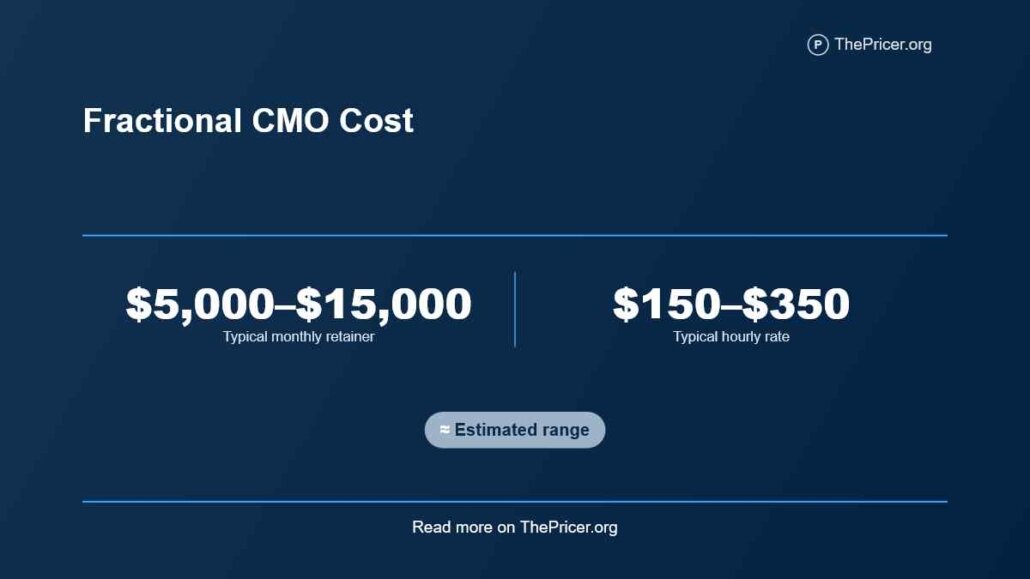
A fractional CMO typically costs $5,000 to $15,000 per month, or approximately $150 to $350 per hour. Limited advisory arrangements can cost $2,000 to $5,000 monthly, while executive-level retainers with substantial management responsibilities can reach $20,000 or more.
These are planning ranges, not a national statistical average. Pricing is usually negotiated around responsibilities, availability, business complexity, and the marketing resources already in place.
| Engagement | Typical Cost | Best Fit |
|---|---|---|
| Hourly consulting | $150–$350/hour | Audits, executive advice, and limited projects |
| Limited advisory retainer | $2,000–$5,000/month | Founder support and occasional strategic direction |
| Ongoing fractional leadership | $5,000–$15,000/month | Strategy, team oversight, and marketing accountability |
| Intensive executive engagement | $15,000–$20,000+/month | Complex growth programs and extensive management |
| Fixed-scope strategy project | $3,000–$15,000+ | Go-to-market planning, positioning, or marketing audits |
These bands are supported by published provider prices, including GoFractional’s pricing guidance of $4,000–$20,000 monthly and a 2026 review of 35 B2B services. That review found a wider spread among publicly priced offers, but only 12 of the 35 providers published any price. Its findings should not be treated as a representative survey of every fractional CMO in the United States.
Published Provider Prices
The clearest way to understand the market is to compare actual advertised offerings. Their differences also explain why a low monthly fee does not necessarily buy the same service as an expensive one.
| Provider | Published Price | Important Terms or Scope |
|---|---|---|
| Firefly CMO | $100/hour or $2,000/month | Approximately five hours weekly; three-month minimum |
| O-CMO | $6,600–$13,200/month | Middle 50% of its published U.S. and Canadian marketplace prices; $8,800 median |
| Marketri | $7,500–$20,000/month | Marketing leadership with a six-month minimum; most engagements reportedly $10,000–$15,000 |
| MarkCMO | $8,000–$20,000/month | Month-to-month executive marketing leadership |
| O8 | $5,000–$20,000/month | From limited strategic hours to near-full-time coverage and execution management |
Prices were checked against provider-published information in October 2026. These are advertised offers or marketplace figures, not quotes obtained specifically for ThePricer. Individual proposals may differ.
Marketri’s pricing illustrates how responsibilities change the fee. Its $7,500 arrangement focuses on leading an existing marketing function. The $10,000–$15,000 tier adds work rebuilding missing foundations, while the $20,000 tier can involve broader positioning, planning, financial responsibility, and executive representation.
At the other end, Firefly publishes a $2,000 monthly arrangement for roughly five hours each week. That can be useful for a small business needing periodic direction, but it should not be compared directly with a retainer that involves running a marketing department.
Hourly and Project Rates
Hourly work is useful when a company wants a second opinion, a short diagnostic, or help with a specific decision before committing to ongoing leadership.
WriteMinded’s cost guide places fractional CMO consulting at approximately $150–$500 per hour, while Velocity Revenue Partners describes senior-level hourly pricing reaching $600. Those upper figures are provider estimates rather than proof that most engagements cost that much.
A project fee can be easier to control. For example, MarkCMO advertises a $4,500 strategy day involving a six-hour working session and follow-up, as well as a $7,500 marketing audit. O-CMO advertises certain fixed-scope marketing audits and go-to-market strategy projects starting at €3,000.
Ask what the project delivers: a presentation, a written strategy, revised positioning, a measurement framework, or hands-on implementation. A polished roadmap has limited value if nobody is assigned to execute it.
What’s Included?
A fractional CMO is generally hired to decide what marketing should accomplish and organize the people, systems, and budgets needed to accomplish it.
Depending on the agreement, the monthly fee may cover:
- Marketing strategy: market selection, positioning, customer profiles, and channel priorities.
- Growth planning: campaign calendars, acquisition targets, launch plans, and budget allocation.
- Team leadership: supervising employees, contractors, and agencies.
- Measurement: dashboards, attribution reviews, lead-quality analysis, and executive reporting.
- Sales alignment: coordinating marketing-qualified leads, pipeline targets, and handoff processes.
- Vendor management: selecting specialists and overseeing outside suppliers.
The distinction between leadership and execution matters. A CMO may direct a search advertising program without writing every advertisement, building landing pages, or managing bids personally. Providers with an attached delivery team may offer those services, but the proposal should identify their separate costs and responsibilities.
What Changes the Price?
Five factors have the greatest practical effect on a fractional CMO quote.
- Hours and availability. A few scheduled advisory calls cost less than being available throughout the working week for operational decisions.
- Responsibility. Advising a founder is different from managing a department, controlling budgets, and reporting to the board.
- Experience. An executive who has led growth at comparable companies may charge more than a general marketing consultant.
- Industry requirements. Specialized B2B sales cycles, healthcare marketing, financial services, or other regulated environments may call for relevant experience and additional review.
- Existing team and systems. A CMO can concentrate on direction when capable employees are already in place. Rebuilding an entire marketing operation usually requires more involvement.
Geography can affect rates, too. O-CMO’s September 2026 regional pricing table shows a U.S./Canada median of $8,800 per month compared with $5,280 for Central and Eastern Europe. These are figures from one marketplace, with different professionals and engagement scopes—not a controlled measure of what identical work costs in each region.
The Effective Hourly Rate
A monthly retainer can look affordable until you compare it with the time and access included.
For illustration, suppose two fractional CMOs both quote $8,000 per month. One expects to work eight hours weekly; the other expects 16 hours. Using 52 weeks divided by 12 months:
| Arrangement | Approximate Monthly Hours | Effective Hourly Cost |
|---|---|---|
| $8,000/month at 8 hours/week | 34.7 | $231/hour |
| $8,000/month at 16 hours/week | 69.3 | $115/hour |
Calculation: Monthly fee ÷ (weekly hours × 52 ÷ 12). These are hypothetical examples, not observed contracts.
The second arrangement provides twice the scheduled time for the same price. However, hours alone do not establish value. A highly experienced executive could solve a particular problem in less time, while another engagement may demand constant team supervision.
Some retainers are explicitly scoped around outcomes rather than tracked hours. Marketri, for example, publishes a $350 senior leadership rate used to establish its fees but says it does not manage engagements through client-approved timesheets. Ask how the provider handles availability, additional work, and scope changes when hours are not contractually fixed.
Fractional vs. Full-Time CMO

The main financial advantage of fractional leadership is that a company buys a portion of an executive’s working capacity. It does not receive the equivalent of a full-time employee at a discounted hourly rate.
The U.S. Bureau of Labor Statistics reports a $166,790 median annual wage for marketing managers in May 2025. That is a broad management occupation, not a CMO-specific compensation figure. Senior CMO packages can be substantially higher, especially when bonuses and equity are included.
| Fractional CMO Retainer | Annual Fee |
|---|---|
| $5,000/month | $60,000 |
| $8,000/month | $96,000 |
| $10,000/month | $120,000 |
| $15,000/month | $180,000 |
| $20,000/month | $240,000 |
At $10,000 per month, a fractional CMO’s annual fee is $46,790 below the BLS marketing-manager median wage, before considering employee benefits or other employment expenses. That comparison is only a scale reference: a fractional executive may work far fewer hours, and the BLS category is not equivalent to a chief marketing officer.
A full-time hire becomes more attractive when marketing requires daily executive availability, continuous personnel management, or an established department large enough to justify permanent leadership. A fractional arrangement makes more sense when the work is intermittent, the company is between executives, or the team already has people who can implement decisions.
Additional Marketing Costs
The CMO fee is not necessarily your complete marketing budget. Advertising, content production, design, software, travel, and outside agencies may all be billed separately.
For example, a business might plan the following monthly spending:
| Expense | Illustrative Monthly Amount |
|---|---|
| Fractional CMO retainer | $8,000 |
| Paid advertising budget | $6,000 |
| Creative and specialist contractors | $3,000 |
| Total | $17,000 |
That equals $51,000 over three months or $204,000 over 12 months, assuming spending stays constant. The CMO receives $8,000 of the $17,000 monthly budget, or approximately 47%; the rest funds execution and media.
This is a budgeting example created from stated assumptions, not a reported customer engagement.
The distinction matters because a CMO may recommend increasing paid search or social advertising without those purchases being included in their fee. ThePricer’s guides to Google advertising costs, Facebook Ads pricing, and Instagram advertising costs explain how the media budget itself is determined. Businesses relying on organic acquisition may instead need to budget for professional SEO services.
Before approving a proposal, identify who pays for advertising platforms, CRM subscriptions, analytics tools, designers, copywriters, video production, and campaign setup. Confirm whether the CMO charges extra for supervising these suppliers.
Contract Length
Contract length can change the financial commitment more than a small difference in monthly rates.
Firefly’s advertised $2,000 monthly engagement has a three-month minimum, making the stated minimum retainer commitment approximately $6,000. Marketri advertises a six-month minimum; at its $7,500 starting fee, that implies $45,000 in retainer payments over the initial term. Its stated termination process also requires written notice, with the notice period depending on engagement size.
By contrast, MarkCMO advertises month-to-month arrangements. That flexibility can matter if the company is uncertain about the role or expects to recruit a permanent executive soon.
Check whether a contract renews automatically, whether unused advisory hours carry forward, and how much notice is required to cancel. Also ask what happens to documents, campaign accounts, vendor relationships, and dashboards when the engagement ends.
Measure the Return
No reliable industry-wide figure establishes that hiring a fractional CMO guarantees a particular revenue increase or return on investment. Results depend on the starting position, product, sales process, budget, and work performed.
Track a small number of measures that reflect the role:
- Qualified pipeline: whether marketing produces more sales opportunities that meet the company’s criteria.
- Customer acquisition cost: the combined marketing and sales spending required to acquire a customer.
- Conversion performance: improvements at relevant points between inquiry and purchase.
- Execution: whether agreed initiatives launch on time and stay within budget.
- Team capability: whether employees can operate more effectively without continued outside supervision.
Set baseline metrics before the engagement begins. Separate early deliverables—such as a marketing plan or improved reporting—from later commercial outcomes. For businesses with long sales cycles, measuring new revenue after only a few weeks may be misleading.
How to Spend Less
A lower quote is useful only if it covers the work the business actually needs. Several approaches can reduce the risk of paying for the wrong arrangement.
- Start with a defined project. A positioning workshop or marketing audit can reveal whether ongoing executive leadership is necessary.
- Write down the responsibilities. Limit the retainer to decisions, meetings, and deliverables that require senior experience.
- Use existing employees. Let capable internal staff handle implementation while the CMO provides direction and quality control.
- Compare three proposals on the same scope. Ask each candidate to price the same expected involvement and responsibilities.
- Separate media spending. Preserve visibility into advertising costs and avoid confusing the executive retainer with campaign expenditure.
- Define an exit plan. Request documentation, account access, and a handover process from the beginning.
When Is It Worth Hiring?
A fractional CMO can be a practical investment when the business already spends meaningful money on marketing but lacks someone senior enough to make coordinated decisions. It can also provide continuity while recruiting a permanent CMO or help a founder establish a marketing function without immediately building an executive team.
It may be the wrong purchase for a small company whose immediate need is simply someone to write content, manage social posts, or operate a few advertising campaigns. Those are execution needs, and a specialist or agency may address them more economically.
A useful test is to ask: What recurring marketing decisions are currently going unmade, and who will carry out the decisions once the CMO makes them? If neither answer is clear, a short diagnostic project may be a better first expense than a long retainer.
Answers to Common Questions
How many hours does a fractional CMO work?
It depends on the agreement. Some published arrangements provide roughly five hours weekly, while others cover extensive leadership responsibilities. Ask whether the quote guarantees hours, availability, or defined outcomes.
Can I hire a fractional CMO for one month?
Yes, some providers offer month-to-month engagements. Others impose three- or six-month minimums. Check termination terms before signing.
Does the monthly fee include advertising?
Usually, advertising spend should be budgeted separately unless the agreement expressly states otherwise. The same applies to production, outside specialists, and software subscriptions.
Is a fractional CMO the same as a marketing agency?
No. A fractional CMO provides executive-level direction and accountability. An agency generally supplies production or channel-specific services. Some providers combine both functions, so examine the actual statement of work.
What is a reasonable starting budget?
For ongoing senior marketing leadership, $5,000–$10,000 monthly is a useful initial planning range. Smaller businesses with limited advisory needs may find lower-priced options, but should confirm the hours and responsibilities included.
Disclosure: Prices reflect public provider information reviewed in October 2026. Rates, contract terms, and service packages can change. Confirm current pricing and the full scope of work before purchasing.
Disclosure: Educational content, not financial advice. Prices reflect public information as of the dates cited and can change. Confirm current rates, fees, taxes, and terms with official sources before purchasing. See our methodology and corrections policy.