
How Much Does a Franchise Disclosure Document Review Cost?
Published on | Written by Alec Pow
This article was researched using 14 sources. See our methodology and corrections policy.
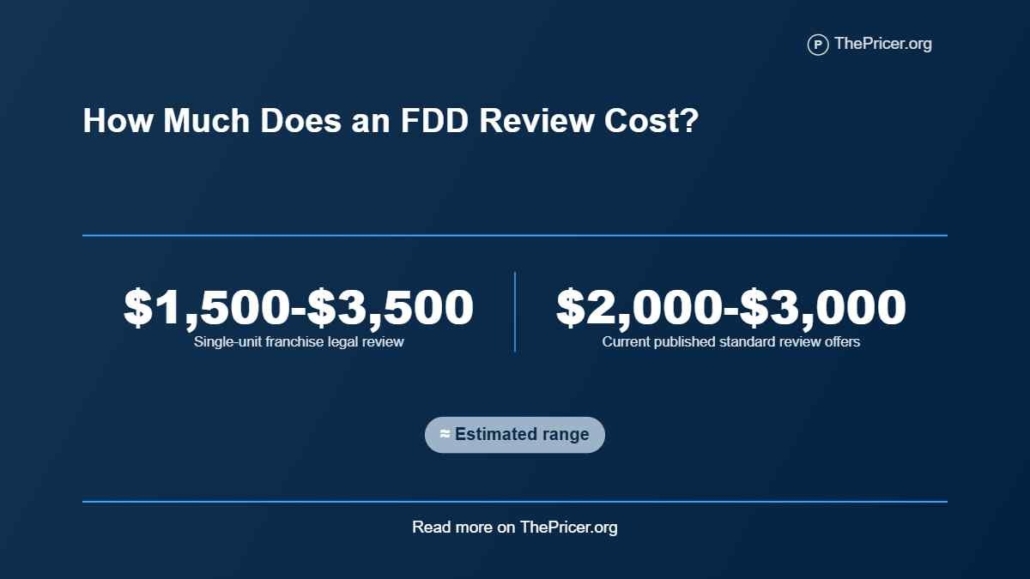
A Franchise Disclosure Document review for a prospective U.S. franchisee typically costs about $1,500 to $3,500 per single-unit review, based on current specialist pricing guidance. The fee pays for a lawyer to analyze the FDD and franchise agreement, flag legal obligations and contract risks, and explain issues before the buyer signs. Negotiation, addendum drafting, entity work, or multi-unit agreements may fall inside the package or create extra legal charges.
The core entities and documents are the prospective franchisee, franchisor, franchise attorney, Federal Trade Commission, FDD, franchise agreement, state addenda, personal guarantee, and any area development agreement.
The main price modifiers are the review unit, document length, deal complexity, written report or issues list, attorney consultation, follow-up questions, negotiation with franchisor counsel, revised contract language, and single-unit versus multi-unit scope. Those details make the included deliverables as important as the quoted fee when two lawyers advertise similar prices.
Article Highlights
Jump to sections
- A current specialist guide places single-unit FDD review at about $1,500 to $3,500 (at $30 per hour, earning that amount would take about 1.3 to 2.9 full-time workweeks, before taxes).
- Current published law-firm offers reviewed for this article run from $2,000 to $3,000 for standard single-unit work.
- Two firms publish a $2,500 price, but one includes franchisor negotiations and the other bills later negotiation work separately.
- Multi-unit review can cost more because an area development agreement adds another contract and another set of territory and development obligations.
- A flat fee near $2,500 equals about 6.7 lawyer hours at Clio’s 2025 Contracts benchmark of $373 per hour.
How Much Does a Franchise Disclosure Document Review Cost?
The headline figure is a secondary market estimate rather than an official fee schedule, so it works best as a planning range. Direct provider prices give the range more shape because they show what a buyer receives for the money. As of September 2026, the four posted offers below use flat-fee or fixed-fee pricing for the defined FDD review service.
The lowest advertised starting point among these firms is tied to document length and complexity, while the higher tiers add deal complexity such as multi-unit or international work. The table also exposes a harder comparison problem. Two standard offers can share the same dollar figure while placing negotiation on opposite sides of the package boundary. Price alone is not enough.
| Published offer | Price | Scope shown by provider |
|---|---|---|
| Crumpton Legal | From $2,000 flat fee | Flat-fee FDD review, final quote varies with length and complexity |
| Internicola | $2,500 single-unit and $2,750 multi-unit | Review letter, consultations, communications and negotiations through signing |
| Drumm Law | $2,500 standard review fee | FDD and franchise agreement review, issues list, discussion up to one hour |
| Lopes Law | $3,000 standard, $5,000 multi-unit, $6,000 international | Written report, attorney consultation, negotiation points identified |
What an FDD Review Covers
The service starts with the Franchise Disclosure Document, or FDD, but it should not be confused with a simple page count or proofreading job. The Federal Trade Commission says the disclosure document contains 23 specific required items. A paid legal review connects those disclosures to the contracts and obligations that follow a franchise purchase.
The FTC’s guidance covers fees and territory restrictions, renewal, termination, financial performance claims, franchisee data, financial statements, and Item 22 contracts. Item 22 requires proposed agreements related to the offering to be attached, including the franchise agreement. A lawyer may compare those contracts with the disclosures, identify clauses that affect the buyer, and explain obligations that continue after signing. The value of the service lies in the legal relationship among the documents, not simply reading all 23 headings.
The exact deliverable still depends on the engagement. Some firms provide a written issues letter, some provide a longer report, and some rely more heavily on an attorney call. Buyers comparing quotes should ask whether the fee covers every agreement attached to the FDD, a written findings document, a consultation, follow-up questions, and any direct contact with the franchisor’s counsel.
Flat Fees vs Hourly Billing
Flat fees are common in the public offers reviewed here, but hourly billing still matters when a matter moves beyond a defined review. Clio’s 2026 rate page reports a 2025 average lawyer hourly rate of $373 per hour for Contracts work. That is a broad contracts-law benchmark, not a franchise-specialist rate, so it should be used for modeling rather than as a quote for an FDD lawyer.
ThePricer calculation shows what common flat fees represent at that benchmark. A $2,000 (about 1.7 full-time workweeks at $30 per hour) flat fee equals about 5.4 hours at $373 per hour. A $2,500 fee equals about 6.7 hours. A $3,000 fee equals about 8.0 hours. The calculation is fee divided by $373, rounded to one decimal hour. This does not mean those firms spend exactly that amount of time. It gives buyers a consistent way to compare a fixed price with a time-billed alternative.
That math becomes more useful when scope is defined. If an hourly lawyer needed eight hours, the modeled charge would be $2,984. Twelve hours would model at $4,476. A flat fee near $2,500 can be economical when the defined package includes a full document review and substantial follow-up, but a smaller engagement could cost less on time billing. The quote should state what work closes the file.
What Changes the Fee
Document length is one visible driver, but deal structure can change the legal work more than page count alone. A separate Crumpton practice page says its FDD review quote depends on length and complexity. A single-unit franchise with one standard franchise agreement presents a different assignment from a multi-unit development deal with territory schedules, development deadlines, and additional agreements.
State-specific attachments can add another layer. The FDD may contain state addenda that change or supplement contract language for buyers in certain jurisdictions. A lawyer may also need to trace how the franchise agreement handles renewal, transfer, termination, dispute resolution, guarantees, required purchases, and territory rights. Those issues can affect the importance of the review even when they do not change the quoted flat fee.
Buyer goals also change the work. A person who wants only risk identification needs a narrower service than a buyer who expects counsel to propose edits, speak with franchisor counsel, review a negotiated addendum, or advise on an entity structure. Quotes should separate FDD review from those adjacent legal jobs. Readers comparing the wider cost of legal services can use the construction lawyer cost guide for another example of how hourly and flat-fee structures change a legal bill.
Negotiation and Add-On Costs
 The clearest hidden-cost issue in the price table is that the same headline fee can buy different post-review work. Internicola’s fixed package includes franchisor negotiations and addendum preparation. The Drumm row above places negotiation, addendum drafting, corporate structuring advice, and corporate documents outside its flat review and into hourly work. Those are different services.
That package boundary changes the likely payable total for a buyer who expects contract changes after the review call. A quote that includes negotiation can keep the next round of legal work inside the fixed price. A quote that ends after the issues discussion may still be appropriate, but the buyer needs a separate estimate for lawyer-to-lawyer communications, revised language, and any addendum work before comparing the two offers.
A modeled total shows why that question can change the budget. Using the published Drumm fee from the price table and the Clio Contracts benchmark cited above, start at $2,500 (about 2.1 full-time workweeks at $30 per hour) and assume three extra hours valued at $373 per hour. Three hours equal $1,119. The modeled legal total becomes $3,619. At one extra hour the model is $2,873, while five extra hours produce $4,365. The assumed hours are a scenario, not observed client billing, and $373 is not Drumm’s disclosed hourly rate.
Single-Unit vs Multi-Unit Reviews
A multi-unit purchase can introduce an area development agreement beside the franchise agreement. That contract may set opening schedules, territory rights, development duties, and consequences for missing required milestones. The fee increase is not standardized. Public schedules show how wide the spread can be even among firms that publish flat pricing.
Using the two public fee schedules cited in the price table, Internicola moves from $2,500 for one unit to $2,750 for multi-unit work. The difference is $250, or 10 percent of its single-unit fee. Lopes Law moves from $3,000 for standard review to $5,000 for multi-unit review, a difference of $2,000, or about 66.7 percent. These percentages are not market surcharges. They compare two firms’ own published tiers and show why a buyer cannot treat “multi-unit review” as one uniform product.
Lopes also posts $6,000 for international review. That higher tier adds cross-border considerations rather than simply adding another franchise location. Buyers should compare the attached agreements, jurisdictions, ownership structure, and expected attorney tasks before comparing the dollar figures. The same principle applies to franchise investment figures. A cost page such as the 85 Degrees Bakery franchise analysis uses FDD investment data for a different purpose than a lawyer’s review fee.
Review Timing Before Signing
Federal timing creates a defined review window. The FTC says a prospective franchisee must receive the FDD at least 14 days before signing a contract or paying money to the franchisor or its affiliate. That is a disclosure minimum, not a promise that 14 days will always be enough for legal, financial, operational, and financing diligence.
Attorney turnaround and buyer diligence can consume much of that period. A buyer who starts legal review late may compress the time available for follow-up questions, negotiation, accountant review, lender work, or conversations with current and former franchisees. The signing target should leave room for a revised agreement or addendum if the parties discuss changes after the initial review. That buffer also gives counsel time to compare a revised draft against the first version.
Planning backward from a proposed signing date is safer than treating the federal period as a countdown to signature. A prospective owner may also need time to test the investment figures disclosed by the franchisor. The Club Pilates franchise cost analysis shows how initial investment, recurring fees, and operating assumptions form a separate financial question from the legal review itself.
Choosing the Right Review Scope
The best quote comparison starts with deliverables rather than price. Ask each lawyer to identify the documents covered, whether the engagement produces a written report or issues list, how much attorney discussion is included, whether follow-up questions are capped, and whether negotiations or revised agreements cost extra. Also ask whether a multi-unit or cross-border structure changes the fee before work begins.
A legal review does not replace business and accounting diligence. The attorney can explain contract rights and obligations, but the buyer still needs to investigate unit economics, startup capital, recurring fees, financing, local demand, and conversations with existing franchisees. The FDD supplies much of the source material, yet different professionals answer different questions.
Makes sense if
- You are close to signing and need the franchise agreement and attached contracts reviewed.
- The deal includes several units, a development schedule, a personal guarantee, or territory language with material financial consequences.
- You want a lawyer to identify negotiation points and explain which post-review work is included in the fee.
- You need legal interpretation rather than a document summary alone.
Does not make sense if
- You are still screening many unrelated franchise concepts and have not selected a deal for legal review.
- You only need basic numbers extracted from the FDD before deciding whether to continue.
- You expect the lawyer’s contract review to replace accounting, financing, market, or operational diligence.
- You have not confirmed whether the quoted package covers the actual agreements you will sign.
Answers to Common Questions
How much should I budget for an FDD review?
A practical starting budget is about $1,500 to $3,500 for a single-unit review. Current posted standard offers reviewed here range from $2,000 to $3,000.
Is a franchise agreement review included?
It often is, but the engagement letter controls. Item 22 of the FDD contains proposed agreements, including the franchise agreement, and the reviewed law-firm packages explicitly include that document.
Does a flat FDD fee include negotiation?
Not always. One reviewed $2,500 package includes negotiations through signing, while another $2,500 package places negotiation and addendum work outside the flat-fee scope.
Why can a multi-unit review cost more?
Multi-unit deals can add an area development agreement, territory terms, opening schedules, and extra obligations. Published examples reviewed here range from $2,750 to $5,000 for multi-unit packages, but the scopes are not identical.
Disclosure: Educational content, not financial advice. Prices reflect public information as of the dates cited and can change. Confirm current rates, fees, taxes, and terms with official sources before purchasing. See our methodology and corrections policy.