
How Much Does a Fully Automated Farm Cost?
Published on | Written by Alec Pow
This article was researched using 15 sources. See our methodology and corrections policy.
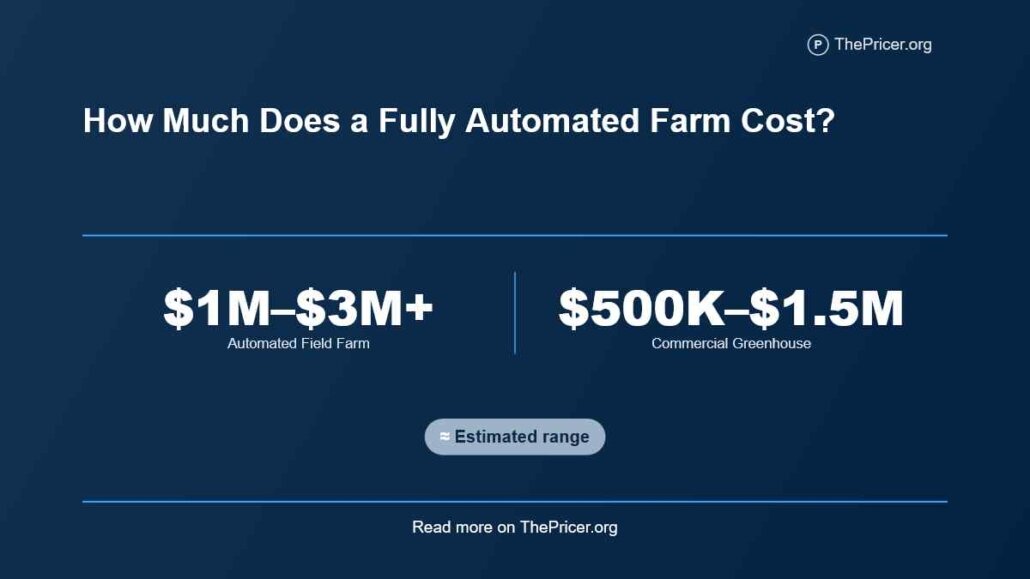
A fully automated farm can require $1 million to $3 million or more in machinery, robotics, irrigation controls, and supporting infrastructure for a medium-sized U.S. field-crop operation, excluding land. A smaller commercial automated greenhouse may cost approximately $500,000 to $1.5 million for 10,000 square feet, while sophisticated indoor vertical farms can cost considerably more.
These are planning ranges derived from equipment prices and agricultural research, not manufacturer quotes for a complete farm. The distinction matters: a tractor that drives itself is not the same as a farm that plants, irrigates, monitors, harvests, transports, and packages everything without workers.
Interest in this technology has grown following demonstrations of unmanned Chinese farms. In July 2025, a Chinese government report described a 3,500-mu, approximately 576-acre wheat-and-corn operation using autonomous machinery, drones, satellite navigation, and automated irrigation. Its reported operating improvements were substantial, but the project did not disclose a complete construction budget.
Article Highlights
Jump to sections
- Field-crop automation: Approximately $1 million to $3 million+ for an ambitious medium-sized operation with substantial equipment purchases, excluding land.
- Existing tractor upgrade: Approximately $40,000 to $45,000 for certain John Deere autonomy retrofits, plus roughly $10,000 annually for the autonomy subscription.
- Commercial greenhouse: Approximately $50 to $150 per square foot, according to University of Florida researchers.
- Land: U.S. cropland averaged $6,020 per acre in 2026, making acreage one of the largest potential expenses.
- Biggest misconception: Many commercially available systems automate individual farming tasks, not the complete production cycle.
How Much Does a Fully Automated Farm Cost?
The price depends first on the farming model. A grain farm needs large machines and extensive land. A greenhouse concentrates production inside a controlled structure. A vertical farm adds artificial lighting and specialized environmental systems.
| Farm or automation model | Estimated investment | Important limitation |
|---|---|---|
| Single tractor autonomy retrofit | $40,000–$70,000 | Tractor and compatible implements generally excluded |
| Extensive automation of an existing crop farm | $150,000–$500,000+ | Existing machinery and infrastructure assumed |
| Medium-sized, heavily automated field farm | $1 million–$3 million+ | Land excluded; some tasks still need people |
| 10,000-square-foot commercial greenhouse | $500,000–$1.5 million | Advanced robotics may cost extra |
| 10,000-square-foot indoor vertical farm | Approximately $1.5 million–$4 million+ | Building, equipment, and operating scope vary |
The first three rows are equipment-based planning estimates, not national average transaction prices. The greenhouse and vertical-farm estimates reflect published construction and research benchmarks that may cover different combinations of growing equipment, climate control, and building work.
Researchers studying indoor agriculture reported substantially higher capital requirements for plant factories than conventional greenhouses. Their peer-reviewed cost comparison also highlights electricity as a major constraint. International research figures should not be mistaken for guaranteed U.S. contractor bids.
A basic high tunnel offers a much cheaper starting point, but it is not a fully automated farm. ThePricer’s hoop greenhouse cost guide explains the difference between simple structures and commercial growing facilities.
Machines and Robotics
Large agricultural machines dominate field-farm budgets. Their automation features are often sold separately, and not every machine is capable of genuinely driverless operation.
An October 2026 interview with a Sloan Implement manager published by the Jacksonville Journal-Courier put a John Deere autonomy upgrade at approximately $40,000 to $45,000, depending on the existing tractor. The associated subscription was estimated at $10,000 per year. Additional guidance subscriptions, equipment compatibility work, and a suitable tillage implement may be required.
Those figures apply to upgrading a compatible tractor, not purchasing a new autonomous machine.
Another commercial approach is the PTx Trimble OutRun system. Successful Farming’s equipment reporting identified a tillage configuration costing approximately $54,000 with a $9,000 annual subscription. A grain-cart configuration was quoted at approximately $55,000 with a $15,000 annual subscription.
Other autonomous tractor retrofits have been advertised around $60,000 to $70,000. Installation, training, supported equipment, and licensing arrangements differ. As AGCO’s retrofit rollout illustrates, packages may include an initial subscription period but require later renewals.
Harvesting creates another large expense. High-capacity modern combines have appeared in recent dealer listings at approximately $600,000 to $800,000. These machines often offer advanced automation assistance, but that does not establish that they can independently complete an entire harvest.
For smaller machinery comparisons, see ThePricer’s guides to tractor prices and mechanical reaper costs.
A practical field-farm purchasing list may include:
- Compatible tractor, autonomous retrofit, and implement
- Combine harvester and crop-specific harvesting attachment
- Grain cart, transport equipment, and compatible guidance controls
- Spraying drone or automated application equipment
- Field sensors, connectivity, and remote monitoring
- Irrigation controls where the operation requires irrigation
Spraying drones represent another substantial purchase. The October 2026 dealer interview cited above placed agricultural drone packages around $50,000 to $100,000, with extensive support arrangements potentially reaching $200,000. Those are system-level figures, not the price of every individual drone.
Irrigation and Sensors
 Automation is not limited to vehicles. Soil moisture monitoring, programmable valves, irrigation scheduling, and automated pumps can reduce field visits and improve water management.
According to Oregon State University Extension, variable-zone irrigation controls may add approximately $15,000 to $25,000 per center pivot. That is an upgrade to suitable existing infrastructure, not the cost of installing an entire irrigation system from scratch.
A Utah State University analysis modeled a 120-acre pivot with approximately $20,000 in zone-control hardware. Under its assumptions, annualized costs were about $26.36 per acre, including ownership and operating considerations.
Other irrigation types can be more expensive to automate. Utah State University’s September 2026 automated surge irrigation guide describes an installation costing around $2,500 per acre at one study site. Applying that figure to 100 acres would produce a $250,000 project, although site conditions and required piping make direct extrapolation uncertain.
Individual sensors are cheaper than complete irrigation systems. The University of Minnesota Extension lists certain soil-moisture sensors around $250 to $350 each, with data loggers potentially adding hundreds or thousands of dollars.
The cost-saving question is therefore not whether a farm can collect data cheaply. It is whether that information can reliably control machinery, pumps, and irrigation equipment.
What Would 500 Acres Cost?
Consider an illustrative U.S. grain operation with 500 acres, suitable existing field access, and some machinery already available. The owner wants autonomous tillage, assisted harvesting, remote irrigation control, and automated crop monitoring.
| Budget item | Illustrative allowance |
|---|---|
| High-capacity combine | $650,000 |
| Compatible tractor purchase | $300,000 |
| Tractor autonomy upgrade | $45,000 |
| Grain-cart automation hardware | $55,000 |
| Compatible cart equipment and adaptations | $100,000 |
| Spraying drone package | $75,000 |
| Irrigation-control upgrade | $20,000 |
| Sensors, connectivity, and setup allowance | $25,000 |
| Initial autonomy subscriptions | $25,000 |
| Total equipment budget | $1,295,000 |
This is a worked planning example, not an actual farm quote. The combine, tractor, adaptations, drone, and monitoring allowances are illustrative selections within a market where specifications change prices substantially. The irrigation amount assumes an upgrade to an existing suitable pivot. The example excludes ordinary crop inputs, storage construction, property expenses, financing, taxes, and contingencies.
Importantly, this investment would create a highly automated operation, not prove that every task can be performed without human supervision.
Now add the land. The USDA’s 2026 farmland figures place average U.S. cropland at $6,020 per acre.
For 500 acres, that is $3,010,000. Combined with the modeled equipment budget, the total reaches $4,305,000 before additional buildings, working capital, and transaction expenses.
First computed insight: Land represents almost 70% of that combined amount. Buying a completely new property can therefore cost much more than adding automation to farmland someone already owns or leases.
Actual land values vary widely. ThePricer’s acre-of-land cost guide explains how soil quality, location, access, and utilities change the calculation.
Indoor Farm Alternatives
An automated greenhouse replaces many large field machines with environmental controls, nutrient delivery, ventilation, and sometimes robotic handling.
The University of Florida IFAS estimates commercial greenhouse construction at approximately $50 to $150 per square foot. That implies:
- 5,000 square feet: $250,000–$750,000
- 10,000 square feet: $500,000–$1.5 million
- 20,000 square feet: $1 million–$3 million
These figures are construction benchmarks. Robotic harvesting, automated packaging, advanced growing systems, utility connections, and land may create additional expenses depending on the quoted scope.
In a greenhouse, automation can control irrigation, fertilizer delivery, lighting, temperature, humidity, and ventilation. Wageningen University research demonstrates how AI can manage entire greenhouse growing cycles, although commercial implementation still involves equipment maintenance and physical crop-handling requirements.
Indoor vertical farms may save ground area but exchange sunlight for purchased electricity. The University of Florida researchers noted that electricity can represent approximately 20% to 30% of operating costs in indoor farming. A cheaper parcel of land does not automatically make the indoor alternative more economical.
A vertical farm also should not be confused with a decorative vertical garden. Commercial food production requires much more demanding lighting, climate, crop-handling, and sanitation systems.
The Hidden Price of Automation
The capital budget attracts attention, but software, repair service, downtime, power, and skilled supervision determine the farm’s long-term economics.
For example, a tractor autonomy subscription of $10,000 annually costs $50,000 over five years if its price remains unchanged. That exceeds the initial $45,000 upgrade allowance in our example.
Second computed insight: Over that five-year period, the modeled retrofit and subscription together cost $95,000 before repairs, financing, and other required guidance services. That is more than double the hardware-only amount.
Other hidden expenses include:
- Software subscriptions and satellite-positioning corrections
- Dealer training, calibration, and equipment compatibility work
- Replacement sensors, cameras, batteries, and electronic components
- Backup communications and cybersecurity controls
- Skilled staff to manage exceptions and equipment faults
- Insurance, equipment financing, and seasonal downtime
A farm may also need a secure machinery building and maintenance space. ThePricer’s barn construction cost guide provides relevant building-cost comparisons.
The U.S. Government Accountability Office identifies high initial costs and infrastructure limitations among barriers to precision-agriculture adoption. Connectivity and repair support matter particularly when equipment must operate during narrow planting and harvest windows.
There is also no universal labor-savings percentage. The Chinese 576-acre case reported approximately 40% lower overall labor costs, but it cannot establish an equivalent result for a U.S. farm with different wages, crops, machines, and operating practices.
Does It Pay Off?
The strongest financial case usually appears where expensive machinery can work many hours each season, qualified operators are scarce, and the farm already owns compatible equipment.
Suppose automation saves 800 paid labor hours annually at an illustrative fully burdened cost of $30 per hour. Gross annual labor savings would be $24,000.
Subtract a $10,000 software subscription and an assumed $4,000 in additional technology maintenance. The remaining $10,000 annually would imply a simple 4.5-year payback on a $45,000 retrofit, before financing, taxes, other costs, or production changes.
If the same equipment saves only 300 hours, gross labor savings fall to $9,000. Under those same subscription and maintenance assumptions, the investment would lose money on labor savings alone.
That comparison illustrates why farm size and annual machine utilization matter more than the technology’s novelty.
The USDA’s precision-agriculture research documents widespread use of automatic guidance, but guidance adoption should not be interpreted as evidence that farms are fully autonomous. The FAO’s automation analysis similarly emphasizes that adoption depends on local costs, infrastructure, skills, and farming conditions.
Makes sense if:
- The farm already owns compatible tractors, implements, or irrigation systems.
- Machinery operates enough hours to spread fixed costs across substantial acreage.
- Labor shortages or time-sensitive fieldwork create measurable financial losses.
- Reliable dealer support and connectivity are available.
Does not make sense if:
- The farm is too small to utilize expensive autonomy hardware regularly.
- Complete replacement of functioning machinery is necessary.
- Subscriptions and servicing eliminate expected labor savings.
- Technology cannot yet automate the operation’s most labor-intensive tasks.
Answers to Common Questions
Can a farm operate completely without people?
Individual machines and growing processes can operate autonomously, but a truly labor-free farm remains unusual. Equipment repairs, crop handling, logistics, safety oversight, and unexpected conditions still require human involvement.
How much does an autonomous tractor cost?
Adding autonomy to certain compatible tractors can cost approximately $40,000 to $70,000, depending on the system. The tractor itself, implements, setup, and recurring software charges may be additional.
What is the cheapest way to automate an existing farm?
Begin with a specific task that consumes measurable labor, such as irrigation scheduling or repetitive tractor work. A targeted upgrade can be substantially cheaper than replacing an entire equipment fleet.
Was China’s fully automated farm built for a known price?
The publicly reported 576-acre operation demonstrated unmanned fieldwork and reported labor savings, but the cited government report did not disclose its complete development cost. Any total project estimate would therefore need separately stated assumptions.
Disclosure: Educational content, not financial advice. Prices reflect public information as of the dates cited and can change. Confirm current rates, fees, taxes, and terms with official sources before purchasing. See our methodology and corrections policy.