
How Much Does a Geran-5 Drone Cost?
Published on | Written by Alec Pow
This article was researched using 14 sources. See our methodology and corrections policy.
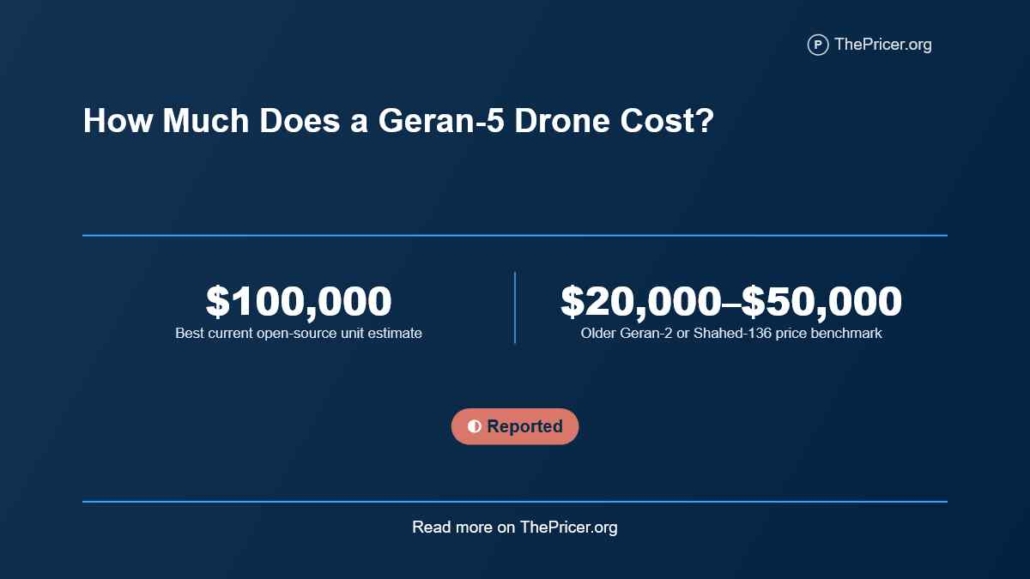
A Geran-5 drone currently costs an estimated $100,000 per weapon in 2026. That is an open-source estimate, not a disclosed Russian procurement invoice. The figure moved into the news on September 14, when reporting on Russia’s new low-cost jet weapons placed the Geran-5 near $100,000 and described it as part of a fast-growing class of cruise-missile-like strike systems.
A day later, Reuters documented the surge in Russian jet-powered drone use, from about 450 launches in June to roughly 2,850 in August. The price matters because Russia is pairing a low six-figure weapon with mass production, higher speed and a growing burden on Ukrainian air defenses.
Article Highlights
Jump to sections
- The best current Geran-5 unit estimate is about $100,000 (at $30 per hour, earning that amount would take about 1.6 years of full-time work, before taxes).
- An early January assessment placed the drone near €40,000 to €50,000, but that older figure should stay separate.
- A jet engine and one identified mesh modem can represent roughly half of the current unit estimate at public reference prices.
- Russia is reported to produce about 3,000 Geran-4 and Geran-5 drones combined each month.
- The current news story is about both price and scale, since jet-powered drones are appearing in much larger attack waves.
How Much Does a Geran-5 Drone Cost?
The strongest current open-source figure is about $100,000 (about 1.6 years of full-time work at $30 per hour) for one Geran-5. Reporting published on September 14 said the Geran-5 and Russia’s Banderol cruise missile are each estimated near that level. The same coverage describes the Geran-5 as a lower-cost jet weapon that brings some cruise-missile characteristics into a price tier far below many traditional missiles. The September Geran-5 cost report traces the figure to Wall Street Journal reporting published the same day.
The number is best treated as a unit-value estimate for a completed weapon. It is not a Russian Ministry of Defense contract rate, audited factory cost or export catalog price. No reviewed public record discloses how Russia allocates labor, overhead, tooling, supplier margins or state support to each aircraft. That evidence gap is why the article uses about $100,000 rather than presenting a false exact invoice such as $99,750.
The Geran-5 itself is a larger, faster departure from the familiar delta-wing Geran-2. Ukrainian military intelligence lists an 850 kg maximum takeoff weight, a cruise speed of 450 to 600 km/h and range of up to 950 km. Its Geran-5 technical disclosure also identifies a Chinese Telefly turbojet and electronics shared with other Geran models. Those features help explain why the useful comparison is with other jet strike weapons, not a consumer quadcopter.
What the Price Covers
The $100,000 (about 1.6 years of full-time work at $30 per hour) estimate applies to one complete Geran-5 weapon. It should not be expanded to include every part of the Russian drone program. A production plant, new assembly halls, storage sites, launch equipment, transport vehicles, communications infrastructure and other military support can all consume money without being part of the aircraft-only estimate. The same rule applies in reverse. A marketplace price for one engine or modem is not the cost of the finished drone.
This distinction becomes important at Alabuga, where Russia has built a large production system around the Geran family. Factory construction can increase total program spending while leaving the estimated value of one aircraft unchanged. A large order can also lower the effective manufacturing burden per unit through repeated tooling and assembly, but no public Geran-5 contract discloses a quantity discount. Dividing a factory budget by an assumed number of drones would create precision that the evidence does not support.
The aircraft estimate covers the integrated weapon as analysts value it. That includes the airframe, engine, navigation hardware, communications equipment, control electronics, power systems, payload, assembly and other installed hardware. Public technical analysis describes the Geran-5 as part of a Russian shift toward low-cost jet weapons that sit between older one-way attack drones and more expensive cruise missiles. That classification explains why price comparisons must match capability and scope rather than compare any two objects called drones.
Inside the Component Bill
Two identified components show why a six-figure estimate is plausible. Ukrainian intelligence identifies a Telefly TF-TJ2000A engine and an XK-F358 mesh modem in the aircraft, according to the Geran-5 component summary. September reporting says DroneSec places Chinese jet engines used in Geran aircraft at $45,000 or less. The Geran engine cost report connects imported commercial and dual-use hardware with Russia’s ability to build these weapons in large quantities.
The Geran-5 also contains an XK-F358 mesh modem from Xingkai Tech. A current supplier-marketplace page lists that model at $8,100 to $9,000 per piece. The XK-F358 public listing is a reference value, not proof of what a Russian buyer actually paid.
Illustrative component check
- Jet-engine reference value of up to $45,000.
- XK-F358 high listing value of $9,000.
- Two-component subtotal of about $54,000.
- Reported complete-unit estimate of $100,000.
- Remaining value under this high-reference case of about $46,000.
The calculation produces a useful bound. $54,000 divided by $100,000 equals 54 percent, so those two public reference values alone can represent just over half of the estimated complete weapon value. The remaining $46,000 is not a researched price for the airframe or warhead. It is the arithmetic remainder available for every other component, integration, assembly and overhead item if the public references are comparable.
Why the Estimate Changed
Early Geran-5 coverage used a lower price. A January 17 analysis estimated one aircraft at about €40,000 to €50,000. That early Geran-5 estimate appeared days after the weapon was first identified, when far less was publicly known about its production, electronics and wider role. The newer $100,000 figure comes after months of recovered-component analysis and battlefield use.
The two figures should not be averaged into one artificial range. They come from different points in the weapon’s public history and may use different assumptions about hardware, production value and configuration. An early analytical estimate can remain useful as a historical marker without carrying the same weight as newer reporting. The current answer uses the September figure because it is more recent and fits the stronger component evidence now available.
This is also why the Geran-5 is in the news now. The story is no longer about a few wreckage photos from January. Russia has moved jet-powered Geran variants into large-scale use. A September review of the shift says reported Geran-4/5 capacity rose from about 500 units per month in May to roughly 3,000 by August. The jet-drone production timeline describes a rapid move from prototypes to industrial output. The price question now sits beside a production-speed question.
Production at Alabuga
Ukraine’s Defense Intelligence told Militarnyi in August that Russia produces about 3,000 Geran-4 and Geran-5 drones combined each month. Serial production is centered in Yelabuga inside the Alabuga Special Economic Zone, with other Russian companies supplying components. The Geran-4 and Geran-5 production report also says Russia is seeking to expand capacity at the site.
The combined figure needs careful handling. It does not mean Russia makes 3,000 Geran-5s each month. Public reporting does not give a reliable monthly split between Geran-4 and Geran-5. That makes any Geran-5-only program total a scenario rather than a documented procurement figure. It also means that multiplying 3,000 by $100,000 and calling the result Russia’s Geran-5 bill would overstate what the evidence can establish.
Production scale still changes the economics. A weapon valued around $100,000 is a modest purchase beside a multimillion-dollar cruise missile, but thousands of units can turn low six-figure hardware into nine-figure monthly output. The manufacturing network also matters because imported engines, modems and electronics can become bottlenecks even when final assembly capacity expands. A related Geran-4 cost analysis shows why the two newer Geran models should remain separate when comparing unit estimates. They share production context but not identical airframes or reported prices.
What a Production Batch Costs
The unknown Geran-4 versus Geran-5 mix can be handled with sensitivity math instead of a guessed production split. Start with the reported combined output of 3,000 units per month and the current Geran-5 estimate of $100,000. If Geran-5 represents one quarter of combined output, that would equal 750 Geran-5s. At the unit estimate, the modeled value would be $75 million per month and $900 million over 12 months at the same pace.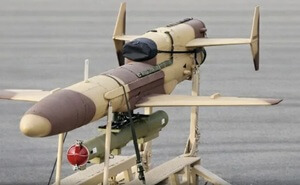
A 50 percent case would mean 1,500 Geran-5s per month, worth about $150 million monthly or $1.8 billion annually. A 75 percent case would mean 2,250 units, worth about $225 million monthly or $2.7 billion annually. These are production-value scenarios, not Russian budget disclosures. The assumed shares are chosen to show sensitivity to the missing model split.
The result adds a useful answer beyond the unit figure. At $100,000 each, every 10 percentage-point change in Geran-5’s share of a 3,000-unit monthly Geran-4/5 total changes modeled monthly value by $30 million. The arithmetic is 300 additional Geran-5 units times $100,000. That makes the undisclosed model mix financially material, rather than a small detail.
The scale also explains the current defense debate. Cheap interceptors designed for slower Shahed-type drones face difficulty against faster jet targets. Russia’s ability to field many low-six-figure weapons can pressure defenders into using scarcer or more expensive countermeasures. The separate drone interception cost data covers that defender-side budget question without folding it into the Geran-5 purchase estimate.
Geran Family Price Comparison
The Geran family spans very different designs, so model names should not be treated as one price series. CSIS estimates the Iranian Shahed-131 and Shahed-136 family at about $20,000 to $50,000 per aircraft. Russia uses the Shahed-136 under the Geran-2 designation. The CSIS Shahed price estimate provides a useful low-cost predecessor benchmark for the newer jet weapons.
| Weapon | Open-source price reference | Pricing context |
|---|---|---|
| Geran-2 or Shahed-136 | $20,000 to $50,000 | Older piston-powered family estimate |
| Geran-4 | about $100,000 | Current ThePricer working reference with higher estimates also reported |
| Geran-5 | about $100,000 | September 2026 open-source estimate |
| Banderol | $50,000 to $150,000 | Current ThePricer working range for a related Russian jet weapon |
The comparison shows how jet propulsion changes the cost tier. A $100,000 Geran-5 is roughly two to five times the $20,000 to $50,000 Shahed benchmark, depending on which edge of the older range is used. That premium buys a much faster and larger weapon with a different aerodynamic layout and a heavier payload. It does not mean every performance improvement can be assigned a clean dollar value.
Geran-4 sits near the same current headline figure, but a separate higher assessment exists for that model. Banderol also overlaps the same low-six-figure band while being classified as a cruise missile rather than a Geran drone. The Banderol cost comparison is useful because it shows how Russian weapons built around commercial components can converge on similar price levels without being the same system.
Drone Cost vs Cruise Missiles
The Geran-5 attracts attention because its price is low beside conventional cruise missiles while its shape, speed and mission increasingly resemble that category. September reporting compares Geran-5 and Banderol at about $100,000 each with U.S. Tomahawk cruise missiles costing more than $2 million. The low-cost weapons investigation places those figures in the same price comparison. Using those reference values, one $2 million missile equals the estimated purchase value of about 20 Geran-5s. That is a price comparison, not a claim that 20 drones provide the same military capability as one Tomahawk.
The comparison is useful because it explains the economic pressure behind the headlines. A defender needs a response that works against a faster target without spending an unsustainable amount on every engagement. That does not make the Geran-5 uniquely cheap in all respects. Its factory network, foreign components, logistics and development effort remain outside the simple unit estimate, while a traditional missile may deliver different accuracy, survivability, payload and mission options.
Makes sense if
- You need a 2026 open-source estimate for one complete Geran-5.
- You keep factory and support spending outside the unit figure.
- You compare the weapon with other one-way attack drones and low-cost jet weapons on the same unit basis.
Does not make sense if
- You need an audited Russian procurement invoice.
- You are pricing only the engine, modem or recovered electronics.
- You treat combined Geran-4/5 production as Geran-5-only output.
- You assume equal price means equal capability across different missile and drone classes.
Takeaways
- Use about $100,000 as the best current open-source Geran-5 unit estimate.
- Keep the older €40,000 to €50,000 estimate as a historical reference rather than blending it with newer reporting.
- The current news cycle is driven by the combination of low-six-figure pricing, rapid production and a sharp increase in jet-drone attacks.
- Two public component references can reach about $54,000, but they do not reveal Russia’s real procurement bill.
- Combined Geran-4/5 output cannot be turned into a Geran-5 program total without an explicit model-share assumption.
Answers to Common Questions
How much does one Geran-5 cost?
The best current open-source estimate is about $100,000 per Geran-5. No public Russian procurement contract confirms an exact factory or purchase price.
Why is the Geran-5 in the news now?
September reporting highlighted both its estimated $100,000 price and Russia’s rapid increase in jet-powered drone use. The story is about an inexpensive weapon being produced and launched at much greater scale.
Is the Geran-5 just a more expensive Geran-2?
No. The Geran-5 uses a different aerodynamic layout, jet propulsion and a much larger airframe. The Geran-2 or Shahed-136 is commonly estimated at $20,000 to $50,000, while the current Geran-5 reference is about $100,000.
Does Russia produce 3,000 Geran-5 drones each month?
No. The reported 3,000-unit monthly figure covers Geran-4 and Geran-5 combined. The public evidence does not provide a reliable Geran-5-only split.
Disclosure: Educational content, not financial advice. Prices reflect public information as of the dates cited and can change. Confirm current rates, fees, taxes, and terms with official sources before purchasing. See our methodology and corrections policy.