
How Much Does A Glaucoma Screening Cost?
Updated on | Written by Alec Pow
This article was researched using 14 sources. See our methodology and corrections policy.
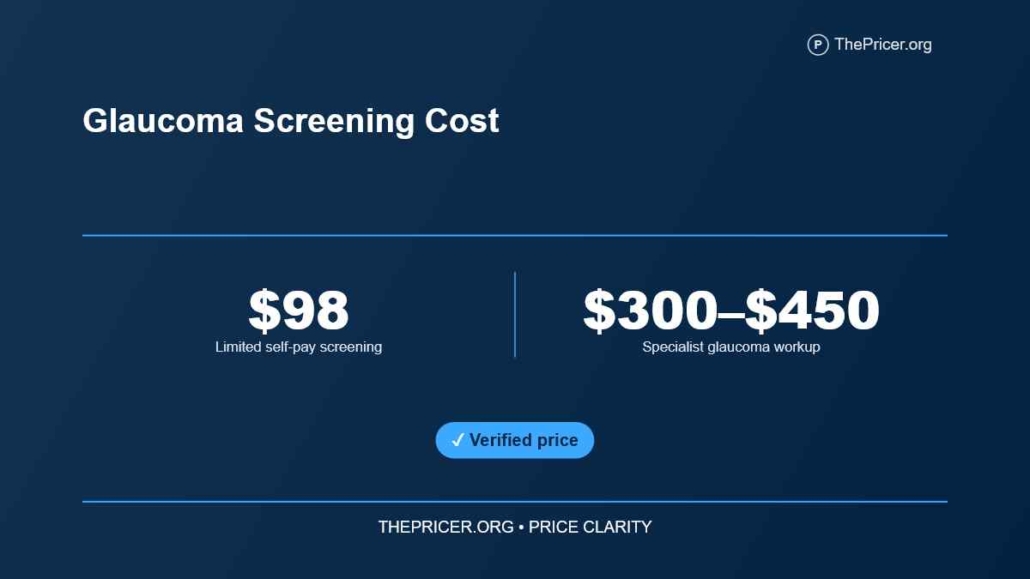
A glaucoma screening can cost about $98 for a limited self-pay package, while a new-patient glaucoma evaluation with OCT, gonioscopy, pachymetry, and visual field testing can reach about $300 to $450 at current published U.S. cash rates.
MDsave lists a $98 screening package in Kansas City, while Eye Center of Texas publishes a $450 glaucoma evaluation with the exam and several diagnostic tests itemized. The wide spread exists because the phrase glaucoma screening can describe a basic risk check or a much larger workup after a suspicious finding. Insurance, Medicare eligibility, and extra imaging can change the patient’s share again.
Article Highlights
Jump to sections
- A current limited self-pay glaucoma screening is listed at $98 (at $30 per hour, earning that amount would take about 3.3 hours of work, before taxes).
- One ophthalmology practice lists a glaucoma evaluation at $300, with OCT priced separately at $100.
- One current specialist price sheet itemizes a new-patient glaucoma workup at $450.
- The difference between the $98 screening and $450 workup is $352, but the services are not equivalent.
- Eligible Medicare patients can receive a glaucoma screening once every 12 months and pay 20% of the Medicare-approved amount after the Part B deductible.
- An eye-pressure reading by itself is not enough to diagnose glaucoma.
How Much Does a Glaucoma Screening Cost?
Glaucoma screening is not one standardized retail package. A low-cost visit may focus on risk history, an eye examination, and intraocular pressure. A glaucoma suspect or a patient with an abnormal finding may need visual field testing, optic nerve imaging, gonioscopy, pachymetry, fundus photography, or repeat measurements. Those services can turn a modest screening bill into a larger diagnostic bill even when both appointments are casually described as glaucoma testing.
 The National Eye Institute explains that glaucoma can develop without early symptoms and that detection relies on a dilated eye examination with appropriate testing. A basic vision check for glasses is a different purchase.
Readers comparing that service can see current routine eye exam pricing, but a low routine-exam fee should not be treated as proof that a glaucoma workup will cost the same amount.
The billing label matters. Screening describes checking a person who may not have a known disease. Diagnostic testing follows a symptom, abnormal result, suspicious optic nerve, elevated eye pressure, or another reason for closer evaluation.
Monitoring applies after glaucoma or ocular hypertension has already been identified. The tests may overlap, yet insurance rules and the number of tests can differ across those stages.
Current Cash Prices
Published cash prices show a useful range without pretending that every clinic sells the same package. MDsave currently lists a glaucoma screening at $98 (about 3.3 hours of work at $30 per hour) and an estimated national benchmark of $151. Its Kansas City provider listing says the purchased screening includes the office visit and an intraocular pressure test if needed. That scope is narrower than the specialty workups published by the two ophthalmology practices below. Provider location and whether testing is bundled can move the final self-pay total too.
| Published cash example | Price | What is included |
|---|---|---|
| MDsave glaucoma screening | $98 | Office visit and intraocular pressure test if needed |
| Gwinnett Ophthalmology glaucoma evaluation | $300 | Gonioscopy, pachymetry, fundus photos, and visual field testing |
| Eye Center of Texas new-patient glaucoma evaluation | $450 | Office exam, OCT, gonioscopy, pachymetry, and visual field testing |
Gwinnett Ophthalmology’s current self-pay glaucoma prices place its bundled evaluation at $300. The spread from $98 to $450 is $352. The larger workup costs about 4.6 times the limited screening price. That calculation is useful only as a scope comparison. It does not show that one provider charges 4.6 times more for the same service.
Extra Testing
The extra bill often appears when a screening result leads to more testing. At Gwinnett Ophthalmology, the $300 (about 1.3 full-time workdays at $30 per hour) glaucoma evaluation includes gonioscopy, pachymetry, fundus photography, and visual field testing, while glaucoma OCT is listed separately at $100. If a patient receives that published evaluation and the separately priced OCT during the same diagnostic episode, those two listed charges total $400. This is a calculation from one clinic’s posted cash schedule, not a national package price.
Eye Center of Texas provides a second itemized example. Its new-patient glaucoma evaluation lists an office exam at $190, OCT for both eyes at $100, gonioscopy at $35, pachymetry at $25, and a visual field test at $100.
The arithmetic is $190 + $100 + $35 + $25 + $100 = $450. That published itemization shows how a specialist workup can rise well above the price of a limited screening without any single test carrying most of the bill.
Prior testing can change the total too. Eye Center of Texas says tests already performed by a referring eye doctor may be usable to offset parts of its published workup. A patient arriving with recent usable field testing or imaging can face a different bill from a new patient who needs every listed test. Ask which prior results the specialist can accept, how recent they must be, and whether testing is needed for one eye or both before treating the full $450 schedule as unavoidable.
One Pressure Test Is Not Enough
Tonometry measures intraocular pressure, but high pressure and glaucoma are not interchangeable. Some people have elevated eye pressure without glaucoma, while some people develop glaucoma with pressure readings that fall in a normal range. The National Eye Institute states that tonometry alone is insufficient for accurate glaucoma detection because it can produce both false-positive and false-negative screening results.
A fuller evaluation may examine the optic nerve, side vision, drainage angle, corneal thickness, and retinal nerve fiber layer. Which tests are needed depends on what the eye doctor sees and the patient’s risk profile. A person who buys only a pressure check should not assume that the fee covers every test used in a glaucoma evaluation. The reverse is also true. A person who already had usable imaging or field testing may not need every line repeated at the next specialist visit.
Home pressure monitoring is another separate cost category. Devices such as the iCare HOME2 can add pressure measurements outside the clinic, but they do not replace an eye examination, optic nerve assessment, or visual field testing. The separate iCare tonometer cost analysis covers purchase and rental pricing for that type of monitoring device.
Insurance and Medicare
Private insurance can change the patient’s bill, but the answer depends on the reason for the visit and the plan. Routine vision benefits and medical eye-care benefits can use different copays, deductibles, networks, and authorization rules. A screening visit may be processed differently from testing ordered after an abnormal finding or from ongoing glaucoma care. Before the appointment, ask the practice which services it expects to bill and ask the insurer how those services are covered.
Medicare has a specific glaucoma screening benefit for people at high risk. Medicare Part B covers one screening every 12 months for eligible patients with diabetes, a family history of glaucoma, African American patients age 50 or older, and Hispanic patients age 65 or older. After the Part B deductible, the patient pays 20% of the Medicare-approved amount. A hospital outpatient setting can add a copayment.
The annual screening benefit should not be treated as a promise that every OCT, visual field test, repeat pressure check, or follow-up visit will have the same cost sharing. Medicare says extra services can create added costs when they fall outside the covered screening benefit. A written estimate from the practice and a benefits check with the insurer give a better patient-cost answer than applying a generic percentage to a cash price from another provider.
When Screening Is Recommended
There is no single screening schedule that applies to every adult. The U.S. Preventive Services Task Force review notes that the American Academy of Ophthalmology recommends a baseline eye evaluation at age 40, followed by examinations based on age and risk. The same review reaches a different type of conclusion for broad primary-care screening. It says current evidence is insufficient to determine the balance of benefits and harms of screening asymptomatic adults age 40 or older for primary open-angle glaucoma.
Risk-based eye care is more targeted. The National Eye Institute advises people at higher risk, including African American adults over 40, adults over 60, and people with a family history of glaucoma, to get a dilated eye exam every 1 to 2 years. An eye doctor may set a different interval when previous findings, diabetes, eye pressure, family history, or another medical factor changes the risk.
Sudden intense eye pain, nausea, red eye, or blurry vision can occur with angle-closure glaucoma and calls for urgent medical evaluation rather than price shopping. For routine appointments, the useful financial question is how much of the visit is a screening and whether the eye doctor expects extra diagnostic tests based on the patient’s history or prior findings.
Free and Lower-Cost Routes
Patients without insurance do not always have to choose between a full retail cash price and skipping care. The National Eye Institute lists free and lower-cost eye care programs, including EyeCare America, community health centers, optometry or ophthalmology school clinics, and other assistance programs. Eligibility differs by program, and some services require an application or referral.
Federally supported health centers are another route for people with limited income. HRSA states that health centers adjust fees by income and family size. Eye services vary by location, so call the local center before assuming that glaucoma testing is available on site. Local availability can differ, so confirm eye services before booking. A lower visit fee can still be useful if the center can arrange an appropriate referral.
For glaucoma-specific help, eligibility matters more than the headline word free. A program may cover a baseline exam but not every later imaging test, medicine, or procedure. Ask what the program pays for, what the patient must pay, and whether follow-up care is included. That prevents a no-cost screening from being mistaken for no-cost glaucoma care after an abnormal result.
How to Compare Quotes
Ask for the exact service name and the list of tests included. A quote that says glaucoma screening should state whether it includes the office examination, dilation, tonometry, visual field testing, OCT, gonioscopy, pachymetry, and fundus photography. If one office bundles several tests and another bills each test separately, the lower first number may not remain lower after the visit is complete.
Makes sense if
- You are comparing cash prices for the same screening scope.
- The office gives you a written list of included tests.
- You know whether OCT or visual field testing is included or billed separately.
- Your insurer has confirmed which benefit will process the claim.
Does not make sense if
- You compare a pressure-only screen with a specialist diagnostic workup as if they are the same service.
- You already have abnormal findings and are pricing the visit as a routine screening.
- You assume a cash marketplace price is the same as an insurer’s allowed amount.
- You choose a test package without knowing why the eye doctor ordered it.
The most useful number is the expected patient total for the tests that apply to that visit. The $98, $300, $400, and $450 examples in this page show distinct scopes rather than one national rate.
Verification
- Checked glaucoma examination components against American Academy of Ophthalmology clinical material.
- Confirmed glaucoma assistance options through Prevent Blindness.
- Cross-referenced eye pressure and glaucoma through the National Eye Institute.
Answers to Common Questions
How much does glaucoma screening cost without insurance?
Current published U.S. cash examples span about $98 to $450. A limited screening can sit near the bottom, while a new-patient glaucoma workup with imaging and field testing can sit near the top.
Is a glaucoma screening the same as a regular eye exam?
No. Some eye exams include glaucoma checks, but a glaucoma workup can add optic nerve imaging, visual field testing, gonioscopy, pachymetry, or other testing that is not part of every routine vision visit.
Does Medicare pay for glaucoma screening?
Medicare Part B covers one glaucoma screening every 12 months for eligible high-risk patients. After the Part B deductible, the patient pays 20% of the Medicare-approved amount, and a hospital outpatient copayment can also apply.
Can an eye-pressure test alone diagnose glaucoma?
No. Eye pressure is one part of glaucoma evaluation. Some people with high pressure never develop glaucoma, while some people with glaucoma have pressure readings in a normal range.
Disclosure: Educational content, not medical advice. Pricing varies by provider, location, and insurance. Confirm eligibility, coverage, and out-of-pocket costs with a licensed clinician and your insurer. See our methodology and corrections policy.