
How Much Does a Go-Kart Cost?
Updated on | Written by Alec Pow
This article was researched using 20 sources. See our methodology and corrections policy.
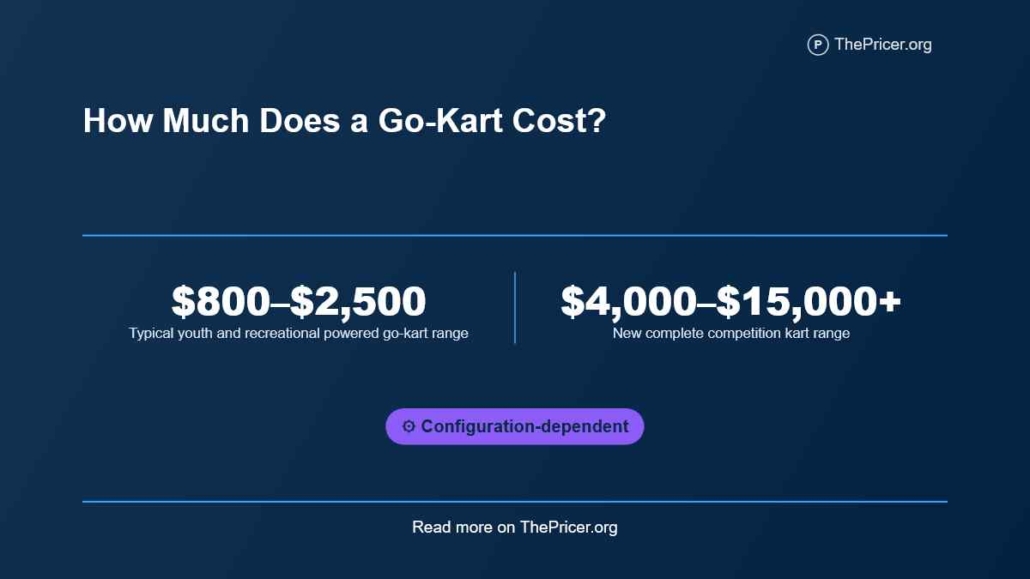
A go-kart can cost about $200 to $1,100 for a quality pedal kart, roughly $800 to $2,500 for many youth or recreational powered karts, about $2,300 to $6,200+ for larger off-road machines, and around $4,000 to $15,000+ for a new competition kart.
Current pedal-kart pricing, recreational kart listings, 300cc buggy prices, and complete racing-kart packages show why one “average go-kart price” is misleading. The biggest distinction is whether the price covers a complete vehicle or only a racing chassis that still needs an engine and other equipment.
Article Highlights
Jump to sections
- Current youth gas karts can start near $800 (at $30 per hour, earning that amount would take about 3.3 full-time workdays, before taxes), while larger recreational models can exceed $2,000.
- Current 300cc off-road buggies run about $4,400 to $6,200+ across published dealer examples.
- New 2026 racing chassis currently run about $3,795 to $7,095 before an engine package.
- Complete competition karts range from roughly $3,995 to $15,395 depending on class and engine.
- Pedal karts range from roughly $249 to $1,099 across several current BERG models.
- A race-ready setup can cost thousands more than the chassis after the engine, tires, safety gear, freight, tools, and track equipment are counted.
How Much Does a Go-Kart Cost?
The current market stretches much wider than the old idea that an average go-kart costs $1,700 to $3,000 (about 1.4 to 2.5 full-time workweeks at $30 per hour). Published 2026 prices span basic pedal vehicles, single-seat youth gas models, full-size recreational machines, off-road buggies, rolling race chassis, and complete competition packages.
| Go-kart type | Current planning price | What the price represents |
|---|---|---|
| Pedal kart | $249 to $1,099 | Current child through XL pedal-kart MSRP examples |
| Youth gas kart | $800 to $1,300 | Entry 98cc to 110cc recreational models |
| Two-seat recreational kart | $1,600 to $2,500+ | Larger gas or electric consumer models |
| Large 300cc off-road buggy | $4,400 to $6,200+ | Current TrailMaster-style recreational machines |
| New racing chassis | $3,795 to $7,095 | Rolling chassis before engine package |
| Complete competition kart | $3,995 to $15,395 | Kid, cadet, TaG, and shifter packages |
The ranges are category guides rather than one national average. A sale price on a backyard kart is not directly comparable with the MSRP of a pedal kart or the package price of a track machine. Retailer freight, setup, tax, protective equipment, and optional accessories can also change what the buyer pays.
The range becomes even wider if used racing equipment or highly equipped off-road machines are included. A used complete racing kart can cost less than a new chassis, while a larger buggy with UTV-style equipment can cost much more than an entry recreational kart despite both products being called go-karts.
What You Are Buying
“Go-kart” covers several products that should not share one price range. A child’s pedal kart is human-powered. A hoverkart is a seat-and-frame attachment driven by a separate hoverboard. A recreational gas kart can use a 98cc to 200cc engine, protective frame, simple suspension, and one or two seats. A larger off-road buggy can add reverse, bigger tires, independent suspension, lighting, storage, and more power.
Competition karts belong in another category. A racing chassis is a low, lightweight machine intended for kart tracks and a defined racing class. It can be sold without an engine. A complete racing kart adds the engine and may also include an engine mount, chain, gearing, fuel-system pieces, exhaust supports, cables, and other class-specific hardware.
That distinction changes the budget. A shopper looking at a $5,000 (about 4.2 full-time workweeks at $30 per hour) racing chassis and a $5,000 off-road buggy is not comparing two finished vehicles with equal scope. One may still need several thousand dollars in powertrain and track equipment, while the other may arrive as a complete recreational machine.
Size alone is not enough either. Engine type, suspension, passenger capacity, transmission, brakes, homologation, included hardware, battery system, and whether assembly is complete can move the price by thousands of dollars.
Youth and Recreational Karts

Youth gas karts still occupy one of the lower-priced powered categories. Tractor Supply currently lists the Coleman GK100, a single-rider 98cc model, with a $799.99 sale price against a regular price of $999.99. MotoBuys currently lists the two-seat 110cc Tao GK110 at a price of $1,249.
Those two machines show why youth kart price depends on more than engine displacement. The Tao adds a second seat, automatic transmission with reverse, hydraulic disc brakes, and other equipment. A child-sized racing kart can cost much more because it belongs to a track competition class rather than the backyard recreation market.
Moving into larger recreational machines raises the purchase cost again. Tractor Supply currently lists the two-seat Coleman GK200, powered by a 196cc engine, at $1,599.99 on sale against $1,799.99 regular. Current retailer listings also put larger electric two-seat machines around $2,500.
A practical shopping budget for current youth and recreational powered karts is roughly $800 to $2,500, but the buyer should match rider size, seating, speed controls, terrain, engine or battery type, and assembly requirements rather than choosing by price alone.
Off-Road Karts and Buggies

Large off-road karts can cost several times as much as an entry youth model because they add bigger frames, larger engines, suspension travel, reverse, stronger brakes, passenger equipment, and more body hardware. MotoBuys currently lists the fuel-injected TrailMaster Cheetah 300E at $4,399, while the more equipped Cheetah 300EX is currently $5,149.
Other current 300cc machines move above $6,000 as equipment is added. The difference is not simply the engine. Windshields, roofs, alloy wheels, lighting, doors, independent suspension, shaft drive, passenger count, and other hardware can all raise the bill.
Replacement components are another ownership consideration. A current TrailMaster 300cc engine with CVT transmission is listed at $1,395. That is not a normal maintenance bill, but it shows why the mechanical condition of a heavily discounted used buggy can matter more than a few hundred dollars of purchase-price savings.
Buyers shopping this category may also want to compare four-wheeler costs, E-Z-GO golf cart prices, and dune buggy costs. Each serves a different use case, so compare passenger capacity, terrain, hauling ability, legal riding areas, and delivered price.
Racing Karts

Racing prices need one label before any number is useful: chassis or complete kart. Kartoholics currently lists 2026 BirelART rolling chassis priced from $3,795 to $7,095, depending on whether the chassis is built for cadet, four-stroke, TaG, or shifter competition.
A chassis price can look close to the old $3,000 to $5,000 racing-kart estimate, but the engine changes the comparison. A current 2026 senior TaG chassis costs $5,695, while the Rotax Senior engine listed by the same dealer costs $4,225. Those two major components total $9,920.
Current complete-kart pricing confirms the difference. PSL Karting lists a complete BirelART Briggs junior or senior kart at $5,695. More powerful TaG and shifter packages cost much more, and a prepared 2026 KZ shifter package can reach above $15,000.
The chassis-versus-complete distinction is the central pricing issue for race-kart shoppers. A used complete kart can sometimes cost less than a new rolling chassis, while a brand-new complete TaG or shifter package can cost two or three times the amount shown on a bare chassis listing.
Race-Ready Startup Cost
The kart itself is only one part of a first racing budget. Word Racing’s current 2026 U.S. karting cost guide puts a competitive used LO206 kart with engine at $2,500 to $4,500, a new chassis without engine or tires at $4,000 to $6,000, safety gear at $800 to $1,500, and tools plus a rolling stand at $350 to $800. Its total startup estimate is $4,000 to $8,000 for LO206 and $7,000 to $12,000 for 100cc competition.
A current youth-racing package provides a more detailed calculation. Kartspeed lists a Croc kid-kart chassis at $2,450, a Honda 50cc engine and mount at $1,100, racing tires at $215, and chain, gearing, cables, and related pieces at $150. Those four required hardware lines total $3,915.
Add the seller’s optional MyChron 5s at $599 and the package reaches $4,514. Its quoted U.S. kart shipping of $350 to $375 raises the delivered hardware to about $4,864 to $4,889 before professional assembly and driver safety gear.
That calculation is the hidden-price lesson. A chassis advertised at $2,450 can require another roughly $2,400 in listed engine, running gear, data equipment, and freight before the driver even budgets a helmet, suit, gloves, shoes, tools, entry fees, fuel, or future tires.
Pedal, Hoverkart, and DIY

Pedal karts now cover a wider price band than the old $80 to $200 estimate. BERG’s current U.S. catalog lists a Buzzy at a $249 MSRP, Buddy models at $499, Rally models at $799, and an XL B.Super at $1,099. Larger geared and electric-assisted pedal products can cost more.

Hoverkarts can be much cheaper than the old $300 to $500 estimate when the rider already owns a compatible hoverboard. Walmart currently lists one adjustable hoverkart attachment at $40.07. A current Jetson hoverboard listing is priced at $78. Buying those two current products together would cost about $118.07 before tax.

A homemade powered kart has no credible single national price. The bill depends on how much is fabricated, which pieces are salvaged, and whether the engine, frame material, axle, brakes, steering, bearings, wheels, seat, chain, and controls are purchased new. A claim that a complete powered kart can normally be built with $100 in new parts is not a useful planning figure.
A DIY project should start with a bill of materials. Salvaged parts can lower cash cost, while a build based on new racing or powersports components can pass the price of a ready-made recreational kart before fabrication time is counted.
Choosing the Right Kart
The useful comparison starts with where the kart will be driven. A child who wants a pedal kart does not need an engine. A family using private trails may care more about two seats, reverse, suspension, parts availability, and low-speed control than racing geometry. A track racer needs to know which class, engine, chassis, tire, and age rules are supported locally before buying equipment.
Used racing equipment can cut the entry price. The current racing-cost data cited earlier places a competitive used complete LO206 kart around $2,500 to $4,500 and a used complete 100cc kart around $3,500 to $6,500. Those figures overlap new chassis prices, which explains why a complete used package can make more financial sense than buying a new chassis and adding every component separately.
Makes sense if
- The kart class matches the rider, terrain, and intended use.
- A complete package includes costly parts that would otherwise be purchased separately.
- Replacement parts and service are readily available for the chosen brand.
- The delivered budget still works after freight, setup, gear, and accessories.
Does not make sense if
- You are comparing a bare racing chassis with a ready-to-drive recreational machine.
- The rider will quickly outgrow the kart and resale demand is weak.
- A cheap used kart needs major engine, brake, frame, or tire work.
- The kart cannot legally or practically be used where you plan to drive it.
Answers to Common Questions
How much does a go-kart cost?
Current prices run from about $200 for simpler pedal products to more than $15,000 for complete high-end competition karts. Powered recreational models occupy the middle of that range.
How much does a racing go-kart cost?
A new racing chassis can cost about $3,800 to $7,100, while complete new competition packages can range from roughly $4,000 to $15,400.
How much does a kids’ go-kart cost?
Current youth gas examples start near $800 and reach roughly $1,300 for basic 98cc to 110cc recreational models. Youth racing karts cost substantially more.
How much does an off-road go-kart cost?
Basic recreational gas karts can cost around $1,000 to $2,500, while larger 300cc buggies can reach roughly $4,400 to $6,200+.
Is it cheaper to build a racing kart from a chassis?
Not necessarily. One current $5,695 senior chassis plus a $4,225 engine already totals $9,920, while a complete current package is listed at $9,995 before any other applicable charges.
Disclosure: Educational content, not financial advice. Prices reflect public information as of the dates cited and can change. Confirm current rates, fees, taxes, and terms with official sources before purchasing. See our methodology and corrections policy.