
How Much Does a Googlebook Cost?
Published on | Written by Alec Pow
This article was researched using 12 sources. See our methodology and corrections policy.
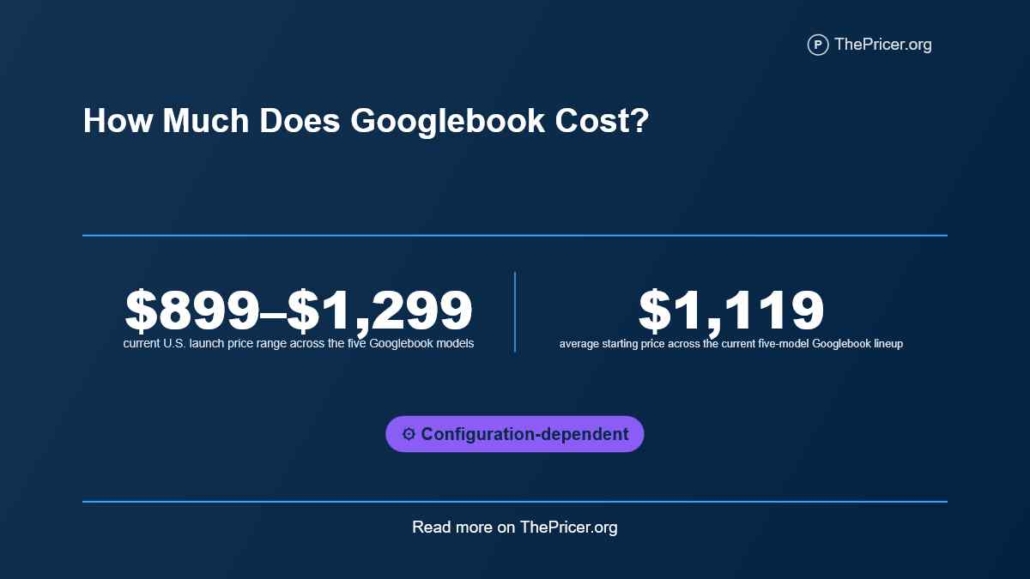
Googlebook is Google’s new premium laptop category built around Googlebook OS, Gemini Intelligence, Android phone integration, and hardware from Acer, ASUS, Dell, HP, and Lenovo. In the United States, a new Googlebook currently costs $899 to $1,299 before sales tax. Five launch models are available for preorder, with the Acer Googlebook 14 at the bottom of the range and the ASUS and HP models at the top.
Preorders opened September 21, 2026, with U.S. retail availability beginning October 4. Unlike the inexpensive Chromebooks many buyers associate with Google-powered laptops, Googlebook is deliberately positioned in the premium-laptop market, with 16GB of RAM, 512GB of storage on the currently listed U.S. configurations, touchscreens, premium chassis materials, and dedicated processors for on-device AI.
Article Highlights
Jump to sections
- Current Googlebook prices run from $899 to $1,299 (at $30 per hour, earning that amount would take about 0.7 to 1.1 full-time workweeks, before taxes) in the United States.
- The five prices currently shown by Google’s live model comparison are $899, $999, $1,099, $1,299, and $1,299.
- The average launch price across those five models is $1,119, while the median is $1,099.
- Every currently listed U.S. launch configuration has 16GB of RAM and 512GB of storage.
- Eligible buyers receive one year of Google AI Pro plus several shorter or one-year software offers.
- The cheapest and most expensive Googlebooks are separated by $400, so the top of the launch range costs about 44.5% more than the $899 entry model.
- The sticker price is not necessarily the long-term cost. Sales tax, optional accessories, subscription renewals, repairs, and possibly an Android phone upgrade can raise the ownership cost.
How Much Does Each Googlebook Cost?
As of September 21, 2026, Google’s U.S. pages show five Googlebook models ranging from $899 to $1,299 (about 0.7 to 1.1 full-time workweeks at $30 per hour). The current launch lineup looks like this:
| Googlebook model | Current starting price | Processor | Display | Claimed web battery life |
|---|---|---|---|---|
| Acer Googlebook 14 | $899 | Intel Core Ultra 5 | 14-inch 2.8K OLED touchscreen | Up to 16 hours |
| Dell XPS Googlebook | $999 | Snapdragon X Elite | 13.4-inch 2.5K LCD touchscreen | Up to 18 hours |
| Lenovo Googlebook 15 | $1,099 | Intel Core Ultra 5 | 15.3-inch 2.8K OLED touchscreen | Up to 13 hours |
| ASUS Googlebook 14 | $1,299 | Intel Core Ultra 5 | 14-inch 2.8K OLED touchscreen | Up to 16 hours |
| HP Googlebook 14 | $1,299 | Snapdragon X Elite | 14-inch 2.8K OLED touchscreen | Up to 19 hours |
The $899 entry configuration currently shown includes 16GB RAM, 512GB storage, an Intel Core Ultra 5 processor, and an OLED touchscreen. Moving to the XPS configuration listed at $999 adds a Snapdragon X Elite platform and a lighter 2.2-pound chassis.
The 15.3-inch Lenovo sits in the middle at $1,099 according to its current product listing, while the ASUS configuration is listed at $1,299. HP also lands at $1,299 in Google’s comparison.
Adding the five current prices produces $5,595, or an average of $1,119 per Googlebook. The middle value is $1,099. For a buyer comparing the category rather than chasing the lowest advertised number, roughly $1,100 is therefore a useful launch-day budget target before tax.
What Do You Get for the Price?
Googlebook is not simply a new name for an inexpensive Chromebook. Google’s launch announcement describes the platform as an Android-based system using desktop foundations developed through ChromeOS, with Gemini features integrated directly into the operating system.
All five launch machines include at least 16GB of memory, touch input, backlit keyboards, dedicated neural-processing hardware exceeding 45 TOPS, and premium materials such as aluminum, magnesium alloy, or carbon fiber. The currently displayed U.S. configurations also carry 512GB of storage.
Google is also using software to justify part of the price. Features include Magic Pointer, which brings Gemini into the context of whatever is on screen; Rambler, which converts spoken thoughts into organized text; and Create My Widget, which generates desktop widgets from natural-language descriptions.
Android phone integration is another major part of the proposition. Googlebook can continue supported activities from a phone, access phone content, and run Android applications alongside the full Chrome browser. Independent hands-on launch coverage describes Google’s goal as giving Android owners the kind of phone-to-laptop continuity Apple has built between the iPhone and Mac.
That makes Googlebook more comparable with the premium end of the broader laptop market than with the least expensive school Chromebooks.
Prices Look Different Online
This launch has an unusual pricing wrinkle. Several same-day reports published manufacturer launch prices that do not perfectly match Google’s live U.S. pages.
For example, some launch material put the Dell XPS Googlebook at $1,199 (about 5 full-time workdays at $30 per hour), while Google’s current product page displays $999. Similar discrepancies have appeared around Lenovo pricing. Current preorder roundups show the same $899, $999, $1,099, $1,299, and $1,299 prices now visible to U.S. shoppers.
The difference matters because someone reading an early announcement could reasonably believe a Googlebook costs hundreds of dollars more than the price currently displayed. Launch-day reporting on the five models also identifies special or limited-time pricing around some configurations.
For budgeting, use the price displayed by the retailer when you are ready to buy rather than relying on a launch article. The Googlebook lineup is only hours into its preorder period as of this update, so promotions, configurations, and retailer-specific prices can still move.
Region matters as well. Google’s initial availability covers the United States followed by Canada, the United Kingdom, Ireland, France, Germany, and Australia, and prices outside the U.S. do not translate directly from the American MSRP.
The Hidden Price
The most important hidden Googlebook cost is not an accessory. It is the collection of subscriptions bundled with the laptop.
Google’s current bundle description says eligible buyers receive 12 months of Google AI Pro, which includes 5TB of cloud storage and expanded Gemini features. Google assigns the included AI plan a stated value of $249.99. Buyers also receive up to $300 or more in additional app offers, including limited periods of YouTube Premium, Adobe Photoshop, CapCut, Luminar, and GeForce NOW.
Free trials can turn into recurring expenses if you continue them. Google’s U.S. offer terms currently show Google AI Pro renewing at $19.99 per month, or the then-current subscription price, after the included period unless it is canceled. The offer details also spell out the renewal requirement.
At $19.99 per month, keeping Google AI Pro for one paid year after the free year adds $239.88. Two paid years add $479.76. Interestingly, that mathematical annual renewal figure is slightly below the $249.99 promotional value Google assigns to the included year, so buyers should use the actual renewal price rather than the marketing value when projecting future spending.
There can also be a hardware compatibility cost. Some of Google’s deeper phone-continuity features require a sufficiently recent Android version. A buyer using an older Android handset may not get the complete ecosystem experience without eventually replacing the phone. That is not automatically a Googlebook expense, but it matters if phone integration is the main reason for buying one.
Repair costs are still difficult to model because these are first-generation machines and model-specific out-of-warranty parts pricing has not had time to develop. For a broader benchmark, our laptop repair cost research covers current labor and common repair-price patterns.
Googlebook vs MacBook
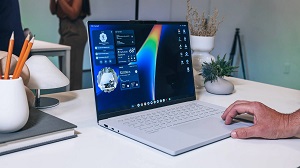 The most revealing comparison is with Apple’s current laptop range. Apple’s live U.S. Mac storefront currently lists the MacBook Neo from $699 and MacBook Air from $1,299.
That means the cheapest $899 Googlebook is $200 more than a base MacBook Neo. At the other end, the $1,299 ASUS and HP Googlebooks reach the same starting price as the current MacBook Air.
The comparison also shows why Googlebook should not be treated as another low-cost Chromebook category. Our Chromebook cost guide covers a much wider market extending from inexpensive web-focused machines through premium models. Googlebook begins almost entirely at the upper edge of traditional Chromebook spending.
Google appears to be charging for a different proposition: premium screens and materials, stronger processors, local AI hardware, Android apps, Linux development tools, integrated Gemini features, and tighter Android-phone continuity.
For buyers comparing ecosystems, our separate MacBook Neo cost analysis is particularly relevant because Apple’s lower-priced notebook now undercuts the least expensive Googlebook by $200.
At $30 per hour in gross earnings, buying the $899 Acer represents almost 30 hours of earnings before taxes and normal living expenses. A $1,299 Googlebook represents about 43.3 hours. Moving from the cheapest Googlebook to the most expensive therefore adds roughly 13.3 hours of work at that wage.
Three Googlebook Budget Scenarios
Lowest-cost entry
A buyer chooses the Acer Googlebook 14 at $899 and lives somewhere with an 8% combined sales-tax rate. The laptop would cost approximately:
$899 + $71.92 tax = $970.92 at checkout.
If the buyer cancels the bundled services before they renew and does not add accessories, $970.92 is a reasonable modeled first-year cost under those assumptions.
Keeping Google AI Pro after the free year
Take the same $899 Acer and the same assumed 8% purchase tax. The checkout cost is still $970.92. If Google AI Pro is then kept for one paid year at the current $19.99 monthly rate:
$970.92 + ($19.99 × 12) = $1,210.80.
Keeping it for two paid years instead raises the modeled total to $1,450.68, before any subscription taxes, repairs, accessories, or future price changes.
Buying near the middle of the lineup
The five current starting prices average $1,119 and have a $1,099 median. A shopper budgeting approximately $1,100 before tax therefore has a more realistic picture of the launch lineup than someone budgeting only around the headline $899 starting price.
At the top, a $1,299 machine costs $400 more than the entry Acer. That is a 44.5% increase, so differences in screen size, weight, battery claims, CPU platform, biometric options, ports, and chassis design deserve more attention than the Googlebook badge itself.
There is no mature used-Googlebook market yet, and there is not enough repair history to produce a defensible secondhand depreciation or ownership-cost curve. Those numbers should become more useful after the first machines have been in consumers’ hands for several months.
Answers to Common Questions
What is the cheapest Googlebook?
The cheapest model currently listed in the United States is the Acer Googlebook 14 at $899. It includes an Intel Core Ultra 5 processor, 16GB of RAM, 512GB storage, and a 14-inch OLED touchscreen.
What is the most expensive Googlebook?
The ASUS Googlebook 14 and HP Googlebook 14 currently start at $1,299, making them the most expensive of the five launch models at their displayed starting prices.
What is the average Googlebook price?
The five current starting prices total $5,595. Dividing by five gives an average of $1,119. The median starting price is $1,099.
Does a Googlebook include Gemini?
Yes. Gemini Intelligence is integrated into Googlebook OS, and eligible purchases currently include 12 months of Google AI Pro with 5TB of cloud storage. The subscription can become a recurring charge if retained after the included term.
Is Googlebook the same thing as a Chromebook?
No. Googlebook uses an Android-based technology stack with desktop technology derived from ChromeOS and is positioned as a premium laptop category. ChromeOS Chromebooks continue to cover a much broader range of inexpensive through premium machines.
When can you buy a Googlebook?
Preorders opened on September 21, 2026. Google’s launch schedule says U.S. retail availability begins October 4, followed by Canada, the United Kingdom, Ireland, France, Germany, and Australia on October 5. Launch-day reporting confirms the $899 starting point and Google’s move into the premium laptop market.
How much should I actually budget for a Googlebook?
For the laptop alone, budget $899 to $1,299 plus sales tax. A budget around $1,100 before tax lands near the center of the current launch lineup. Add more if you plan to keep bundled subscriptions after their free periods or need accessories, repairs, or a newer Android phone to use every cross-device feature.
Disclosure: Educational content, not financial advice. Prices reflect public information as of the dates cited and can change. Confirm current rates, fees, taxes, and terms with official sources before purchasing. See our methodology and corrections policy.