
How Much Does a Home Inspection Cost?
Updated on | Researched and reviewed by Alec Pow, Founder & Pricing Investigator
Prices, claims, and calculations checked against 11 cited sources. See our research methodology and corrections policy.
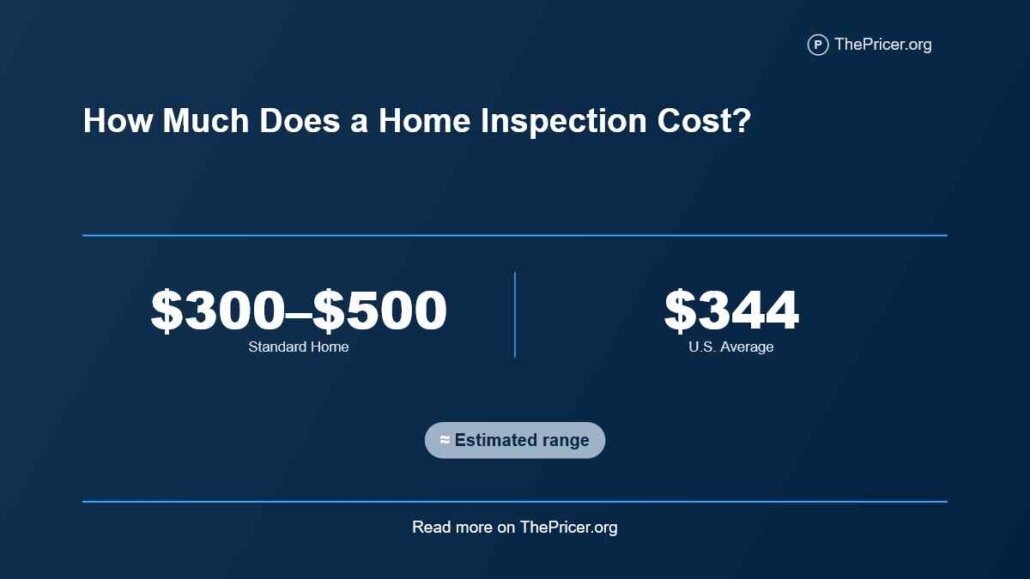
A standard home inspection costs approximately $300 to $500 for many U.S. single-family homes in 2026. Angi reports a national average of $344, with most projects between $296 and $425. Larger houses, older buildings, challenging access, and higher-priced local markets can push a basic inspection above $500.
The price covers a professional visual assessment of accessible building components, not every possible test. Radon testing, sewer-camera inspections, termite reports, mold sampling, and specialist structural evaluations may cost extra. A buyer ordering several services can spend $700 to $1,200 or more before completing the purchase.
The most useful comparison is the total cost of the specific inspection package. Two inspectors may quote the same base fee but include different systems, outbuildings, testing services, and report deliverables.
Article Highlights
Jump to sections
- Angi’s September 2026 data places the average home inspection at $344, based on 34,526 projects.
- HomeGuide reports approximately $200 to $500 for standard inspections across common home sizes.
- Ross Home Inspection’s published 2026 schedule starts at $500 for homes up to 1,500 square feet.
- Radon testing costs approximately $125 to $400, while sewer-camera inspections run $125 to $500.
- A 2,000-square-foot inspection with bundled radon and sewer testing costs $875 under one published provider schedule.
- A standard inspection does not guarantee that concealed defects, environmental hazards, or future system failures will be discovered.
How Much Does a Home Inspection Cost?
Square footage is one of the main factors used to price home inspections. Larger properties have more rooms, fixtures, electrical circuits, roofing, plumbing, and heating or cooling equipment to evaluate.
Angi’s September 2026 home inspection data reports a $344 national average and a typical range of $296 to $425. Its dataset includes 34,526 projects.
HomeGuide’s home inspection pricing research gives the following size-based estimates.
| Home size | Estimated standard inspection |
|---|---|
| Under 1,000 sq. ft. | $200–$250 |
| 1,001–1,500 sq. ft. | $250–$300 |
| 1,501–2,000 sq. ft. | $300–$400 |
| 2,001–2,500 sq. ft. | $400–$450 |
| 2,501–3,000 sq. ft. | $450–$500+ |
These are market estimates rather than standardized prices. HomeGuide’s published size ranges also differ somewhat from Angi’s data, particularly for homes around 2,000 square feet.
A condo inspection may cost less because the inspector is assessing the individual unit rather than the entire condominium building. However, shared building defects and association maintenance obligations can require separate document reviews or specialist assessments.
What Inspectors Charge
Published contractor rates help show the difference between national survey figures and a real inspector’s pricing structure.
Ross Home Inspection’s 2026 services and rates schedule uses finished and unfinished square footage to determine its standard package price.
| House size | Published Ross inspection rate |
|---|---|
| Up to 1,500 sq. ft. | $500 |
| 1,501–2,000 sq. ft. | $525 |
| 2,001–2,500 sq. ft. | $550 |
| 2,501–3,000 sq. ft. | $575 |
| 3,001–3,500 sq. ft. | $600 |
| 4,501–5,000 sq. ft. | $675 |
The same schedule specifies a $100 crawlspace surcharge, an additional $25 to $75 for homes at least 25 years old, and $100 for an outbuilding or barn.
That rate sheet shows why a property can exceed the broad national benchmark without being exceptionally large. A 1,900-square-foot, 60-year-old house with a crawlspace costs $675 under the published schedule before optional testing.
These are one provider’s advertised rates, not industrywide surcharges. Other inspectors may include crawlspace access or older-home work in their base package.
Standard Inspection
A general home inspection examines accessible, installed building systems and components. The inspector documents visible defects, significant concerns, and areas needing further investigation.
The American Society of Home Inspectors’ Standards of Practice describe a visual inspection of accessible portions of the property. Typical coverage includes the structure, roof, exterior, heating, cooling, plumbing, electrical systems, insulation, ventilation, and interior components.
An inspector may examine:
- Roof covering, visible flashing, gutters, and drainage conditions.
- Accessible foundation walls, floors, framing, and signs of movement.
- Electrical panels, outlets, switches, and visible wiring.
- Accessible plumbing fixtures, drains, and water-heating equipment.
- Heating and cooling system operation, where conditions permit testing.
- Attics, basements, crawlspaces, windows, doors, and interior finishes.
InterNACHI’s home inspection standards also explain that an inspection is not technically exhaustive and cannot be expected to find every concealed or latent defect.
This limitation is important. A visual inspection might identify water staining beneath a bathroom but not determine the precise location of concealed pipe damage. Additional leak diagnosis could be required, with costs separate from the original inspection. The water leak repair cost guide explains how repair prices vary with accessibility and damage.
Radon, Sewer, and Termite Add-Ons
Specialty services are often the largest reason the inspection budget exceeds the advertised base price.
HomeGuide’s researched add-on estimates place radon testing at $125 to $400, sewer-camera inspections at $125 to $500, termite inspections at $50 to $350, and mold inspections at $300 to $650. These are distinct services, and not every buyer needs all of them.
| Additional inspection | Estimated cost |
|---|---|
| Radon testing | $125–$400 |
| Sewer scope | $125–$500 |
| Termite inspection | $50–$350 |
| Mold inspection | $300–$650 |
| Foundation specialist | $400–$750 |
| Septic inspection | $150–$650 |
| Well and water inspection | $250–$550 |
A September 2026 add-on guide identifies radon, termite, mold, and sewer testing as common options that address limitations of the basic visual inspection.
Ross Home Inspection offers more concrete bundle comparisons. Radon testing and sewer scoping each cost $175 with a standard inspection, compared with $250 each when booked independently.
For two services, the published bundle saves $150 compared with two separate $250 bookings. This assumes the buyer wants both tests and is eligible for the package pricing.
Radon testing is particularly relevant because the gas cannot be detected by sight or smell. The EPA’s Home Buyer’s and Seller’s Guide to Radon describes real estate testing procedures and recommends mitigation at 4 picocuries per liter or above.
If testing identifies elevated concentrations, the cost of a radon mitigation system is a separate potential expense, not part of the testing fee.
Follow-Up Testing

A standard inspector may identify a problem but lack the equipment, scope, or credentials to determine its full extent. That can require another paid visit before the buyer knows the likely repair cost.
For example, a suspicious sewer condition may warrant a camera inspection. The Roto-Rooter services cost guide documents standalone sewer-camera pricing around $295 to $350 for that service category.
Specialist electrical evaluations also differ from a general inspection. HomeGuide’s electrical inspection research quotes approximately $100 to $200 for a standard electrical safety assessment, with more extensive tests costing extra.
Not every observed mold concern needs paid air sampling. The EPA’s mold testing guidance says that sampling is usually unnecessary when mold growth is already visible. Finding and correcting the moisture source is often the more useful next action.
This means spending another $300 to $650 automatically on mold samples is not always justified. A qualified specialist may instead recommend an investigation of the moisture problem.
The hidden cost is not limited to extra tests. Inspection findings can reveal repairs, delay contract decisions, or require renegotiation while the buyer’s inspection deadline continues running.
A Complete Inspection
Consider an illustrative buyer purchasing a 2,000-square-foot detached home and choosing a standard inspection, radon test, sewer camera inspection, and termite inspection.
Using Ross Home Inspection’s published 2026 rate schedule, the itemized total would be:
- Standard inspection for 1,501–2,000 sq. ft.: $525
- Bundled radon test: $175
- Bundled sewer scope: $175
- Termite inspection, starting rate: $150
- Total estimated inspection package: $1,025
The termite inspection is paid directly to the pest inspector under this provider’s published arrangement. The scenario assumes no age, crawlspace, travel, or additional-system surcharges.
The total is almost double the $525 base price, an increase of approximately 95%. It demonstrates why buyers should compare the complete inspection package with the work they actually need.
For a smaller scope, the same home with only radon testing would cost $700 at the same published rates. A base-only appointment would cost $525.
These are provider-specific scenarios, not representative national package averages.
Condos and Insurance Inspections
Home inspections are useful beyond traditional purchases of older detached houses. The appropriate service changes with the property and the buyer’s purpose.
For new construction, HomeGuide reports $100 to $400 for predrywall inspections and approximately $250 to $350 for an inspection near the end of a typical first-year builder warranty. These visits address different stages of construction and should not be treated as substitutes for every other inspection.
An insurance four-point inspection is another distinct product. It focuses on the roof, plumbing, electrical, and HVAC systems rather than the full condition of the house.
HomeGuide’s four-point inspection pricing puts the cost at approximately $75 to $175, with an average near $125. Insurance companies may request this type of report under their underwriting requirements.
A four-point report is not the same as a buyer’s full home inspection. Paying less for a narrower inspection can leave other important areas unexamined.
Condominium inspections may also be less expensive, but owners should consider the building’s association responsibilities, reserve information, and shared systems separately from the individual unit inspection.
Who Pays?
In a typical purchase, the buyer selects and pays for the inspection. Sellers may commission a pre-listing inspection before marketing their property. The purchase agreement determines the inspection period, access rights, and what happens if defects are discovered.
The Consumer Financial Protection Bureau’s home inspection guidance recommends scheduling the inspection promptly after selecting the property. It explains the distinction between a home inspection and an appraisal, which serves the lender’s valuation needs.
If the contract includes an applicable inspection contingency, the buyer may have the right to negotiate repairs or cancel under its terms. An inspection contingency is not automatic in every purchase, and the parties are not guaranteed to agree on repairs.
The wording of an as-is contract also matters. It may limit the seller’s obligation to make repairs without necessarily preventing the buyer from inspecting the property. Applicable law and contract language control.
After closing, periodic home watch services can help owners monitor an unoccupied property, but those recurring visits are not substitutes for the detailed due-diligence inspection conducted before purchase.
Makes sense if
- You are buying a home and have time to inspect it under the contract.
- You want an independent assessment of accessible systems before making a major purchase.
- A prior report identifies concerns requiring specialist follow-up.
- You are approaching an applicable builder-warranty milestone.
Does not make sense if
- You expect a general visual inspection to reveal every concealed defect.
- You purchase every optional test without regard to the property or its risks.
- You use a narrow four-point insurance inspection as a replacement for a full buyer inspection.
- You select an inspector without confirming the scope, qualifications, report, and contract deadlines.
Choosing an Inspector
Inspection quality matters at least as much as a modest difference in quoted price. Before booking, request the written scope of work and a sample inspection report.
Ask whether the inspector covers accessible roofs, crawlspaces, attics, outbuildings, and major mechanical systems. Find out whether photographs, defect descriptions, and recommendations for specialist evaluation are included.
Licensing rules differ by state. Where the state requires inspector licensing, verify the credential with the relevant authority. Membership in a professional organization is not automatically a replacement for licensing.
The written contract should identify excluded services, additional charges, the report delivery deadline, and responsibility for reinspection visits.
Attend the inspection when possible. Seeing a defect and hearing the inspector’s explanation can help distinguish a minor maintenance item from a concern requiring prompt expert evaluation.
Answers to Common Questions
How much does a home inspection cost for a 2,000-square-foot house?
Market estimates commonly place a standard inspection around $300 to $450. The reviewed Ross Home Inspection schedule quotes $525 for a 1,501–2,000-square-foot property before add-ons.
How long does a home inspection take?
Many standard inspections take approximately two to four hours, depending on the house, accessibility, and inspector’s scope. Specialist testing may require additional appointments or processing time.
Does a home inspection include mold and radon testing?
Not automatically. Standard visual inspections may identify suspicious conditions, but laboratory mold analysis and radon measurement are typically separate services unless included in the agreed package.
Is a home inspection included in closing costs?
The buyer usually pays the inspection fee before closing. It should be included in the overall home-purchase budget, even when it does not appear as a charge due on the Closing Disclosure.
Do new houses need inspections?
Yes, new construction can have defects. Predrywall, completed-home, and builder-warranty inspections serve different purposes and may be purchased separately.
Can a buyer inspect an as-is house?
Often, yes, but inspection access, cancellation rights, deadlines, and repair negotiations depend on the signed purchase contract and applicable law.
Disclosure: Educational content, not financial advice. Prices reflect public information as of the dates cited and can change. Confirm current rates, fees, taxes, and terms with official sources before purchasing. See our methodology and corrections policy.