
How Much Does a Home Warranty Cost Per Year?
Published on | Written by Alec Pow
This article was researched using 14 sources. See our methodology and corrections policy.
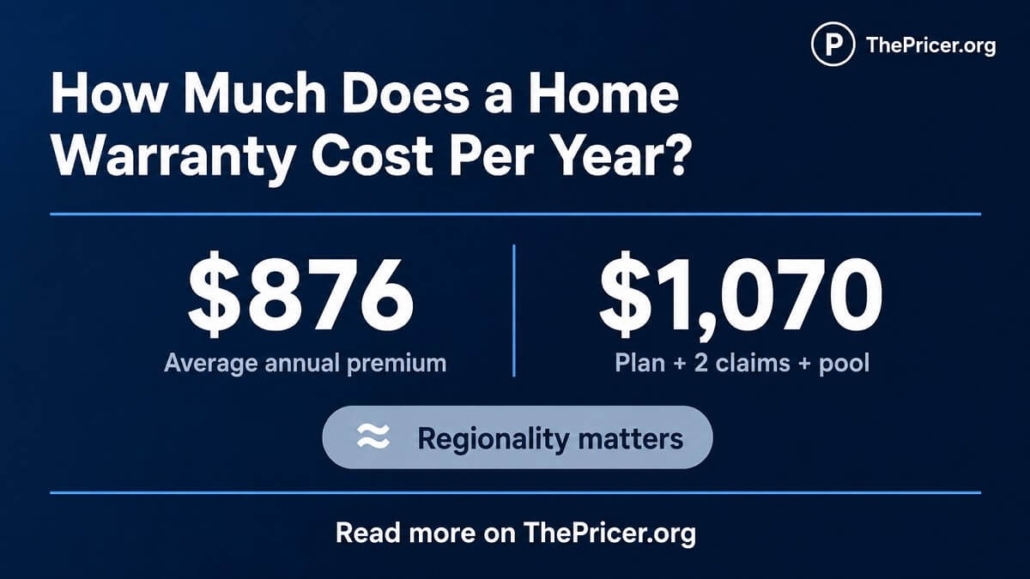
American Home Shield, Choice Home Warranty, AFC Home Warranty, and First American Home Warranty sell residential service contracts that cover specified home systems, appliances, or both after eligible breakdowns from normal use. NerdWallet found an average premium of $73 per month, or $876 per year, with sampled plans ranging from $28 to $191 per month in its March 2026 market analysis.
The annual premium is only one part of the bill. Service-call charges, optional coverage, payout limits, exclusions, ZIP code, home type, and plan scope can change the amount paid during the contract year. Companies may also require an address before producing a firm quote because property and location details enter the pricing process.
Home warranty spending is measured per month or per year for the contract, then claim-related charges are added when service is requested. The two largest modifiers are the selected coverage level and the service-call structure.
How Much Does a Home Warranty Cost Per Year?
Jump to sections
- This Old House found an annual plan band of $564 to $984 (at $30 per hour, earning that amount would take about 2.4 to 4.1 full-time workdays, before taxes) in its June 2026 annual cost study.
- Forbes Home reported a research average of $60 per month, equal to $720 per year, in its 2026 provider pricing review.
- American Home Shield service fees of $100 to $125 per claim appear in June 2026 seller-plan data published by This Old House.
What you’re buying
A home warranty is a service contract rather than homeowners insurance or a manufacturer warranty. The contract names the systems and appliances eligible for service, the events that qualify for repair or replacement, the claim process, and the limits placed on the provider’s payment. Coverage can focus on built-in systems, household appliances, or both. Some contracts also let the buyer add equipment that sits outside the base plan.
The provider also controls parts of the repair process. A claim may lead to a contractor visit, a repair authorization, a replacement decision, or a cash settlement under the contract language. Exclusions can remove a failure from coverage even when the appliance or system appears on the plan.
That structure separates a home warranty from keeping a repair fund and hiring any technician directly. The buyer is purchasing defined contract rights and a service process, not unlimited repair reimbursement.
Home warranty vs insurance
Homeowners insurance responds to covered events such as fire, theft, storms, and other insured losses. A home warranty addresses a different problem, mechanical failure or breakdown from use when the contract includes that item. A homeowner can carry both because the products address different risks. The warranty also remains optional in many buying situations, so the financial comparison is often between paying the contract premium and keeping the same money available for future repairs.
Direct spending gives the homeowner control over the repair company, parts, timing, and replacement choice. It also leaves the full invoice with the homeowner. That route can be attractive when the house has few aging covered items or when the likely repair is narrow.
A buyer comparing contract coverage with refrigerator replacement costs may reach a different decision from someone facing several older mechanical systems. A smaller repair can tilt the equation again. A dryer belt repair bill may be easier to absorb directly than a sequence of unrelated household failures.
Plan configurations and property details
Coverage breadth changes both the premium and the financial exposure retained by the homeowner. As of August 2026, American Home Shield separates homeowner coverage into ShieldSilver, ShieldGold, and ShieldPlatinum. Its published plan coverage limits list systems coverage across the three plans, appliance coverage on the two broader plans, and roof-leak coverage inside ShieldPlatinum.
The same material lists HVAC limits of $5,000 (about 4.2 full-time workweeks at $30 per hour) per covered system, appliance limits of $2,000 per appliance on ShieldGold and $4,000 per appliance on ShieldPlatinum, plus a $1,000 roof-leak limit on ShieldPlatinum. A household with several kitchen and laundry appliances has a different exposure profile from one focused on heating, cooling, plumbing, and electrical equipment.
Add-on availability matters too because pools, guest units, septic pumps, well pumps, and electronics may sit outside the base configuration. Home size and location can also enter the quote calculation, so the same plan name does not guarantee the same premium at every property.
| Plan style | Systems | Appliances | Extra coverage |
|---|---|---|---|
| Systems-focused | Included | Excluded | Selected add-ons may be available |
| Systems plus appliances | Included | Included | Selected add-ons may be available |
| Broad plan | Included | Included | May include an item sold separately on lower plans |
The useful comparison is the contract’s covered-item list and limits rather than the plan name alone. Two broad plans can place very different ceilings on appliances, HVAC work, roof leaks, permits, or related work.
What households can pay
Budget case. ConsumerAffairs reported a 2026 systems-plan figure of $612 (about 2.6 full-time workdays at $30 per hour) per year with service fees listed at $100 to $125 in its June 2026 systems-plan data. Using the lower cited service charge for one claim gives $612 + $100 = $712 for that year before uncovered work or add-ons. This case is driven by narrower coverage and light claim use.
Claim-heavy case. Forbes Home listed Choice Home Warranty premiums from $46.83 to $54.75 per month and a $100 service fee in its 2026 company premium table. At the cited upper premium, twelve months equals $657, and three service requests add $300, producing $957 before uncovered work. Location-driven case. A homeowner with the same preferred coverage can receive a different quote after the provider processes the property address, home type, and local service market. Claims may never occur, yet geography alone can change the contract premium. These cases are calculations, not customer stories.
Service fees, payout limits
 The fee is separate. A homeowner can pay the yearly premium and still owe money when a technician is dispatched. Repeated service requests can make claim charges a material part of yearly spending even when every approved repair remains inside the contract limits. An add-on creates another recurring line item when equipment such as a pool, septic system, or specialized HVAC component falls outside the base contract.
Coverage ceilings create another owner-paid layer. A contract may limit payment per appliance, per system, per repair category, or across the agreement term. Exclusions can shift the entire repair back to the homeowner if the failure does not meet the contract conditions.
A cash settlement can also be lower than the retail replacement bill if the provider’s contract permits payment based on its replacement terms. Read the coverage limit beside the item name, then check exclusions, maintenance language, unauthorized-repair rules, and settlement provisions before comparing premiums.
Renewal, cancellation
Contract timing can affect both access to service and the next year’s bill. Choice Home Warranty states that its plan may be renewable and that a renewing customer is notified of the prevailing rate and terms.
As accessed in August 2026, its renewal and service-fee terms also list a $100 trade service call fee per claim. A renewal notice deserves a fresh comparison because the new premium or contract wording may differ from the first term. Promotional first-year offers should not be treated as proof of the later renewal amount.
Coverage can also begin after enrollment rather than on the purchase date. American Home Shield states in its 30-day waiting-period terms that the standard ShieldPlatinum agreement has a 30-day coverage waiting period before the first service request can be placed. A breakdown during that period can remain entirely owner-paid. Cancellation rules deserve the same contract-level review. Check the refund calculation, administrative charges, claims already paid, and notice requirements before assuming an unused portion of the premium returns dollar for dollar.
A one-year home warranty budget
Claims change the math. HomeAdvisor’s June 2026 cost table lists a total-protection plan figure of $740 per year, service calls from $75 to $125, and pool or spa coverage at $15 per month. Using only those cited inputs, a household with that plan, the low-end service charge, two service visits, and pool coverage produces the itemized budget below.
- Base plan – $740
- Two service calls – 2 × $75 = $150
- Pool or spa add-on – 12 × $15 = $180
- One-year total – $740 + $150 + $180 = $1,070
The worked total is $330 above the cited base premium because $150 + $180 = $330 was added for claim use and optional coverage. A household with no claims would avoid the service-call portion, and a property without a pool would avoid that add-on. An excluded repair could raise the year’s spending beyond the calculated total because the contract would no longer absorb that repair bill.
Who this cost makes sense for
A home warranty has a stronger financial case when several covered systems or appliances create repair exposure at the same time and the owner accepts the provider’s contractor process. The contract can also fit a household that wants a defined service route rather than sourcing a technician after each breakdown. Direct repair remains a credible substitute. Older Friedrich AC repair pricing shows how individual HVAC components can produce very different repair bills, which is why the likely equipment failure matters when comparing a contract with a repair reserve.
Makes sense if
- Several covered appliances or mechanical systems are aging and still operating.
- A large repair would put pressure on the household’s repair reserve.
- The contract limits are high enough for the equipment the owner cares about.
- The homeowner accepts the assigned-contractor process and claim rules.
Doesn’t make sense if
- The likely failures sit outside the selected plan.
- The homeowner wants unrestricted choice of technician and repair method.
- Existing defects or maintenance records create a high denial risk.
- A strong repair reserve makes direct payment comfortable.
The decision should be made from the sample contract, not the premium alone. Compare the covered-item list with the actual equipment in the house, then read the service fee, limits, exclusions, waiting period, renewal language, and cash-settlement terms. A low premium can still be poor value if the expensive household systems fall outside coverage or carry limits far below likely repair exposure.
Answers to Common Questions
How much is a home warranty for one year?
Current 2026 studies do not produce one universal figure. Published annual figures cluster in the high hundreds, with narrower plans below that level and broad plans or heavy claim use pushing spending higher.
Do you pay a service fee every time you use a home warranty?
Many contracts charge a service fee when a technician is dispatched. The exact trigger comes from the agreement, so separate problems or separate trades can create more than one charge.
Is a home warranty the same as homeowners insurance?
No. A home warranty is a service contract centered on listed systems and appliances. Homeowners insurance addresses covered property losses under an insurance policy.
Can a home warranty still leave an out-of-pocket repair bill?
Yes. Coverage limits, exclusions, denied claims, noncovered components, service fees, and cash-settlement rules can leave part of the repair or replacement expense with the homeowner.
Disclosure: Educational content, not financial advice. Insurance pricing depends on underwriting, coverage limits, deductibles, and region. Confirm quotes and policy terms with a licensed insurer. See our methodology and corrections policy.