
How Much Does a Hospital Stay Cost Per Day?
Published on | Written by Alec Pow
This article was researched using 11 sources. See our methodology and corrections policy.
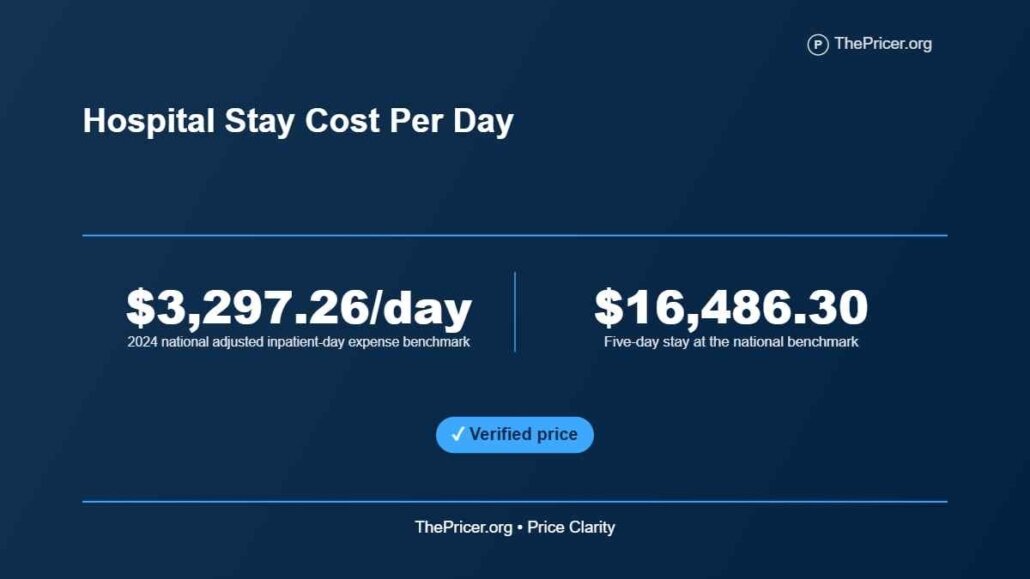
A U.S. hospital incurs an estimated $3,297 per adjusted inpatient day in operating and other expenses, according to KFF’s latest national data for 2024. That is a measure of hospital expenses, not a patient’s daily bill.
A hospital can charge substantially more than its costs, insurers generally negotiate different payment amounts, and a patient’s final responsibility depends on coverage, deductibles, and the treatment received.
For an eligible patient with Original Medicare, the 2026 Part A inpatient deductible is $1,736 per benefit period, with $0 daily Part A coinsurance for the first 60 covered days after the deductible.
A privately insured patient may owe a different deductible or coinsurance amount. Uninsured patients should request the hospital’s discounted cash price and available financial assistance.
The cost of an ordinary inpatient admission also differs from intensive care, surgery, an emergency department visit, or an overnight observation stay. Those differences make a single advertised hospital-room price an unreliable estimate of the entire stay.
Article Highlights
Jump to sections
- KFF reports $3,297.26 in average U.S. hospital expenses per adjusted inpatient day for 2024.
- State figures range from $1,400.53 in Mississippi to $4,744.25 in California, illustrating wide geographic variation.
- Original Medicare’s 2026 Part A inpatient deductible is $1,736 per benefit period.
- Medicare Part A daily coinsurance is $0 for days 1–60 after the deductible, $434 for days 61–90, and $868 for lifetime reserve days.
- A five-day hospitalization represents roughly $16,486 in modeled hospital expenses at the national adjusted-day rate, not a guaranteed bill.
- Hospital charges, negotiated insurance rates, patient payments, and hospital expenses are four different numbers.
How Much Does a Hospital Stay Cost Per Day?
The most reliable broad measure of hospital daily expenses comes from KFF State Health Facts. Its 2024 estimate is $3,297.26 nationally, based on American Hospital Association survey information.
However, the statistic uses adjusted inpatient days, which account for both inpatient and outpatient hospital activity. It cannot be interpreted as an average daily hospital bill or the exact expense of treating one additional inpatient.
| Location or hospital category | 2024 daily expense estimate |
|---|---|
| United States, all hospitals | $3,297.26 |
| Nonprofit hospitals, national | $3,449 |
| For-profit hospitals, national | $2,623 |
| Government hospitals, national | $3,089 |
| Mississippi, all hospitals | $1,400.53 |
| Texas, all hospitals | $3,060.35 |
| New York, all hospitals | $4,200.99 |
| California, all hospitals | $4,744.25 |
The national figures by ownership type are reported in Becker’s May 2026 analysis of the same underlying KFF data. They are not estimates of patient copayments.
The Healthcare Cost and Utilization Project, operated by AHRQ, also distinguishes costs from charges in its national inpatient cost data. Hospital charges are amounts billed, while estimated costs describe resources consumed in delivering care.
How Much Does Medicare Pay?
For Original Medicare beneficiaries, inpatient hospital coverage is primarily governed by Part A. The patient’s responsibility is organized by benefit periods and lengths of stay, not a flat daily room charge.
The official Medicare inpatient coverage page specifies the following 2026 amounts:
- Part A deductible per benefit period: $1,736
- Days 1–60 after deductible: $0 per day
- Days 61–90: $434 per day
- Days 91–150, using lifetime reserve days: $868 per day
- After covered lifetime reserve days are exhausted: patient responsibility may include all costs
The CMS 2026 deductible announcement confirms these figures and their effective year.
For example, a five-day covered inpatient stay could create a $1,736 Part A deductible, with no additional daily Part A coinsurance for those five days. That assumes the deductible has not already been satisfied in the benefit period.
Physician services billed under Part B, supplemental coverage, Medicare Advantage arrangements, and excluded services can change the actual amount owed. A Medicare Advantage patient should check the plan’s inpatient copayment schedule rather than apply Original Medicare’s charges automatically.
What Private Insurance Changes
 A privately insured patient usually does not pay the hospital’s full published charge for covered in-network services. Instead, the insurer applies its negotiated rate and the plan’s cost-sharing terms.
The plan might require a deductible, an inpatient admission copayment, daily hospital copayments, coinsurance, or a combination. Some costs may already have been satisfied earlier in the insurance year.
For 2026 Marketplace plans, HealthCare.gov’s out-of-pocket guidance establishes maximum annual limits of $10,600 for an individual and $21,200 for a family. Specific plans may have lower limits.
Those ceilings apply to qualifying covered in-network cost sharing. They do not include monthly premiums, excluded services, or certain out-of-network charges.
Someone with a high deductible who is hospitalized early in the year could owe substantially more than someone who already reached their out-of-pocket maximum.
The heat stroke treatment cost guide illustrates how emergency care may progress from an emergency department visit to hospitalization, depending on medical severity.
A Five-Day Hospital Stay Example
Consider a hypothetical five-day admission. First, use the KFF national adjusted inpatient-day expense figure as an economic illustration of hospital resource use.
Five days multiplied by $3,297.26 equals approximately $16,486.30.
That figure must not be labeled the patient’s bill. It is a modeled allocation using an aggregate hospital expense statistic, not a diagnosis-specific treatment cost or insurer payment.
Now consider an illustrative privately insured patient whose hospital stay generates a $20,000 negotiated allowed amount. Assume the patient has $2,000 of deductible remaining and owes 20% coinsurance on the amount above the deductible.
- Negotiated allowed amount, assumed: $20,000
- Remaining deductible, assumed: $2,000
- Amount subject to 20% coinsurance: $18,000
- Patient coinsurance: $3,600
- Total modeled patient responsibility: $5,600
- Modeled insurer payment: $14,400
The example assumes all services are covered, in network, and subject to those exact cost-sharing terms. If the patient had already met a lower remaining out-of-pocket limit, their actual liability would be capped accordingly.
A negotiated allowed amount is not the same as the hospital’s sticker charge, and a patient’s share is not simply the allowed amount divided by the number of nights.
Intensive Care Costs More
Intensive care can involve continuous monitoring, higher staffing intensity, specialized drugs, ventilation, advanced imaging, and repeated laboratory testing.
An ICU admission is therefore not comparable with an uncomplicated medical-floor stay. A single national adjusted-day expense figure cannot reliably price both situations.
A patient having major neurosurgery, for example, may also incur surgical facility costs, implants, anesthesia, imaging, and specialist fees. ThePricer’s brain surgery cost analysis distinguishes bundled surgical episodes from isolated line-item facility charges.
Similarly, the heart transplant pricing guide describes why intensive monitoring, organ procurement, surgery, and postoperative care can produce exceptionally large hospitalization totals.
For these cases, request an estimate covering the anticipated treatment episode and specialists, rather than asking only for a per-night room rate.
Observation Status
Spending a night in a hospital bed does not necessarily mean a patient has been formally admitted as an inpatient.
According to Medicare’s hospital status explanation, patients receiving observation services may remain outpatients even when they spend the night in the hospital.
This distinction can affect how services are billed and whether certain post-hospital skilled nursing facility benefits are available.
Observation care may be billed under outpatient coverage rather than inpatient Part A rules. The patient should ask whether the physician has formally admitted them and whether the hospital has provided an applicable observation notice.
The number of nights spent inside the building is therefore not a reliable substitute for confirmed billing status.
What Uninsured Patients Pay
An uninsured patient may face gross hospital charges, discounted cash prices, or a negotiated assistance amount. Those numbers can be dramatically different.
Under federal hospital price transparency rules, hospitals must publish pricing information including gross charges, discounted cash prices when applicable, and insurer-negotiated charges.
The CMS hospital transparency guidance explains how patients can examine prices for shoppable services and associated items.
For nonemergency care, the federal Good Faith Estimate rules generally require an estimate when uninsured or self-pay patients schedule care sufficiently in advance or request one.
If an eligible self-pay patient’s bill from an individual provider or facility is at least $400 above that provider’s Good Faith Estimate, a federal dispute process may be available. Emergency care does not ordinarily come with an advance estimate.
Ask each relevant facility and provider about prices and discounts. A hospital estimate may not contain every separately billed specialist’s fees.
How to Reduce a Hospital Bill
Emergency medical decisions should be based on medical necessity, not the ability to comparison-shop while seriously ill. For planned care, however, patients can often request information before admission.
The CMS hospital pricing requirements provide for machine-readable prices and consumer-friendly shoppable service information.
After treatment, compare the bill with the insurer’s Explanation of Benefits and check for duplicate charges, incorrect insurance information, or services not received.
The CMS payment assistance guide recommends asking about payment plans, reductions, and financial assistance. Eligible nonprofit-hospital patients may qualify for charity care.
Makes sense if
- You compare full treatment estimates for planned admissions, not just room charges.
- You verify network status and plan cost sharing before scheduled care.
- You ask the hospital whether your stay is classified as inpatient or outpatient.
- You request financial assistance when the bill exceeds your ability to pay.
Does not make sense if
- You treat a national hospital expense average as your exact personal bill.
- You assume a quoted room rate includes surgeons, anesthesia, and specialists.
- You delay medically necessary emergency treatment to obtain price comparisons.
- You pay a disputed bill without first examining the insurer’s explanation and the hospital’s itemization.
Answers to Common Questions
How much does one night in a U.S. hospital cost?
KFF estimates $3,297.26 in national hospital expenses per adjusted inpatient day, but this is not a one-night patient bill. Actual charges and patient payments depend on treatment, hospital, and insurance.
How much does a five-day hospital stay cost?
Applying the national adjusted-day expense rate produces a modeled $16,486.30 in hospital expenses. A patient’s actual bill, insurer payment, and out-of-pocket responsibility can be very different.
Does Medicare pay for hospital stays?
Original Medicare Part A generally covers eligible inpatient stays, subject to a $1,736 deductible per benefit period in 2026 and daily coinsurance for extended admissions.
Is an ICU day more expensive?
Often, because intensive care requires more staffing, monitoring, and specialized treatment. The actual amount depends on clinical services and the hospital’s billing and reimbursement arrangements.
Can an uninsured patient negotiate a hospital bill?
Yes. Patients can ask about discounted cash prices, hospital financial assistance, payment plans, and correction of billing errors. Eligibility and available discounts vary.
Disclosure: Educational content, not medical advice. Pricing varies by provider, location, and insurance. Confirm eligibility, coverage, and out-of-pocket costs with a licensed clinician and your insurer. See our methodology and corrections policy.