
How Much Does a Javelin Missile Cost?
Published on | Written by Alec Pow
This article was researched using 11 sources. See our methodology and corrections policy.
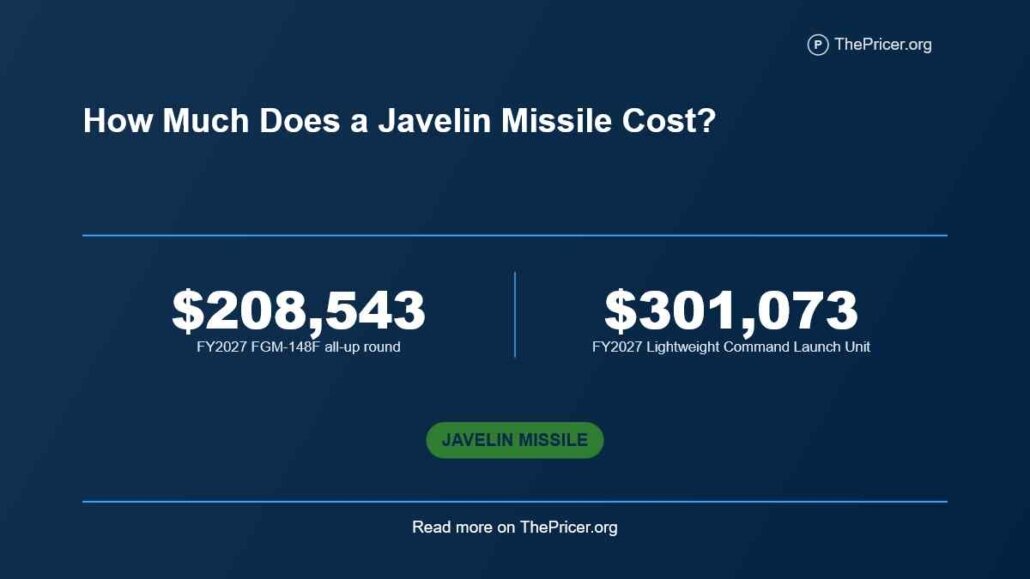
A current U.S. Army Javelin missile costs about $208,543 per FGM-148F all-up round in the FY2027 procurement plan. The reusable Lightweight Command Launch Unit, or LwCLU, costs another $301,073. That means the hardware needed to field one launcher with one missile represents about $509,616, although the launcher survives the shot and can fire additional rounds.
Older figures of $75,000, $100,000 or even $150,000 per Javelin are now poor benchmarks for a new U.S. round. Army contract history shows the all-up-round price rising from $168,366 in FY2022 to $196,132 in FY2023, $221,188 in FY2024, $236,000 in FY2025 and a planned $208,543 in FY2027.
The distinction between missile and weapon system matters. A Javelin team does not throw away the thermal sight and targeting unit every time it fires. It consumes the missile and disposable launch tube, then attaches another round to the same Command Launch Unit. Foreign military sales add another layer because their headline prices can include launchers, trainers, spare parts, batteries, technical assistance, transportation and years of support.
Article Highlights
Jump to sections
- The Army’s FY2027 planned price for one Javelin FGM-148F all-up round is $208,543.
- The FY2027 Lightweight Command Launch Unit costs about $301,073.
- One launcher plus one missile represents about $509,616 in current procurement hardware.
- Four missiles plus one reusable launcher represent about $1.135 million.
- The FY2027 Army request includes 645 missiles and 671 LwCLUs.
- Javelin missile production capacity is being expanded from 2,400 rounds a year to 3,960 annually.
- A 2024 production award worth $1.3 billion included missiles, equipment and production support, so it is not a missile-only unit price.
- Australia’s approved export case valued 161 LwCLUs at $49 million in major defense equipment, equal to roughly $304,348 per launcher before support, closely matching the current Army figure.
How Much Does a Javelin Missile Cost?
The cleanest current missile price appears in the Army’s FY2027 procurement justification. It schedules 645 FGM-148F all-up rounds at a planned recurring unit cost of $208,543 each. An all-up round is the missile packaged in its disposable launch tube and ready to be paired with the reusable sighting and launch unit.
The broader missile procurement line is larger than 645 multiplied by $208,543. The Army requests $215.011 million for the 645 missiles plus additional Battery Coolant Units and related program costs. Dividing that entire line by the missile quantity produces a gross weapon-system unit cost of $333,350, but that number is not the missile’s recurring production price.
| Javelin cost measure | FY2027 figure | What it includes |
|---|---|---|
| FGM-148F all-up round | $208,543 | Planned recurring missile cost |
| Missile gross unit cost | $333,350 | Broader missile procurement line allocated across 645 rounds |
| LwCLU | $301,073 | Reusable targeting and launch unit |
| One missile + one LwCLU | $509,616 | Calculated first-set hardware value |
The Department of Defense’s FY2027 weapon-system summary confirms that Javelin procurement continues around the FGM-148F missile and the new Lightweight Command Launch Unit. The Army is buying both at the same time, which is why a budget table that simply says “Javelin” can represent two very different pieces of hardware.
The Launcher Costs More
The surprising part of current Javelin pricing is that the reusable launcher costs more than the missile. The Army’s FY2027 budget allocates $202.020 million for 671 Lightweight Command Launch Units, producing a gross weapon-system unit cost of $301,073 each.
The LwCLU replaces the older Command Launch Unit and is not consumed when a missile is fired. RTX says the first new launchers reached the Army in May 2026. The company says the new unit is 30% smaller and 25% lighter while offering roughly twice the target detection and recognition range of the legacy launcher.
That produces a useful cost distinction. A unit acquiring its first launcher and its first FY2027-price round needs:
$301,073 + $208,543 = $509,616.
After firing that round, the $301,073 launcher remains available. A second shot does not require another half-million-dollar equipment set. It requires another missile, plus expendable batteries and the ordinary support involved in operating the system.
An export case gives a useful independent check on the launcher number. Australia’s notified Javelin case places $49 million of Major Defense Equipment value on 161 LwCLUs. That works out to:
$49 million ÷ 161 = about $304,348 per launcher.
The Australian figure is within roughly 1% of the Army’s $301,073 FY2027 launcher cost, despite coming from a separate foreign-sale estimate. The complete $97.3 million Australian case is much larger because it also includes trainers, simulation rounds, spare parts, lifecycle support, tools, training and technical services.
What One Shot Costs
A combat firing consumes the all-up round, not the launcher. That makes about $208,543 the best current answer to the cost of one FY2027 Javelin missile shot if the unit already owns a compatible launcher.
The first shot looks much more expensive if the launcher must also be purchased. Using current Army planning figures, one LwCLU with one missile represents $509,616. Add three reloads and the equipment set becomes:
- 1 Lightweight Command Launch Unit: $301,073
- 4 FGM-148F missiles: 4 × $208,543 = $834,172
- Total hardware: $1,135,245
If all four missiles were fired, the consumable ammunition cost would be $834,172. The launcher would remain in service. Dividing the entire $1.135 million equipment set by four shots would produce $283,811 per firing, but that would only be an artificial four-shot allocation because the LwCLU is designed to serve across many more engagements.
This reusable-launcher structure is one reason Javelin prices are often reported inconsistently. A newspaper may quote a missile price. A foreign-sale notice may price missiles, launchers and training together. An Army budget line may allocate Battery Coolant Units or other costs across the annual missile quantity.
The same accounting problem appears with larger weapons. A current AMRAAM missile price refers to an all-up round rather than the fighter, radar and training system needed to employ it, while an SM-6 price can exclude the ship, Aegis combat system and vertical-launch infrastructure.
Why the Price Changed
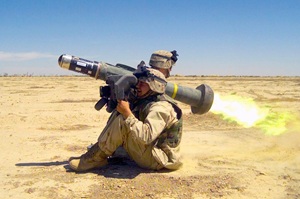 Historical Javelin prices are not imaginary, but they belong to earlier contracts. The current Army budget’s procurement history shows all-up rounds at $168,366 in FY2022, $196,132 in FY2023, $221,188 in FY2024 and $236,000 in FY2025. The planned FY2027 unit falls back to $208,543 as the quantity rises to 645 Army-funded rounds.
From FY2022 to FY2024, the contract unit price increased:
($221,188 – $168,366) ÷ $168,366 = 31.4%.
The FY2027 figure is then about 11.6% lower than FY2025’s $236,000. Those changes should not be described as simple inflation. Procurement quantity, contract timing, supplier capacity and the mix of U.S. and foreign demand all affect the lot price.
Production history also matters. The Army’s earlier budget documents show that large Ukraine-related supplemental purchases exceeded existing manufacturing capacity and extended delivery schedules. The FY2027 book says industrial-base investments made after 2022 are expected to shorten those lead times as additional capacity comes online.
The latest GAO sustainment review adds another long-term cost issue. GAO says the Army’s estimated Javelin operating and support cost grew 49% above its earlier estimate, equal to a $1.6 billion increase in 2024 constant dollars. GAO attributes much of the change to a much larger inventory, more launcher units, additional variants and longer equipment life rather than a 49% jump in the cost of firing one missile.
The Production Ramp
Javelin has moved from a relatively modest anti-armor production line into a much larger industrial program. Lockheed Martin says current production capacity is about 2,400 missiles per year and is being expanded to 3,960 missiles annually by late 2026.
The difference is substantial:
3,960 – 2,400 = 1,560 additional missiles of annual capacity.
That is a 65% increase over the stated 2,400-round capacity. At the FY2027 planned recurring missile price of $208,543, 1,560 additional rounds correspond to about $325.3 million of missile hardware if output actually reached that level and each round carried the same unit cost. That is a scale illustration, not a forecast of annual government spending.
Lockheed says its 2026 production work has included new tooling, test equipment and supplier investments. Increasing the final assembly rate only works if seeker, propulsion, electronics, warhead and other suppliers can increase output as well.
The contracting structure reflects that industrial push. The Army established a $7.2 billion IDIQ production vehicle for fiscal years 2023 through 2026, while a later FY2024 order was worth $1.3 billion. That single-year award included weapon systems, production support and more than 4,000 rounds intended to replenish missiles transferred to Ukraine. Dividing $1.3 billion by one assumed missile quantity would not produce a clean Javelin unit price.
Ukraine and Replacement Cost
Ukraine is one reason modern Javelin pricing became a public-money issue rather than an obscure procurement number. Thousands of U.S. Javelin rounds were transferred from existing stocks after Russia’s 2022 invasion, creating a separate need to replace donated inventory.
One of the clearest replacement contracts came in September 2022, when the Army awarded $311 million for more than 1,800 Javelins to replenish stocks sent to Ukraine. If the contract covered exactly 1,800 rounds, a simple ceiling division would be about $172,778 each. The Army said “more than 1,800,” so the actual contract-equivalent amount per round would be lower, and the contract should not be treated as an exact hardware invoice without a final quantity.
That historical scale aligns much better with Army all-up-round prices from the period than modern articles claiming a Javelin still costs $80,000. FY2022 procurement history shows $168,366 per round, close to the rough replenishment-contract scale.
Replacement spending also differs from valuing donated weapons at an old accounting cost. A missile sitting in government inventory may have been purchased years earlier for less money. Replacing that missile requires paying a current production price, which can be much higher.
That is the useful budget lesson from Ukraine: the economic cost of transferring an existing missile is not necessarily its original purchase price. The relevant replenishment question is what a new round costs when the inventory has to be rebuilt.
Foreign Sale Prices
Recent foreign military sales show why Javelin package prices can look much higher than the U.S. missile-only number. Poland’s 2025 notification covers 2,506 FGM-148F missiles and 253 LwCLUs for an estimated $780 million. The package also includes simulation rounds, battery coolant units, tools, spares, training, transportation and technical assistance.
Dividing the Polish package ceiling only by missile count gives:
$780 million ÷ 2,506 = about $311,253 per missile-equivalent.
That is not a $311,253 missile price because the numerator also buys 253 reusable launchers and the support package.
Taiwan provides another current example. Its approved package includes 1,050 FGM-148F missiles, 10 fly-to-buy acceptance missiles and 70 LwCLUs for an estimated $375 million. Dividing $375 million by 1,060 missiles yields about $353,774 per missile-equivalent before acknowledging that the case also buys launchers, trainers, spare parts and lifecycle support.
Ireland gives a cleaner historical missile signal. Before launchers were added to its case, 44 Javelin missiles sat inside an $8.7 million total case with $7.9 million in Major Defense Equipment. The MDE amount divided by 44 is about $179,545 per missile, although even that remains an export-case accounting figure rather than an Army production-lot invoice.
These examples explain why export headlines ranging from roughly $180,000 to more than $350,000 per missile-equivalent can coexist with a current U.S. planned all-up-round price of $208,543.
Javelin vs Other Missiles
Javelin is more expensive than some older anti-armor missiles but much cheaper than large air-defense and air-to-air interceptors. The comparison only works when mission differences remain attached.
A recent Army TOW production history lists earlier missile contract prices around the low six figures, with a FY2021 TOW contract unit near $90,480. Javelin costs more partly because the missile carries an imaging infrared seeker and is designed as a true fire-and-forget weapon. Once a Javelin gunner has locked the seeker and launched, the missile guides itself rather than requiring the operator to steer it throughout the engagement.
A Hellfire missile sits closer to Javelin in price, with recent U.S. production-lot figures in the mid-$100,000 range, but Hellfire is primarily an air-launched or vehicle-integrated weapon with a different guidance and employment system.
At the higher end, the current AMRAAM cost exceeds $1 million per round. Using the FY2027 AMRAAM base price of $1.449 million and Javelin’s $208,543 recurring price:
$1.449 million ÷ $208,543 = about 6.95.
One FY2027-price AMRAAM therefore represents about the same procurement value as seven current Javelin rounds.
The comparison is financial, not tactical. A Javelin is optimized for armored and surface targets. AMRAAM is an air-to-air missile. The useful insight is how widely precision-missile prices can vary even before the aircraft, vehicle, radar or launcher needed to employ them is counted.
Answers to Common Questions
How much does a Javelin missile cost?
The U.S. Army’s FY2027 plan prices the FGM-148F all-up round at $208,543 in recurring production cost.
Why do some sources say a Javelin costs $80,000 or $100,000?
Those figures largely come from older procurement periods. Army contract history now shows modern all-up-round costs above $200,000 in several recent lots.
How much does the Javelin launcher cost?
The FY2027 Army budget puts the Lightweight Command Launch Unit at approximately $301,073.
How much does a complete Javelin system cost?
One current-price missile plus one LwCLU represents about $509,616 in hardware. The launcher is reusable, so additional shots require additional missile rounds rather than another launcher.
Disclosure: Educational content, not financial advice. Prices reflect public information as of the dates cited and can change. Confirm current rates, fees, taxes, and terms with official sources before purchasing. See our methodology and corrections policy.