
How Much Does a JDAM-ER Bomb Cost?
Published on | Written by Alec Pow
This article was researched using 14 sources. See our methodology and corrections policy.
JDAM-ER is an extended-range version of the Joint Direct Attack Munition family, combining precision guidance with a deployable wing kit that turns a conventional bomb body into a longer-range glide weapon.
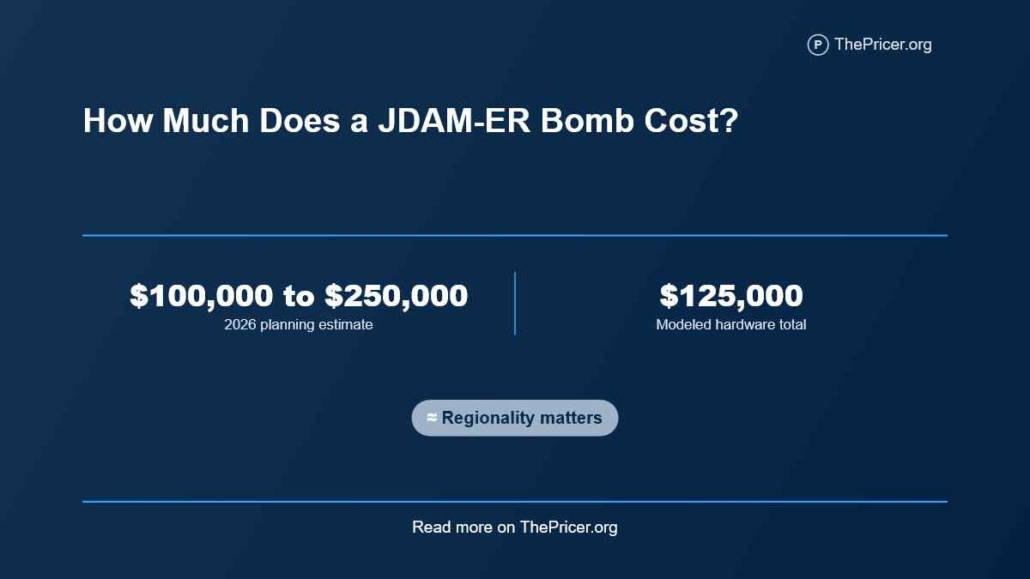
No public 2026 contract gives one clean factory price for a complete JDAM-ER. Current procurement evidence supports a hardware-focused estimate near $100,000 to $150,000 per weapon, with broader export-package allocations reaching roughly $244,000 to $500,000 per weapon-equivalent.
The distinction matters because government records may price the tail kit, wing assembly, complete weapon, or an export package containing years of support. Package math is not unit price.
How Much Does a JDAM-ER Bomb Cost?
Jump to sections
A defensible 2026 estimate is about $100,000 to $250,000 (at $30 per hour, earning that amount would take about 1.6 to 4 years of full-time work, before taxes) per JDAM-ER depending on what is included. Ukraine’s 2026 JDAM-ER package reached $373.6 million for 1,532 requested kits plus support, while Saudi Arabia’s newly approved JDAM-ER package carries a ceiling near $5 billion.
Important numbers
- Current U.S. standard JDAM procurement works out near the low $80,000s per kit.
- A hardware-focused JDAM-ER model lands near $100,000 to $150,000.
- Ukraine’s complete 2026 package allocates roughly $243,900 per requested kit-equivalent.
- The Saudi export package approaches $500,000 per weapon-equivalent when its full ceiling is divided by the reported guided-weapon quantity.
What a JDAM-ER price represents
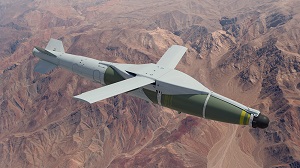
JDAM-ER is not one self-contained bomb design with one permanently attached price. Boeing describes the system as a modular extended-range wing kit that can be fitted to an existing JDAM Mk 82 weapon, using the normal JDAM aircraft interface and allowing the wing kit to be installed or removed in the field on compatible weapons in its JDAM-ER product card.
The bomb body matters. So do the KMU guidance tail, GPS and inertial navigation hardware, fuze, deployable wings, and integration equipment. Public documents can quote any one of these pieces or bundle several together. Foreign Military Sales cases can add spare parts, repair support, software, engineering, transportation, and technical services. A meaningful unit figure must identify which of those layers the published number contains.
Worked cost model
The best starting point for a hardware model is current U.S. JDAM procurement. The FY2026 weapons budget assigns $187.5 million (about 3 thousand years of full-time work at $30 per hour) to 2,298 JDAM kits in the Defense Department weapon budget. Dividing those figures produces about $81,593 per standard kit. JDAM-ER then adds wing hardware and related integration that the public budget does not break into a clean per-unit line.
- Current standard JDAM allocation, about $81,600
- Modeled ER wing and related hardware allowance, about $43,400
- Modeled JDAM-ER hardware total, about $125,000
The arithmetic is $81,600 + $43,400 = $125,000. The second component is an analytical allowance, not a disclosed Boeing wing-kit invoice. The result is useful as a midpoint inside a hardware-focused $100,000 to $150,000 band, but it excludes export support, transportation, training, spares, and program services.
Standard JDAM procurement
Standard JDAM procurement gives the cleanest modern floor because the government publishes both quantity and funding. Across the Air Force and Navy, 2,298 FY2026 kits receive $187.5 million (about 3 thousand years of full-time work at $30 per hour), producing the roughly $81,593 blended allocation above. That number is far more useful for a 2026 estimate than decades-old JDAM prices that still circulate online.
The service mix also shows that one budget average is not a factory sticker. Air Force procurement is 1,500 kits for $126.4 million, or about $84,267 each, while the Navy allocation is 798 kits for $61.1 million, or about $76,566 each. Those arithmetic results describe standard JDAM procurement allocations rather than complete extended-range bombs. Readers comparing this class with purpose-built glide weapons can see a similar contract-versus-unit distinction in current glide bomb pricing.
Models and configurations
JDAM-ER configurations differ with bomb size and guidance hardware. Ukraine’s 2026 case includes KMU-572 kits associated with 500-pound Mk 82 class weapons and KMU-556 kits associated with heavier 2,000-pound weapons. The basic JDAM family also supports several bomb bodies, which means explosive body, guidance tail, fuze, and extended-range hardware do not have to be identical from one delivered weapon to another.
The ER wing is a separate value-bearing component. Boeing says Ferra Engineering is its global supplier for 500-pound JDAM-ER wing kits and extended the production partnership through 2028 in the Boeing-Ferra production agreement. Federal contract data also shows the STOKER 3.0 JDAM Extended Range wing-kit delivery order at roughly $248 million in current obligations on the federal award record. The public record does not expose a reliable delivered quantity for dividing that award into a clean wing price.
U.S. procurement vs Ukraine export
The Ukraine sale shows how dramatically the accounting boundary can change the apparent unit figure. The 2026 notification covers 1,200 KMU-572 tail kits and 332 KMU-556 tail kits, giving 1,532 requested kits. Its estimated Major Defense Equipment portion is $93.6 million, while the complete notified package is $373.6 million, according to the Federal Register sale notice.
Dividing the MDE subtotal by 1,532 gives about $61,097 per requested kit-equivalent. Dividing the complete package by the same quantity gives about $243,864. Neither number is a complete factory price. The first leaves out most support elements, while the second assigns every support dollar to the requested tail-kit count. The wide gap is exactly why an export-package headline should not be substituted for the price of the weapon itself.
Support, spares, software
The largest gap between a hardware estimate and a Foreign Military Sales allocation comes from everything bought around the weapon. Ukraine’s package includes FMU-139 fuze systems, JDAM support equipment, spare and repair parts, consumables, repair-and-return support, weapons software, publications, technical documentation, transportation support, studies, surveys, and U.S. government and contractor engineering, technical, and logistics services, according to the May 2026 sale report.
A country buying a precision weapon for the first time may need more of this surrounding support than a U.S. service drawing another production lot into an established inventory, which makes dividing a complete export ceiling by the weapon quantity a useful budget comparison but a poor substitute for the undisclosed manufacturing price of a guidance kit, wing set, fuze, bomb body, or assembled round. The same accounting issue appears with heavier weapons covered in bunker-buster bomb pricing.
Support can be expensive. It is also mission-specific, so one country’s package should not be assumed to match another country’s support burden.
Three JDAM-ER cost cases
U.S. procurement case. The current standard JDAM allocation sits near $81,600 per kit. This is the lower modern anchor and excludes a separately identifiable ER wing price. It is useful for showing where the core guidance hardware begins before extended-range equipment enters the calculation.
Ukraine package case. Aviation Week describes the May 2026 approval as up to 1,532 extended-range precision weapons for $373.6 million in its Ukraine JDAM sale report. Full-package division gives roughly $243,900 per requested weapon-equivalent, with support embedded in the result.
Saudi package case. The newest large export case moves much higher. Breaking Defense reports just over 10,000 JDAM-ER kits, a similar quantity of conventional bomb bodies, and associated equipment in a package valued at $5 billion on the September 2026 Saudi sale report. That is a national weapons package, not a bare kit purchase.
$500,000 per weapon
 The Saudi case provides the highest current public allocation in this research. Aviation Week reports 10,004 precision-guided bombs in the proposed sale, including 5,004 500-pound JDAM-ER weapons, in its September 4 quantity report. Assigning the complete $5 billion ceiling across 10,004 guided weapons produces about $499,800 per weapon-equivalent.
That arithmetic should not be called Boeing’s JDAM-ER unit price. The proposal also contains large numbers of bomb bodies and associated equipment, so the sale funds more than guidance and wing hardware. The calculation is valuable because it measures how much a government may authorize per fielded weapon position after wider acquisition needs are folded into the case. It is much less useful for estimating what one additional JDAM-ER costs to manufacture on an established production line.
Which JDAM-ER number is the defensible benchmark
A reader asking for the price of the physical weapon should use about $100,000 to $150,000 as a hardware-focused research model, not as a disclosed contract quote. A broader $100,000 to $250,000 planning range captures the difference between a modeled U.S.-style weapon value and the much higher allocation visible in Ukraine’s supported export procurement. Full national packages can move toward $500,000 per weapon-equivalent without proving that the bomb itself costs that amount.
Makes sense if
- You identify whether the figure covers a kit, weapon, or national package.
- You label modeled hardware numbers as estimates.
- You keep support and logistics visible in export arithmetic.
- You attach the procurement year and customer to each figure.
Doesn’t make sense if
- You call a full export ceiling the factory price.
- You divide an ER wing contract by an assumed quantity.
- You use decades-old kit prices as current figures.
- You combine bomb and support costs twice.
What we verified
- Checked Boeing’s 2026 supplier update, which confirms multiple JDAM Extended Range wing-kit export contracts with Ferra Engineering.
- Confirmed Boeing’s current precision-munitions portfolio still lists JDAM-ER as an active product.
- Cross-referenced current U.S., Ukrainian, and Saudi procurement evidence before separating hardware estimates from package allocations.
Answers to Common Questions
How much does one JDAM-ER cost?
A useful 2026 planning estimate is about $100,000 to $250,000, with the lower portion representing hardware-focused modeling and the upper portion reflecting supported export-package evidence.
Why is the Saudi JDAM-ER figure much higher?
The Saudi approval includes thousands of guided weapons, bomb bodies, associated equipment, and program support. Dividing the full package ceiling by weapon quantity assigns those extra costs to each weapon-equivalent.
Is JDAM-ER the same as a normal JDAM?
No. JDAM-ER adds extended-range wing hardware to the JDAM concept, increasing stand-off range while retaining compatible guidance and bomb-body architecture.
Does the quoted JDAM-ER price include the bomb body?
It depends on the source. Some records cover guidance or wing kits, while export packages can include bomb bodies, fuzes, support equipment, spares, software, transportation, and technical services.
Disclosure: Educational content, not financial advice. Prices reflect public information as of the dates cited and can change. Confirm current rates, fees, taxes, and terms with official sources before purchasing. See our methodology and corrections policy.