
How Much Does a Kickboxing Gym Membership Cost?
Published on | Written by Alec Pow
This article was researched using 14 sources. See our methodology and corrections policy.
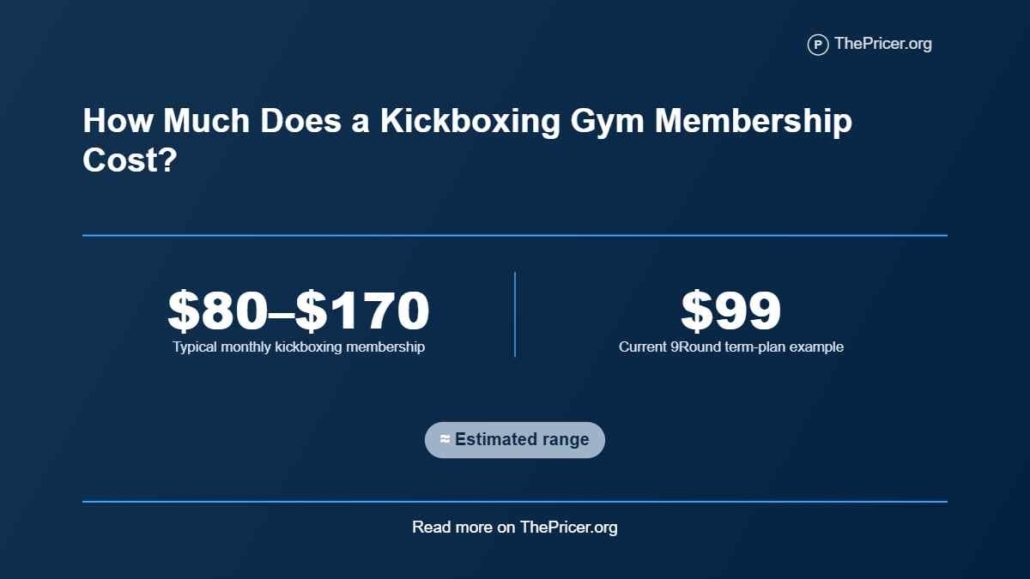
Kickboxing gym memberships in the United States commonly land around $80 to $170 per month in published pricing guides, though individual gyms can sit outside that band. MMA Gym Finder’s May 2026 training guide lists kickboxing at $80 to $160 per month. Lessons.com lists monthly kickboxing classes at $120 to $170.
Those figures work as a starting budget, not a universal rate. The bill changes with training format, city, class limits, commitment length, and whether the membership covers only kickboxing or several combat-sport programs. Current provider prices checked in September 2026 show why comparing the access attached to each fee matters as much as comparing the fee itself.
Article Highlights
Jump to sections
- Published U.S. kickboxing benchmarks run about $80 to $170 (at $30 per hour, earning that amount would take about 2.7 to 5.7 hours of work, before taxes) per month.
- Current direct gym examples range from a $99 per month term plan to flexible plans above $200 per month.
- A four-location 9Round sample has an $80 monthly spread, equal to $960 across 12 months.
- At one gym, six drop-ins cost $180, which exceeds its $160 unlimited monthly plan.
- Commitment savings can be offset by early-exit charges, so the contract matters alongside the advertised dues.
Current Kickboxing Prices
Live provider pages show a wider set of structures than a single national range can capture. Classic Kickboxing in Pasadena lists a current group pricing menu with a $30 (about 1 hour of work at $30 per hour) single class, $240 for 10 group classes, a $250 one-month membership, $195 per month on a three-month plan, and $179 per month on a six-month plan. The shorter commitment carries the highest recurring rate.
| Gym and access | Published price | What the price covers |
|---|---|---|
| TAEJO Kickboxing | $225 per month, $200 per month, or $175 per month | Membership and cancellation terms covering unlimited kickboxing on month-to-month, six-month, or 12-month plans, with a $300 early-cancellation fee on commitment plans |
| Reno City Kickboxing | $130 per month standard or $110 per month for listed eligible groups | Unlimited monthly membership, with a separate $30 drop-in |
| Core Cardio Kickboxing Club | $160 per month unlimited or $125 per month for eight classes | Monthly kickboxing packages, plus a $30 drop-in and $225 10-class package |
The table is a set of current advertised examples, not a national average. It also shows why the membership label needs a scope check. Reno publishes an eligibility-based discount, Core separates limited and unlimited attendance, and TAEJO changes the monthly rate according to commitment length. A member paying less may be accepting fewer classes, a longer term, or an eligibility condition rather than receiving the same product at a random discount.
What a Membership Buys
A kickboxing membership can describe several different products. A technical gym may teach stance, footwork, combinations, defense, pad work, partner drills, and controlled sparring progression. A kickboxing-fitness studio may use punches and kicks inside a coached conditioning circuit without contact between members. A multi-discipline gym can bundle kickboxing with boxing, Muay Thai, strength work, or other martial arts. Those formats should not be treated as interchangeable simply because each uses the word kickboxing.
Access rules also change the value of the monthly fee. One plan may allow unlimited scheduled classes, while another caps attendance or sells a fixed class package with an expiration window. Some facilities add open-gym access, trainer guidance, equipment areas, or several class types.
Readers comparing technical striking with hand-only instruction can also check current boxing lesson costs. A broader school comparison is available in current martial arts class pricing. The useful unit is not only dollars per month. It is dollars for the kind of coached access the member will actually use. Schedule density matters too, because a technically rich program has little value to a member who cannot attend its available class times.
The Price of a Contract
Commitment can cut the recurring rate by a meaningful amount. TAEJO’s published menu charges $225 (about 7.5 hours of work at $30 per hour) per month month-to-month, $200 per month for a six-month commitment, and $175 per month for a 12-month commitment. Using those already cited rates, the annual plan is $50 per month below the flexible plan. Across 12 months, that difference is $600, which matches the gym’s stated annual saving.
The same membership page states a $300 fee for canceling a six-month or 12-month commitment before the term ends. That changes the decision. ThePricer’s calculation divides the $300 exit charge by the $50 monthly discount, producing a six-month threshold. After six months, accumulated monthly savings equal $300. Before that point, paying the early-exit fee can erase the financial advantage of the lower rate. Renewal terms matter too. A low advertised monthly figure has less value when the member expects a move, schedule change, or uncertain training routine before the commitment is complete.
How Much Location Changes Dues
Location can move the price even inside one franchise and one training format. The Fort Myers membership page lists unlimited workouts at $99 per month for a six-month term and $119 per month month-to-month, with trainer guidance and gear sold separately. The comparable Temple flexible plan is $129 per month, the Miami flexible plan is $145 per month, and the Mt. View flexible plan is $199 per month. Temple also marks gear as a separate purchase.
Across these four current 9Round locations, the high-to-low difference is $80 per month. Multiplying $80 by 12 gives a $960 annual spread before gear or other local charges. The Mt. View rate is about 67 percent above Fort Myers, calculated as $80 divided by $119.
This is a four-location comparison, not a U.S. 9Round average. Its value is narrower and more useful. A national brand name does not make local dues uniform, so a shopper should check the exact studio rather than carry a price from another city into the budget. Term length can vary by location as well, which makes local plan structure part of the price comparison.
Class Packs or Unlimited
 People who train irregularly can pay less with a limited package, but the break-even point can arrive quickly. Core Cardio Kickboxing Club publishes a $160 unlimited monthly plan, a $125 plan capped at eight classes, a $30 drop-in, and a $225 10-class package that must be used within 60 days. All four rates came from the pricing page cited earlier, so the attendance math can be compared on one gym’s own menu.
Five drop-ins cost $150, while six cost $180. That puts the drop-in versus unlimited crossover between the fifth and sixth visit in one month. The eight-class plan is even cheaper for someone who can stay within its cap. Using all eight classes produces an effective rate of about $15.63 per class, and moving from that plan to unlimited costs another $35 per month. The 10-class package works out to $22.50 per used class when every session is taken before expiration. Attendance is the deciding variable. A cheap unlimited plan wastes money when it sits unused, while an active member can make a higher monthly sticker price cheaper per visit.
Costs Beyond Monthly Dues
Personal training gear can sit outside monthly dues, so a starter budget should treat it separately unless the local membership terms say otherwise. Technical gyms may also have their own glove, wrap, shin-guard, or protective-equipment rules. For a reproducible starter example, Venum currently lists Contender boxing gloves at $49.99 and Kontact hand wraps at $13.99 on the same retail page. That pair adds $63.98 before tax or shipping. It is a retail benchmark, not a required bundle at every gym.
Contract charges can be larger than starter gear. The contract calculation above shows how an early-exit charge can consume months of term savings. Other policies can affect timing rather than adding a named one-time charge.
A cancellation notice window may allow another scheduled payment to process, and a membership pause can have its own fee. Ask for the written agreement before paying, then check billing date, term length, renewal, freeze rules, package expiration, and which gear the gym expects you to own. Those items decide the first-year cash outlay more accurately than the monthly dues alone. They also help separate a true membership charge from optional spending that can be postponed or purchased elsewhere.
Three Realistic Budgets
A flexible fitness member at 9Round Fort Myers can use the published $119 per month month-to-month plan as a simple recurring budget. Twelve unchanged payments would total $1,428. A technical kickboxing member using TAEJO’s flexible rate would spend $2,700 across 12 unchanged monthly payments at $225. These are arithmetic scenarios based on published rates, not promises that the prices will remain unchanged for a full year.
A third scenario shows the cash effect of prepaying. 9Round Temple lists a 12-month term at $109 per month and a 12-month paid-in-full option at $1,090. Twelve monthly term payments equal $1,308, so paying in full saves $218, about 16.7 percent against that term-billing total. Add the illustrative Venum gloves at $49.99 and wraps at $13.99, and the first-year subtotal becomes $1,153.98. Taxes, shipping, replacement gear, and any unlisted local charges are excluded.
- 12-month paid-in-full Temple membership, $1,090
- Illustrative gloves, $49.99
- Illustrative hand wraps, $13.99
- Calculated first-year subtotal, $1,153.98
The prepaid case saves money only if the member can use the term. Someone comparing coached fitness studios can also check TITLE Boxing Club pricing or current Rumble Boxing costs. Those alternatives have different formats, so the comparison should focus on coaching style, usable class access, and total commitment rather than the monthly number alone.
Matching a Plan to Your Training
The strongest purchase decision starts with realistic attendance. If a gym charges $30 per drop-in and $160 for unlimited access, the member needs roughly six visits in a month before the unlimited price beats repeated drop-ins. A capped plan can still win at moderate attendance. A long contract can cut monthly dues, but the TAEJO calculation shows how an exit charge can consume months of savings. The cheapest advertised rate is not automatically the lowest-risk choice.
Training format belongs in the same decision. Someone seeking technical kickboxing should check partner drills, defensive instruction, sparring eligibility, class progression, and coach access. Someone seeking a short coached workout may care more about schedule convenience and the number of sessions available each week. Compare the exact membership agreement at the local gym, not a franchise-wide marketing statement.
Makes sense if
- You expect to attend enough classes for the recurring plan to beat drop-ins.
- The membership covers the technical or fitness format you want.
- The term discount is worth the commitment you can realistically keep.
- The class schedule works with the hours you can train.
Does not make sense if
- You expect fewer visits than the cheaper class-pack threshold.
- You may move or change schedules before a fixed term ends.
- You are comparing cardio circuits with technical sport training as identical products.
- You would use a cheaper general gym just as often for the workout you want.
Takeaways
- Use $80 to $170 per month as a published U.S. benchmark, then verify the local gym.
- Compare access scope before comparing dues.
- Run the attendance math for drop-ins, capped plans, and unlimited access.
- Price the full term, not only the monthly discount.
- Add gear and any written cancellation or pause charges to the first-year budget.
- Read the local agreement before prepaying a long term.
Answers to Common Questions
How much is a kickboxing gym membership per month?
Published U.S. guides place kickboxing around $80 to $170 per month. Current individual gyms can fall below or above that range based on city, commitment, class limits, and training scope.
Is unlimited kickboxing cheaper than paying per class?
It can be. At the Core rates used above, five $30 drop-ins cost $150, while six cost $180. Its unlimited plan is $160 per month, so the crossover comes between the fifth and sixth visit.
Do kickboxing memberships include gloves?
Not always. The Fort Myers and Temple 9Round plans reviewed above mark gear as a separate purchase. A gym may loan, sell, bundle, or require different equipment, so ask what is included before buying gear elsewhere.
Can a long kickboxing contract save money?
Yes, when the term is completed. TAEJO’s cited rates put its 12-month plan $50 per month below month-to-month, but its published $300 early-cancellation fee equals six months of that saving.
Disclosure: Educational content, not medical advice. Pricing varies by provider, location, and insurance. Confirm eligibility, coverage, and out-of-pocket costs with a licensed clinician and your insurer. See our methodology and corrections policy.