
How Much Does a Kitten Cost in the First Year?
Published on | Written by Alec Pow
This article was researched using 14 sources. See our methodology and corrections policy.
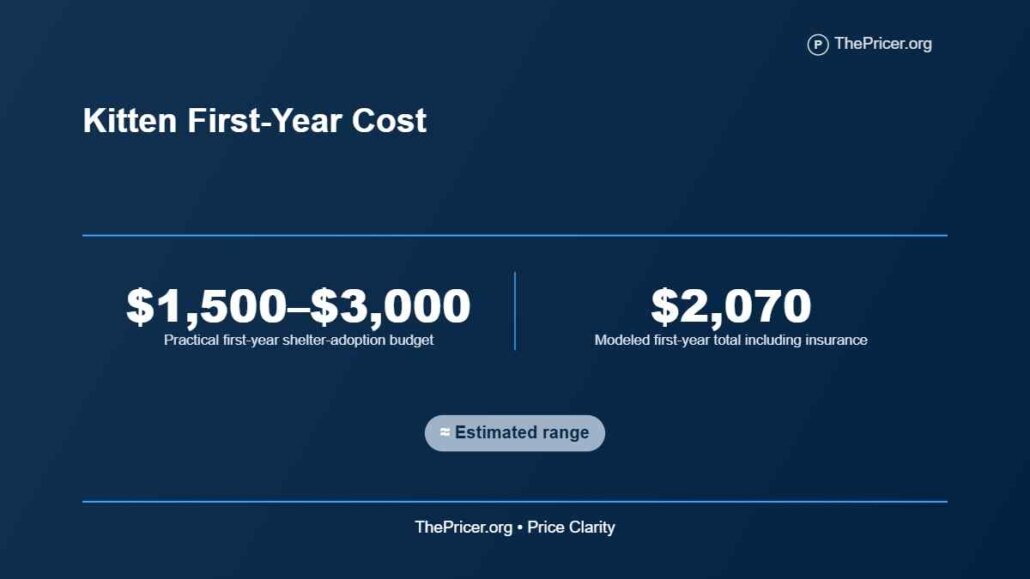
A kitten’s first year can cost about $1,500 to $3,000 in a practical U.S. shelter-adoption budget, before major illness, paid travel care, or housing charges. This is a planning estimate, not a national spending average. The itemized scenario below totals $2,070 with insurance, using a documented adoption fee and labeled care allowances.
The budget covers the first 12 months after bringing a kitten home, rather than only the months before its first birthday. It combines acquisition, supplies, food, litter, remaining veterinary care, and optional insurance.
Buying from a breeder can raise the total sharply. The key is to subtract care already included in the handoff package, then add only what you still need to buy. Cash held for emergencies remains separate from money actually spent.
Article Highlights
Jump to sections
- The worked shelter-adoption scenario totals $2,070, including a chosen insurance allowance.
- Two documented shelter kitten fees are $150 and $200, with substantial veterinary care included.
- A refundable $150 surgery deposit can raise pickup-day cash without raising the eventual adoption expense.
- A documented $3,500 breeder kitten produces a different first-year budget.
- Check vaccine records before budgeting for a complete new series.
- Keep an emergency reserve separate from the routine spending total.
How Much Does a Kitten Cost in the First Year?
This illustrative scenario uses Dane County Humane Society’s published kitten adoption package at $150, excluding tax. The fee includes sterilization, microchipping, age-appropriate FVRCP and rabies vaccination, parasite treatment, and veterinary care as needed. It does not promise that every future vaccine or examination is already covered.
All other entries are selected planning allowances, supported by the price references discussed in the following sections. The medical allowance covers remaining examinations, vaccines, and tests, with parasite prevention listed separately. Surgery and a new microchip are omitted because this adoption package already includes them.
| Expense | Selected allowance | Scope |
|---|---|---|
| Adoption | $150 | Documented shelter fee before tax |
| Startup equipment | $200 | Basic home supplies |
| Food | $450 | Chosen 12-month allowance |
| Litter | $240 | Chosen 12-month allowance |
| Remaining veterinary care | $350 | Exams, vaccines, and tests still due |
| Parasite prevention | $200 | Chosen annual allowance |
| Optional insurance | $480 | Assumed $40 monthly premium |
| First-year total | $2,070 | Excludes emergencies, tax, travel, and housing charges |
The calculation is $150 + $200 + $450 + $240 + $350 + $200 + $480 = $2,070. Without the optional insurance premium, the same routine-care scenario totals $1,590. Removing insurance changes who carries unexpected medical risk. It does not remove that risk or create a fund to pay an emergency clinic.
Replace each allowance with your own quote before committing. A kitten arriving with fewer completed vaccinations may need more medical spending, while a household with usable equipment may need less setup money.
Adoption Fees Versus Breeder Prices
The handoff price buys different things at different organizations. Humane Society of Westchester lists a $200 kitten donation with medical care and starter supplies, including sterilization, FIV and leukemia testing, age-appropriate vaccinations, deworming, registered microchipping, food, a carrier, and a follow-up veterinary exam. Compare those inclusions before treating its fee as more expensive than another shelter’s.
For kittens too young for surgery, Westchester also requires a refundable $150 deposit. The advertised adoption expense remains $200 if the deposit is returned, but pickup requires $200 + $150 = $350. Refunds arrive by mailed check after the return surgery appointment. That temporary cash requirement matters when the same paycheck must buy supplies.
A separate advertised breeder case is Posh Raggies in New Jersey, where listed Ragdoll kittens cost $3,500. The package includes sterilization, registered microchipping, age-appropriate vaccines, a carrier, and starter supplies. Its $500 reservation deposit applies to the price, so adding it again would overstate acquisition by $500.
These are specific offers, not a national breeder range. Breed selection changes the purchase budget before any recurring expenses begin. The Russian Blue kitten cost article gives another breed-specific comparison, including differences between breeder packages and care left to the buyer.
Veterinary Care
An adoption record can reduce the remaining bill, but “vaccinated” does not mean every kitten appointment is finished. UC Davis describes repeated kitten vaccine appointments from roughly six to eight weeks of age through at least 16 weeks, followed by a later booster. The veterinarian should build the remaining schedule from the actual record and the kitten’s circumstances.
For a budgeting reference, Daily Paws lists $200 to $500 for veterinary exams and vaccinations in its April 2026 kitten-cost article. The worked budget selects $350 within that band. This allowance is not a clinic quote and may be too low if numerous tests or sick visits become necessary.
Ask the clinic to separate examinations, vaccine doses, laboratory tests, and medication. A vaccine-only appointment and a full new-patient examination have different scopes. Written itemization also reveals whether parasite medication is included, preventing duplication with the annual prevention allowance.
The handoff age affects timing as much as total price. A younger kitten may require several appointments soon after adoption, concentrating costs early. An older kitten with complete records may shift more spending toward later preventive visits. Budget from the next unpaid appointment onward, rather than automatically buying another complete starter package.
Food and Litter
Petco’s June 2026 guide lists $351 to $584 for first-year food, $50 to $150 per wellness examination, and $100 to $200 annually for food and preventive care budgets. Those are published estimates rather than guaranteed store or clinic prices. They support the selected food and prevention allowances, while local quotes should replace them.
Rover’s 2026 research gives a wider $320 to $1,870 annual food-and-treats band and $125 to $580 for litter. It also lists $22 to $44 for drop-in care and $35 to $70 for boarding or house sitting in its cat ownership cost research. Different diet choices and paid services explain why ownership budgets extend beyond a modest food estimate.
Using the narrower cited food band and Rover’s litter band, those two categories alone combine to $476 to $1,164 annually. Hold the worked budget’s other inputs fixed at $1,380, and the calculated total becomes $1,856 to $2,544. That is a sensitivity test, not an observed spending distribution.
The result shows how much the same adoption can cost under different consumable allowances. Compare the intended feeding plan and litter replacement quantity before pickup. A bag’s purchase price is useful only after accounting for how long that bag lasts in your household.
Startup Gear
 Great Pet Care publishes a $169 to $698 kitten-supplies estimate in its first-year supplies cost discussion, reviewed in March 2026. The article draws several budget figures from older research, so this band is a rough reference rather than a current shopping basket. The worked scenario chooses a restrained $200 equipment allowance.
Use that allowance for the items actually missing at home, such as a carrier, bowls, litter equipment, scratching surfaces, toys, and grooming tools. It is a basket budget, not a promise that a particular retailer sells the entire set at that price. Shopping receipts or a saved cart provide the better final figure.
Starter packages can change the basket. Westchester includes a carrier, and the documented Ragdoll package includes one plus several other supplies. Subtract usable included items before purchasing replacements. A food sample reduces the first shopping trip, but it should not be mistaken for a year’s food supply.
Equipment also creates a choice between initial setup and later upgrades. Buying an elaborate cat tree immediately uses money that might otherwise cover scheduled medical care. Set a separate optional-upgrade limit, then test the first-year total with that amount added. This keeps convenience purchases visible rather than burying them inside food or veterinary allowances.
The Hidden Price of a Free Kitten
A kitten transferred without a fee can still have unpaid medical work. The Humane Society of Sonoma County’s July 2026 surgical prices are $100 for cat neutering and $150 for spaying. These appointment-only services are intended for low- to moderate-income families and include the examination, surgery, postoperative pain medication, microchip, nail trim, and recovery collar. The same schedule lists rabies and FVRCP vaccination at $15 each, an FeLV/FIV test at $30, and an FeLV vaccine at $20. For a qualifying owner selecting those four additions at surgery, the extras total $80. The calculated appointment subtotal is $180 for a male or $230 for a female, before any other needed services.
This is not a complete first-year vaccine course. It illustrates how an acquisition fee of $0 can be followed by an immediate medical bill. Availability, eligibility, remaining doses, and follow-up care must be checked before adopting this clinic’s prices as your budget.
The clinic example also shows why a separate microchip charge should not be added to every surgery estimate. Here it is included. The cat spay and neuter cost article explains broader clinic differences. Compare completed services and remaining obligations, rather than assuming a free transfer must beat a shelter package on total cost.
Insurance and Emergency Cash
The worked budget assumes $40 monthly insurance, or $480 annually. That is a chosen allowance, not a personalized quote. For historical context, NAPHIA’s April 2025 release reported an average U.S. cat accident-and-illness premium of $386.47 annually for 2024 in its cat insurance premium data. That older figure should not be presented as a current kitten quote.
Coverage scope matters more than the premium alone. ASPCA Pet Health Insurance says its routine preventive coverage costs extra and reimburses specified services up to set amounts. Do not subtract vaccines or sterilization from a routine-care budget merely because you purchased accident-and-illness insurance. Check the policy’s exclusions, deductible, reimbursement, and limits before calculating a potential payout.
Keep cash accessible. A chosen $1,000 emergency reserve would raise the worked scenario’s funding target from $2,070 to $3,070, but it would not raise spending unless used. The reserve is a household planning choice, not an estimate that every emergency can be treated for that amount.
Premiums are spent. Reserves remain yours until used. Keeping them separate makes the budget easier to compare with published ownership totals. The pet insurance cost article explains how policy design changes the owner’s share of a covered bill.
Choosing a Budget You Can Maintain
The shelter model, free-transfer clinic example, and breeder listing represent three different starting points. To test the breeder case, replace the model’s $150 adoption input with the documented $3,500 Ragdoll price. Holding other allowances unchanged produces $5,420. Treat this as a provisional scenario before subtracting usable starter equipment and adjusting remaining medical care to the breeder’s records.
Travel care creates a separate sensitivity. Seven chosen nights at the cited $35 to $70 nightly rate add $245 to $490, taking the shelter scenario to $2,315 to $2,560. These are conditional calculations, not invoices. Confirm what a booking includes before applying a nightly rate to your trip.
After the first year, acquisition and much setup spending disappear, but food, litter, preventive care, and any insurance continue. A lower second-year total should come from removing completed one-time expenses, not from assuming veterinary needs vanish. Build the decision around the recurring commitment and the early cash demands together.
Makes sense if
- You can fund the remaining care shown by the medical records.
- Your monthly budget can support consumables and planned preventive care.
- You can keep emergency money separate from the acquisition payment.
Does not make sense if
- The purchase fee consumes money needed for food or appointments.
- Your plan relies on every included vaccine being the final dose.
- You can afford the kitten only by ignoring housing or travel costs.
Answers to Common Questions
How much should I budget for a kitten’s first year?
A practical shelter-adoption planning band is about $1,500 to $3,000 before major illness, housing charges, and paid travel care. The worked scenario totals $2,070 with optional insurance. Replace its assumptions with your own quotes.
Is a free kitten cheaper than adopting?
It can be, but unpaid surgery, vaccines, testing, and supplies may remove the initial saving. Compare the remaining obligations with what the shelter fee already includes.
Does insurance pay for kitten vaccines?
Do not assume it does. The cited insurer treats preventive coverage as an extra option with specified reimbursement amounts. Check your selected policy before reducing the vaccine budget.
Should emergency savings count as first-year spending?
No. A reserve increases the money you need available, but it becomes an expense only when used. Keep it separate so your ownership total does not count unspent savings as a veterinary bill.
Disclosure: Educational content, not medical advice. Pricing varies by provider, location, and insurance. Confirm eligibility, coverage, and out-of-pocket costs with a licensed clinician and your insurer. See our methodology and corrections policy.