
How Much Does A Knee Replacement Cost?
Updated on | Written by Alec Pow
This article was researched using 14 sources. See our methodology and corrections policy.
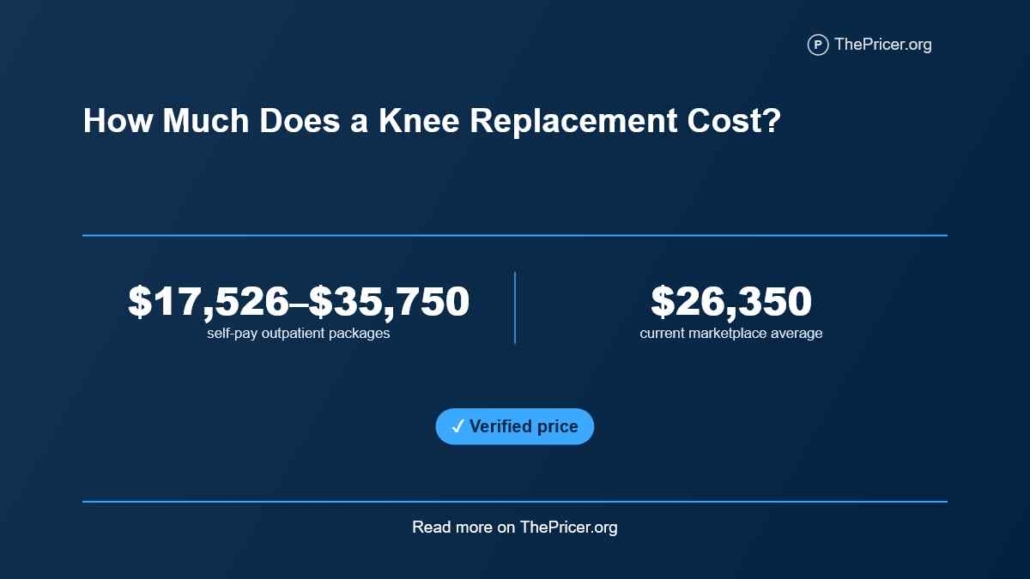
A knee replacement can cost $17,526 to $35,750 for a current U.S. self-pay outpatient package, with a marketplace average near $26,350. The published outpatient knee prices come from MDsave and describe bundled cash offers rather than hospital sticker charges.
An insured patient may owe much less than the package price, and Medicare uses a separate payment system. The amount also changes with total versus partial replacement, surgical setting, included therapy, implant and anesthesia bundling, and whether later revision surgery is needed.
The safest comparison is the price for the same procedure with the same included services. Adding an implant price, surgeon fee, facility fee, and therapy cost on top of an already bundled surgical quote can count the same expense twice.
Article Highlights
Jump to sections
- Current self-pay outpatient total knee replacement packages run about $17,526 to $35,750 (at $30 per hour, earning that amount would take about 3.4 to 6.9 months of full-time work, before taxes).
- The current MDsave marketplace average for outpatient total replacement is about $26,350.
- Partial outpatient replacement currently runs about $16,847 to $31,307 on the same marketplace.
- Medicare’s 2026 approved total for outpatient total knee arthroplasty is $10,552 at an ambulatory surgical center and $14,275 at a hospital outpatient department.
- A hospital outpatient Medicare case can have a higher approved total yet a slightly lower displayed patient share than the ASC case.
- Registry evidence indicates that many total knee replacements last far longer than the old 10-to-15-year replacement assumption.
How Much Does a Knee Replacement Cost?
Self-pay pricing is easier to compare when the package scope is published. One current Twin Cities Orthopedics offer lists an outpatient total knee replacement at $26,675 (about 5.1 months of full-time work at $30 per hour). Its published surgical bundle includes the surgeon and physician assistant, ambulatory surgery center and implant, anesthesia, a care suite when applicable, medications, meals, nursing care, laboratory work, walking equipment, therapy, and postoperative visits during the stated package period. The initial evaluation is excluded.
| Price benchmark | Published amount | What the figure represents |
|---|---|---|
| Outpatient total knee replacement range | $17,526 to $35,750 | Current MDsave self-pay marketplace range |
| Outpatient total replacement marketplace average | $26,350 | Current MDsave national marketplace average |
| One bundled outpatient total replacement | $26,675 | Provider-specific package with implant, anesthesia, therapy, equipment, and follow-up inclusions |
The table should not be used to add separate implant, anesthesia, and therapy estimates to every package. The $26,675 bundle already contains those listed services. A quote that excludes therapy or durable medical equipment may need extra spending, while a broader package may already cover them. The hidden error in many knee-replacement estimates is double counting services that sit inside the surgical bundle.
What the Surgery Covers
Total knee replacement, also called total knee arthroplasty, removes damaged joint surfaces at the lower end of the femur and upper end of the tibia and replaces them with metal and plastic components. The kneecap surface may also be resurfaced. The American Academy of Orthopaedic Surgeons describes total knee replacement surgery as an option for severe knee damage when nonsurgical care no longer provides enough relief.
The billed episode can include the surgeon, assistant, operating facility, implant, anesthesia, recovery-room care, medications, laboratory testing, walking aids, therapy, and follow-up visits. Which of these appear inside one package varies by provider. A cash bundle can include many of them, while another hospital may bill several providers separately. That is why a low surgical quote cannot be compared with a larger all-in package until the included services are matched.
Outpatient replacement usually means discharge the same day or within 24 hours. Inpatient care involves formal hospital admission. A patient may spend a night at a hospital and still be classified as outpatient, which matters for Medicare and private insurance billing. The medical setting is chosen from the patient’s clinical needs, not from price alone.
Total vs Partial Replacement
A partial knee replacement resurfaces only the damaged compartment rather than replacing the full joint surface. Current MDsave data place partial replacement cash prices at $16,847 to $31,307 (about 3.2 to 6 months of full-time work at $30 per hour), with a marketplace average around $23,485. Compared with the current total-replacement marketplace average of $26,350, the partial-replacement average is $2,865 lower, or about 10.9% lower.
That arithmetic does not mean partial replacement is a lower-cost substitute for every patient. AAOS states that partial knee replacement candidates need disease limited to one knee compartment, and factors such as ligament damage or substantial stiffness can make the procedure unsuitable. A total replacement and a partial replacement should be compared financially only after both are medically realistic choices.
The price gap can also narrow or reverse at a particular provider. Facility contracts, implant arrangements, anesthesia, local labor costs, and package contents all affect the offer. The meaningful buyer question is not whether partial surgery is cheaper in theory. It is whether the clinically appropriate procedure has a lower complete price for the services that will actually be used. The surgical scope is different.
Medicare Costs in 2026
Medicare gives a useful matched comparison because its procedure lookup shows the same total knee arthroplasty code in two outpatient settings. For CPT 27447, the 2026 Medicare price tool lists an approved total of $10,552 at an ambulatory surgical center. That amount consists of a $1,159 doctor fee and $9,393 facility fee. The displayed average patient payment is $2,109.
At a hospital outpatient department, the same tool lists a $1,159 doctor fee and $13,116 facility fee, creating an approved total of $14,275. The approved hospital amount is $3,723 higher, or about 35.3% above the ASC figure. Yet the displayed patient payment is $1,967, which is $142 lower than the ASC payment because Medicare caps outpatient hospital copayments for this procedure.
This is a useful price warning. A lower total system payment does not always mean a lower Original Medicare copay for one procedure. Supplemental insurance or Medicare Advantage can change what the patient actually owes.
If the surgery requires formal inpatient admission, Part A rules apply instead. Medicare’s 2026 inpatient hospital costs start with a $1,736 deductible for each benefit period, followed by $0 daily hospital coinsurance for days 1 through 60. Physician services are handled separately under Part B.
Insurance and Self-Pay
Private insurance does not produce one national knee-replacement out-of-pocket price. The patient share depends on the plan’s allowed amount, remaining deductible, coinsurance, copays, network status, authorization rules, and out-of-pocket limit. For 2026 Marketplace coverage, the federal individual out-of-pocket maximum can be no higher than $10,600 for covered in-network benefits. That ceiling does not include premiums, noncovered services, out-of-network care, or amounts outside the plan’s allowed charge.
A patient with employer coverage, Medicare Advantage, Medicaid, or another type of insurance can face different rules. Ask the insurer for the expected patient responsibility for the surgeon, facility, anesthesia, implant, therapy, and durable medical equipment. Also ask whether postoperative therapy is covered under the same benefit or begins a separate series of copays or coinsurance. Plan design can shift thousands of dollars.
Self-pay patients should request a written, itemized estimate before scheduled surgery and compare it with any bundled cash offer. Ask which providers will send separate bills and whether the quote includes the implant, anesthesia, therapy, equipment, and planned follow-up. This makes the comparison more useful than relying on one headline surgical number.
The Hidden Price: Recovery
 Recovery can add costs that are absent from the surgical quote. AAOS says patients may go home the day of outpatient surgery, while hospital stays for admitted patients often last 1 to 3 days. Its postoperative recovery guidance also notes that some patients need temporary rehabilitation or skilled nursing care and that help at home may be needed for days or weeks.
Walking equipment is another possible expense, although some bundles include it. Patients may initially use a walker, crutches, or cane. Current prices for crutches and a wheelchair can help with a household recovery budget when those devices are not supplied or covered elsewhere. Home modifications, raised seating, shower equipment, transportation, parking, and temporary help with meals or household tasks can also sit outside the surgical package.
Physical therapy deserves special attention. A bundle may include therapy, while another quote may stop at the operating-room episode. Rather than assuming a fixed number of visits or one national therapy price, ask how many visits are expected for the planned recovery, where they will take place, and what the insurer or cash package pays. Lost wages and caregiver time can exceed several small medical add-ons when work leave is unpaid.
Revision and Long-Term Cost
A knee replacement should not be budgeted as though revision automatically arrives after 10 or 15 years. Long-term registry evidence summarized in PubMed found that more than 80% of total knees can remain in place at 25 years. Implant survival varies by patient, implant, surgical factors, infection, fracture, loosening, wear, and other causes, so that population result is not a lifespan guarantee for one knee.
Revision surgery is still a material financial risk. Current MDsave data place inpatient revision prices at $22,657 to $39,660, with a marketplace average near $31,021 and an estimated national benchmark of $58,305. Revision can require removal of prior components and more complex reconstruction than a first replacement, so its scope should not be compared with primary surgery on price alone.
The long-life evidence changes the budgeting logic. A 55-year-old and an 80-year-old do not face the same lifetime probability of needing another operation, even if both receive the same implant today. The useful financial plan treats revision as a possible future event rather than a scheduled replacement every decade. Age at the first operation can change that lifetime exposure.
How to Compare Quotes
Ask every provider to identify the exact procedure, setting, and package contents. The quote should say whether it includes the surgeon, assistant, implant, anesthesia, facility, laboratory work, medications, postoperative visits, walking aids, physical therapy, and any overnight or recovery-suite care. Also ask what happens if the surgeon changes the plan during the operation or the patient needs an unplanned admission.
Makes sense if
- You compare total replacement with total replacement and partial replacement with partial replacement.
- You compare packages after matching surgeon, facility, anesthesia, implant, therapy, and follow-up inclusions.
- You ask the insurer for patient responsibility using the actual provider and facility.
- You include recovery equipment and therapy only when they are not already inside the package.
Does not make sense if
- You add a separate implant estimate to a cash package that already includes the implant.
- You compare Medicare-approved amounts directly with hospital sticker prices.
- You assume an overnight hospital stay automatically means an inpatient claim.
- You treat revision surgery as a routine bill due every 10 to 15 years.
The best quote is the one that matches the actual medical plan and exposes exclusions before surgery. A lower headline number can become more expensive when important services sit outside the package, while a larger bundle can cover items that would otherwise generate separate claims.
Verification
- Checked hospital status rules because an overnight stay can still be outpatient care.
- Confirmed walking-aid recovery guidance through AAOS.
- Cross-referenced self-pay dispute protections for bills at least $400 above a qualifying estimate.
Answers to Common Questions
How much does a knee replacement cost without insurance?
Current published outpatient cash packages run about $17,526 to $35,750. The final amount depends on location and what the package includes.
How much does Medicare pay for a knee replacement?
For 2026 outpatient total knee arthroplasty, Medicare lists an approved total of $10,552 at an ambulatory surgical center and $14,275 at a hospital outpatient department. The displayed average patient payments are $2,109 and $1,967, before any supplemental coverage changes the amount owed.
Is partial knee replacement cheaper than total knee replacement?
In current MDsave outpatient listings, the partial-replacement marketplace average is about $23,485, compared with about $26,350 for total replacement. Partial replacement is limited to patients whose knee damage fits that procedure.
How long does a knee replacement last?
Large registry evidence shows that more than 80% of total knee replacements can remain in place at 25 years. Individual implant life varies, so revision should not be scheduled in a budget at a fixed 10-to-15-year interval.
Disclosure: Educational content, not medical advice. Pricing varies by provider, location, and insurance. Confirm eligibility, coverage, and out-of-pocket costs with a licensed clinician and your insurer. See our methodology and corrections policy.