
How Much Does a Major Music Tour Cost to Produce?
Published on | Written by Alec Pow
This article was researched using 6 sources. See our methodology and corrections policy.
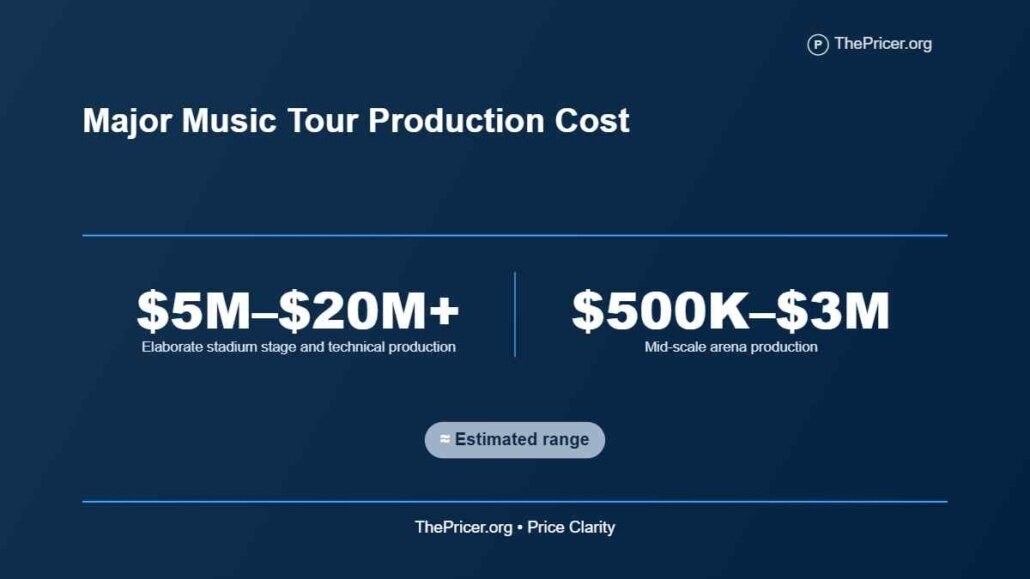
A major music tour can cost several million dollars to tens of millions of dollars to design, build, rehearse, transport, staff, and operate. A large arena tour may put roughly $500,000 to $3 million into its stage and core technical production, while an elaborate stadium-scale stage and production package can reach approximately $5 million to $20 million+.
Those figures cover only part of the financial picture. Touring crew, rehearsals, trucks, buses, freight, hotels, catering, local labor, insurance, maintenance, special effects, and repeated show-day expenses can push a long major tour into the tens of millions of dollars. The biggest superstar stadium productions can go considerably higher when they combine custom stages, large touring parties, extensive video systems, duplicate infrastructure, and months on the road.
Article Highlights
Jump to sections
- A major arena tour can require a production investment measured in millions of dollars.
- Elaborate stadium-scale staging and technical production can reach roughly $5 million to $20 million+.
- A current rental example for arena audio, lighting, LED video, and lasers totals $27,125 per show day before staging, rigging, freight, power, and labor.
- Large arena productions can travel with roughly 8 to 30 trucks, while the biggest stadium productions can use many more.
- A $10 million fixed production investment spread over 20 shows equals $500,000 per show, but over 60 shows it falls to about $166,667 per show.
- Gross ticket revenue is not the same as tour profit or production cost.
How Much Does a Major Music Tour Cost to Produce?
Scale changes both the initial production investment and the recurring road expense. Current market estimates put custom mid-scale arena staging and technical production around $500,000 to $3 million, while elaborate stadium production can reach approximately $5 million to $20 million+. These are market estimates rather than audited budgets from individual artists, but they illustrate the jump created by larger structures, video surfaces, automation, custom scenic elements, and stadium-scale engineering.
Individual rental prices also show how quickly technical components accumulate. One current nationwide touring rate card lists an arena audio package at $9,475 per show day, arena lighting at $7,650, a 90-panel LED system at $6,400, and a laser package at $3,600. Freight, staging, rigging, power, and many labor costs remain separate.
| Production component | Planning figure | What the figure represents |
|---|---|---|
| Mid-scale arena stage and technical production | $500,000 to $3 million | Market estimate for tour-level production investment |
| Large stadium production | $5 million to $20 million+ | Elaborate custom stage and technical production |
| Arena audio rental example | $9,475 per show day | Audio component only |
| Arena lighting rental example | $7,650 per show day | Lighting component only |
| 90-panel LED package example | $6,400 per show day | Video component only |
| Laser package example | $3,600 per show day | Special-effects component only |
Combining those four published technical rentals produces $27,125 per show day. Across 40 performances, straight multiplication gives $1.085 million. That is a ThePricer calculation rather than a complete arena-tour estimate. It excludes the stage itself, trucking, buses, rigging, local labor, power, backline, rehearsals, hotels, catering, insurance, touring payroll, and other production requirements.
What Tour Production Covers
Tour production begins with the physical and technical show. That can include scenic design, structural engineering, stage fabrication, decking, roof or support structures, truss, motors, rigging, audio systems, lighting fixtures, control consoles, LED screens, cameras, media servers, lasers, automation, lifts, moving platforms, special effects, backline, power distribution, communications systems, barricades, and other equipment required to reproduce the performance.
Producing the show also requires people. A major touring party can include production managers, stage managers, carpenters, riggers, lighting programmers, lighting technicians, audio engineers, video technicians, camera operators, automation technicians, backline technicians, wardrobe personnel, dancers, musicians, special-effects personnel, drivers, caterers, security staff, and support personnel. Local stagehands and riggers can supplement the traveling crew in each market.
The physical stage is therefore only one budget line. A basic platform price tells a reader little about a major concert once engineering, delivery, setup, strike, rigging, audio, lighting, video, power, and technical labor are added. ThePricer’s coverage of stage rental costs explains these distinctions at the individual-event level, while a touring production adds the challenge of repeating that process across many cities.
Building the Show
 Before trucks begin moving between arenas, a major tour can spend months designing and preparing the production. The artist and creative team develop the visual concept, while production designers and technical vendors translate it into structures, video systems, lighting positions, automation, effects, and equipment that can survive repeated assembly and dismantling. Custom fabrication is particularly expensive because the equipment has to satisfy creative requirements while remaining transportable and structurally suitable for touring.
Large productions also need rehearsals. Technical rehearsals allow lighting, audio, video, automation, cameras, special effects, musicians, dancers, and stage movements to work together before paying audiences arrive. Renting a rehearsal facility, staffing the production, operating equipment, and housing personnel creates costs before the first show generates ticket revenue.
Ambition can create a compounding effect. Current touring-industry reporting on the economics behind increasingly elaborate touring productions notes that adding production elements can also mean adding trucks, personnel, hotel rooms, meals, and other expenses. A larger video wall is not necessarily just a video expense if it requires more structure, power, technicians, and freight capacity.
Some stadium tours solve scheduling problems by duplicating major structural components. One stage system can be installed in the next city while the artist performs on another. That strategy can make aggressive routing possible, but it increases fabrication and equipment requirements. The economics are different from a small tour carrying one production package that can be loaded out after a show and installed at the next venue overnight.
Trucks, Buses, and Freight
Transportation becomes one of the defining expenses of a major tour because virtually everything visible on stage must reach the next venue on schedule. Touring trucks can carry staging, lighting, sound, video, wardrobe, instruments, backline, special effects, and support equipment. Current touring guidance places many arena productions at roughly 8 to 30 trucks, while very large stadium productions can exceed 90.
The upper end can be enormous. Reporting on Taylor Swift’s Eras Tour described approximately 90 trucks and transportation costs reaching as much as $500,000 per week. That figure concerns an exceptional superstar-scale production rather than a normal arena tour, but it demonstrates why freight can rival the original investment in stage equipment.
At that reported weekly level, 20 weeks of transportation would equal approximately $10 million. Forty weeks would equal $20 million. These are simple ThePricer calculations using the reported $500,000 weekly figure, not estimates of the Eras Tour’s complete transportation bill.
Passenger transport is separate. Artists and touring personnel may travel by sleeper buses, coaches, commercial flights, charter flights, vans, or combinations of them. Bus and truck schedules can also diverge because equipment may need to leave immediately after load-out while performers and other personnel follow another itinerary. Routing a tour inefficiently can therefore increase fuel, driver, freight, hotel, and labor costs simultaneously.
Crew and Road Costs
A touring production needs to pay its people whether a particular expense is visible to the audience or not. Current touring rate examples put some specialist technicians in roughly the $400 to $850 per day range, depending on the position and engagement. A major production can carry dozens or even hundreds of people once performers, dancers, musicians, technicians, production staff, drivers, wardrobe, catering, and other departments are counted.
Accommodation compounds the payroll expense. If 80 touring personnel require 40 hotel rooms at an assumed average of $200 per room, one hotel night costs $8,000. Thirty such nights equal $240,000. That is a modeled example rather than a national touring-hotel rate, and real tours can have different room counts, negotiated prices, destinations, and travel patterns.
Food matters at the same scale. Touring productions may provide catering at venues and per diem when personnel are traveling or feeding themselves. One $50 daily allowance for 80 people would cost $4,000 per day. Across 60 paid days, the modeled total reaches $240,000. A seemingly small per-person cost becomes significant once multiplied across a large touring party and a long schedule.
Exceptional bonuses should not be confused with normal payroll. Reporting on the Eras Tour said Taylor Swift distributed more than $50 million in bonuses to tour personnel during the U.S. run. That is useful evidence of the scale possible at the top of the industry, but it is not an appropriate payroll benchmark for a typical major tour.
More Dates Change the Math
A major production contains both fixed and recurring costs. Design, engineering, fabrication, programming, and some rehearsal expenses can be incurred before opening night. Once the tour begins, trucking, hotels, catering, local labor, equipment operation, payroll, maintenance, and other costs continue from date to date. That makes the number of performances an important part of production economics.
Suppose a tour invests $10 million in design, fabrication, technical equipment, programming, and other fixed production preparation. If it performs only 20 shows, that investment equals $500,000 per show before recurring expenses. Across 40 shows it falls to $250,000 per show. Across 60 shows it falls to approximately $166,667 per show.
This does not mean adding dates makes the tour cheaper in total. Another performance creates additional operating expenses and only works economically when expected revenue supports them. It does show why an elaborate stage is easier to justify across a long successful run than across a handful of performances. Fixed production spending is being spread over more ticketed events.
Revenue should still remain separate from cost. Beyoncé’s first five Cowboy Carter Tour performances at SoFi Stadium generated a reported $55.7 million in gross ticket sales, or about $11.14 million per show. That is box-office gross, not the amount Beyoncé spent producing each concert and not the tour’s net profit.
A 40-Date Arena Tour Model
Consider a hypothetical major artist planning 40 arena performances. Assume the production invests $2 million in initial design, fabrication, staging, programming, and related technical preparation. This is an illustrative allowance within the broader arena-production range rather than a quoted tour budget.
Next, use the previously cited audio, lighting, LED, and laser rental components totaling $27,125 per performance. Across 40 shows, those selected technical rentals equal $1.085 million. The running modeled total is now $3.085 million, before the tour has accounted for trucking, buses, crew, hotels, catering, local labor, rehearsals, insurance, maintenance, or venue-specific requirements.
Assume 15 trucks for the modeled tour and an average all-in trucking allowance of $2,000 per truck per movement across 39 moves between 40 dates. The calculation is 15 × 39 × $2,000, producing $1.17 million. This trucking rate is a scenario assumption, not a claimed national market price. Adding it brings the modeled subtotal to $4.255 million.
Now assume $1.5 million for touring crew payroll and related road labor across the run, plus $500,000 for hotels, catering, per diem, and personnel transport. These are deliberately rounded scenario allowances rather than sourced averages because crew size and travel arrangements vary dramatically. The subtotal reaches $6.255 million.
Add a 10% contingency on that subtotal for equipment replacements, schedule changes, additional freight, repairs, and other production surprises. Ten percent of $6.255 million is $625,500, bringing this illustrative 40-date arena production to about $6.88 million, or roughly $172,000 per show.
That total is not a national average and does not include every promoter-side expense. Its purpose is to show how a $2 million production concept can turn into a nearly $7 million touring operation once selected technical rentals, logistics, personnel, road costs, and contingency are added.
What Pushes Costs Higher
Stadium scale is one obvious driver. Larger scenic structures require more engineering, equipment, rigging, power, labor, and transportation. Giant LED surfaces, long runways, moving stages, lifts, automation, flying elements, lasers, flames, fireworks, water effects, and other show features can add specialized equipment and personnel. Some effects also bring permitting, safety, and venue restrictions that change from market to market.
Routing can be just as important as visual ambition. Closely spaced cities can make trucking and crew movement easier, while long jumps increase transportation demands. International touring adds air and ocean freight, customs procedures, work permits, local regulations, currency exposure, and different labor systems. Stadium availability can force routing decisions that would not be chosen solely for transportation efficiency.
Venue labor is another variable. Local union rules, minimum calls, overtime, rigging requirements, forklift needs, security, and load-in schedules can change show-day costs. An unusually complicated production may also require longer setup periods. If the show cannot be loaded in and tested within a normal window, the tour may need additional labor or venue access before the performance date.
Reliability costs money too. A major tour cannot casually cancel a sold-out arena because one essential technical component failed. Productions carry spare equipment, maintenance capability, backup systems, and technicians who can troubleshoot problems under tight deadlines. Redundancy adds expense, but it protects a much larger revenue-generating operation.
Answers to Common Questions
How much does an arena tour cost to produce?
A major arena tour can require several million dollars across stage design, technical equipment, trucking, crew, rehearsals, hotels, and other road expenses. A current market estimate puts the stage and technical production portion alone around $500,000 to $3 million for mid-scale arena work, with the full touring budget potentially much higher.
How much does a stadium concert production cost?
Elaborate stadium staging and technical production can reach roughly $5 million to $20 million+. A long stadium tour then adds recurring freight, labor, travel, maintenance, accommodation, and show-day expenses.
How many trucks does a major concert tour use?
Large arena productions can use roughly 8 to 30 trucks, depending on the show. Exceptionally large stadium productions can use many more, with some superstar tours reportedly approaching or exceeding 90 trucks.
Does the artist pay all the tour production costs?
Not necessarily. Financial responsibility depends on the touring, promoter, venue, and vendor agreements. Artist-side production, promoter expenses, venue costs, local labor, marketing, and settlement items can be allocated differently from one tour to another.
Is a tour’s box-office gross the same as its profit?
No. Gross ticket sales are revenue before production expenses, promoter and venue costs, ticketing arrangements, labor, travel, commissions, taxes, and other deductions. A tour grossing millions of dollars per night can also carry an extremely expensive production.
Disclosure: Educational content, not financial advice. Prices reflect public information as of the dates cited and can change. Confirm current rates, fees, taxes, and terms with official sources before purchasing. See our methodology and corrections policy.