
How Much Does a Military Medical Evacuation Drone Cost?
Published on | Written by Alec Pow
This article was researched using 10 sources. See our methodology and corrections policy.
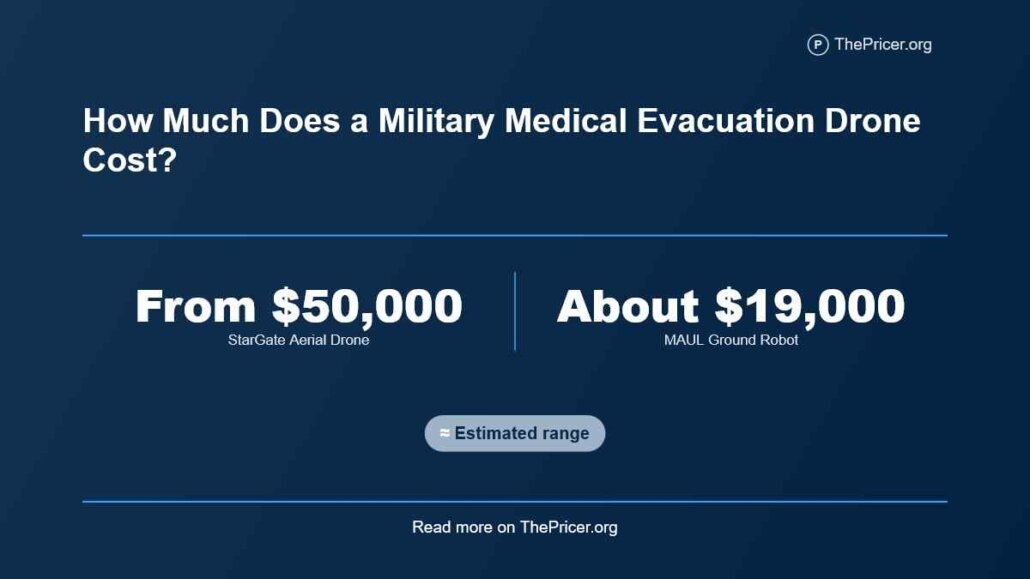
A military medical evacuation drone costs approximately $50,000 or more for a purpose-built aircraft capable of carrying a wounded soldier, based on Ukrainian manufacturer SkyFall’s October 2026 pricing for its StarGate aerial evacuation system. Ground-based casualty evacuation robots can be cheaper: Ukraine’s MAUL has reported manufacturing and configuration costs ranging from approximately $19,000 to $36,000. More extensively equipped robotic vehicles can cost considerably more.
The prices became particularly relevant after Ukraine completed a reported airborne evacuation of a wounded soldier on October 19, 2026, using an adapted heavy hexacopter. Separately, SkyFall has begun frontline evaluations of its dedicated StarGate evacuation aircraft. These are different systems: the successful rescue used a Gurzuf Defence drone supplied free for the operation, not a StarGate purchased for $50,000. The distinction matters when estimating what militaries actually spend to rescue personnel.
Article Highlights
Jump to sections
- SkyFall estimates that one StarGate aerial medevac system will cost at least $50,000, depending on configuration.
- Ukraine’s MAUL ground evacuation robot has a reported manufacturing cost starting around $19,000, with other configurations reported near $24,000–$36,000.
- StarGate is designed to lift a wounded person and equipment weighing up to 150 kilograms, with a stated one-way range of 15 kilometers.
- An October 19 rescue used a modified Gurzuf Defence heavy drone provided free for that mission; its normal selling price was not disclosed.
- StarGate includes dual communication channels, navigation features for GPS-denied conditions, and a stretcher-based medical module.
- A hypothetical five-drone StarGate fleet has a minimum aircraft-value benchmark of $250,000 before spare parts, training, and support.
How Much Do Medevac Drones Cost?
The price depends first on whether the vehicle flies or travels along the ground.
For an aircraft carrying an injured person, the strongest recent cost statement comes from SkyFall, the Ukrainian defense technology manufacturer behind StarGate.
During an exclusive Associated Press demonstration in October 2026, the company said the system would cost at least $50,000 per unit, depending on configuration.
That is a manufacturer estimate rather than a publicly documented mass-production contract price. It does, however, establish a concrete starting point for a purpose-built airborne medical evacuation drone.
For ground evacuation, the available evidence is more varied. Some Ukrainian platforms cost around $10,000, while armored casualty carriers commonly cost tens of thousands of dollars.
The different prices reflect important differences in mobility, protection, payload capacity, communications, and battlefield mission.
| Military evacuation system | Reported cost | Price basis |
|---|---|---|
| SkyFall StarGate aerial drone | From $50,000 | October 2026 manufacturer estimate |
| MAUL ground evacuation robot | About $19,000 | Charity-reported manufacturing cost |
| MAUL, other configurations | $24,000–$36,000 | Reported 2025 equipment range |
| Ukrainian ground robotic systems | $10,000–$50,000 | Broad military-source market range |
| Adapted Gurzuf Defence rescue drone | Not disclosed | Provided without charge for October 19 operation |
| Conventional medevac aircraft | $1M–$15M+ | Different aircraft category, equipment dependent |
The figures are not identical purchasing scopes. The MAUL manufacturing amount, for instance, is not necessarily an export retail price or a complete military support package.
What Is Ukraine’s StarGate Drone?
StarGate is a heavy-lift hexacopter developed specifically to evacuate wounded soldiers from dangerous areas without sending a conventional rescue team into the same location.
SkyFall developed the aircraft in response to a request from a Ukrainian combat commander whose troops faced increasingly difficult medical evacuations.
The Ukrainian news outlet LB.ua reported that the aircraft began frontline evaluations in October 2026.
StarGate’s manufacturer-stated specifications include:
- Maximum payload of 150 kilograms, approximately 330 pounds.
- Maximum speed of 105 kilometers per hour.
- Typical cruising speed of approximately 65 kilometers per hour.
- One-way operating range of up to 15 kilometers.
- Approximately 10 minutes of preparation before flight.
The cargo arrangement includes a stretcher-based medical module rather than a conventional open cargo sling.
The 150-kilogram allowance must accommodate the casualty and whatever equipment the aircraft actually carries within its rated payload. It does not mean every injured soldier and all associated medical equipment can be carried regardless of weight.
At the stated 65-kilometer-per-hour cruise speed, an idealized 10-kilometer flight would take about 9.2 minutes. That is a travel-time calculation, not a measured combat evacuation time: loading, approach, weather, obstacles, and threat avoidance can add substantial delays.
The manufacturer aims to manufacture up to 1,000 systems monthly by the end of 2026, but that remains a production objective, not verified achieved output.
How Was a Soldier Rescued by Drone?
On October 19, Ukrainian forces described a successful extraction of a wounded soldier using a heavy aerial drone.
According to Ukrainska Pravda’s account of the operation, the extraction took place where mines and enemy drone activity made conventional ground evacuation exceptionally dangerous.
The aircraft was a Gurzuf Defence heavy hexacopter adapted for carrying a person.
Specialists worked with the manufacturer to modify the system and test its stability under a suspended casualty load.
The manufacturer provided the aircraft without charge for that operation. That does not establish the aircraft’s normal production or replacement price.
The rescue involved cooperation among multiple Ukrainian formations, including UAV operators and the manufacturer.
It was also not the StarGate demonstration: the two aircraft originate from different companies and represent different development approaches.
The distinction illustrates two possible procurement models. A military can modify an existing heavy-lift aircraft for a particular rescue, or it can purchase a standardized platform designed specifically for evacuation.
The first approach may save development time when equipment is already available. The second may offer a more repeatable medical configuration, but requires dedicated procurement and testing.
Why Does It Cost $50,000?
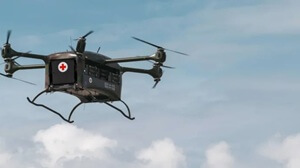 Carrying a wounded person creates demanding requirements beyond those of a reconnaissance quadcopter.
The aircraft must lift a substantial payload, maintain stability while the load shifts, and operate in terrain where enemy fire, jamming, and poor visibility are common.
SkyFall’s design includes dual communications using Starlink and its proprietary L-Link system.
The company also describes navigation assistance when GPS becomes unavailable or unreliable, including a contingency function intended to guide the drone toward a safe area if communications are lost.
A detailed RBC-Ukraine examination describes thermal imaging for nighttime use, detachable arms for transportation, and proposed resilience against certain hardware failures.
StarGate’s test demonstrations have included a net-launching countermeasure against attacking FPV drones.
Each capability adds equipment, engineering work, or integration requirements. However, SkyFall has not disclosed the price of its motors, batteries, navigation software, medical module, or communications equipment separately.
The $50,000 starting figure should therefore be interpreted as a system-level price expectation, not as an itemized bill of materials.
Independent battlefield performance also remains under evaluation. A successful demonstration does not establish the probability of safely completing every mission under combat conditions.
Ground Robots Can Cost Less
Ukraine has already used unmanned ground vehicles to evacuate wounded soldiers from heavily contested territory.
One example is MAUL, an evacuation platform developed by Ukraine’s First Separate Medical Battalion with industrial partners.
It uses a wheeled, remotely controlled vehicle with a protected enclosure for the casualty.
The Ukraine Aid Fund’s MAUL fundraising project lists an approximate manufacturing cost of $19,000, equivalent to 800,000 Ukrainian hryvnias under its stated estimate.
Meanwhile, Ukrainian defense-industry reporting places MAUL configurations between 1 million and 1.5 million hryvnias, depending on communications equipment.
Contemporary dollar conversions put that higher range at approximately $24,000–$36,000.
The figures may represent different dates, configurations, production arrangements, and inclusions. They should not be averaged into an invented official list price.
One reason MAUL’s design differs from StarGate is protection. The ground platform uses a casualty capsule intended to withstand battlefield hazards, whereas an aerial carrier avoids some ground obstacles but encounters aviation and drone-interception risks.
The British Army’s Soldier magazine documented a MAUL evacuation in which the robot continued moving after a mine damaged a wheel and remained protective during additional attacks.
That operational history is valuable, although a successful mission does not establish the platform’s overall reliability percentage.
A Complete Drone Team
The price of one aircraft is not the same as the cost of establishing a reliable medical evacuation capability.
A unit may require several aircraft to cover different locations, conduct maintenance, and retain replacements when one is damaged or lost.
Consider a hypothetical medical unit buying five StarGate systems at the manufacturer’s starting price.
- Five StarGate aircraft at $50,000 each: $250,000
- Illustrative reserve of 10% for spare components: $25,000
- Illustrative training and preparation reserve of 5%: $12,500
- Modeled initial program allowance: $287,500
The spare-parts and training percentages are explicit budgeting assumptions, not manufacturer quotations or documented Ukrainian procurement rates.
The model excludes recurring communications charges, battery replacements, transport vehicles, medical staffing, major repairs, and any additional equipment required by the purchaser.
One important implication is that a five-aircraft purchase can require more than a quarter-million dollars before the unit has accumulated meaningful combat experience.
A separate uncertainty is the actual number of functioning aircraft available at any moment. If two of five systems are awaiting repair, the unit has only three operational aircraft despite having paid for five.
Losing a Drone
Attrition has a direct effect on the cost of battlefield evacuations.
The Associated Press documented Ukrainian ground robots costing from approximately $1,000 to $64,000 across different roles.
In its 2025 reporting on frontline robotic units, soldiers described losing several vehicles in a week and adapting them to withstand electronic warfare and enemy attacks.
A medical evacuation drone is intended to be reusable, but the aircraft may still be damaged during a mission.
As a simple financial example, assume a $50,000 StarGate completes ten casualty evacuations before being lost or retired, with no resale value.
The aircraft acquisition expense averages $5,000 per completed evacuation.
At 25 successful evacuations, the average falls to $2,000. At 50, it falls to $1,000.
These are hypothetical acquisition-only averages, not observed StarGate mission costs. They exclude the operating team and equipment maintenance.
They demonstrate why the drone’s survivability and reuse rate can matter as much as a small difference in purchase price.
The other side of that calculation is the risk to human rescuers. A drone may be financially worthwhile even when its purchase price is high if it avoids exposing a medical crew to the same dangerous extraction route.
That benefit cannot responsibly be reduced to a single speculative dollar value for a human life.
Can a Ground Robot Be Better?
Ground and aerial systems solve related but different evacuation problems.
Ground robots can carry protective enclosures and may transport greater loads without the severe energy requirements associated with hovering aircraft.
They can also be obstructed by rubble, mines, damaged roads, water, or deeply churned terrain.
An aerial drone can cross some of those obstacles directly, but its operation depends on payload limits, weather, battery capacity, communications, and threats from the air.
The November 2025 MAUL rescue account described a nearly six-hour, 64-kilometer mission involving a mine strike and drone attack. That is a very different operating profile from StarGate’s advertised 15-kilometer one-way aerial range.
A Ukrainian robotics commander’s assessment placed many domestic ground systems between $10,000 and $50,000, depending on size and configuration.
Consequently, a military organization may be better served by a combination of ground and aerial systems rather than purchasing only the platform with the lowest advertised price.
For context, ThePricer’s U.S. military FPV drone cost guide documents substantially cheaper small unmanned aircraft. Those strike and reconnaissance FPVs cannot be compared as though they could safely carry wounded personnel.
Likewise, a long-range military drone serves a different mission and may cost millions because of its range, sensors, and endurance.
Comparison With Conventional Medevac
Traditional medical evacuation relies on vehicles, helicopters, and aircraft with crews capable of assessing and treating patients during transport.
An unmanned casualty carrier offers a different capability: transporting a wounded person away from a dangerous location without necessarily exposing a rescue crew.
It does not automatically replace a medically equipped ambulance or staffed evacuation aircraft.
ThePricer’s medevac plane cost guide places many equipped conventional aircraft between roughly $1 million and $15 million or more, depending on age, type, and equipment.
At a starting price of $50,000, StarGate’s acquisition cost is one-twentieth of a $1 million aircraft benchmark.
That ratio is a capital-cost comparison only. It does not establish equivalent range, safety, medical care, payload, reliability, or legal certification.
The economic opportunity is greatest when an inexpensive unmanned aircraft can perform a dangerous initial extraction and deliver the casualty to a safer location where medical personnel can take over.
For broader drone procurement context, the military sea drone price guide also shows why a bare unmanned platform and a complete deployed fleet carry different price tags.
An aerial medevac drone makes sense when:
- Roads and ground approaches expose evacuation crews to severe danger.
- The casualty and equipment fit the aircraft’s verified payload rating.
- The route lies within the aircraft’s safe operating and communications envelope.
- There is a suitable receiving location for medical personnel.
A ground platform may be preferable when:
- The casualty requires a protected enclosure against nearby blast or fragments.
- Longer travel distances exceed the aerial system’s practical range.
- Weather or aircraft limitations make flying unsafe.
- A suitable ground route exists and the robot provides adequate protection.
Answers to Common Questions
How much does a military medical evacuation drone cost?
SkyFall estimates that its purpose-built StarGate aerial evacuation drone starts at approximately $50,000, depending on configuration. Ground-based casualty evacuation robots can start around $19,000, with more advanced versions costing considerably more.
How much does Ukraine’s StarGate drone cost?
The manufacturer’s October 2026 estimate is at least $50,000 per system. This is not yet a verified large-scale military contract price.
Was the October 19 drone rescue performed by StarGate?
No. That reported evacuation used an adapted heavy hexacopter from Gurzuf Defence, provided without charge for the mission. StarGate is a separate aircraft undergoing frontline evaluation.
Can a drone really carry a wounded soldier?
Yes. Ukraine has demonstrated heavy aircraft carrying simulated casualty loads and has reported an actual soldier evacuation with an adapted hexacopter. StarGate is rated by its developer for a 150-kilogram payload, but its reliability in combat remains under evaluation.
Are medical evacuation drones cheaper than helicopters?
Their initial equipment prices can be much lower, but they cannot provide all the range, medical staffing, weather tolerance, and other capabilities of a staffed air ambulance. Total costs depend on the missions the platforms can safely perform.
Disclosure: Educational content, not medical advice. Pricing varies by provider, location, and insurance. Confirm eligibility, coverage, and out-of-pocket costs with a licensed clinician and your insurer. See our methodology and corrections policy.