
How Much Does A Money Order Cost?
Updated on | Written by Alec Pow
This article was researched using 8 sources. See our methodology and corrections policy.
A money order costs up to $1 at Walmart or $2.65 to $3.75 at the U.S. Postal Service in October 2026. Walmart’s exact fee varies by store, while USPS charges $2.65 for domestic money orders up to $500 and $3.75 for amounts from $500.01 to $1,000. Banks, grocery stores, and other agents set their own prices, so there is no single nationwide fee.
These charges are the purchase fees, not the amount written on the money order. Someone buying a $500 postal money order pays $502.65 in total. Additional expenses may apply if the payment must be mailed, replaced, researched, or refunded. Unlike wire transfers, ordinary money orders are prepaid paper payment instruments, generally purchased in person and delivered to the recipient separately.
Article Highlights
Jump to sections
- Walmart charges a maximum of $1 for a money order, with the exact price depending on the store.
- USPS charges $2.65 for amounts up to $500 (at $30 per hour, earning that amount would take about 2.1 full-time workdays, before taxes) and $3.75 for amounts above $500 through $1,000.
- USPS military postal facilities charge $0.85 for qualifying postal military money orders.
- Domestic USPS money orders have a $1,000 maximum face value.
- Replacing a lost or stolen USPS money order costs $23 under its current published policy.
- Western Union money order refund processing costs $0, $5, or $15, depending on the money order’s face value.
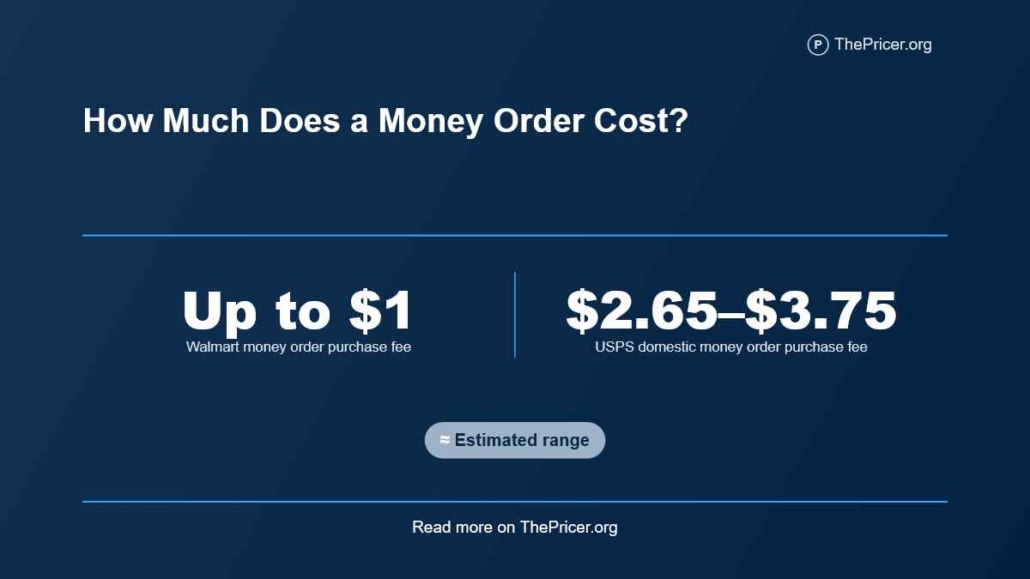
How Much Does a Money Order Cost?
The lowest published standard money order fees are available at major retailers and the Postal Service. Walmart’s official money order pricing establishes a $1 maximum fee, but does not promise that every store charges the same amount.
USPS publishes fixed rates through its domestic money order service. The fee changes when the amount exceeds $500 (about 2.1 full-time workdays at $30 per hour), even though the maximum value remains $1,000.
| Provider or service | Purchase fee | Conditions |
|---|---|---|
| Walmart | Up to $1 | In-store money order, location-dependent fee |
| USPS, $0.01–$500 | $2.65 | Domestic postal money order |
| USPS, $500.01–$1,000 | $3.75 | Domestic postal money order |
| USPS military facilities | $0.85 | Eligible postal military money orders |
| Western Union agents | Varies | Purchase fee established by the selling location |
| MoneyGram agents | Varies | Confirm availability and fee at the agent |
| Banks and credit unions | Varies | May depend on institution and account relationship |
| Grocery and convenience stores | Varies | Issuer, availability, and fee depend on store |
Walmart currently identifies Western Union as the provider behind its money order service. That does not mean the same purchase fee applies at every other Western Union agent.
The original article confused money orders with Western Union and MoneyGram money transfers, assigning fees of $15 to $30 to ordinary money orders. Those figures should not be presented as current paper-money-order prices without evidence from the specific issuing agent.
USPS Money Order Fees and Limits
Postal money orders are available at Post Office counters and can be purchased with cash or a debit card. USPS does not accept credit cards for this purchase. The domestic face-value limit is $1,000 (about 4.2 full-time workdays at $30 per hour) per money order.
Consider three purchase amounts under the published USPS schedule.
- A $100 money order costs $102.65 including its fee.
- A $500 money order costs $502.65 including its fee.
- A $750 money order costs $753.75 including its fee.
Unlike a percentage-based transfer fee, the postal charge is fixed within each band. Someone buying a $100 money order pays the same $2.65 issuance fee as someone buying one for $500.
This creates an important difference in proportional costs. The $2.65 charge represents 2.65% of a $100 money order but only 0.53% of a $500 money order. For a single larger payment, the fixed fee becomes relatively less expensive.
USPS money orders do not expire. The service also allows recipients to cash valid postal money orders at a Post Office without a cashing fee, subject to identification and other requirements.
Walmart Money Orders
Walmart’s advertised maximum fee of $1 makes it a strong option for basic domestic payments. Money orders are purchased in stores through a MoneyCenter or customer service desk, rather than through a general online checkout.
Walmart’s published instructions say purchasers can pay with cash or an eligible debit card. The customer must provide the necessary purchaser and payee information.
A $1 fee on a $500 money order represents 0.2% of the payment amount. Compared with the USPS fee of $2.65 for the same amount, the difference is $1.65 per money order.
For an individual buying only one money order, the savings may be modest. For someone paying rent with a money order every month, the repeated difference is worth considering.
Availability, identification requirements, service-desk hours, and exact fees should be checked locally. Not every store service counter necessarily operates throughout the store’s full opening hours.
Worked Example for Monthly Rent
A renter needs to pay $1,350 each month using money orders. Because a domestic USPS money order is limited to $1,000, the renter needs more than one instrument.
Assume the renter buys one money order for $1,000 and another for $350.
- First USPS money order, $1,000 face value: $3.75 fee
- Second USPS money order, $350 face value: $2.65 fee
- Monthly purchase fees: $6.40
- Total paid at the counter: $1,356.40
- Annual issuance fees over 12 payments: $76.80
ThePricer calculated scenario: $76.80 a year in USPS issuance fees for twelve monthly rent payments of $1,350. This excludes postage or any other delivery expenses.
At a Walmart location charging its advertised maximum $1 per money order, the same two-instrument monthly arrangement would carry no more than $2 in purchase fees, equivalent to $24 annually.
The potential annual difference is $52.80. This calculation assumes both instruments are available at the quoted Walmart fee and the landlord accepts multiple money orders.
A practical limitation matters here. The lowest issuance fee is not necessarily the lowest overall cost if the renter must travel substantially farther to purchase the money orders or if payment delivery creates additional expense.
Hidden Fees for Lost Money Orders

Replacing a missing money order can cost considerably more than buying it in the first place. The largest hidden financial risk is the possibility that the instrument is lost, stolen, or cashed before the issuer can complete an investigation.
USPS states that lost or stolen postal money orders can be replaced, but cannot simply be stopped like an ordinary personal check. Its published replacement processing charge is $23.
USPS says confirming a loss or theft may take up to 30 days, while an investigation can take up to 60 days. Keeping the original receipt is important because it contains identifying information needed to investigate the instrument.
For a $100 money order, a $23 replacement fee equals 23% of the original payment amount. That is much greater than the issuance charge and illustrates why the potential recovery cost matters, particularly for smaller payments.
Damaged postal money orders are different. USPS has a procedure for replacing defective or damaged money orders, and its replacement policy allows certain damaged instruments to be replaced without an additional fee when the customer presents the original receipt and damaged document.
Western Union Refunds and Inactivity Fees
Western Union sells paper money orders through participating retail agents. A paper money order should not be confused with a Western Union wire transfer or electronic international remittance.
Under Western Union’s retail money order terms, a refund request is subject to the following processing fees.
- Face value of $5 or less: $0
- Face value above $5 but below $100: $5
- Face value of $100 or more: $15
The refund must meet the provider’s eligibility conditions. Western Union’s online refund procedure requires identifying information and proof of purchase, and an instrument that has already been cashed is not eligible for the ordinary refund process.
There is another potential hidden expense. Western Union states that money orders generally do not expire, but inactivity charges can reduce their value after the applicable period.
Its standard terms provide for a potential $1.50 monthly service charge where permitted by law, subject to state-specific rules and limits. California, Connecticut, Maryland, Minnesota, New Jersey, Puerto Rico, and Texas have different provisions listed in the terms.
It would therefore be inaccurate to claim that every money order automatically incurs a standard monthly dormancy charge after 12 months. The issuer and state rules control the answer.
Money Orders vs. Other Payment Methods
A money order is a prepaid paper instrument made payable to a recipient. It can be useful when the recipient wants a noncash payment but the purchaser lacks a checking account or prefers not to use a personal check.
A cashier’s check is issued by a bank and commonly supports larger transactions without the typical $1,000 money-order limit. The cost of a cashier’s check depends on the bank and account type, making it an alternative worth comparing for large payments.
Electronic transfers work differently. The cost of sending money with Western Union may include transfer charges and foreign exchange margins, while a paper money order’s purchase fee is charged when the instrument is issued.
The distinction also applies to check cashing. Services such as H-E-B check cashing involve converting an existing payment instrument into cash rather than purchasing a new money order.
Bank account holders may be able to use checks, ACH payments, or other transfer arrangements instead. The best option depends on the recipient’s accepted payment methods, transaction amount, timing, and total fees.
Where to Buy and How to Use One
Money orders can be purchased at Post Offices, participating retailers, certain banks or credit unions, and some grocery or convenience stores. Availability varies by provider and location.
Western Union’s money order instructions recommend retaining the receipt so the purchaser can verify payment status and request assistance when necessary.
The practical steps are straightforward.
- Confirm that the recipient accepts money orders and obtain the correct payee name.
- Choose an issuer and confirm the purchase fee, maximum face value, and accepted payment methods.
- Purchase the money order for the required amount.
- Complete the payee and purchaser fields according to the issuer’s instructions.
- Keep the detached receipt and payment identifying information in a safe place.
- Deliver the money order securely and retain evidence of delivery if needed.
Do not make a money order payable to cash merely for convenience. If someone else obtains an improperly completed instrument, recovering the funds may become more difficult.
Mailing a money order introduces a separate delivery expense. USPS postage or any purchased tracking service is a mailing cost, not an automatic money order issuance fee.
Fraud Risks and Safer Decisions
Prepayment does not make a money order immune to counterfeiting or theft. The Consumer Financial Protection Bureau warns about counterfeit money orders used in overpayment scams.
In a typical scheme, a stranger sends a money order for more than the agreed price and requests the difference back. If the original instrument later proves counterfeit, the recipient may owe the bank for money already withdrawn.
The CFPB’s August 2026 scam guidance also identifies urgency, impersonation, and unusual payment demands as warning signs.
Makes sense if
- You need a prepaid paper payment and do not have a checking account.
- The recipient specifically accepts money orders.
- The payment is within the issuer’s allowed face-value limit.
- You can retain the receipt and deliver the instrument securely.
Does not make sense if
- A stranger demands a money order and pressures you to act immediately.
- You need an instant electronic payment or international currency conversion.
- A low-cost bank transfer is available and accepted by the recipient.
- The transaction exceeds the issuer’s limits and requires an unnecessarily complicated set of instruments.
Before cashing an unfamiliar postal money order, verify its security features and status through USPS. Funds being provisionally credited to a bank account do not prove that a suspicious payment is genuine.
Answers to Common Questions
How much is a money order at Walmart?
Walmart charges a maximum purchase fee of $1, with the exact amount varying by store. Money orders are purchased at participating in-store service counters.
How much does a $1,000 money order cost at USPS?
The USPS issuance fee is $3.75, making the total amount paid $1,003.75.
Can I buy a money order with a credit card?
USPS accepts cash or debit cards, not credit cards. Walmart accepts cash and eligible debit cards. Payment rules may differ at other issuers.
Can I track a USPS money order for free?
USPS provides an online status-checking service using information from the receipt. A formal lost-money-order inquiry or replacement is a separate process and may involve a charge.
Do money orders expire?
USPS domestic money orders do not expire. Western Union money orders generally do not expire either, but inactivity fees can reduce their value where permitted by law.
Disclosure: Educational content, not financial advice. Prices reflect public information as of the dates cited and can change. Confirm current rates, fees, taxes, and terms with official sources before purchasing. See our methodology and corrections policy.