
How Much Does a NASAMS Air Defense System Cost?
Published on | Written by Alec Pow
This article was researched using 13 sources. See our methodology and corrections policy.
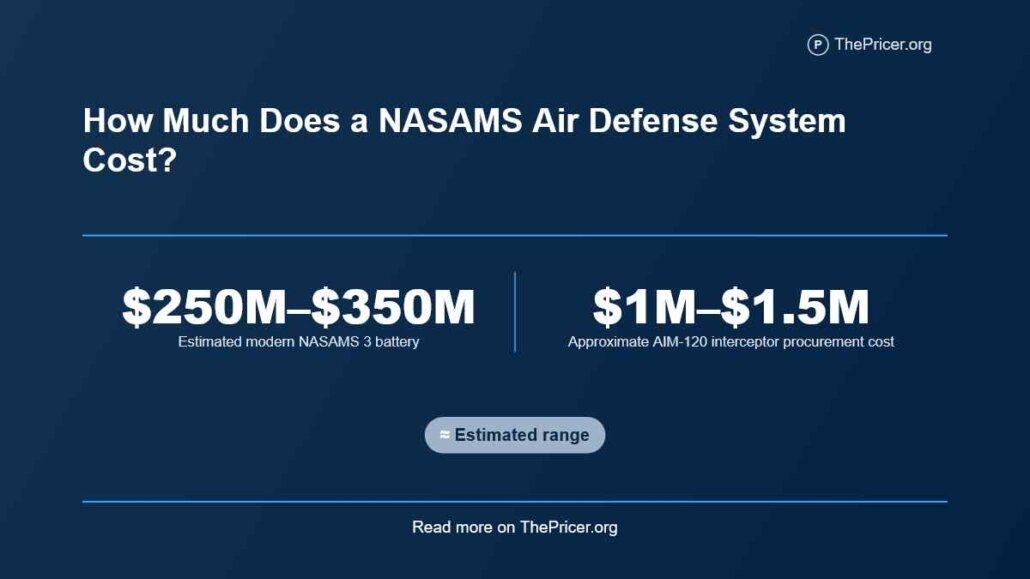
A NASAMS air defense battery costs an estimated $250 million to $350 million for a modern configuration with radar, launchers and fire control, based on published defense-market estimates. This is an indicative planning range, not a fixed Kongsberg price. Documented purchases vary substantially. Lithuania signed a €193 million expansion and modernization contract in 2024, Denmark ordered NASAMS equipment worth €500 million in 2025, and Belgium signed a NOK 10 billion national acquisition in September 2026.
The missile inventory changes the bill. NASAMS uses AMRAAM-family interceptors whose U.S. procurement costs run around $1 million to $1.5 million per round, depending on the variant and budget measure. Extended-range missiles, alternate interceptors, spare parts, training and support can cost more.
On October 26, 2026, Ukraine reported delays obtaining U.S. approval for NASAMS and Patriot missiles. That development does not establish a new system price, but it shows why delivery access and interceptor replenishment matter alongside procurement cost.
Article Highlights
Jump to sections
- A modern NASAMS battery has an indicative planning value of $250 million to $350 million, depending on configuration and inclusions.
- Belgium’s September 2026 NASAMS contract was worth NOK 10 billion.
- Denmark signed a €500 million NASAMS procurement contract in November 2025.
- Taiwan’s proposed three-system U.S. package carried a $1.16 billion ceiling, equivalent to $386.7 million per system when the whole package is allocated equally.
- Egypt’s proposed NASAMS-related package reached $4.67 billion, including hundreds of missiles and extensive support.
- A six-missile launcher reload represents approximately $6.2 million in AIM-120 all-up-round hardware using the FY2026 U.S. Air Force cost element.
How Much Does a NASAMS Air Defense System Cost?
NASAMS is sold as a configurable defense network rather than a standardized retail product. Its acquisition price depends on the number of radars, launchers, fire distribution centers, missiles and support items.
An independent air-defense acquisition cost database estimates a standard NASAMS 3 battery at $250 million to $350 million, with older NASAMS 2 configurations around $150 million to $250 million. These figures are third-party estimates, not published manufacturer quotations.
Actual contracts provide firmer evidence of what governments have budgeted. However, they frequently cover several fire units, modernization and national command integration.
| Buyer or cost example | Reported amount | Scope |
|---|---|---|
| Indicative NASAMS 3 battery | $250M–$350M | Third-party configured-battery estimate |
| Lithuania, 2024 | €193M | Additional NASAMS capability and upgrades |
| Denmark, 2025 | €500M | Signed NASAMS acquisition contract |
| Belgium, 2026 | NOK 10B | Signed national NASAMS procurement |
| Taiwan, 2024 approval | $1.16B | Three systems, missiles and support |
| Kuwait, 2022 approval | $3.0B | Multiradar network, interceptors and services |
| Egypt, 2025 approval | $4.67B | Integrated system and large mixed missile inventory |
The signed contracts and U.S. approvals are different kinds of financial evidence. A contract records an agreement, while a Foreign Military Sale notification states a possible maximum value that may change during negotiation and implementation.
The range also depends on what military organizations call a battery or fire unit. Launcher counts, sensors and shared network equipment vary between buyers.
What Is Included in NASAMS?
NASAMS stands for National Advanced Surface-to-Air Missile System. Norway’s Kongsberg Defence & Aerospace develops the system with RTX, formerly Raytheon.
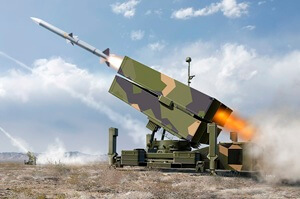
Its main components include the Fire Distribution Center, Sentinel surveillance radar, launchers, command and communications equipment, and interceptor missiles.
Kongsberg’s description of the Danish acquisition identifies Raytheon radar and missile technology alongside Kongsberg fire distribution and multipurpose launchers.
NASAMS can use AIM-120 AMRAAM, AMRAAM-Extended Range and AIM-9X missiles in compatible configurations. The choice affects both the threats that can be engaged and the cost of replacing fired weapons.
A buyer may also pay for vehicles, generators, identification systems, encrypted data links, command centers, spare missiles, test equipment, training and infrastructure.
Modern NASAMS installations can distribute launchers and sensors across a defended area. Shared command systems improve operational flexibility, but they also make the cost of one isolated launcher a poor substitute for the price of an entire defensive network.
Recent European NASAMS Contracts
Europe provides some of the clearest current contract evidence.
In September 2026, Belgium ordered NASAMS equipment under a NOK 10 billion contract. The Netherlands’ procurement authority placed the order on Belgium’s behalf.
The published announcement confirms the contract value but does not provide a complete public unit-by-unit price list. Dividing the total into a supposed number of identical batteries would therefore require assumptions that the disclosure does not support.
Denmark’s November 2025 €500 million contract adds another documented example of an advanced system acquisition, but its disclosed amount should not be interpreted as the universal NASAMS battery price.
Lithuania has pursued a different strategy. Its €193 million expansion contract included upgrades to previously acquired NASAMS equipment.
An earlier €200 million Lithuanian order also combined additional systems with modernization.
These contracts demonstrate a practical cost distinction. Extending an existing NASAMS network can reuse personnel, infrastructure and compatible equipment, while a first-time buyer must establish more of those functions.
The Netherlands signed a separate NOK 12 billion defense agreement in 2024. That deal includes both NASAMS and the shorter-range NOMADS system, so its full value must not be assigned to NASAMS alone.
Taiwan’s $1.16 Billion Package
Taiwan’s October 2024 Foreign Military Sale notification provides a rare example with an explicit system count.
The proposed $1.16 billion NASAMS purchase includes three medium-range air-defense solutions, three AN/MPQ-64F1 Sentinel radars, 123 AMRAAM-ER missiles and additional equipment.
The package-wide arithmetic is straightforward.
$1.16 billion ÷ 3 systems = $386.7 million per system.
That is an allocated acquisition-package value, not a manufacturer price for one battery. The missiles, communications equipment, training and support are included in the numerator.
At the same time, this is more informative than quoting an unexplained price for a generic NASAMS battery. It identifies the purchaser, number of systems, total ceiling and major hardware requirements.
In November 2025, a separate $698.94 million production award to Raytheon was reported for Taiwan’s NASAMS fire-unit equipment, with work expected to continue into 2031.
The production award should not be added automatically to the earlier $1.16 billion possible-sale ceiling. They concern related stages of the same procurement program.
Egypt’s $4.67 Billion Request
Egypt’s July 2025 proposal illustrates why a large NASAMS purchase can exceed several billion dollars.
The $4.67 billion Egyptian approval includes four Sentinel radars, 100 AMRAAM-ER missiles, 100 AIM-120C-8 missiles and 600 AIM-9X Sidewinders.
The notice also lists training missiles, spare guidance sections, fire distribution centers, launchers, tactical control equipment, support vehicles, communications, software and technical services.
The independent Egyptian sale assessment confirms that the large missile inventory is a major part of the proposal.
A March 2026 published breakdown classified approximately $3.84 billion as major defense equipment and $830 million as other equipment and services.
That means approximately 82% of the ceiling falls within the major-defense-equipment category. It does not mean 82% represents NASAMS launchers or radars, because the category also contains hundreds of missiles.
Egypt’s full package cannot responsibly be divided by four radars to produce a per-battery price.
NASAMS Interceptor Costs
Missiles are the principal recurring consumable in a NASAMS system. Each successful engagement removes one or more rounds from the available inventory, and replacement procurement can require a separate contract.
The U.S. Air Force’s FY2026 missile procurement budget lists a recurring hardware element of approximately $1.028 million for an AIM-120 all-up round. Its broader gross weapon-system unit measure is approximately $1.616 million, including allocated program expenses beyond the basic round.
These figures describe Air Force procurement accounting, not an automatically transferable export price for every NASAMS missile variant. AMRAAM-ER and AIM-9X have different specifications and acquisition costs.
For a fuller comparison of years, variants and export packages, see AMRAAM missile costs.
A NASAMS launcher commonly carries six missiles. Six AIM-120 rounds at the FY2026 direct hardware element give a calculated replacement value of approximately $6.17 million.
Using the broader $1.616 million procurement measure produces approximately $9.70 million for six missile-equivalents. The larger figure includes allocated spending beyond the missiles themselves, so it is not a separate quotation for loading the launcher.
The Polish AMRAAM export approval illustrates the distinction further. Its $1.33 billion ceiling covers 400 AIM-120D3 missiles plus spare guidance sections, support and services, producing approximately $3.33 million per requested missile-equivalent.
Export-package averages are not interchangeable with U.S. domestic procurement-line costs.
A Battery and Reload Cost Example
A practical ownership calculation starts with a clearly labeled hypothetical installation rather than treating a foreign national contract as a standard price list.
Assume a modern NASAMS battery budgeted at $300 million, within the independent $250 million to $350 million market estimate.
Suppose that battery operates three six-round launchers and a planner wishes to hold 36 additional AIM-120 missiles for replenishment. The three-launcher choice and 36-round stock are illustrative quantities, not a published standard purchase configuration.
At the FY2026 Air Force direct round hardware benchmark of $1.028 million, 36 additional missiles represent approximately $37.0 million.
That produces an illustrative total of $337 million if the original $300 million battery budget excludes those 36 reserve missiles.
If the base package already includes that inventory, adding it again would double-count the same weapons. Export pricing and any different missile mix could materially change the outcome.
The example shows why a government must distinguish the price of an operational battery from the additional missile stocks it intends to maintain.
Maintenance and Long-Term Spending
 NASAMS remains expensive after procurement.
Operators must maintain radar and command systems, replace electronic components, preserve missiles in suitable conditions, train crews and periodically test equipment.
The United States approved $180 million in air-defense sustainment for Ukraine in July 2025. The notification concerned support for existing U.S.-origin systems, rather than a new NASAMS battery.
It included training, maintenance, spare parts, repair-and-return support and government and contractor technical assistance.
That broad sustainment case should not be relabeled as a NASAMS-specific annual maintenance rate. Public reporting does not establish one universal annual cost for every NASAMS configuration.
Maintenance expenses change with the number of batteries, operating tempo, deployment conditions, software requirements and size of the missile inventory.
For budgeting, the more consequential recurring question is how many interceptors an operator expects to consume and replenish, alongside maintaining the equipment that fires them.
NASAMS vs Patriot and Other Systems
NASAMS occupies a different air-defense role from long-range, high-end ballistic-missile defenses.
The Patriot missile system cost is substantially higher for a heavily armed battery, with loaded-system estimates exceeding $1 billion and PAC-3 MSE interceptors costing several million dollars each.
That comparison does not make the systems interchangeable. Patriot can engage higher-end ballistic threats that may exceed the capabilities of a typical NASAMS installation.
At the shorter-range end, Iron Dome battery costs concern rocket and mortar defense using a different radar and interceptor family.
Portable Stinger missile costs are relevant to lower-level air defense rather than a networked medium-range battery.
Russia’s S-400 system pricing provides a broader long-range procurement comparison, although equipment packages, interceptor mixes and operational requirements differ.
A layered network may use different systems for different threats rather than relying on one expensive missile type for every engagement.
Ukraine and the October 2026 Shortage
NASAMS has attracted renewed attention because Ukraine relies on Western-supplied interceptors to defend cities and infrastructure against Russian air attacks.
On October 26, Ukrainian President Volodymyr Zelenskyy said Kyiv had waited nearly a month for U.S. authorization of critical missiles for Patriot and NASAMS.
Reuters documented the approval dispute involving weapons purchased by NATO allies through the Prioritised Ukraine Requirements List.
The quantity and contract value of the delayed NASAMS missiles were not disclosed. It would therefore be inappropriate to assign a total dollar amount using an assumed missile count.
The delay demonstrates that obtaining funding, export authorization, production capacity and physical delivery are separate procurement problems.
A country may already own expensive radars and launchers yet face reduced defensive capacity if its missile supply is interrupted.
When NASAMS Makes Financial Sense
NASAMS is a significant national-defense investment, but it can be useful where the mission requires distributed medium-range protection rather than the capabilities of a larger long-range system.
Its modular design can be attractive to countries expanding an existing compatible network. Lithuania’s repeat purchases illustrate how additional equipment can be integrated with previously acquired systems.
Makes sense if
- The defended area faces aircraft, cruise missiles and other threats within NASAMS’ supported engagement profile.
- The purchaser can fund radar, command equipment, launchers and missile stocks together.
- Existing command networks can integrate the additional systems.
- Replacement missiles, training and long-term support have reliable funding and delivery plans.
Does not make sense if
- The primary requirement is protection against threats beyond the selected NASAMS configuration’s capability.
- The purchase funds launchers without enough missiles to sustain operations.
- Required maintenance, integration and crew training cannot be supported.
- A lower-cost defensive layer can meet the actual threat requirement.
Answers to Common Questions
How much does one NASAMS battery cost?
A modern NASAMS 3 battery is estimated at approximately $250 million to $350 million in third-party cost references. Actual national purchases differ substantially according to missiles, launchers, radar, command networks and support.
How much does one NASAMS missile cost?
An AIM-120 missile used with compatible NASAMS configurations costs around $1 million to $1.5 million under selected U.S. procurement measures. Export packages, AMRAAM-ER and AIM-9X can have different costs.
Does Taiwan’s NASAMS deal mean every system costs $386.7 million?
No. The figure divides Taiwan’s $1.16 billion possible-sale ceiling by three systems and includes a substantial missile inventory, equipment and support.
Why is Egypt’s NASAMS purchase so expensive?
Egypt’s $4.67 billion notification includes extensive radar, command, launcher and support equipment alongside hundreds of AMRAAM, AMRAAM-ER and AIM-9X missiles. It is not a simple four-battery price.
Is NASAMS cheaper than Patriot?
The indicative NASAMS battery cost is lower than the frequently cited $1 billion-plus Patriot loaded-battery benchmark, but they have different defensive capabilities, missile inventories and operational roles.
Disclosure: Educational content, not financial advice. Prices reflect public information as of the dates cited and can change. Confirm current rates, fees, taxes, and terms with official sources before purchasing. See our methodology and corrections policy.