
How Much Does a NASCAR Engine Cost?
Updated on | Researched and reviewed by Alec Pow, Founder & Pricing Investigator
Prices, claims, and calculations checked against 15 cited sources. See our research methodology and corrections policy.
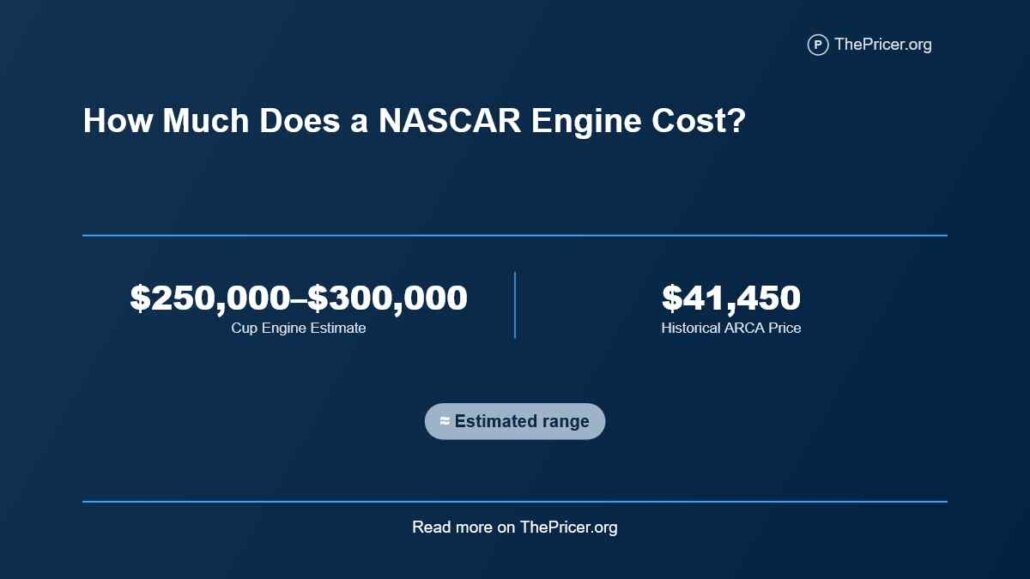
A modern NASCAR Cup Series engine is commonly estimated to cost $250,000 to $300,000 to build, but that is not the price most teams pay to race one. Cup teams generally obtain engines through manufacturer-backed supply programs, while lower-series teams may lease engines or purchase approved racing engines outright.
For a more directly documented purchase example, the Ilmor 396 engine used in ARCA was publicly priced at $41,450 in 2017. Its original program also published rebuilding costs of $10,000 to $15,000, depending on replacement parts. Those are historical prices, not verified 2026 quotations.
The cost depends on whether you are buying an engine, leasing one for a race, paying for a season-long program, or rebuilding an existing unit. These are different transactions and should not be compared as though they buy the same equipment and services.
There is also an important 2026 change: NASCAR increased the Cup Series horsepower target to 750 horsepower at road courses and selected shorter ovals. That replaces the older assumption that every non-superspeedway Cup engine operates under the same 670-horsepower configuration.
How Much Does a NASCAR Engine Cost?
Jump to sections
There is no official public NASCAR engine price list covering every national series. Teams work with different builders, and many commercial agreements are confidential.
| Engine or program | Published price or estimate | Important qualification |
|---|---|---|
| Cup Series engine | $250,000–$300,000 | Industry build-cost estimate, not a public retail quote |
| Xfinity engine lease | About $800,000 per season | 2025 reported budget example, approximately $24,242 per race |
| ARCA Ilmor 396 | $41,450 | Documented 2017 purchase price, excluding tax and shipping |
| ARCA Ilmor rebuild | $10,000–$15,000 | Original published program pricing, not a current quote |
| Chevrolet CT400 crate engine | About $9,800–$11,100 | Current dealer listings; not Cup or Truck Series legal by default |
The Cup estimate appears in reporting by Mavis and The SportsRush. Neither source provides an independently audited manufacturer production cost.
The more useful distinction is between the engine’s estimated value and the team’s contractual expense. A lease can cover several engines, maintenance, replacements, technical personnel, and engineering updates throughout the season.
Cup Engine Costs
Cup engines are specialized naturally aspirated V8s developed within NASCAR’s technical rules. Chevrolet, Ford, and Toyota programs work with established engine builders and engineering partners rather than operating a conventional consumer retail market.
For 2026, NASCAR confirmed a 750-horsepower target at road courses and ovals measuring less than 1.5 miles. The organization subsequently added several tracks to the relevant technical configuration.
The official horsepower announcement explains that the increase was designed around existing engine capabilities. NASCAR and its builders considered 750 horsepower manageable without the development burden associated with much higher output.
The subsequent technical update specified the aerodynamic package accompanying those higher-output engines.
That distinction matters financially. An increase in peak horsepower does not automatically mean every engine becomes proportionally more expensive. Changes to airflow restrictions may be less costly than developing an entirely new engine design.
On the other hand, producing more power can affect component loading, thermal management, service life, and the amount of testing required to maintain reliability.
A Cup team purchasing the expertise of a leading engine supplier is paying for more than an assembled V8. Engineering development, parts inventories, dyno testing, quality control, and race-weekend support all contribute to the program’s cost.
Engine Leases
Leasing is central to understanding professional NASCAR engine spending. The team receives an engine for competition while the supplier retains responsibility for significant portions of preparation and maintenance.
A detailed 2025 Xfinity Series budget published by The Autopian used an approximately $800,000 season-long engine lease, equivalent to $24,242 across 33 races.
That example describes suppliers delivering engines before race weekends, collecting them afterward, performing testing, and providing specialists at the track. Spare engines can also be available when mechanical problems occur.
It is not a confirmed universal 2026 lease rate, nor should it be applied to Cup teams without a separate supporting contract.
Historical reports of Xfinity leases costing $32,000 to $42,000 per race describe a different period and potentially different arrangements. The original article treated those figures too much like a current standard rate.
A 2021 Jayski report on Our Motorsports illustrates why a team might choose a major supplier. Its engine agreement with Earnhardt-Childress Racing gave it access to ongoing improvements in tuning and performance.
Before comparing leases, a team needs answers to five questions:
- Does the price include a fresh engine for every event?
- Who pays when an engine fails during practice or qualifying?
- Are rebuilds, dyno testing, and technical updates included?
- Does the supplier provide personnel and spare engines at the track?
- Are freight, installation, insurance, and damage charges separate?
A lower lease price is not necessarily cheaper if those services must be purchased separately.
Truck and ARCA Engines
 The Ilmor engine programs provide some of the clearest publicly documented NASCAR-related engine costs.
In the original ARCA program, Ilmor developed a sealed, fuel-injected 396-cubic-inch V8 intended to reduce the expense of competing with individually developed engines.
Contemporary EngineLabs reporting identified an initial engine price of $35,000, an additional $5,000 installation kit, and rebuilds costing $10,000 to $15,000 depending on the work required.
In 2017, Professional Motorsport World reported a $41,450 engine purchase price, plus tax and shipping. That package included several important external components and specified manufacturer technical support.
These historical figures should not be merged into a fabricated current price. Buyers need a new quotation from Ilmor for the applicable specification and service agreement.
Ilmor’s official ARCA specifications identify approximately 700 horsepower, a 7,500-rpm maximum, and a 1,500-mile racing interval before rebuilding.
The NASCAR Craftsman Truck Series uses Ilmor’s NT1 engine extensively. The manufacturer describes its Truck Series program as combining engine supply with testing, development, and trackside assistance.
Importantly, Ilmor is not necessarily the only technically permitted route. Race Engine Technology’s 2026 coverage explains that qualifying built engines can also compete under different restrictions. Teams must confirm the current rules before choosing hardware.
Worked Cost Example
Consider a team evaluating an ARCA-spec engine using the original Ilmor program’s published prices. This is a transparent historical-cost model, not a quotation for a 2026 purchase.
| Expense | Illustrative amount |
|---|---|
| Ilmor 396 engine | $35,000 |
| Required installation kit | $5,000 |
| One scheduled rebuild | $10,000–$15,000 |
| Combined historical cost | $50,000–$55,000 |
Taxes, shipping, engine installation labor, and accident damage are excluded because no universal verified amounts were established for them.
Computed insight: The installation kit increased the original $35,000 engine purchase price by approximately 14.3%. A comparison that ignores the kit understates the original acquisition cost by $5,000.
If the engine completes 1,500 racing miles before a $10,000–$15,000 rebuild, the rebuild alone represents about $6.67–$10 per racing mile. This is a maintenance-cost calculation, not a claim that every operating mile costs that amount.
At 300 race miles per event, a 1,500-mile service interval represents five events. At 150 miles per event, the same distance covers ten. Actual service scheduling depends on the racing conditions and manufacturer instructions.
This is why buyers should ask for an engine’s remaining service life rather than comparing purchase prices in isolation.
What the Price Includes
A complete racing engine package can include much more than the block, crankshaft, cylinder heads, pistons, connecting rods, camshaft, and valvetrain.
Depending on the specification, external components can include:
- Oil pump and lubrication hardware
- Fuel delivery components
- Electronic control unit and wiring
- Ignition components and sensors
- Bellhousing, clutch, or related drivetrain hardware
- Exhaust and installation components
- Dyno documentation and technical support
The 2017 Ilmor package description is particularly useful because it identifies equipment included in that engine’s stated purchase price.
By contrast, an inexpensive used long block might exclude most of these components. The buyer may then need special brackets, plumbing, electronics, and a separate testing session before the engine is ready to install.
The original article also assumed several specific freight and track-support prices without enough evidence to establish them as current NASCAR-standard charges. These remain quote-dependent expenses.
Ask the seller for an itemized component list, recent inspection results, engine history, and the precise condition of all included equipment.
Rebuilds and Maintenance
Racing engines are serviced according to competition duty rather than ordinary road-car mileage. High engine speeds, sustained temperatures, and repeated acceleration place substantial demands on internal components.
Ilmor’s ARCA specifications provide a useful documented benchmark of 1,500 racing miles before rebuilding. Earlier reporting described service life around 1,200–1,500 miles, depending on the program.
An EngineLabs examination confirms that the 396 was designed around extended racing mileage compared with more frequently serviced alternatives.
Typical rebuild work can involve inspecting or replacing bearings, rings, valve springs, seals, and other stressed parts. Additional work may be necessary when measurements reveal wear or damage.
A routine refresh and a repair after mechanical failure are different jobs. An engine with damaged pistons, cylinder heads, or crankshaft components may exceed the expected rebuilding budget.
Maintenance records are therefore a financial asset. A complete log of racing miles, temperatures, oil pressures, dyno results, and previous work can make an engine easier to evaluate and potentially more attractive to a future buyer.
Owners should also verify service restrictions. The original sealed Ilmor program required approved servicing, limiting the opportunity to save money through an independent local machine shop.
Other Racing Engines
Drivers entering regional stock-car racing can often buy less expensive sealed crate engines, although these are not interchangeable with engines approved for NASCAR’s national series.
Chevrolet Performance offers CT350, CT400, and CT525 circle-track engines. Its official specifications rate the CT400 at 404 horsepower.
Current retailer listings provide tangible price comparisons:
| Engine | Published asking price |
|---|---|
| Chevrolet CT350/602 | $7,293.66 |
| Chevrolet CT400/604 | $9,809.19 |
| CT400/604, dressed and dyno-tested | $11,128.24 |
These are advertised prices from Karl Kustoms, not national manufacturer list prices or guaranteed delivered totals. Another retailer, Lefthander Performance, advertises a CT400 at $9,958.24.
Computed insight: The dressed and dyno-tested CT400 costs approximately $1,319 more than the basic $9,809.19 listing, a premium of about 13.4%. Whether that premium is worthwhile depends on the components and testing the buyer would otherwise need to purchase.
These engines can be a practical route into an eligible regional racing class. They are not a way to enter the Cup Series with a $10,000 engine.
For perspective on other motorsport categories, see our research on sprint car costs and IndyCar expenses.
Buying Used
A used race engine may appear inexpensive compared with a current professional program, but its value depends heavily on condition, specification, and remaining service life.
Before buying, verify:
- The engine’s exact model and serial number
- Whether it is legal in the intended racing series
- Racing miles since the last rebuild
- Leak-down, compression, and oil-pressure results
- Recent dyno results and maintenance documentation
- Included electronics, pumps, wiring, and accessories
- Transport arrangements and the seller’s return policy
A used engine sold shortly before a required rebuild carries an immediate additional expense. If its next refresh costs $15,000, a $25,000 asking price becomes a $40,000 engine-and-rebuild commitment before installation and transport.
That is an illustrative calculation, not a verified current market price for a particular engine.
Sealed engines also require special attention. Altered seals, unauthorized modifications, or missing documentation can create eligibility problems that are much more expensive than routine maintenance.
Buyers should verify that a series will accept the engine before paying a deposit. A theoretically powerful engine has little competitive value if the intended class will not allow it.
What We Verified
What We Verified: We examined NASCAR’s 2026 technical announcements, Ilmor’s official engine specifications, contemporary reporting on original Ilmor purchase and rebuild costs, a detailed Xfinity team-budget analysis, and current Chevrolet crate-engine retailer listings.
- NASCAR confirmed the 750-horsepower Cup configuration for selected 2026 tracks.
- Ilmor identifies a 1,500-mile service interval for the ARCA 396.
- The original Ilmor program documented $35,000 engines, $5,000 installation kits, and $10,000–$15,000 rebuilds.
- A later 2017 report documented a $41,450 engine purchase price.
- A 2025 Xfinity budget analysis used approximately $800,000 for a season-long engine lease.
- Current Chevrolet CT400 retail listings establish a much lower-priced regional racing alternative.
What remains undisclosed: Current universal Cup engine construction costs, standard 2026 Cup lease prices, and an official current Ilmor purchase-and-rebuild rate card. Public estimates must not be represented as confidential contract prices.
Professional racing costs are sensitive to series regulations, technical specifications, and supplier agreements. Teams should obtain written quotations and check the current rulebook before purchasing or leasing an engine.
For a comparison with a different high-performance engine program, our Top Fuel dragster cost guide explains why engine purchase prices and full racing budgets require separate accounting.
Frequently Asked Questions
How much does a NASCAR Cup engine cost?
Published industry estimates commonly place a Cup engine’s construction value around $250,000–$300,000. These are not verified manufacturer retail prices. Cup teams generally participate in supplier arrangements whose terms are not publicly standardized.
How much does a NASCAR engine lease cost?
A detailed 2025 Xfinity Series budget used approximately $800,000 per season, or $24,242 per race across 33 events. Other teams and series may pay different amounts depending on performance, maintenance, replacements, and support.
How long does a NASCAR engine last?
There is no single mileage rule covering every NASCAR engine. Ilmor specifies approximately 1,500 racing miles before rebuilding for its ARCA 396, while Cup engine service schedules depend on regulations, engine allocation, usage, and supplier decisions.
Can I buy a NASCAR engine for my own race car?
Used engines and some NASCAR-related racing engines are available privately, but legality depends on the racing class. A Chevrolet CT400 crate engine is a substantially cheaper option for approved regional classes, not a substitute for a current Cup engine.
Why are NASCAR engines so expensive?
They require specialized components, precise assembly, extensive testing, and reliable operation under severe racing conditions. At the professional level, engine costs also support research, logistics, replacement inventories, and technical personnel.
Disclosure: Educational content, not financial advice. Prices reflect public information as of the dates cited and can change. Confirm current rates, fees, taxes, and terms with official sources before purchasing. See our methodology and corrections policy.