
How Much Does a Pearle Vision Eye Exam Cost?
Updated on | Researched and reviewed by Alec Pow, Founder & Pricing Investigator
Prices, claims, and calculations checked against 15 cited sources. See our research methodology and corrections policy.
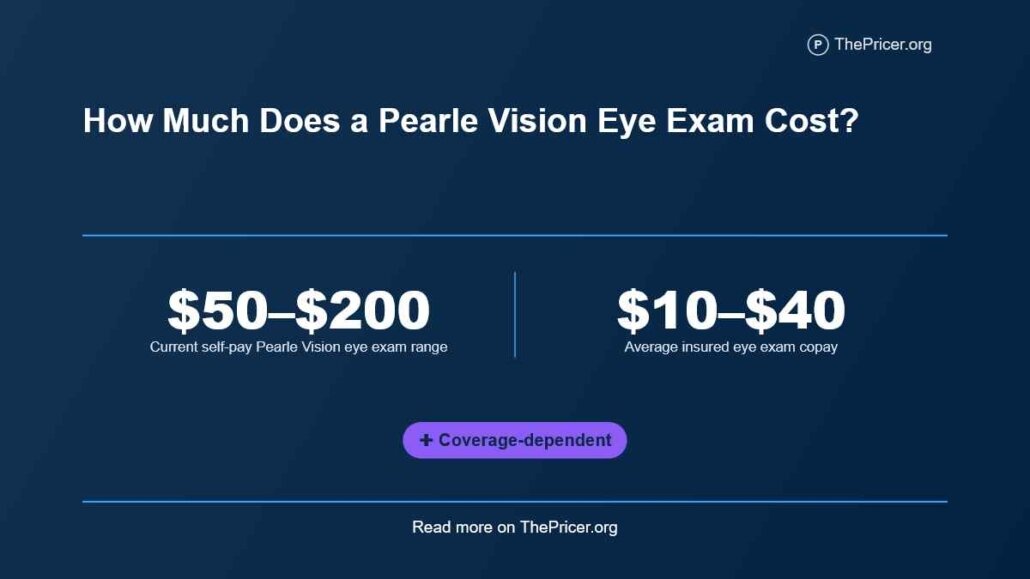
Pearle Vision’s current published exam pricing puts an eye exam at $50 to $200 without vision insurance, while insured exam copays average $10 to $40. The exact price depends on the EyeCare Center, the doctor, the tests performed, and the terms of the patient’s vision plan. Contact lens fitting can raise the bill, and Pearle does not publish one national contact lens exam fee.
The exam is only one part of the budget if new eyewear is needed. Pearle sells frames, prescription lenses, and contacts, but frame prices vary by local inventory and lens prices can change sharply with prescription type, material, thickness, and treatments. A useful budget separates the exam from the eyewear instead of treating them as one fixed package.
Article Highlights
Jump to sections
- Pearle Vision lists an uninsured eye exam at $50 to $200.
- With vision insurance, Pearle says the average exam copay is $10 to $40.
- Contact lens exam pricing varies by location, insurance, lens type, and follow-up needs.
- Pearle does not publish one national frame price.
- Its lens guide gives a broad $50 to $1,000 range for basic single-vision lenses.
- Original Medicare does not cover routine eye exams for eyeglasses or contact lenses.
How Much Does a Pearle Vision Eye Exam Cost?
Pearle Vision’s current eye exam pricing guidance puts a standard self-pay exam at $50 to $200. Pearle also says an insured patient may face a copay of $10 to $40, though a plan can cover more of the exam or apply different terms. These are national planning ranges, not a guaranteed menu for every location.
The wide self-pay span is tied to local pricing and service scope. The same visit can include a prescription check, eye-health testing, pressure measurement, and other tests selected by the doctor. Tests beyond the routine visit can change the amount due. Pearle advises patients to call the local center for a price estimate because the doctor and location matter.
| Service or cost component | Published price | Scope |
|---|---|---|
| Eye exam without insurance | $50 to $200 | Pearle national planning range |
| Eye exam copay with insurance | $10 to $40 | Pearle average copay range, plan dependent |
| Difference between matching range endpoints | $40 to $160 lower with the published copay range | ThePricer calculation from Pearle’s two exam ranges, not a matched patient quote |
ThePricer range comparison shows how strongly insurance can change the exam portion. At matching ends of Pearle’s published ranges, $10 is one-fifth of $50, and $40 is one-fifth of $200. The dollar gap is $40 to $160. This is arithmetic across Pearle’s published ranges, not a promise that one patient’s plan will reduce the bill by exactly 80%.
What the Exam Price Covers
A routine Pearle eye visit can include a health-history review, visual acuity testing, refraction for a glasses prescription, eye-pressure testing, eye movement checks, and an examination of eye structures. Pearle’s exam process overview describes preliminary testing followed by the doctor’s examination. The exact sequence varies with the patient’s needs and the doctor’s judgment. Ask whether any imaging or diagnostic test carries a separate patient charge before it is performed.
The refraction matters because it determines the lens prescription. Extra imaging or testing may be recommended when the doctor needs more information. A retinal image, field test, or other diagnostic service should not be assumed to be included merely because the base appointment is called an eye exam. Ask what the quoted exam fee contains and which tests can create a separate charge.
Pearle uses a locally operated EyeCare Center model, so a national planning range cannot capture every doctor’s fee schedule or local service mix. The optical retail side and the clinical side are often available in the same center, yet the exam and eyewear remain separate parts of the budget. The local quote should identify the exam charge before any frames, lenses, or contacts are added.
Contact Lens Exams
A contact lens visit requires work beyond a glasses prescription. Pearle’s contact lens exam page says the doctor evaluates eye measurements, lens fit, vision, eye response to lens wear, and factors such as dryness. A new wearer or someone changing lens type may also need follow-up before the fitting is finished.
Pearle does not publish a chainwide contact lens exam price. It states that the charge varies with the location, vision plan, contact lens type, and follow-up needs. That makes the old claim that every contact lens exam falls inside one narrow national range unreliable. A local quote is the better number. New wearers may also have a different fitting path from established wearers who are renewing the same lens type.
Ask whether the contact lens charge includes the routine eye exam or is added to it. Also ask whether trial lenses and follow-up are part of the quoted fitting fee. The answer can change the comparison between two locations even when both advertise a similar base exam. Someone who only needs a glasses prescription should not use a contact lens fitting price as the expected cost of a routine visit. A fitting quote is only comparable when the included visits and lens service are the same.
Insurance Changes the Bill
Pearle works with major vision plans, but network participation is not identical everywhere. All U.S. Pearle Vision EyeCare Centers accept EyeMed, and Pearle says exact EyeMed benefit amounts depend on the member’s plan. Pearle’s separate VSP location list says many centers accept VSP and directs patients to check the participating store.
Plan participation and benefit size are separate questions. A location may accept the insurer while the patient’s plan still limits exam frequency, frame allowance, lens benefits, or contact lens allowance. The doctor can also have network terms that differ from the optical retail counter. Ask the plan to confirm both the provider and the benefits before the appointment.
Before the visit, ask the center to check benefits for the doctor who will perform the exam. Then ask the insurer what applies to the exam, contact lens fitting, retinal imaging, frames, and lenses. That distinction matters. A $10 to $40 exam copay does not mean every test or every pair of glasses will carry the same low out-of-pocket cost. Ask before you book. Confirm whether any optional testing is excluded from the quoted copay.
Glasses and Lens Costs
Pearle does not publish one national frame-price range. Its frame pricing FAQ says the cost depends on material and features and directs shoppers to the local EyeCare Center. Inventory also changes by location, so a current quote for the chosen frame is more reliable than an old chainwide estimate.
Lenses have a different price structure. Pearle’s prescription lens guide gives a broad $50 to $1,000 range for basic single-vision lenses and says cost depends on material, lens type, prescription, insurance, and discounts. Progressive designs, thinner materials, photochromic treatment, and anti-reflective coatings can move the price.
An illustrative cash scenario shows why the eye exam should not be used as the total eyewear budget. Assume a shopper selects a $150 frame as a chosen budget, not as a Pearle national price. Add Pearle’s $50 to $200 exam range and its $50 to $1,000 lens range. The resulting scenario is $250 to $1,350 before tax and any other upgrades. Without the assumed frame, the exam-plus-lens subtotal is $100 to $1,200. Lens choice can move the bill much more than the exam fee.
Promotions and Hidden Prices
Discounts can help, but a promotion needs a current end date and terms. One current Pearle store page still displays a 40% lens offer whose terms say it ended March 31, 2026. Those terms also say the discount applied to lenses, required a complete-pair purchase, excluded selected products, and could not be combined with vision benefits. Confirm any offer before using it in the budget.
The harder price difference is often the interaction between insurance and store promotions. A cash discount may not combine with vision benefits, while an insurance allowance may reduce the frame or lens charge in a different way.
Compare the final patient amount, not the size of the advertised percentage. Ask the store to show the price with insurance and the price under any eligible cash promotion before choosing the billing route.
A promotion can look larger than its effect on the final order when the percentage applies to only one component. Compare the price of the same frame, prescription, lens design, and treatments under each eligible payment route. Two pairs with different lens materials or coatings are not matched offers even when the frames look similar.
Pearle vs Other Options
Pearle can fit a shopper who wants the eye doctor and eyewear counter in one local center. A warehouse optical department or another chain can be cheaper for a particular exam or frame, but that cannot be assumed from the brand name alone. The nearby doctor’s fee, insurance network, contact lens needs, and eyewear configuration decide the useful comparison.
The existing cost guides for JCPenney eye exams, Costco eye exams, and Eyemart Express eye exams provide adjacent benchmarks. Compare the exam first, then compare glasses using the same prescription and lens features. A low exam fee paired with expensive lens upgrades may not produce the lowest total.
Federal rules also preserve the ability to shop elsewhere after the exam. The FTC says patients have a right to their prescription after a glasses refraction, and after a contact lens fitting is complete. The prescriber cannot require an eyewear purchase just to release that prescription.
Makes sense if
- You want an exam and eyewear shopping in one location.
- Your doctor is in network for your vision plan.
- You value in-person frame fitting and later adjustments.
- You compare the final lens configuration before buying.
Does not make sense if
- You are relying on an expired coupon found in search results.
- Your plan treats another local provider more favorably.
- You only compare the exam fee and ignore eyewear costs.
- You assume contact lens fitting is included without checking.
How Often to Book an Exam
Exam frequency should reflect age and risk rather than one blanket annual rule. The American Optometric Association’s adult examination schedule says asymptomatic, low-risk adults ages 18 through 64 should have an exam at least every two years. Adults 65 and older are listed for annual exams, while people with higher-risk factors may need annual or doctor-directed visits. Contact lens wear is one of the risk factors listed by the AOA.
That schedule also changes long-run cost. A low-risk adult who has five self-pay exams over ten years at Pearle’s published $50 to $200 range would spend $250 to $1,000 on the exam portion. Ten annual exams at the same unchanged range would total $500 to $2,000. This is a budgeting scenario, not a reason to lengthen a medically advised interval.
Original Medicare has another boundary. The 2026 Medicare benefits booklet says routine refraction exams for eyeglasses or contact lenses are not covered and that most eyeglasses and contacts are also not covered. Part B has a limited corrective-lens benefit after qualifying cataract surgery. Medicare Advantage plans can offer benefits beyond Original Medicare.
Verification notes
- Checked Pearle’s current network history, which states more than 500 locally operated practices and a 1961 founding.
- Confirmed Pearle’s 30-day eyewear guarantee and free adjustments at participating centers.
- Cross-referenced Pearle’s refraction exam description against the exam-cost page to separate prescription testing from contact lens fitting.
Answers to Common Questions
How much is a Pearle Vision eye exam without insurance?
Pearle currently gives an average self-pay range of $50 to $200. The local doctor, location, and tests performed can change the final fee.
How much is a Pearle Vision eye exam with insurance?
Pearle says average vision-plan copays run $10 to $40. Your exact cost depends on the plan, network status, and services billed.
Does Pearle Vision charge extra for a contact lens exam?
Contact lens pricing is location-specific. The fitting requires extra measurements and evaluation, so ask whether the local quote includes the routine eye exam, trial lenses, and follow-up.
Does Medicare pay for a Pearle Vision eye exam?
Original Medicare does not cover routine refraction exams for glasses or contacts. A Medicare Advantage plan may include a separate routine vision benefit.
Do I have to buy glasses from Pearle after the exam?
No. Federal prescription rules let patients receive their glasses prescription after the refraction and their contact lens prescription after the fitting is complete, subject to the applicable prescription rules.
Disclosure: Educational content, not medical advice. Pricing varies by provider, location, and insurance. Confirm eligibility, coverage, and out-of-pocket costs with a licensed clinician and your insurer. See our methodology and corrections policy.