
How Much Does a Pluto Ad Cost?
Updated on | Researched and reviewed by Alec Pow, Founder & Pricing Investigator
Prices, claims, and calculations checked against 10 cited sources. See our research methodology and corrections policy.
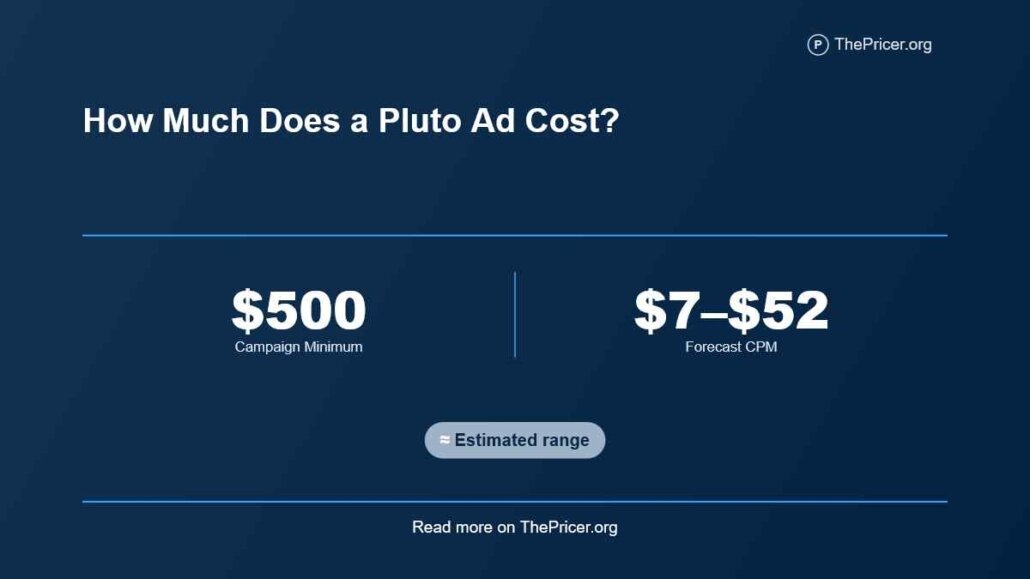
Advertising on Pluto TV can start with a $500 campaign through Paramount Ads Manager. Paramount’s October 2026 pricing tool displays possible connected-TV advertising rates of $7 to $52 CPM, meaning $7 to $52 per 1,000 impressions, depending on targeting and inventory. A separate advertising platform publishes a $23.35 CPM Pluto TV rate-card example. Neither figure is a guaranteed price for every Pluto TV campaign.
Pluto TV is a free, ad-supported streaming service owned by Paramount. Advertisers primarily buy video impressions through Paramount’s self-service platform, an agency, or an advertising technology partner. Actual spending depends on the buying route, audience, content selection, campaign length, and whether creative production or management is included. A $500 media budget can launch an eligible campaign, but meaningful testing may require more spending.
Article Highlights
Jump to sections
- Paramount Ads Manager accepts campaigns starting at $500.
- The official October 2026 forecast spans $7–$52 CPM across selectable inventory and targeting.
- One independent platform lists a Pluto TV rate-card CPM of $23.35.
- A $1,500 media budget at an assumed $25 CPM buys approximately 60,000 impressions.
- Paramount offers a free video-ad creation tool for eligible self-service campaigns.
- Pluto TV-only inventory and mixed Paramount inventory must be distinguished when comparing proposals.
How Much Does a Pluto Ad Cost?
There is no single public Pluto TV rate card applying to every audience and buying arrangement. Paramount instead calculates a forecast based on campaign settings.
The official Paramount pricing tool shows a CPM range of $7–$52, labeled with a pricing date of October 7, 2026. It allows advertisers to explore different audience, geography, placement, and inventory combinations.
Its inventory choices include Core, described as broad Pluto TV reach, Expanded, which combines Paramount+ and Pluto TV with other premium placements, and Full, which adds wider Paramount content access.
| Buying example | Published price | Important limitation |
|---|---|---|
| Paramount campaign minimum | $500 | Per campaign, not monthly |
| Paramount forecast range | $7–$52 CPM | Varies by selected settings |
| Antebyte Pluto TV rate card | $23.35 CPM | One seller’s offer |
| Broader FAST market | $15–$25 CPM | Market benchmark, not Pluto quote |
| Premium CTV market | $25–$65 CPM | Different inventory mix |
Antebyte’s September 2026 rate card lists Pluto TV at $23.35 CPM and reports an average billed CTV CPM of $20.56 across its July–September 2026 delivery records. The first is a Pluto-specific seller rate. The second measures broader CTV activity, not exclusively Pluto TV.
Paramount’s 2026 advertising-cost guidance gives a wider $25–$65 CPM range for entry-level CTV industry pricing, while identifying $7 as its own platform’s starting level. These figures describe different purchasing scopes and should not be combined into an invented Pluto national average.
How Pluto TV Ads Are Purchased
Pluto TV is a free ad-supported television service, commonly called FAST. Its programming resembles traditional television channels, alongside on-demand movies and shows.
Advertisers reach viewers through streaming video placements rather than purchasing a physical advertising space or a fixed television station time slot.
Paramount Ads Manager provides a direct self-service route. An advertiser selects a budget, duration, audience, content bundle, and video creative, then reviews a delivery forecast before payment.
Screenbridge’s October 2026 buying guide confirms the $500 entry point and identifies self-service campaigns up to $260,000 through Paramount Ads Manager. It also describes managed campaigns that combine Pluto TV with other services.
This leads to an important buying distinction. A campaign purchased through Paramount’s Expanded inventory may appear across several services. Its delivered impressions should not all be described as Pluto TV impressions.
Paramount also sells inventory through other commercial and technology arrangements. These may involve different reporting rules, agency costs, minimum commitments, and access to particular placements.
How Many Impressions Can You Buy?
CPM stands for cost per thousand impressions. If an advertiser spends $1,000 at a $20 CPM, the media budget theoretically purchases 50,000 impressions.
The same budget reaches fewer impressions when CPM rises. This is why selecting a narrowly defined audience can materially change delivery.
The following calculations use hypothetical fixed CPMs rather than actual Paramount checkout quotations.
| Media budget | At $15 CPM | At $25 CPM | At $40 CPM |
|---|---|---|---|
| $500 | 33,333 | 20,000 | 12,500 |
| $1,000 | 66,667 | 40,000 | 25,000 |
| $2,500 | 166,667 | 100,000 | 62,500 |
| $5,000 | 333,333 | 200,000 | 125,000 |
These numbers represent impressions, not unique viewers. A household seeing the same commercial three times contributes three impressions.
Universal Ads’ October 2026 pricing analysis also distinguishes the minimum required to launch from the amount needed for a useful experiment. Its published CTV guidance spans approximately $8–$45 CPM, with a $100 minimum on that separate platform.
A $500 Paramount campaign can establish whether a business’s ad is approved and serving. It may be too small to support a reliable judgment about sales effectiveness.
What Changes the CPM?
The main price drivers are audience selection, available content, geographic coverage, competition, and the chosen video format.
Paramount offers targeting by state, metropolitan television market, ZIP code, age, gender, household income, interests, and behaviors. The company also offers automated audience-selection options.
Its inventory access guide describes combinations of Pluto TV, Paramount+, CBS, and other Paramount media through one buying interface.
Narrow geographic coverage can help a local business avoid impressions outside its service area. However, adding restrictive audience conditions reduces the available pool of eligible viewers and can raise the CPM.
Content selection matters. A broad entertainment campaign may receive a different forecast from one emphasizing premium sports, specific genres, or particular audience attributes.
Video length may also affect pricing or available supply. Advertisers should check the actual forecast rather than assume a 30-second commercial always costs exactly twice as much as a 15-second one.
For planning context, Stillwater Media’s August 2026 analysis explains how publisher, deal type, audience data, and intermediary fees make two seemingly similar CTV CPM quotations difficult to compare.
Video Production
Advertising media and the video itself are separate economic inputs. A company with an existing television-ready commercial may only need to pay for distribution. Another business must create an appropriate video before it can launch.
Paramount offers a free creation option. Its Creative Express documentation describes generating a streaming-TV commercial from a business website, existing images, branding, text, voice-over, and other inputs.
That allows a small advertiser to test streaming television without automatically hiring a production company.
More elaborate projects can still involve scriptwriting, filming, editing, animation, voice talent, music rights, or agency supervision. Costs depend on the creative scope, revisions, and licensing terms.
Our commercial production cost guide covers these broader production decisions, although traditional national television production budgets are not appropriate minimums for a basic self-service Pluto TV campaign.
A second potential cost is campaign management. An agency may charge a monthly retainer, a percentage of media spending, or a separate project fee. Those charges should be identified independently of the actual inventory CPM.
Self-service buying through Paramount does not require an agency retainer. A managed advertising proposal may provide useful creative, measurement, and buying support, but its gross spend cannot be compared directly with a self-service media-only purchase.
A $1,500 Pluto Campaign Budget
Consider a local home-services company testing Pluto TV through Paramount Ads Manager. Assume it selects the Core inventory option, purchases impressions at a hypothetical $25 CPM, and allocates $1,500 to media.
The campaign would theoretically purchase 60,000 impressions. The advertiser also reserves $250 for internal creative preparation and landing-page work. This allowance is an explicit scenario assumption, not a Paramount platform charge.
- Streaming advertising media: $1,500.
- Creative and landing-page allowance: $250.
- Complete test budget: $1,750.
- Estimated media impressions: 60,000.
- Media-only CPM: $25.00.
- Effective all-in CPM: $29.17.
The creative allowance raises the true cost per thousand impressions by about 16.7% compared with the media-only figure.
That difference changes how a campaign should be evaluated. A media buyer quoting a $25 CPM and an agency quoting a $29 CPM inclusive of certain services may not be offering such different economics after adjusting for all included work.
The example excludes applicable taxes, outside agency fees, extra versions, and any conversion-tracking implementation costs.
Reach, Frequency, and Customers
Impressions do not equal people reached. Repeated exposures can be useful, but a report showing 60,000 impressions cannot establish that 60,000 different households saw the commercial.
If the hypothetical campaign averaged three impressions for each reached household, 60,000 delivered impressions would correspond to roughly 20,000 households under that simplified assumption.
That calculation does not predict Paramount’s delivered reach. Real reach and frequency must come from campaign reporting.
The other important figure is the cost of acquiring a customer.
Suppose the full $1,750 campaign generates 14 new customers. Its cost per acquired customer is $125.
If the advertiser earns $200 in contribution profit from each new customer before advertising expense, those 14 customers generate $2,800. The campaign leaves $1,050 after its modeled advertising cost, before other business overhead.
If each customer generates only $80 of contribution profit, the same campaign would produce $1,120 and fail to recover the advertising investment.
At $200 profit per new customer, at least nine acquired customers would be needed to cover the $1,750 budget, assuming all of those customers were truly incremental.
This is why low CPM by itself does not prove an advertising campaign is profitable.
Tracking Results and Fees
Paramount Ads Manager includes measurement features beyond impression counts. The platform supports reporting on video completion, audience delivery, and certain downstream actions.
Its measurement documentation describes the Paramount Pixel, which connects advertising exposure with website activities including form submissions, sign-ups, and purchases.
A business may still need technical support to install tracking correctly, create landing pages, or reconcile incoming sales with its customer records.
Attribution should be interpreted carefully. A customer who sees a streaming ad and later buys a product may also have encountered paid search, social media, an email offer, or another advertising channel.
Connected-TV reports can help identify patterns and attributed outcomes, but they do not automatically establish incremental sales caused solely by the campaign.
Additional management fees, reporting subscriptions, and creative refresh costs should be requested in writing when purchasing through an outside agency.
Pluto TV vs Other Ad Channels
Pluto TV competes for advertising budgets with other streaming platforms, broadcast television, radio, outdoor media, search, and paid social.
Other FAST services offer similar ad-supported viewing but have separate purchasing routes and pricing. Universal Ads, for example, advertises a $100 self-service entry point. That minimum applies to its own inventory offering, not Paramount Ads Manager.
Traditional television and radio also use different measures. Our radio advertising cost research explains why a negotiated price per spot must be connected to audience estimates before making a CPM comparison.
Billboard advertising prices involve physical placements or digital outdoor impressions, which represent different opportunities to see an advertisement.
For businesses that need immediate inquiries rather than broad video awareness, Google advertising costs provide a useful alternative. Search campaigns typically focus on clicks from users already expressing an intent to find a product or service.
The cheapest CPM is not necessarily the cheapest customer acquisition method. A campaign with more expensive impressions can be economically stronger if it reaches a better-matched audience and generates more profitable customers.
Which Buying Route Makes Sense?
The first decision is whether to use Paramount’s self-service interface or a managed media buyer. Self-service offers a low entry amount and direct control over campaign settings. A managed buying arrangement can be appropriate when the advertiser needs help with several publishers, multiple creative versions, or extensive measurement.
Paramount’s published Pluto advertising guidelines also establish restrictions for certain advertising partners and categories. The guidelines address brand approvals, content restrictions, reporting rights, and the handling of Pluto-specific inventory. Advertisers should not assume that every third-party buying route offers unrestricted control over individual shows or branded placements.
Makes sense if
- A business can afford a controlled media experiment and measure the result.
- The target customers watch ad-supported streaming television.
- Video creative is already available or can be created economically.
- The campaign has a clear geographic and customer-value objective.
Does not make sense if
- The advertiser expects guaranteed sales from the advertised CPM.
- A blended Paramount campaign is being represented as Pluto-only delivery.
- Agency fees are omitted from a supposedly all-in quotation.
- A very small budget is expected to produce conclusive conversion statistics.

Answers to Common Questions
What is the minimum budget for Pluto TV advertising?
Paramount Ads Manager accepts eligible campaigns starting at $500. Other media buyers may have different commercial terms and minimums.
What is Pluto TV’s average advertising CPM?
There is no verified universal average. Paramount’s October 2026 forecast spans $7–$52 CPM across its selectable offerings. One independent buyer publishes a $23.35 CPM Pluto TV rate-card example.
Can a small business advertise on Pluto TV?
Yes. Paramount’s self-service platform offers a relatively low campaign minimum, geographic targeting, and an option for creating a video ad without a separate production charge.
Are Pluto TV ads charged per click?
The principal self-service pricing model is CPM, meaning cost per thousand impressions. Website visits, leads, and purchases can be measured separately where tracking is available.
Does a Paramount campaign run only on Pluto TV?
Not necessarily. Paramount offers different inventory packages, including Pluto-focused and broader mixed-service options. Check the selected inventory and delivery report before describing a campaign as Pluto-only.
Disclosure: Educational content, not financial advice. Prices reflect public information as of the dates cited and can change. Confirm current rates, fees, taxes, and terms with official sources before purchasing. See our methodology and corrections policy.