
How Much Does a Public Library Cost to Build?
Published on | Written by Alec Pow
This article was researched using 13 sources. See our methodology and corrections policy.
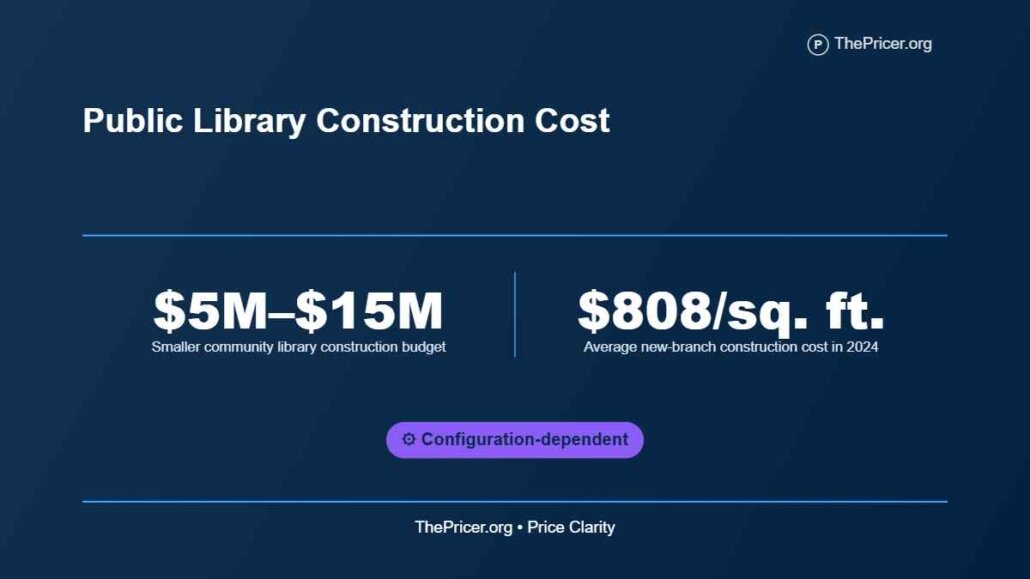
Building a new public library in the United States can cost approximately $5 million to $15 million for a smaller community branch, while a larger 20,000-to-30,000-square-foot library may require $15 million to $30 million or more.
Major urban and central libraries can exceed $40 million to $100 million. These are project-planning ranges based on published construction programs, not a national price schedule.
The Urban Libraries Council reported average new-branch construction costs of approximately $808 per square foot for projects started in 2024. More recent municipal estimates vary substantially. Broken Arrow, Oklahoma, proposed a 20,000-square-foot branch with $10.2 million in building and site costs plus $2.8 million for furnishings, equipment, books, and technology.
The largest budgeting mistake is treating a contractor’s building price as the cost of opening a working library. Land, architecture, parking, computers, shelving, book collections, contingencies, and financing may be outside the construction contract.
Article Highlights
Jump to sections
- A smaller new public library can require approximately $5 million to $15 million, depending on size and project scope.
- The Urban Libraries Council reported an average of about $808 per square foot for new branches started in 2024.
- Broken Arrow’s proposed 20,000-square-foot branch carries a combined building and equipment estimate of $13 million.
- Riverside, California, budgets $21.48 million for a 15,000-square-foot new library.
- Williamsburg, Virginia, estimates approximately $37.2 million for its planned 50,000-square-foot downtown library, including specified additional soft costs.
- Furniture, technology, collections, land, temporary facilities, and financing can create major costs beyond the contractor’s bid.
How Much Does a Public Library Cost to Build?
The cost of a public library depends on building area, location, architectural requirements, the level of interior finishing, and whether the project replaces an existing library or creates an entirely new location.
The Urban Libraries Council’s 2025 report recorded 29 new branch construction starts during 2024. Its reported average construction cost was approximately $808 per square foot, compared with $695 for the previous year’s sample.
Those figures come from surveyed urban library systems, not every library built nationally. Individual municipal estimates can fall below or above the reported average.
| Library project | Reported budget | Building size |
|---|---|---|
| Broken Arrow, Oklahoma | $13.0 million | 20,000 sq. ft. |
| Riverside Eastside, California | $21.48 million | 15,000 sq. ft. |
| Williamsburg, Virginia | $37.2 million | 50,000 sq. ft. |
| Rego Park, New York | $39 million | Replacement branch |
| Douglaston-Little Neck, New York | $40.2 million | Replacement branch |
| Southdale, Minnesota | $106.8 million | Large redevelopment |
These are project budgets with different inclusions, rather than identical construction-only bids. Some include demolition, site preparation, equipment, or other improvements.
What Real Municipal Projects Cost
Municipal approvals offer particularly useful evidence because they identify what a public agency is planning to purchase and how the project is funded.
In January 2026, Broken Arrow’s library proposal identified approximately $10.2 million for a 20,000-square-foot building and site, plus $2.8 million for books, computers, furnishings, and other unattached items.
The combined estimate is $13 million, equal to $650 per square foot. The proposal included plans for a children’s outdoor amphitheater and a makerspace.
Riverside Public Library’s Eastside Library project has a published budget of $21,479,105 for a 15,000-square-foot building scheduled to open in 2027.
That works out to approximately $1,432 per square foot when the full reported project budget is divided by its building area. It should not be mistaken for a direct building-contractor unit rate.
Williamsburg’s September 2026 library agreement establishes a $32,347,826 design-build contract total, including previously paid interim design costs, plus $4,852,174 in estimated additional soft costs.
That produces an overall planned amount of approximately $37.2 million for a 50,000-square-foot downtown facility, or $744 per square foot.
Construction Cost Per Square Foot
 Cost per square foot is useful for early planning, but only when the same categories of spending are included in each comparison.
The City of Phoenix’s library infrastructure cost plan uses an estimated $8,791,604 for a 13,000-square-foot branch, equivalent to approximately $676 per square foot.
That estimate includes construction, design, engineering, and permits, but excludes separately purchased library equipment and land, which the city already controls for the modeled sites.
The Urban Libraries Council’s roughly $808 average is higher than Phoenix’s modeled unit figure, but this does not prove the Phoenix estimate is insufficient. Geography, project dates, building requirements, and cost definitions differ.
For a preliminary project, a municipality might test several all-in budgets between $600 and $1,000 per square foot, provided it verifies whether site work, books, equipment, design fees, and contingency are included. This is a sensitivity range rather than a universal 2026 construction price.
A 15,000-square-foot library at those assumed all-in rates would cost approximately $9 million to $15 million. A difficult site or distinctive civic building could exceed that range considerably.
Land, Parking, and Site Preparation
Acquiring the property can be a major expense in established neighborhoods and central business districts. A library also needs safe pedestrian access, accessible routes, deliveries, parking where appropriate, and connections to public utilities.
The San Juan Island Library’s building project documents describe a roughly $20 million project, including earlier property acquisition and design-related expenditures.
The library identifies approximately $14.5 million in construction costs including furniture, fixtures, and equipment, with property-related borrowing and professional services contributing to the broader budget.
For a smaller library, previously owned municipal land can substantially reduce the cash required. However, using existing land does not eliminate utility improvements, surveying, stormwater controls, or site engineering.
ThePricer’s church construction cost guide examines comparable community-facility issues, including parking, site preparation, and infrastructure beyond the building footprint.
On constrained urban sites, underground parking and complex foundations can be especially expensive. The design may also require demolition and temporary relocation of existing services.
Furniture, Books, and Technology
A public library is not ready to open when its walls and roof are completed. Shelving, seating, service desks, public computers, security systems, digital infrastructure, and book collections require additional purchases.
Broken Arrow’s proposal is particularly useful because it prices unattached furniture, equipment, technology, and collections separately at $2.8 million.
That represents approximately 21.5% of its combined $13 million building-and-equipment estimate.
Applying the same percentage to a different library would be only an illustration, not a reliable price formula. Collection size, the amount of existing material being transferred, and digital-service requirements can change the result.
For a smaller renovation, Napa County’s 2025 procurement allocated $220,000 to furniture-related work for the American Canyon Library Remodel, including associated management and contingency.
That contract demonstrates how a furniture package can be procured separately from general construction.
Computers, software, printers, public Wi-Fi, audiovisual equipment, and makerspace tools also have future replacement cycles. They are not one-time costs for the lifetime of the building.
A Complete 20,000-Square-Foot Budget
Consider a municipality planning a new 20,000-square-foot neighborhood library on publicly owned land, using Broken Arrow’s documented building and equipment estimates as the main reference.
Assume the building and site construction budget already includes ordinary contractor work. Add explicit allowances only for additional owner-side costs outside those quoted amounts.
- Building and site construction: $10,200,000
- Furniture, technology, and collection: $2,800,000
- Additional owner-side professional costs: $500,000
- Project administration and opening preparation: $300,000
- Reserve for additional scope and price changes: $1,200,000
The modeled total is $15 million, or $750 per square foot.
The additional professional costs, administration, and reserve are illustrative allowances. Before applying them to an actual proposal, the municipality must verify which are already included in construction, program management, or equipment contracts.
The $1.2 million reserve is 8% of the total modeled budget and approximately 8.7% of the pre-reserve amount. It is money allocated for possible risks, not spending that is certain to occur.
The model excludes land acquisition, financing interest, unusual environmental remediation, and any temporary library facilities.
The Hidden Cost of Project Scope
The least visible risk is not always a dramatic architectural feature. It is an incomplete definition of what the approved budget actually buys.
The Southdale Library project in Minnesota has an estimated $106.8 million budget. Hennepin County explains that the amount covers consulting, demolition, stormwater work, landscaping, furniture, technology, and other soft costs.
Its scope also includes substantial site redevelopment and parking, making the total unsuitable for comparison with a straightforward single-story branch on an uncomplicated site.
In New York City, the Douglaston-Little Neck replacement project carries a $40.2 million budget including demolition, design, and construction.
A separate Rego Park library project is budgeted at approximately $39 million, also involving demolition and replacement.
A contractor bid that excludes those additional categories can appear much cheaper without offering a truly comparable project.
Renovation Versus New Construction
Renovating an existing library or adapting another building can save money when the structure has appropriate floor heights, load capacity, access, utilities, and room layouts.
However, converting an older structure can also introduce costs for fire protection, elevators, structural reinforcement, asbestos removal, electrical systems, and accessibility improvements.
Lincoln City Libraries is pursuing an 80,000-square-foot adaptive reuse project at a total estimated cost of $58.8 million, using a former educational and commercial building.
That works out to approximately $735 per square foot on a total-project basis. The city describes the reuse approach as less expensive than its alternatives, although that conclusion is specific to its building and proposals.
Lake Forest Library’s capital project budget allocates $24 million for historic restoration, expansion, furniture, and technology.
For general building-cost context, ThePricer’s apartment construction price analysis shows how site conditions, building systems, and soft costs affect large construction programs. Apartment cost-per-square-foot figures should not be substituted directly for public library prices.
Annual Operating Costs After Opening
Constructing a library and operating it are separate financial commitments. Staff salaries, utilities, maintenance, collections, programming, cleaning, insurance, and technology subscriptions continue year after year.
Pickerington Public Library’s new branch proposal estimates approximately $3 million annually to operate a full-service 25,000-to-28,000-square-foot location.
The library notes that the proposal replaces an existing location, so the full amount would not necessarily be additional spending beyond the current system budget.
If a newly constructed library required $15 million in capital spending and $1.5 million annually in operating expenses, a ten-year undiscounted planning total would be $30 million, assuming unchanged yearly costs.
That calculation excludes financing interest, major capital replacements, inflation, and any residual asset value. It is a useful illustration of why approval of the construction budget alone does not ensure long-term financial sustainability.
How Communities Pay for Libraries
Funding can come from municipal bonds, capital reserves, state grants, charitable donations, development contributions, and other local programs.
Williamsburg’s project financing plan includes municipal borrowing and planned private fundraising toward furniture and other soft costs. Riverside’s published funding schedule combines state grants and several local funding sources.
Borrowing spreads the payment over future years but creates interest expenses. The construction budget and the eventual total bond repayment are therefore different measures.
Makes sense if
- The community has established a realistic service-area and building-size requirement.
- The project budget includes furniture, books, technology, site work, and professional costs.
- The long-term operating budget can support staffing and maintenance.
- Renovation and adaptive reuse have been assessed against equivalent new-build scope.
Does not make sense if
- A construction-only bid is presented as the complete project cost.
- The proposed building is much larger than demonstrated community demand.
- Operating expenses are ignored when committing to capital borrowing.
- Contingency is omitted despite incomplete plans, site uncertainty, or a lengthy construction schedule.
Answers to Common Questions
How much does a small public library cost to build?
A small new branch may require approximately $5 million to $15 million, depending on its floor area, site, and equipment. This is a planning range, not a standard nationwide construction price.
How much does a library cost per square foot?
The Urban Libraries Council reported approximately $808 per square foot for new branches started in 2024. Actual project budgets vary depending on whether land, furnishings, and other costs are included.
Does the building budget include books?
Not always. Some municipal projects budget collections, shelves, public computers, and furnishings separately. Broken Arrow’s proposal includes an additional $2.8 million for those and related items.
Is renovating an existing building cheaper than constructing a new library?
It can be, particularly when the structure and utilities are suitable. Extensive accessibility, structural, electrical, or environmental repairs can eliminate those savings.
How much does it cost to operate a public library?
Operating expenses vary with size and services. Pickerington estimates approximately $3 million annually for its proposed full-service 25,000-to-28,000-square-foot branch, which would replace an existing location.
Disclosure: Educational content, not financial advice. Prices reflect public information as of the dates cited and can change. Confirm current rates, fees, taxes, and terms with official sources before purchasing. See our methodology and corrections policy.