
How Much Does a Puppy Cost in the First Year?
Published on | Written by Alec Pow
This article was researched using 12 sources. See our methodology and corrections policy.
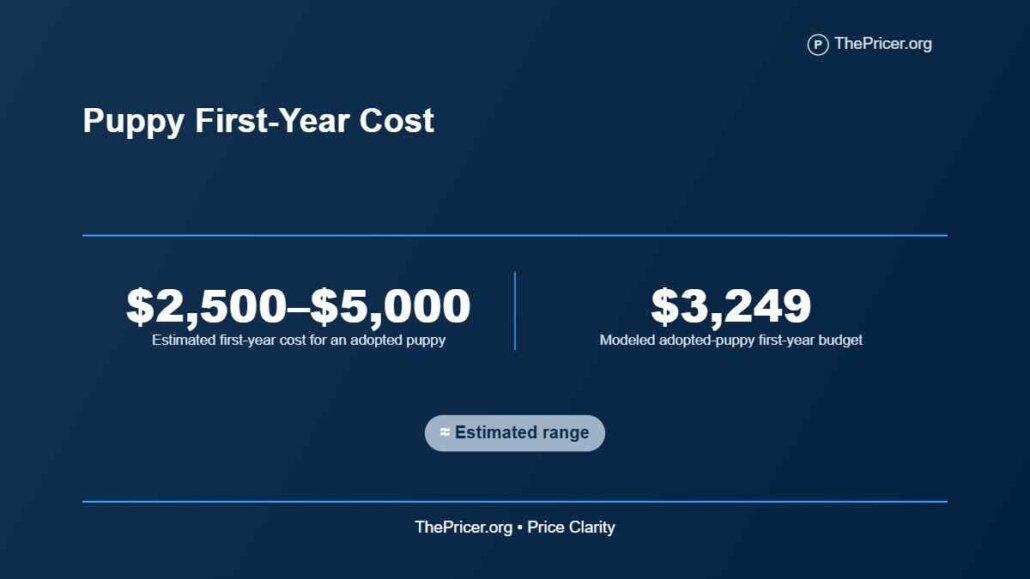
A puppy’s first year can cost an estimated $2,500 to $5,000 when adopted or $4,500 to $8,000 when purchased from a breeder in the United States. These are planning budgets for acquisition, supplies, routine veterinary care, food, basic training, and selected recurring expenses. Frequent paid care, expensive diets, or serious illness can push the total higher.
The purchase price is only one part of raising a puppy. A shelter fee may include surgery and microchipping, while a breeder purchase may leave those bills to the buyer. The useful comparison is the first 12 months after bringing the puppy home, with included services removed from the budget and emergency savings kept separate from money actually spent.
Article Highlights
Jump to sections
- Plan roughly $2,500 to $5,000 for an adopted puppy’s first year, depending on included care and household choices.
- A breeder puppy can bring the first-year planning budget to $4,500 to $8,000, with higher prices possible.
- The itemized adopted-puppy scenario below totals $3,249, excluding emergencies and paid daytime care.
- Three weekly paid visits for 36 weeks add at least $2,592 at the illustrated starting rate.
- A separate $1,000 emergency reserve raises the example’s cash target to $4,249, but is not an expense unless used.
How Much Does a Puppy Cost in the First Year?
A first-year puppy budget covers three different commitments. Acquisition gets the animal home. Setup provides equipment and a suitable living space. Ongoing care pays for feeding, veterinary services, training, and any help the household needs. Mixing these commitments produces misleading comparisons, especially when one estimate includes the puppy and another covers care alone.
Rover’s 2026 research lists puppy annual care costs of $1,460 to $6,745, alongside separate acquisition and setup figures. Its listed breeder acquisition range is $675 to $4,440, and essential starter supplies run $260 to $1,125. Those categories should not be added blindly because equipment and medical services can overlap. The planning budgets above use a coherent basket instead of adding every published maximum.
Define the dates before making your own estimate. Twelve months of ownership beginning at eight weeks of age extend beyond the puppy’s first birthday. A birthday-based budget includes fewer months of owner-paid food and care.
Also decide whether insurance and professional grooming belong in the basket. Neither should appear as an unexplained mandatory fee.
A workable budget identifies what you will buy, what the adoption or purchase contract already provides, and which expenses remain conditional.
Adoption Versus Breeder Prices
A documented low acquisition price comes from Florida’s Humane Society of Polk County, which lists a $200 puppy adoption fee and includes surgery and starter veterinary care, a microchip with registration, and the first set of shots. That is a local offer, not a national adoption average. The vaccination history still matters because an initial dose does not pay for all future care.
Breeder purchases should be compared through the written contract, health records, and services included. A chosen $2,000 purchase allowance sits within the researched acquisition range, but it is an illustration rather than a quote for every breed. Travel, delivery, deposits, and sales tax should be added only when they apply to the actual transaction. A deposit credited toward the purchase price is not another full acquisition charge.
For the worked budget below, replacing the $200 adoption with a $2,000 breeder purchase adds $1,800. If that puppy also needs a chosen $500 surgery allowance and $40 for identification, the first-year scenario rises from $3,249 to $5,589. The calculation assumes neither service was included. This $2,340 difference shows why comparing the two acquisition prices alone understates the possible gap. It does not establish that every breeder puppy needs the same additional care.
Veterinary Bills and Timing
Routine puppy care is a sequence of appointments, not one vaccination purchase. PetMD’s veterinarian-reviewed guidance estimates $300 to $350 for an initial puppy veterinary visit including the described services, and explains that records help avoid unnecessary repeat care. That figure is broader than an exam-only fee. Ask for a written estimate showing the exam, vaccines, tests, deworming, and medication separately.
Low-cost clinics can change the total. Nevada Humane Society lists $15 each for rabies and DHPP vaccination, $20 for microchipping, and dog surgery appointments at $200 for males or $250 for females, with needed vaccines and microchipping included in its low-cost veterinary service packages. Its Reno surgery program has residency requirements, and appointments depend on availability. These offers demonstrate a lower-cost route without establishing what a private hospital will charge elsewhere.
The example allocates $450 for remaining routine visits, vaccines, and tests after adoption, plus a chosen $330 annual parasite-prevention allowance. Both need adjustment to the puppy’s records and local prescription quote.
Do not count medicine inside a clinic plan and then charge it again separately. Surgery timing can also move a bill into year two. The veterinarian should determine the schedule, while the owner keeps the future expense visible rather than treating a delayed procedure as a permanent saving.
Food and Puppy Equipment
 Food spending depends on the diet, quantity consumed, and package size. Chewy lists Purina ONE large-breed puppy food at $31.58 for 16.5 pounds, $49.98 for 31.1 pounds, and $61 for 40 pounds on its puppy food size options. These are listed purchase prices, excluding any applicable tax, and are different from the first-order Autoship promotion. One discounted shipment is not a yearlong food price.
Using those prices, the smaller bag costs about $1.91 per pound and the 40-pound bag about $1.53 per pound. For an explicitly assumed 300 pounds of the same food, the proportional cost is about $574 versus $458, a difference of roughly $117 before whole-bag rounding, waste, tax, and delivery. That calculation measures purchasing efficiency. It does not prescribe how much a puppy should eat, and a bulk purchase loses value if food is wasted.
The worked budget uses $600 for food and $150 for treats and chews as chosen allowances, not universal feeding requirements. Its $350 equipment allowance covers a crate or pen, bed, bowls, leash, collar, brushes, and basic cleaning supplies. Compare washable, suitable equipment before paying for decorative upgrades.
The cost of a dog bed is one component of setup, and replacements belong in a separate allowance when they are likely purchases.
Training and Coat Care
Basic group training has a published price anchor. Petco says its puppy training courses start at $149. That supports the single-course allowance used below. It does not cover unlimited private instruction, specialized behavior treatment, or residential training. Compare the course length, class format, and follow-up options before substituting one program for another.
Owners who need individual help should price it as an extra service. The cost of professional dog training depends on the type of instruction, so an advertised puppy class should not stand in for a complex behavior program.
A class also does not replace the household’s practice time. Choosing a less expensive course only reduces the cash budget if the format actually addresses the owner’s needs.
Coat care creates another recurring difference. Kiplinger reports $40 to $100 per salon grooming visit and $70 to $150 for mobile grooming in its discussion of training and grooming expenses. Four chosen salon visits at $60 produce the example’s $240 allowance.
Eight visits at $90 instead cost $720, adding $480 to the same budget. Actual frequency depends on the coat and services required. Nail care, brushing tools, and professional haircuts should be distinguished so that an apparently cheap grooming plan does not omit needed work.
A Worked Puppy Budget
This illustrative budget uses the documented $200 adoption offer, the published $149 training starting price, and explicitly chosen allowances for the other categories. It assumes surgery and microchipping are included in adoption, the owner provides daytime care, and the puppy has no major illness. Food, medical, and equipment allowances are informed by the evidence above but are not provider quotations.
| First-year expense | Illustrative U.S. budget | Scope |
|---|---|---|
| Puppy adoption | $200 | Documented local fee with included services |
| Initial equipment | $350 | Chosen setup allowance |
| Food | $600 | Chosen 12-month allowance |
| Treats and chews | $150 | Chosen annual allowance |
| Remaining routine veterinary care | $450 | Chosen allowance after included adoption care |
| Parasite prevention | $330 | Chosen allowance, confirm prescription quote |
| One training course | $149 | Published starting price |
| Pet insurance | $600 | Assumed premium of $50 monthly |
| Professional grooming | $240 | Four assumed visits at $60 |
| Replacement supplies and cleaning | $150 | Chosen allowance |
| Local licensing | $30 | Placeholder budget allowance, check municipality |
| Total planned spending | $3,249 | Excludes emergencies, paid care, travel, and tax |
The listed items sum to $3,249. Adding a chosen $1,000 emergency reserve gives a cash target of $4,249. Insurance is included as a budget assumption, not a national puppy premium. Obtain a quote before relying on it. The licensing row is also an allowance rather than a researched municipal fee. Replace each assumption with an actual offer before committing.
Cash timing matters. The adoption, equipment, and training rows alone require $699, before the first food purchase, veterinary appointment, and insurance payment. Dividing the whole annual total by 12 would conceal that opening commitment.
A household that already owns suitable equipment can reduce setup spending, but should retain money for growth-related replacements and consumables.
The Hidden Price of Daytime Care
Paid care can exceed the acquisition fee. Wag advertises 30-minute dog walks starting at $24, with the complete booking price shown before confirmation. Treat that as a starting rate. Location, caregiver pricing, and the final booking terms determine the payable amount, and a young puppy’s care needs may call for a different visit arrangement.
At that starting rate, an assumed three visits weekly for 36 weeks cost 3 × 36 × $24 = $2,592, before any extra charges or tips. Adding that service schedule to the adopted-puppy example produces $5,841 in planned spending. Five visits weekly for the same period cost $4,320, lifting the example to $7,569. This sensitivity calculation explains why a modest acquisition fee can still accompany an expensive first year.
The service schedule is illustrative, not a recommendation about leaving a puppy alone. Price the help your household actually needs, including holidays and backup arrangements. Compare dog walking and pet sitting by visit length and frequency.
A paid walker, drop-in sitter, daycare facility, and overnight boarder provide different services. Rental pet charges, damage, transport, and vacation care sit outside this example and should be added from the lease or actual quote.
Planning Beyond the Purchase
Insurance and savings do different jobs. Embrace’s coverage FAQ distinguishes its accident-and-illness policy from routine wellness expenses and exclusions, including pre-existing-condition rules. Check the deductible, reimbursement percentage, annual limit, waiting periods, and payment process. A premium is a recurring expense. A reserve is available cash. Neither guarantees that every veterinary bill will be paid.
The model uses a chosen $50 monthly premium and a separate emergency reserve without assuming a claim. Removing that premium lowers the illustrated spending total to $2,649, but leaves the household with the corresponding uninsured exposure. That is a budget comparison, not a prediction of which option will save money. Year two also needs its own estimate because acquisition drops out while food, prevention, and other recurring bills remain.
Makes sense if
- You can pay for setup and routine care without using the emergency reserve.
- Your schedule or priced support plan covers the puppy’s daily needs.
- You have checked included medical care, insurance terms, and housing permission.
Does not make sense if
- The purchase price consumes the entire available pet budget.
- Your estimate depends on unconfirmed free services or unavailable clinic appointments.
- You have omitted paid care that your work schedule requires.
Answers to Common Questions
Can a puppy cost less than $2,500 in the first year?
Yes. Included adoption care, existing equipment, and lower service spending can reduce the bill. That does not make $2,500 a guaranteed minimum or justify omitting care the puppy needs.
Is the puppy’s purchase price included?
Yes, the planning ranges here include acquisition. The worked adopted-puppy total includes a $200 fee, while the breeder comparison substitutes an assumed $2,000 purchase.
How much emergency money should be added?
The example adds a chosen $1,000 reserve. That is a planning choice, not a maximum veterinary bill. Adjust it to available cash, insurance terms, and local emergency-clinic estimates.
Does adoption cover all first-year vaccinations?
Not necessarily. The adoption offer may cover only age-appropriate doses already administered. Have the veterinarian review the records and price the remaining schedule.
Disclosure: Educational content, not medical advice. Pricing varies by provider, location, and insurance. Confirm eligibility, coverage, and out-of-pocket costs with a licensed clinician and your insurer. See our methodology and corrections policy.