
How Much Does A Queen Mattress Cost?
Updated on | Researched and reviewed by Alec Pow, Founder & Pricing Investigator
Prices, claims, and calculations checked against 13 cited sources. See our research methodology and corrections policy.
A queen mattress typically costs $300 to $2,000 in the United States, although basic models can sell for under $300 and luxury mattresses can exceed $5,000. Budget queen mattresses commonly cost $250–$700, midrange models $700–$1,500, and premium mattresses $1,500–$3,000 or more. A standard queen measures 60 inches wide by 80 inches long.
For many shoppers, $700–$1,200 is a useful initial budget for comparing quality foam and hybrid mattresses. However, a higher price does not guarantee greater comfort or durability. Delivery, the required foundation, return charges, and old-mattress disposal also affect what replacing a bed actually costs.
Article Highlights
Jump to sections
- $250–$700 covers budget foam and innerspring queen mattresses.
- $700–$1,500 is a common midrange budget for foam and hybrid models.
- $1,500–$3,000+ covers many premium innerspring, hybrid, and latex mattresses.
- IKEA currently advertises a queen VESTERÖY for $299 and a VALEVÅG for $399.
- Some mattress trials have fees. Saatva charges $99 for mattress returns or exchanges.
- A matching foundation, delivery arrangements, and removal of the old mattress may change the checkout total.
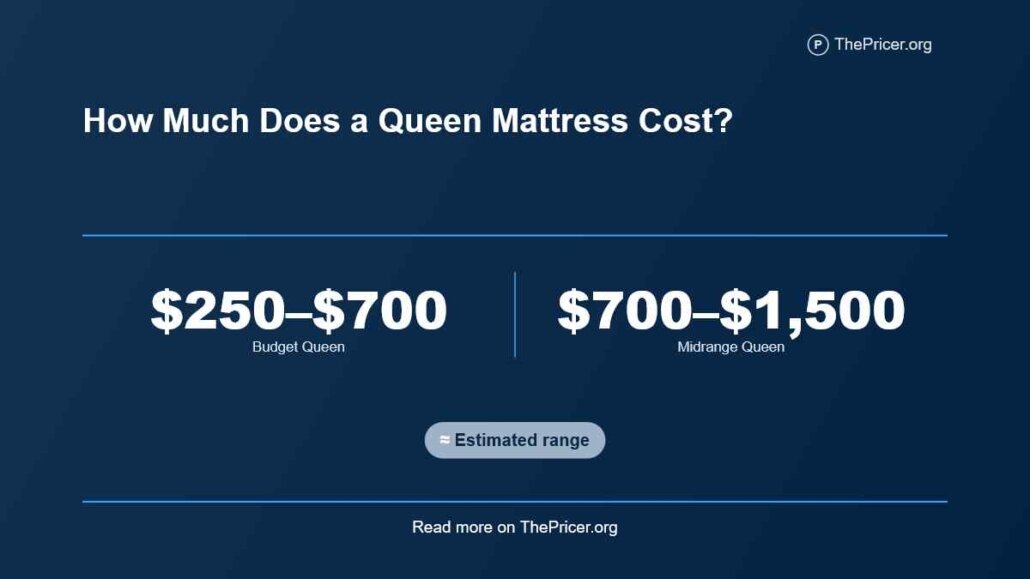
How Much Does a Queen Mattress Cost?
Queen mattress prices vary by construction, materials, retailer, and current promotions. The following ranges describe broad U.S. shopping categories rather than statistically measured national averages.
| Mattress category | Typical queen price | Common construction |
|---|---|---|
| Economy | $150–$350 | Basic foam or springs |
| Budget | $350–$700 | Foam, pocket springs |
| Midrange | $700–$1,500 | Memory foam, hybrids |
| Premium | $1,500–$3,000 | Advanced hybrids, latex |
| Luxury | $3,000–$5,000+ | Specialty and adjustable beds |
The Sleep Foundation mattress-cost analysis identifies average queen prices of approximately $600 for budget mattresses, $1,000 for midrange models, and $1,800 for luxury models within its pricing categories.
A separate Sleepopolis mattress-price analysis uses somewhat higher category boundaries. Its review of 195 mattresses found that the two models with the highest combined ratings were both priced below $1,000.
Those findings support comparing construction and independently tested performance instead of assuming that a luxury price automatically buys better sleep.
Actual Queen Mattress Prices
Published retailer prices make the differences between price categories easier to understand.
| Queen mattress | Advertised price |
|---|---|
| IKEA VESTERÖY | $299 |
| IKEA VALEVÅG | $399 |
| Costco Novaform ComfortGrande | $419.99–$719.99 size-dependent range |
| Brooklyn Bedding CopperFlex | $649 |
| Helix Midnight, selected queen configuration | $1,183 |
| Leesa Sapira Chill Hybrid | $1,698 |
| Saatva Classic | $1,795 reviewed price |
| WinkBed | $2,570 reviewed price |
IKEA’s U.S. queen mattress catalog lists VESTERÖY and VALEVÅG at $299 and $399 respectively. These are mattress-only offers.
Costco’s queen mattress selection provides additional mainstream options, including Novaform memory foam mattresses and Sealy models. Its displayed price ranges may include multiple sizes, so buyers must select queen before comparing exact totals.
For more expensive options, Sleep Foundation’s 2026 testing lists the Brooklyn Bedding CopperFlex at $649, Helix Midnight Luxe at $1,874, and Saatva Classic at $1,795 among reviewed queen models.
These prices are snapshots, not guaranteed checkout amounts. Promotions, firmness choices, cooling upgrades, and selected configurations can change the price.
Costs by Mattress Material
Construction has a major influence on price, although material labels alone reveal little about whether a mattress will suit an individual sleeper.
Innerspring mattresses
Budget spring mattresses can cost $250–$600, while better-equipped innerspring models frequently reach $600–$1,200. Premium designs can cost substantially more.
Traditional interconnected coils and individually pocketed springs offer different movement and support characteristics. Pocketed coils can reduce the transfer of movement between sleepers, but comfort layers and the surrounding construction remain important.
IKEA’s queen VALEVÅG pocket-spring mattress costs $399 and includes a ten-year limited warranty.
Memory foam mattresses
Queen memory foam mattresses commonly cost $250–$1,500, with luxury versions priced higher. Differences include foam density, thickness, firmness, edge support, and materials used to address heat retention.
Independent mattress testing under $1,000 identifies multiple foam and hybrid models that performed well without requiring luxury-level spending.
Hybrid mattresses
Hybrids combine springs with substantial comfort layers, commonly foam or latex. Prices can begin below $1,000, but higher-end queens often cost $1,200–$3,000.
The Helix Midnight pricing configurator shows how options change the cost. A selected queen configuration with a standard knit cover was advertised at $1,183 during a promotion. Upgraded cooling and support layers cost extra.
Latex and adjustable mattresses
Latex queens often cost $1,000–$3,000+, depending on the amount and type of latex, certifications, and construction. Natural latex can cost more than conventional polyurethane foam.
Adjustable-firmness mattresses occupy another market segment. Sleep Number’s mattress catalog includes models priced from approximately $999 to several thousand dollars, plus specialized systems exceeding $10,000. Prices for adjustable bases and bundled equipment require separate inspection.
Hidden Mattress Replacement
A new mattress may require additional purchases beyond the advertised price. The most important question is whether the existing bed frame and foundation can support the new product under its warranty terms.
Potential expenses include a foundation, mattress protector, delivery, assembly, old-mattress removal, and sales tax. An adjustable base can add substantially more than a conventional support system.
For example, IKEA sells a queen VALEVÅG with a NISSEHOLM mattress pad for $548. The combined mattress package costs $149 more than the $399 mattress alone.
That difference buys an additional mattress pad, not merely an identical mattress at a higher price. This distinction matters when comparing product bundles.
Before replacing the foundation, inspect its condition and the new mattress manufacturer’s support requirements. Some mattresses can work on closely spaced slats or a suitable platform without a traditional box spring.
The cost of manufacturing a mattress also offers context on how materials and distribution contribute to retail prices. Manufacturing cost should not be mistaken for a directly comparable consumer selling price.
Trials, Returns, and Delivery Fees
Mattress return policies can materially change the risk of purchasing an expensive bed. Trial length, minimum use periods, collection charges, and refund conditions vary among sellers.
Saatva’s 365-night mattress trial terms specify a $99 processing charge for a mattress return or exchange. The company also includes premium delivery services with eligible mattress purchases.
Helix advertises a 120-night trial with a minimum 30-night adjustment period for its mattresses, while IKEA’s queen mattress listings describe a 90-day exchange arrangement.
These are different offers. A 90-day exchange is not necessarily a full refund, and a 365-night trial is not automatically free to reverse.
Buyers should verify whether the seller will collect the mattress, whether the original delivery fee is refundable, and whether stains, damage, or lack of a suitable foundation affect eligibility.
A mattress offered with free delivery but a $99 return charge can create more financial risk than a similarly priced product offering free returns, particularly when the buyer has never tested the design.
A Complete Queen Mattress Budget
Consider someone replacing a queen mattress but retaining a compatible bed frame. The buyer selects IKEA’s $399 VALEVÅG, purchases a queen mattress protector, and arranges removal of the existing mattress.
The following is an illustrative budget. The mattress price is a published listing, while the other amounts are explicit planning allowances rather than a verified retailer quote.
| Expense | Cost |
|---|---|
| VALEVÅG queen mattress | $399.00 |
| Mattress protector allowance | $45.00 |
| Old mattress removal allowance | $75.00 |
| Illustrative 8% tax on mattress and protector | $35.52 |
| Estimated total | $554.52 |
This example excludes delivery and any new foundation. The removal allowance should be replaced with a local quote, and tax treatment depends on location.
Someone comparing the $399 mattress with a hypothetical $899 upgrade would spend $500 more upfront. Spread across eight years, that premium equals $62.50 annually, or approximately $5.21 per month.
The more expensive mattress makes financial sense only when its comfort, construction, support, or other benefits justify that additional amount. A higher price by itself does not establish a longer usable lifespan.
More Expensive Mattresses
Mattress durability depends on construction, use, body weight, care, and support. A warranty lasting ten or more years is not a guarantee that the mattress will remain comfortable for that entire period.
Suppose a $500 mattress lasts five years and a $1,200 mattress lasts nine years. Their annualized purchase costs would be $100 and approximately $133 respectively.
The premium mattress still costs more per year in that example, even with four additional years of use. It might nonetheless be the better purchase if it provides meaningfully better comfort or support.
Independent 2026 Saatva price research also shows why promotional timing matters. The Saatva Classic queen was advertised at approximately $1,904 during a September sale, compared with $2,229 before that discount.
For comparable products, a verified sale can matter more than an upgrade to a premium brand. Shoppers should compare actual recent selling prices rather than treating a large advertised percentage discount as proof of exceptional value.
Choosing the Right Queen Mattress

A standard queen provides 60 inches of width, giving two adults approximately 30 inches each. It is a practical size for many couples, although individual comfort preferences and bedroom dimensions determine whether it provides enough space.
The Sleep Foundation buying guidance recommends comparing sleeping position, body weight, preferred firmness, mattress type, and the full bedroom budget.
Side sleepers may prefer a surface that cushions shoulders and hips. Back and stomach sleepers often prefer stronger resistance to excessive sinking. Couples should also assess motion isolation and edge support.
Makes sense if
- A budget queen matches your actual comfort requirements.
- You pay more for materials or construction that address an identified problem.
- The bed includes suitable trial, warranty, and delivery terms.
- The mattress works with your existing foundation.
Does not make sense if
- You choose an expensive mattress primarily because of the brand name.
- The quoted price excludes mandatory accessories needed for warranty compliance.
- A costly cooling upgrade lacks convincing evidence of benefit for your needs.
- The return policy exposes you to unacceptable costs if the mattress is uncomfortable.
For a smaller room, a twin mattress may be more practical and less expensive. A queen remains the more useful comparison for two sleepers or someone who wants additional space without moving to a king-size bed.
Answers to Common Questions
How much should I spend on a good queen mattress?
A reasonable starting budget is $700–$1,200, but quality models are available below $700. Compare comfort, construction, materials, and return terms before spending more.
Can I buy a queen mattress for $300?
Yes. IKEA currently lists the VESTERÖY queen pocket-spring mattress at $299. Other economy foam and innerspring mattresses can fall within a similar price range.
How long should a queen mattress last?
Many buyers plan around seven to ten years, but actual lifespan varies considerably. Visible sagging, persistent discomfort, and declining support can justify replacement earlier. A long warranty does not guarantee the same number of years of satisfactory comfort.
Does a queen mattress need a box spring?
Not necessarily. Many mattresses can use a compatible platform or slatted foundation. Check the manufacturer’s requirements for spacing, support, and warranty coverage before eliminating or replacing a box spring.
Disclosure: Educational content, not financial advice. Prices reflect public information as of the dates cited and can change. Confirm current rates, fees, taxes, and terms with official sources before purchasing. See our methodology and corrections policy.