
How Much Does a Robinson R44 Helicopter Cost?
Published on | Written by Alec Pow
This article was researched using 17 sources. See our methodology and corrections policy.
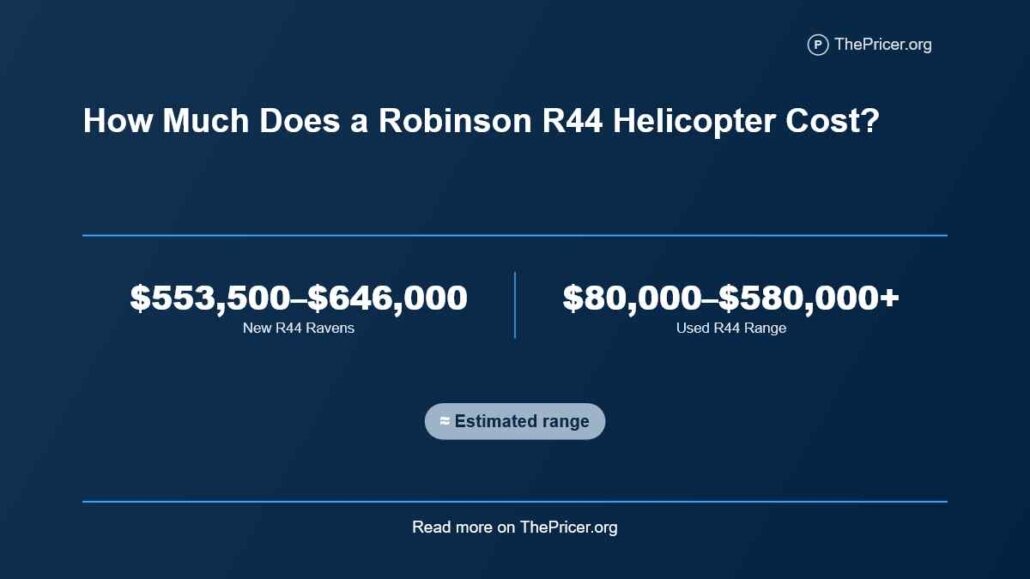
A new Robinson R44 helicopter costs $553,500 for a Raven I or $646,000 for a Raven II at the manufacturer’s 2026 U.S. suggested prices. The two-seat R44 Cadet starts at $520,000. On the used market, asking prices can range from about $80,000 for an aircraft approaching major work to $580,000 or more for a recently overhauled example. The least expensive listing is not necessarily the least expensive helicopter to own.
For a Raven II flown 100 to 300 hours annually, a practical planning calculation is approximately $51,800 to $112,300 per year for flying costs, overhaul reserves, manufacturer-modeled insurance, and a $600 monthly hangar allowance. That excludes the purchase, financing, depreciation, taxes, paid pilot, and unexpected major repairs. Higher-use owners spread fixed costs over more hours, but spend more in total.
Article Highlights
Jump to sections
- New Raven II: $646,000 before options, delivery, and applicable taxes.
- Used R44: roughly $80,000 to $580,000 across very different maintenance conditions.
- Factory Raven II hourly figure: $331.43 at 500 hours annually, including an overhaul reserve and modeled insurance, but not hangar rent.
- Full 2,200-hour overhaul budget: about $328,350 from current factory component and labor assumptions, subject to the aircraft’s actual condition and work scope.
- Rental alternative: an advertised $570 to $650 per flight hour at two U.S. helicopter schools, before applicable instructor charges, taxes, or surcharges.
How Much Does a Robinson R44 Helicopter Cost?
Robinson’s published 2026 operating-cost sheets identify three clear purchase starting points. The R44 Cadet cost sheet lists $520,000, the Raven I cost sheet lists $553,500, and Robinson’s Raven II cost sheet lists $646,000. These are standard-equipment figures, not dealer-delivered totals.
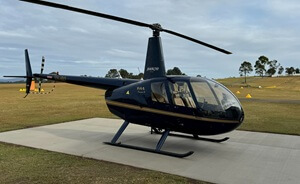
The Cadet is configured for two occupants and has a longer published overhaul interval of 2,400 hours. The Raven I and Raven II are four-seat helicopters, including the pilot. The Raven II has a fuel-injected engine and is a common comparison point for private owners, operators, and flight schools. Robinson’s Raven II specifications describe the aircraft and its equipment.
The 2026 R44 price list also places the float-equipped Clipper II at $689,500 with fixed floats or $776,500 with pop-out floats. This is a distinct mission-specific configuration, not the price of every Raven II.
Options change the cash price before the owner buys fuel or pays insurance. The published Raven II air-conditioning option is $27,400, leather seats $1,920, and metallic base paint $2,500. Adding those three to the standard helicopter gives $677,820, an increase of $31,820, or about 4.9%. That worked configuration excludes transport, tax, registration-related services, and other selected equipment. An actual aircraft quotation controls.
Used R44 Prices
Used R44 prices have unusually wide spreads because two helicopters of the same model year can have very different remaining flight hours, calendar life, overhaul status, records, and damage histories. One Robinson-focused dealer groups the market into approximately $80,000 to $160,000 for run-out machines, $200,000 to $400,000 for mid-life examples, and $440,000 to $580,000 for freshly overhauled aircraft. These are dealer guide ranges, not a verified national transaction-price index.
Actual advertised prices can sit outside those bands. Listings aggregated by PlanePHD’s marketplace have included a 2017 Raven II at $369,000, a 2015 Raven II advertised at $449,000, and a much older Raven I at $99,000. Asking prices are neither closed sales nor proof that two aircraft offer comparable remaining useful life. Verify that a listing is current and that its serial number, logs, and actual equipment match the advertisement.
A buyer comparing models should also consider the more general cost of buying a helicopter. A used R44 is less expensive than many turbine aircraft, yet a low sticker price can conceal a substantial near-term maintenance obligation.
What Ownership Costs
The largest recurring expense is not always fuel. The factory’s 2026 Raven II model allocates $153.60 per flight hour to direct running expenses and another $149.25 per hour to future overhaul work. That is $302.85 per flying hour before fixed insurance and parking. Its separate modeled annual insurance premium is $14,288 for a specific pilot-experience profile. At 500 hours a year, those components add up to Robinson’s published $331.43 per hour after rounding.
To show how fewer annual hours change a private owner’s cash planning, the following calculation keeps Robinson’s per-hour assumptions and adds $600 monthly hangar rent. That amount is an illustrative allowance within small-aircraft hangar-price territory, not a confirmed quote for an R44-sized space. Available door clearance, rotor dimensions, and airport restrictions can make helicopter storage more expensive. See the breakdown of hangar space costs when requesting local quotes.
| Annual flying | Variable costs and reserve | Insurance and hangar | Annual total | Effective hourly cost |
|---|---|---|---|---|
| 100 hours | $30,285 | $21,488 | $51,773 | $517.73 |
| 300 hours | $90,855 | $21,488 | $112,343 | $374.48 |
| 500 hours | $151,425 | $21,488 | $172,913 | $345.83 |
Calculation: annual cost = flight hours × $302.85 + $14,288 insurance + $7,200 hangar. The owner flying 300 hours has an effective cost about $143.25 per hour lower than the 100-hour owner, because the same fixed expense is distributed over three times as many hours. Yet the 300-hour owner spends $60,570 more per year. Using the aircraft more does not reduce the annual bill.
Fuel alone is meaningful. Robinson uses 15 gallons per hour and $6.51 per gallon in its Raven II estimate, resulting in $97.65 per hour for fuel. An airport charging $8.00 per gallon would raise that component to $120 per hour, adding $22.35 for every flight hour, or $6,705 over 300 hours. Fuel availability and actual consumption vary by operation. Independent ownership modeling also uses higher local fuel assumptions, which helps explain why owner estimates do not all match Robinson’s published figure.
Overhaul and Hidden Costs
 A Robinson R44’s 2,200-hour overhaul framework makes remaining component life central to any valuation. The factory Raven II reserve uses $207,200 for the aircraft overhaul kit, $91,900 for engine work, and 225 labor hours at $130, or $29,250. Together these produce a modeled full-work cost of $328,350 and the $149.25-per-hour overhaul reserve. Additional repairs, shop rates, shipping, removed-component conditions, and downtime may change the final bill.
A specialist’s overhaul kit quotation also shows a $20,150 core deposit for the Raven II kit. That can raise the initial cash needed for parts, but it is potentially refundable when acceptable cores are returned under the supplier’s terms. It should not automatically be counted as a permanent cost on top of the factory kit price. The same dealer’s overhaul decision guide describes total work in the $300,000 to $350,000 territory, before aircraft-specific exceptions.
A useful used-aircraft test: suppose a near-run-out Raven II is offered for $120,000. Adding the modeled $328,350 full overhaul gives an effective $448,350 purchase-plus-overhaul commitment, before prebuy inspections, downtime, taxes, transport, and unforeseen parts. That is already within the reported $440,000 to $580,000 band for freshly overhauled listings. The difference is the buyer’s overhaul exposure, not just the advertised price.
Hours and calendar age must be treated separately. A 12-year calendar event is not automatically identical in scope and price to the full 2,200-hour overhaul. A Robinson-focused dealer explains the 12-year inspection distinction, including situations where eligible components may remain in service after inspection. A separate maintenance regulation analysis notes that enforceable life limits, manufacturer instructions, and operating rules are not interchangeable. Commercial operating requirements can differ from private operations. A qualified Robinson maintenance specialist must determine which work and limits apply to the specific serial number and intended use.
Beyond major components, owners can encounter blade or component-life replacements, scheduled inspections, avionics repairs, paint damage, tiedown or hangar charges, annual training, and gaps while the aircraft is unavailable. A focused prepurchase inspection should reconcile airframe and engine logs, accident history, airworthiness directives, applicable life limits, and hours or dates remaining on major parts. These are reasons to buy condition and records, not only a model year.
Insurance and Financing
Robinson’s $14,288 annual Raven II insurance example is based on stated experience assumptions, including helicopter hours, time in an R44, and safety training. It is not a guaranteed premium for a new private buyer. Insurance quotations can change with hull value, pilot qualifications, use, location, liability limits, and deductibles. A 2026 helicopter insurance market report reinforces the importance of pilot experience and mission type.
Financing makes the up-front price more accessible while adding a separate financial obligation. As a transparent illustration, a $646,000 Raven II with a 20% down payment requires $129,200 down and a $516,800 loan, before tax and fees. At a hypothetical 8% annual interest rate amortized over ten years, the payment is about $6,270 per month, or $75,240 annually. That rate is an illustration, not an advertised helicopter-loan offer. Loan structures and borrower requirements differ, as covered by an aviation broker’s R44 financing discussion.
The annual ownership table does not include these loan payments, nor depreciation or the opportunity cost of cash tied up in the helicopter. Do not confuse the overhaul reserve, a provision for future work, with an invoice automatically paid each flight. An owner’s cash flows can be uneven even when the average hourly budget looks predictable.
Renting Versus Buying
Not every prospective R44 pilot needs to own one. Helicopter Academy of America advertises $570 per hour for R44 aircraft rental and $65 per hour for an instructor, putting a dual-instruction hour at $635 before any applicable adjustments. Another training provider, Quantum Helicopters, lists $650 per hour for solo R44 rental and $695 for dual instruction. These are school rates subject to location, eligibility, aircraft availability, taxes, and policies, not standardized nationwide charter prices.
At the first school’s advertised R44 rate of $570 per hour, 50 rental flight hours cost $28,500 before an instructor or surcharge. Under the self-flown ownership assumptions above, 50 hours cost $36,630.50 for variable expense, reserve, insurance, and hangar. In that simplified comparison, renting is $8,130.50 less before even considering the owner’s aircraft purchase or financing.
There is a mathematical crossover at about 80 hours annually: $21,488 fixed cost divided by the difference between $570 rental and $302.85 owner variable cost. This is not a universal buy-versus-rent threshold. It omits financing, depreciation, taxes, and ownership risk, while rental access and instruction needs may make the options incomparable. It illustrates why occasional pilots should calculate annual hours before committing capital.
Other Aircraft Options
The Raven II costs more than a Cadet but provides additional seating and a different mission profile. A family or operator requiring four seats should not compare it directly with a two-seat Cadet as if they were substitutes. The larger question is whether piston-helicopter payload, altitude performance, range, and operating limitations actually fit the planned flights.
Owners needing a turbine aircraft may consider a different price class, such as the AS350 helicopter. For recreational pilots whose mission does not require hovering or vertical landing, gyrocopters have a different and sometimes far lower cost structure, but they do not perform the same job. A single-seat experimental craft such as the Mosquito helicopter is not a four-seat certified R44 substitute.
Makes sense if:
- You need regular access to a four-seat helicopter and can realistically budget major maintenance.
- You fly enough hours to distribute fixed expenses without flying unnecessarily.
- You have qualified maintenance, insurance, training, and suitable storage arranged before delivery.
Does not make sense if:
- You expect the used asking price to represent the complete cost of a run-out aircraft.
- You fly only occasionally and suitable rental access is available.
- You cannot fund unscheduled repairs or time out of service.
Answers to Common Questions
How much does a new R44 Raven II cost?
Robinson’s 2026 standard-equipment suggested price is $646,000. Air conditioning, other options, delivery, taxes, and purchase-related fees increase the final amount.
What is the cheapest used Robinson R44?
Dealer guide ranges put some run-out aircraft at approximately $80,000 to $160,000. Those prices can precede extensive work. A current listing, logs, parts status, and a specialist prebuy inspection are more useful than the lowest search result.
How much does it cost to fly an R44 per hour?
Robinson models a Raven II at $331.43 per hour when it flies 500 hours annually, including its listed overhaul reserve and insurance. Adding illustrative storage raises the computed 500-hour cost to about $345.83 per hour. At 100 hours annually, fixed expenses lift the example to approximately $517.73 per hour.
Does an R44 need a $328,350 overhaul every 12 years?
No single dollar amount or work scope applies automatically to every 12-year event. The $328,350 figure is a modeled full 2,200-hour overhaul budget using current kit, engine, and labor components. Calendar inspections, mandatory component limits, and operating requirements must be reviewed for the individual aircraft.
Disclosure: Educational content, not financial advice. Prices reflect public information as of the dates cited and can change. Confirm current rates, fees, taxes, and terms with official sources before purchasing. See our methodology and corrections policy.