
How Much Does a Robot Vacuum Cost to Own Per Year?
Published on | Written by Alec Pow
This article was researched using 13 sources. See our methodology and corrections policy.
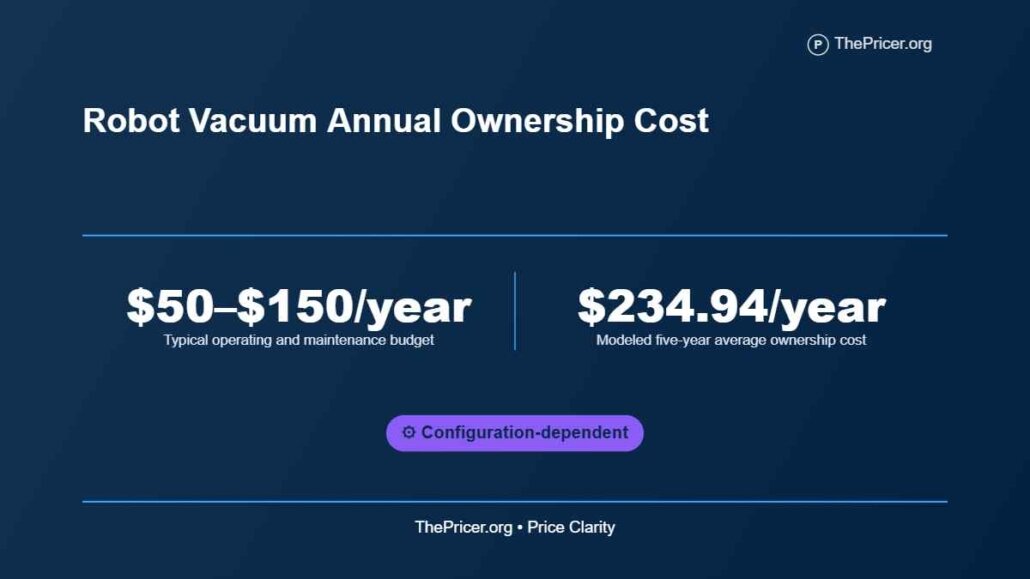
A robot vacuum costs an estimated $50 to $150 per year to operate and maintain for many ordinary U.S. households, excluding the original purchase and major repairs. Budget models without disposable dock bags can cost less, while premium vacuum-mop systems with automated washing stations can require $150 to $300 or more annually in replacement parts and cleaning supplies.
Including the purchase price spread over its useful life changes the calculation. A household buying a $400 robot and using it for five years has an additional $80 annual ownership cost before filters, brushes, electricity, bags, and repairs. The annualized total can therefore be substantially higher than the amount spent on maintenance.
We compared manufacturer accessory prices, replacement schedules, electricity data, and published product-lifespan guidance to separate unavoidable expenses from optional purchases.
Article Highlights
Jump to sections
- $50 to $150 per year is a practical estimated maintenance budget for many conventional robot vacuums, excluding major repairs.
- Official Roomba replacement-part kits currently range from $39.99 to $85.99 across several model families.
- Self-emptying docks introduce recurring dust-bag expenses that basic bagless charging stations avoid.
- Electricity can cost only a few dollars annually for an efficient setup, although power-hungry automated docks can use considerably more.
- Battery replacement, declining parts availability, and the purchase price can have a greater effect on lifetime ownership cost than electricity.
- Comparing machines over four to six years gives a more useful purchasing picture than comparing sticker prices alone.
How Much Does a Robot Vacuum Cost to Own Per Year?
A robot vacuum has several separate ownership expenses. Filters trap fine dust, brushes move debris into the suction path, and self-emptying stations may store collected dirt in disposable bags. Vacuum-mop combinations add washable or disposable pads, water-handling components, and sometimes proprietary cleaning products.
The amounts below are planning allowances rather than a national price survey. The estimates assume regular household use, compatible replacement parts, and no major mechanical failure.
| Annual expense | Estimated budget | What changes the cost |
|---|---|---|
| Replacement filters | $15–$50 | Model, cleaning frequency, filter lifespan |
| Main and side brushes | $15–$50 | Pet hair, carpeting, brush design |
| Self-emptying dust bags | $0–$50 | Dock type, debris volume, bag capacity |
| Mop pads and cleaning fluid | $0–$70 | Wet-cleaning equipment and frequency |
| Electricity | $3–$25 | Energy consumption, dock functions, local tariff |
| Major repairs | Variable | Age, warranty, component failure |
These categories should not simply be added at their maximum values. A basic robot may have no dust bags or wet-cleaning supplies. Replacement kits can also contain several components already counted individually.
Manufacturer pricing illustrates the differences. The Roomba replenishment kit listings include products costing $39.99 for certain newer series and $66.99 for e, i, and j-series machines. The s-series kit is listed at $85.99.
These are kit purchase prices, not guaranteed annual spending. Whether one kit covers a full year depends on its contents and the owner’s replacement schedule.
Filters and Brush Wear
Filters and brushes are among the most predictable expenses. Their replacement schedules vary more than buyers might expect.
According to iRobot’s i-series maintenance schedule, filters should be replaced every two months, while main brushes have a recommended replacement interval of six to twelve months. That works out to six filters and potentially one or two brush changes annually for that particular product family.
Newer designs have different intervals. The Roomba 100-series care schedule specifies filter replacement every three to six months and main-brush replacement every six to twelve months.
Current individual Roomba accessory prices include a three-pack of e, i, and j-series filters for $36.99, a three-pack of compatible edge-sweeping brushes for $19.99, and three replacement filters for certain 105 and Essential models for $19.99.
A household buying two $36.99 filter packs to obtain six filters spends $73.98 on filters alone. This illustrates why a robot with a frequent replacement schedule may exceed a modest annual maintenance budget.
Roborock provides another price comparison. Its official replacement accessory catalog lists selected two-filter packs at $32.99, with published replacement intervals varying by product family. Some compatible filters are recommended for replacement every three to six months, while others allow six to twelve months.
Pet hair, thick carpeting, and larger cleaning areas can accelerate wear. Removing tangled hair and cleaning sensors regularly can help avoid replacing otherwise usable components prematurely.
Self-Emptying Dock Expenses
Self-emptying docks reduce manual bin emptying, but bagged versions transfer the debris into disposable containers that owners must replenish.
iRobot lists selected three-packs of disposal bags at $19.99. At that price, six bags cost approximately $39.98, assuming two packs are purchased at the listed price.
A household using three bags annually spends the equivalent of roughly $20. Another household replacing a bag monthly could spend close to $80. These are usage scenarios, not measured average consumption.
Some models use substantially fewer bags. Capacity, dirt volume, household pets, and cleaning frequency determine how quickly they fill.
Bagless self-emptying designs can eliminate this particular purchase, although their bins and filters still require cleaning. When comparing two robots, calculate the dock’s consumable expenses separately from its convenience features.
Robot Mop Supplies
Hybrid vacuum-mop machines have additional consumables. Even when mop pads are washable, they eventually wear out. Automated washing docks may also require cleaning fluid and periodic tray maintenance.
Roborock lists its selected replacement mop accessories at prices including $25.99 for a two-pad pack and $29.99 for a four-pad pack, depending on the compatible model.
Premium maintenance can become substantially more expensive. The ECOVACS accessories catalog includes model-specific maintenance kits priced above $100, with some listed half-year kits above $160. These are product bundles, not evidence that every owner must buy the entire kit twice annually.
Check exactly which items a kit contains. Buying filters, brushes, pads, and complete maintenance bundles simultaneously can duplicate supplies.
The dock itself also needs attention. ECOVACS recommends regular robot vacuum cleaning, including clearing debris, wiping sensors, and periodically inspecting replaceable components. Neglect can reduce performance and potentially increase repair expenses.
Electricity and Charging
 Electricity is usually one of the smaller direct expenses, but the amount depends on the entire system rather than just the vacuum motor.
The U.S. Energy Information Administration reported an average residential electricity price of 18.31 cents per kWh for July 2026 in its national electricity price data.
Using that rate, a robot and dock consuming an illustrative 20 kWh annually would cost approximately $3.66 per year. At 60 kWh, the bill increases to $10.99. At 120 kWh, it reaches $21.97.
Those consumption levels are assumptions for comparison, not laboratory measurements of one machine.
Independent wattmeter reporting by French robot vacuum specialist L’AspiRobot estimated annual consumption of approximately 60 to 120 kWh for some robot-and-station setups, demonstrating why automated docks deserve separate attention.
Heated mop washing, pad drying, dust extraction, and standby power can all affect the annual result. The most accurate household figure comes from measuring the complete charging station with an electricity monitor over several representative cleaning cycles and standby periods.
A Worked Ownership Budget
Consider a U.S. household buying a self-emptying robot for an assumed $450. The following example uses published accessory prices and an illustrative electricity allowance. It is not a documented customer purchase or a manufacturer-approved maintenance schedule.
- Robot vacuum purchase: $450.00
- Two three-packs of compatible filters: $73.98
- One three-pack of side brushes: $19.99
- Two three-packs of disposal bags: $39.98
- Illustrative annual electricity: $10.99
The resulting first-year cash expense is $594.94, excluding tax, delivery, repairs, and any main roller replacement.
The ongoing consumable and electricity portion is $144.94 per year. This example assumes all purchased filters, brushes, and bags are used within the year, rather than carrying unused stock forward.
If the robot lasts five years and comparable maintenance spending continues, its modeled five-year cash cost is $1,174.70. Dividing this total by five gives an average annual cost of $234.94.
This calculation exposes a frequently overlooked difference. An owner might describe the robot as costing only $145 per year after purchase, but the full five-year ownership model assigns another $90 annually to the initial equipment.
Battery and Repair Costs
Routine consumables are predictable. Repairs are not.
The battery gradually loses usable capacity with age and charging cycles. Wheels, sensors, motors, electronics, and docking equipment can also fail. Replacement costs depend on whether the individual component is available and whether the repair requires professional labor.
ECOVACS describes an approximate four-to-six-year robot lifespan under suitable maintenance conditions, while acknowledging substantial differences among models and usage patterns. This is manufacturer guidance rather than an independently established lifespan average.
A major failure after several years can change the ownership economics quickly. General vacuum cleaner repair costs provide broader comparison figures, but robot-specific electronics and battery repairs should be quoted separately.
Roborock’s repair and spare-parts policy explains that out-of-warranty service may be charged and that parts availability depends on model and inventory. There is no universal published repair fee covering every failure.
A practical decision test is to compare the repair quote with the delivered price of a replacement robot, including new warranty coverage and any reusable dock accessories. An expensive repair is harder to justify when the older machine also needs a battery and several consumables.
The Hidden Cost of Replacement
The largest omitted cost in many annual estimates is the eventual replacement of the robot itself.
Existing Roomba purchase price research places many models across roughly $180 to $900, with more expensive advanced systems exceeding that range. Purchase price therefore makes a substantial difference to annualized ownership cost.
Three illustrative ownership scenarios show the effect:
- Basic robot: A $200 purchase used for five years with $35 in annual running expenses produces $75 per year in annualized ownership cost.
- Self-emptying robot: A $450 purchase used for five years with $100 in annual running expenses produces $190 per year.
- Premium vacuum-mop: A $1,000 purchase used for four years with $200 in annual running expenses produces $450 per year.
These figures assume no resale value, financing interest, major repair, or additional replacement during the period.
There is also a useful lifespan sensitivity calculation. Extending a $600 robot’s useful life from three years to five reduces its annualized purchase cost from $200 to $120. That is an $80 yearly difference before accounting for additional maintenance during the extra two years.
Consequently, spending modestly on appropriate maintenance can be financially sensible if it extends the machine’s useful life without creating disproportionate repair bills.
Choosing the Right Setup
The least expensive machine to buy is not automatically the least expensive to own. Compare compatible accessory packs, replacement schedules, available repair parts, and dock operation before placing greater weight on premium features.
Makes sense if
- You want routine floor cleaning several times weekly without manually vacuuming every session.
- Replacement filters and brushes remain readily available for the chosen model.
- The dock’s convenience justifies its consumable and electricity expenses.
- You expect to maintain the machine for several years rather than upgrading frequently.
Does not make sense if
- The machine cannot navigate important areas of your home.
- You mainly need deep carpet cleaning that still requires a conventional vacuum.
- The model depends on unusually expensive or difficult-to-find consumables.
- Its premium mopping system adds costs for functions you rarely use.
A useful comparison is the amount of manual cleaning the robot actually replaces. If it saves an assumed 30 minutes weekly, that is 26 hours across a year. At $190 in modeled annual ownership costs, the equipment expense equals approximately $7.31 per hour of manual cleaning avoided. This is a cost-efficiency measure, not a claim that the household earns that amount or eliminates conventional vacuuming.
Households with extensive carpeting should also consider occasional professional carpet cleaning costs separately rather than assuming routine robotic vacuuming replaces deeper maintenance.
Answers to Common Questions
How much does robot vacuum maintenance cost each month?
An estimated annual maintenance allowance of $50 to $150 equals approximately $4.17 to $12.50 monthly. Actual expenses arrive unevenly because parts are purchased in packs.
Do robot vacuums require a monthly subscription?
Many standard robot vacuums provide their core cleaning functions without a recurring paid membership. Check the specific model’s app features and service terms before purchasing, particularly if advanced cloud features matter to you.
How often should robot vacuum filters be replaced?
Replacement intervals depend on the machine. Some Roomba models specify two months, while newer product families may recommend three to six months. Follow the exact model’s instructions.
Is a self-emptying robot cheaper to maintain?
Not necessarily. Bagged docks can increase recurring costs, although they reduce manual bin emptying. Bagless docks avoid disposable dust bags but still need filter and container maintenance.
How much should I budget over five years?
For a $450 robot with an assumed $100 in annual operating expenses, a five-year ownership model totals $950 before taxes and unexpected repairs. Your actual total depends on the machine, maintenance frequency, and useful life.
Disclosure: Educational content, not financial advice. Prices reflect public information as of the dates cited and can change. Confirm current rates, fees, taxes, and terms with official sources before purchasing. See our methodology and corrections policy.