
How Much Does a Rolex Watch Cost?
Updated on | Researched and reviewed by Alec Pow, Founder & Pricing Investigator
Prices, claims, and calculations checked against 18 cited sources. See our research methodology and corrections policy.
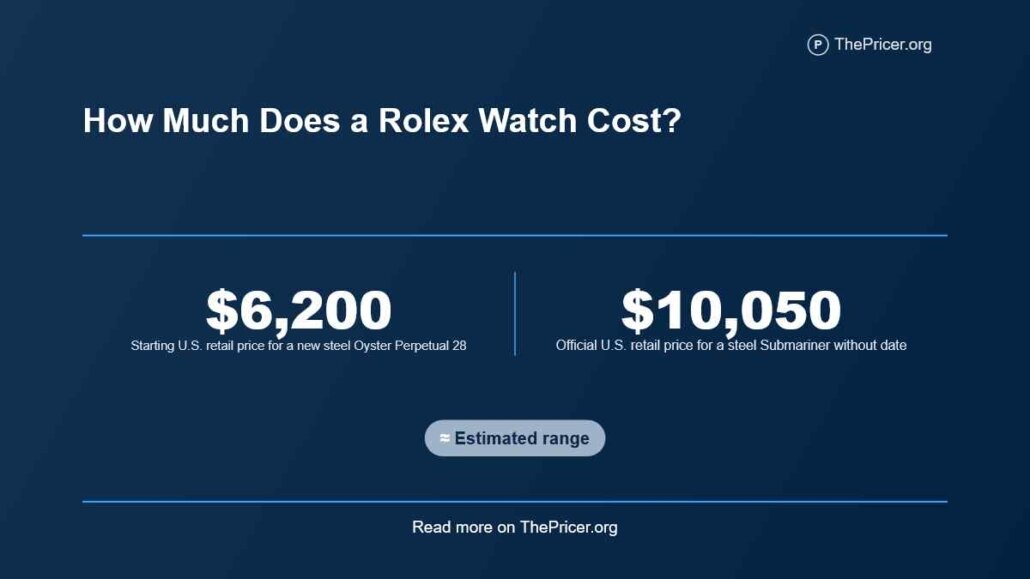
A new Rolex costs from $6,200 for an Oyster Perpetual 28 in the U.S. catalog reviewed in October 2026. Popular stainless-steel models include the Datejust 36 at $8,150, the Submariner at $10,050, the GMT-Master II from $11,800, and the Cosmograph Daytona at $16,900. Precious-metal and diamond-set Rolex watches can exceed $100,000.
Those are official advertised retail prices, not promises of immediate availability. A particular watch can trade above or below retail on the secondary market. Its reference number, dial, metal, condition, documentation, and seller determine the comparison.
Ownership also involves sales tax, possible insurance, servicing, and eventual selling expenses. Rolex watches should be purchased primarily for their design, craftsmanship, and use rather than treated as investments guaranteed to appreciate.
Article Highlights
Jump to sections
- The steel Oyster Perpetual 28 starts at $6,200, while the 41 mm version costs $7,050.
- A steel Datejust 36 starts at $8,150 in the reviewed configuration.
- The Submariner without date costs $10,050, while a Submariner Date costs $11,350.
- The steel Daytona retails for $16,900, although the 126500 has a much higher estimated resale-market value.
- Rolex’s Day-Date collection includes precious-metal and gemstone versions priced above $100,000.
- Independent service estimates run around $800–$1,600 for many full overhauls, with complicated repairs costing more.
- Luxury watch insurance commonly starts around 1% to 2% of insured value annually.
How Much Does a Rolex Watch Cost?
Rolex publishes prices for particular watches rather than one price for an entire collection. Changing case size, metal, bezel, bracelet, or dial can alter the cost.
The manufacturer’s Oyster Perpetual U.S. catalog lists the 28 mm steel model at $6,200, the 36 mm at $6,750, and the 41 mm at $7,050. These are current advertised prices, not historical launch figures.
| Rolex collection | Selected U.S. retail price | Configuration |
|---|---|---|
| Oyster Perpetual | $6,200 | 28 mm, Oystersteel |
| Datejust | $8,150 | 36 mm, Oystersteel |
| Explorer | $8,350 | 40 mm, Oystersteel |
| Submariner | $10,050 | 41 mm, Oystersteel, no date |
| GMT-Master II | $11,800 | 40 mm, Oystersteel |
| Yacht-Master | $13,200 | 40 mm, steel and platinum |
| Cosmograph Daytona | $16,900 | 40 mm, Oystersteel |
| Sky-Dweller | $17,750 | 42 mm, steel and white gold |
| Day-Date | $45,900 | 36 mm, yellow gold |
These are selected configurations from Rolex’s U.S. collection, not collection-wide averages. The exact reference should be checked before comparing one listing with another.
Prices exclude applicable sales tax and may change with future manufacturer revisions.
Oyster Perpetual and Datejust
The Oyster Perpetual is the starting point for many buyers. It offers a self-winding mechanical watch with a time display and various case sizes, without the added cost of more complex calendar or chronograph functions.
The Datejust collection price list includes a 36 mm Oystersteel watch at $8,150 and a 41 mm steel version at $8,950. Precious-metal bezels, two-tone cases, diamonds, and different bracelets increase prices.
The Datejust 36 costs $1,400 more than the $6,750 Oyster Perpetual 36 in the reviewed configurations, approximately 20.7% extra. That additional spending buys a different model with a date display and its own design options.
It would be misleading to assign the entire premium to the date mechanism. Case construction, bracelet options, and commercial positioning also differ.
Rolex’s complete U.S. watch catalog also lists an Air-King at $8,150, an Explorer 40 at $8,350, and an Explorer II at $10,600.
These alternatives provide different designs and practical functions in the same broad spending bracket as the Datejust and steel professional models.
Submariner, GMT, and Daytona
Professional Rolex collections carry different functions. The Submariner is designed around diving, the GMT-Master II tracks another time zone, and the Daytona adds a mechanical chronograph.
The Submariner retail collection includes the steel no-date model at $10,050 and the steel Submariner Date at $11,350. The date-equipped version costs $1,300 more.
Rolex’s GMT-Master II watch selection includes a steel configuration from $11,800. Gold and two-tone versions cost more, while individual bezel and bracelet combinations affect secondary-market demand.
The Daytona chronograph collection lists the stainless-steel model at $16,900. Precious-metal Daytona versions can cost several times that amount.
A Daytona is not simply a Submariner with a different dial. Its chronograph movement, case, and intended functions differ, making the collections inappropriate substitutes when a buyer needs a specific complication.
The official Yacht-Master model selection includes a 40 mm steel-and-platinum watch at $13,200 and a 42 mm titanium configuration at $16,050.
Gold and Platinum Rolex Prices
Precious-metal Rolex watches occupy a distinct price category. Gold cases and bracelets substantially increase the amount payable compared with steel versions, while diamond setting can push prices higher.
Rolex’s Day-Date collection catalog includes a yellow-gold Day-Date 36 at $45,900 and a platinum Day-Date 40 at $68,800. Selected diamond-set Day-Date configurations exceed $100,000.
The Sky-Dweller price catalog includes a steel-and-white-gold configuration at $17,750 and more expensive all-gold versions. Its annual calendar and second-time-zone functions distinguish it from simpler time-only watches.
Metal content does not establish the manufacturer’s production cost. Design, assembly, finishing, distribution, and commercial pricing also contribute to retail value.
The separate question of Rolex manufacturing costs should not be answered by subtracting estimated gold value from retail price. Detailed internal production costs are not publicly disclosed in that form.
Why Resale Prices Differ

Retail and secondary-market pricing can diverge sharply. An authorized jeweler’s listed price may be substantially below what an independent seller asks for a particular immediately available reference.
WatchCharts’ October 2026 Rolex market prices estimate the steel Daytona 126500 at $32,042, against its $16,900 retail price. The implied market premium is $15,142, approximately 89.6%.
The same dataset estimates the steel Submariner 124060 at $12,361, versus a $10,050 retail price. That difference is $2,311, approximately 23%.
These estimated market values are not guaranteed sale proceeds. A dealer buying a watch may offer less than its advertised resale price, and condition or missing components can reduce the amount.
The WatchCharts Rolex Market Index methodology uses 30 models weighted by transaction value. As of September 14, 2026, the index was up 5.7% over one year but down 9.2% over five years.
Its October 10 market report also recorded a 0.4% Rolex decline during September, with 11 of 15 collections falling.
Those figures contradict the claim that Rolex ownership is inherently a stable appreciating investment. Performance depends on the particular watch and the purchase and sale dates.
Authorized and Pre-Owned Rolexes
Rolex’s official buying guidance states that new genuine Rolex watches are sold through its authorized jeweler network. Published prices do not establish whether a requested model can be purchased immediately.
Pre-owned watches introduce additional choices. Buyers may encounter discontinued models, vintage references, private sellers, independent dealers, and manufacturer-certified pre-owned stock.
The Rolex Certified Pre-Owned program covers qualifying watches at least two years old and provides an official authenticity assessment and a two-year international guarantee.
A certified watch may cost more than an otherwise comparable independently sold example. The value of that difference depends on the dealer’s documentation, after-sales support, condition, and the exact reference.
Recent Financial Times vintage-watch buying advice emphasizes originality, provenance, condition, and seller reliability. Altered dials, excessive polishing, or replacement parts can matter greatly for collectible references.
Original papers are useful evidence but do not automatically establish authenticity. Buyers should verify the whole watch, including its bracelet and movement, before paying a secondary-market premium.
Servicing and Insurance Costs
Rolex recommends professional servicing approximately every ten years, depending on the watch and how it is used. Its official watch-care guidance also explains that a service center assesses the individual watch before preparing a quotation.
There is no one published Rolex service price for every movement. The cost of Rolex servicing and overhaul is different from routine external cleaning or bracelet care.
Bob’s Watches’ 2026 Rolex service pricing research estimates $800 to $1,600 for many full overhauls. Complex chronographs or work requiring replacement parts can exceed $2,800. These are independent estimates, not official factory fees.
For watch insurance, Jewelers Mutual’s published watch premium guidance places starting premiums around 1% to 2% of insured value annually. Actual premiums depend on location, deductible, coverage, and appraisal value.
A Datejust insured for $8,150 would therefore have an indicative annual premium of approximately $81.50 to $163 at those percentages.
External watch cleaning costs should not be mistaken for full movement servicing. Damage to the crystal may also require separate watch crystal replacement.
A Ten-Year Rolex Budget
Consider a new steel Datejust 36 purchased for the official $8,150 retail price. Assume a 7% local sales tax, annual insurance at 1.5% of purchase value, and one $900 mechanical service within ten years.
The watch price is documented. The tax, fixed insurance percentage, and service expense are assumptions used for this illustration.
- Rolex Datejust 36 purchase: $8,150
- Assumed 7% sales tax: $570.50
- Ten years of insurance at 1.5% annually: $1,222.50
- One assumed complete service: $900
- Illustrative ten-year cash spending: $10,843
The spending beyond the original watch price totals $2,693, equivalent to about 33% of the original retail amount.
This model excludes major accidental damage, rising insurance premiums, changing insured values, and any financing costs. It also excludes resale proceeds.
One practical distinction is that a watch’s market value can rise while its owner’s realized financial return remains negative. Sales tax, insurance, servicing, and the eventual dealer selling spread all affect the net result.
For the modeled Datejust, resale proceeds would need to exceed $10,843 merely to recover the illustrated cash spending before selling fees or other transaction costs.
Choosing a Rolex Within Budget
A budget below $8,000 limits a new-watch search primarily to selected steel Oyster Perpetual configurations in the reviewed catalog. The Datejust and professional collections require higher initial spending.
For buyers paying above retail on the secondary market, the premium should be evaluated separately from the watch’s actual long-term usefulness. A higher resale-market quotation does not make the movement inherently more accurate or durable.
Makes sense if
- The exact reference and configuration fit the intended use and spending limit.
- New-watch buyers confirm availability through an authorized jeweler.
- Pre-owned buyers examine originality, condition, authenticity, and service history.
- Tax, insurance, and future servicing fit the ownership budget.
Does not make sense if
- An above-retail listing is interpreted as guaranteed future profit.
- A watch is purchased before the seller’s authenticity and return terms are checked.
- A collector reference is heavily modified without evaluating the effect on originality.
- A low purchase price hides major servicing or restoration needs.
Answers to Common Questions
What is the cheapest new Rolex?
The steel Oyster Perpetual 28 starts at $6,200 in the reviewed October 2026 U.S. catalog.
How much does a Rolex Submariner cost?
The steel no-date Submariner retails for $10,050, while a steel Submariner Date costs $11,350. Resale-market prices can differ.
Do Rolex watches go up in value?
Some references appreciate, but others lose value. Rolex’s secondary-market index was down 9.2% over five years as of September 14, 2026, even though certain individual watches retained premiums over retail.
How much does Rolex maintenance cost?
Independent published estimates put many full overhauls around $800 to $1,600. Rolex issues an individual service quotation following inspection.
Can I buy a Rolex at its advertised retail price?
Authorized jewelers sell new Rolex watches, but availability depends on the model and retailer. An official price listing does not guarantee immediate stock.
Disclosure: Educational content, not financial advice. Prices reflect public information as of the dates cited and can change. Confirm current rates, fees, taxes, and terms with official sources before purchasing. See our methodology and corrections policy.