
How Much Does a Self-Storage Unit Cost Per Month?
Published on | Written by Alec Pow
This article was researched using 14 sources. See our methodology and corrections policy.
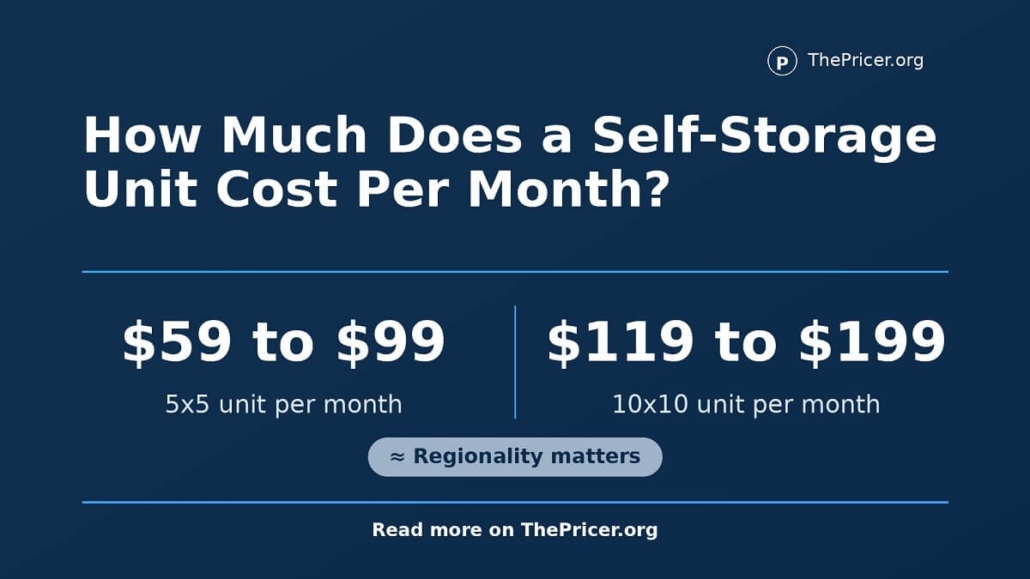
Self-storage gives households and businesses dedicated space inside a managed facility, with Public Storage, Extra Space Storage, U-Haul, RentCafe, StorageCafe, and Move.org covering different parts of the U.S. rental market. As of July 2026, current monthly unit figures put a 5×5 at $59 to $99 per month and a 10×10 at $119 to $199.
Unit size sets the starting point, then metro location, climate control, drive-up access, floor level, local inventory, insurance, and promotions can move the bill. A renter storing a few boxes is buying a different amount of space from a household storing furniture from several rooms, even when both rentals sit at the same property.
The base rent pays for use of the unit. Insurance or a protection plan, a lock, a setup charge, taxes, late charges, and later rent changes can sit outside the advertised figure. Online promotions can also make the move-in bill different from a later monthly bill, so recurring rent and one-time charges need to be separated.
Self-storage is priced mainly per unit per month. A standard indoor 10×10, a drive-up 10×10, and a climate-controlled 10×10 can carry different rents because the access type, facility configuration, and local availability are different.
How Much Does a Self-Storage Unit Cost Per Month?
Jump to sections
- Current published size bands from Public Storage put 5×5 units at $59 to $99 (at $30 per hour, earning that amount would take about 2 to 3.3 hours of work, before taxes) per month and 10×10 units at $119 to $199.
- Billing unit is monthly rent, with the quote tied to one unit size, configuration, and facility.
- Main add-on buckets include tenant coverage, locks, setup charges, taxes, and late-payment charges.
What you’re buying
Self-storage is enclosed space that a customer rents inside a facility and fills with personal or business property. The renter handles packing, transportation, loading, retrieval, and removal. The operator supplies the space, controlled access to the property, and the security or environmental features attached to the selected unit. Indoor units may sit behind hallways and elevators. Drive-up units open toward a vehicle lane. Climate-controlled rooms add heating or cooling systems intended for belongings that should not sit through outdoor temperature swings.
A storage unit does not provide transportation. A U-Haul truck rental solves the moving part, with the renter driving the vehicle between locations. Portable containers combine storage with another delivery model. Self-storage suits belongings that can be taken to a fixed facility and retrieved there later, making location, access hours, unit configuration, and available space central parts of the purchase.
A first-month storage bill
A useful budget separates recurring rent from move-in charges. As of January 2026, January 2026 Chicago rates from Extra Space Storage listed a 10×10 unit at an average $128 (about 4.3 hours of work at $30 per hour) per month. Its July 2026 published storage fee schedule lists a $50 one-time administrative charge, tenant protection at $11 to $47 per month, and a storage lock at $10 to $20.
For a worked budget, use the $128 Chicago rent and the low end of the published protection amount at $11. Base rent of $128 plus the $50 setup charge plus $11 protection equals a first-month subtotal of $189 before tax or a lock purchase. If the base rent stayed unchanged, the next month would be $139 with that protection level. The $50 difference between the two subtotals is the one-time setup charge. The first bill can differ.
- Base rent $128
- Administrative charge $50
- Protection in this worked budget $11
- First-month subtotal $189
Size bands
Unit dimensions create one of the clearest differences in rent. A 5×5 supplies 25 square feet of floor area, a 10×10 supplies 100 square feet, and a 10×20 doubles that floor area again. Bigger spaces can hold furniture from several rooms, appliances, business stock, or vehicles where the facility permits them. Paying for unused floor area can become expensive across a long rental, so measuring large furniture and estimating stacked box volume before reserving a unit has a direct financial effect.
Public Storage’s November 2025 Washington, DC unit data placed the average 5×5 at $61.48 (about 2 hours of work at $30 per hour) per month and the average 10×10 at $158.99. The difference is $97.51 each month. Across 12 months, $97.51 multiplied by 12 becomes $1,170.12. Renting the larger unit for unused space can turn into a four-figure difference across a year. Matching floor area still does not make two units equivalent because climate control, floor level, doorway access, and local availability can move the quoted rent.
Insurance, locks, setup charges
Base rent is not always the full recurring obligation. A facility may require proof that stored belongings are covered through an accepted homeowners or renters policy or through a storage-specific protection product. Coverage limits, exclusions, deductibles, and rules for property kept away from the home vary by policy. A renter should check the facility agreement and the insurance contract rather than assuming the unit advertisement includes coverage for the belongings inside.
Move-in spending can also include a lock and an administrative charge. Late payment can create another expense because facility agreements may add a fee after the due date and can eventually trigger lien procedures when an account remains unpaid. For a current insurance benchmark, Public Storage’s July 2026 published storage insurance prices put plans at $10 to $40 per month depending on the coverage level. Renters planning a longer stay should keep that recurring charge separate from one-time move-in purchases such as a lock.
Two renter cases
Published city rates show how different storage needs can produce different monthly bills. These are planning cases built from operator data rather than customer stories. One renter needs only a small footprint for boxes and seasonal belongings. The other places more weight on environmental control for furniture, electronics, documents, or other property that the renter does not want exposed to outdoor temperature swings.
| Renter case | Current price signal | Primary driver |
|---|---|---|
| Small-space renter in Las Vegas | Extra Space Storage’s March 2026 Las Vegas rates listed a 5×5 at an average $28 per month. | Low storage volume |
| Climate-control renter in Charlotte | Its Charlotte climate-control data listed climate-controlled units across sizes at an average $86 per month in April 2026. | Climate-controlled space |
The Las Vegas renter is paying for a small footprint. The Charlotte renter’s requirement centers on the unit environment rather than fitting into the smallest available room. Neither figure is a guaranteed quote for another address. Inventory changes by property, and a climate-controlled 10×20 is a different rental from a standard 5×5 even when both appear in the same city search. Matching the quote to the belongings matters more than comparing citywide figures alone.
Location, climate control
Geography can move the monthly figure as much as unit size. RentCafe reported a national self-storage street rate of $135 per month in June 2026 in its June 2026 street-rate report. The same report placed Santa Clarita, California, at $192 per month and Akron, Ohio, at $103. The $89 monthly gap becomes $1,068 across 12 months because $89 multiplied by 12 equals $1,068. Facility design creates another layer inside the same metro.
Climate-controlled rooms use equipment to manage interior temperature, which can change the quoted rent. Drive-up units trade indoor corridors for vehicle-side loading. Upper-floor rooms may depend on elevators and carts, and ground-floor indoor rooms can offer easier movement without outdoor exposure.
The renter should compare the exact configuration rather than only the advertised dimensions. A lower monthly figure can be a poor match if heavy furniture must travel farther through a building, and a higher figure may buy a feature with little value for durable boxes stored for a brief period. In dense urban facilities, loading distance, elevator dependence, gate schedules, and parking access can matter almost as much as floor area when belongings are heavy or visits are frequent.
Access hours also matter for businesses and households that expect frequent retrieval. A unit that is difficult to reach during the renter’s normal schedule can create practical costs even when its monthly rent is lower.
Promotions, month-to-month billing
An introductory offer can make the first bill look unlike a later rental bill. U-Haul’s March 2026 first-year price-lock policy says base storage rent remains unchanged for the first 12 months for qualifying new rentals, including rentals that begin with a free-month promotion. The guarantee applies to base rent rather than optional coverage or late charges. Rate tre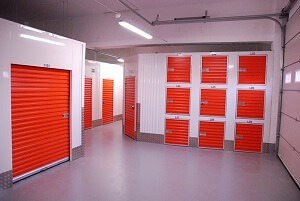 atment differs by operator and offer, so a renter expecting to keep a unit for many months needs the recurring-rent terms as well as the opening promotion.
Move-out timing can affect the last bill too. Public Storage says under its seven-day move-out rule that customers should provide at least seven days’ notice and that moving out on or after the rent due date triggers the full month’s charge. A renter who clears the unit shortly after the due date may still owe the full billing period. The useful comparison is the expected spending across the planned stay, not only the opening month.
Who this cost makes sense for
Self-storage fits a defined space problem better than an open-ended habit. It can serve a household between leases, a renovation that temporarily displaces furniture, a small business that needs room for inventory, or a family with belongings that should not stay in a garage or attic. The financial test becomes harder when low-value possessions remain stored month after month because accumulated rent can eventually approach their replacement value.
A portable container changes the decision because it can combine storage with transport. Readers comparing those services can review current PODS moving and storage costs. Self-storage has a stronger fit when belongings can be transported to one fixed facility and the renter wants recurring access there rather than container delivery at a residence.
Makes sense if
- A move creates a known gap between leaving one home and entering another.
- A renovation requires furniture to leave occupied rooms for a defined period.
- Business stock needs accessible space without leasing a full warehouse.
- Temperature-sensitive belongings need a climate-controlled room away from the home.
Doesn’t make sense if
- Low-value belongings may remain untouched for years.
- The household already has suitable garage, basement, attic, or spare-room capacity.
- Daily retrieval makes the facility location or gate schedule impractical.
- The move needs both transport and storage, making a portable container a closer match.
What we verified
- Checked the storage insurance requirement published by Extra Space Storage in April 2026, including the option to use qualifying outside coverage.
- Confirmed independent consumer storage research from Move.org as historical 2024 context showing that administrative charges and monthly insurance were excluded from its quoted unit figures.
- Cross-referenced the 2025 renter-demand survey from StorageCafe for recent U.S. self-storage usage and renter context.
Article Highlights
- Published 2026 small-unit figures can stay below $100 per month, but city, facility inventory, and configuration matter.
- A 10×10 can cost far more than a 5×5 across a full year.
- Insurance, locks, and setup charges can make the move-in bill higher than later months.
- Climate control and access type can separate quotes for units with similar dimensions.
- Promotional rent should be compared with the expected bill after the opening offer.
- Move-out timing can determine whether another full month is charged.
Answers to Common Questions
How much is a small self-storage unit per month?
Published 2026 operator figures place many 5×5 units in the tens of dollars per month, with some markets and facilities higher. Location, availability, unit configuration, and promotions determine the live quote.
Is storage insurance included in the monthly rent?
It may be separate. Some operators require qualifying outside coverage or offer a protection product through the facility. The rental agreement states what coverage is accepted and what charges apply.
Can a storage company raise the monthly rent?
Month-to-month agreements can permit later rate changes under their contract terms. Some operators also offer fixed-rate periods for qualifying rentals, so the notice provisions and promotion terms matter during a long stay.
What size storage unit should I rent?
The smallest unit that safely fits the planned belongings avoids paying for unused floor area. Measure large furniture, count bulky boxes, allow aisle space for retrieval, and check door dimensions before choosing between nearby size classes.
Disclosure: Educational content, not financial advice. Prices reflect public information as of the dates cited and can change. Confirm current rates, fees, taxes, and terms with official sources before purchasing. See our methodology and corrections policy.