
How Much Does a Sport Court Cost?
Updated on | Written by Alec Pow
This article was researched using 14 sources. See our methodology and corrections policy.
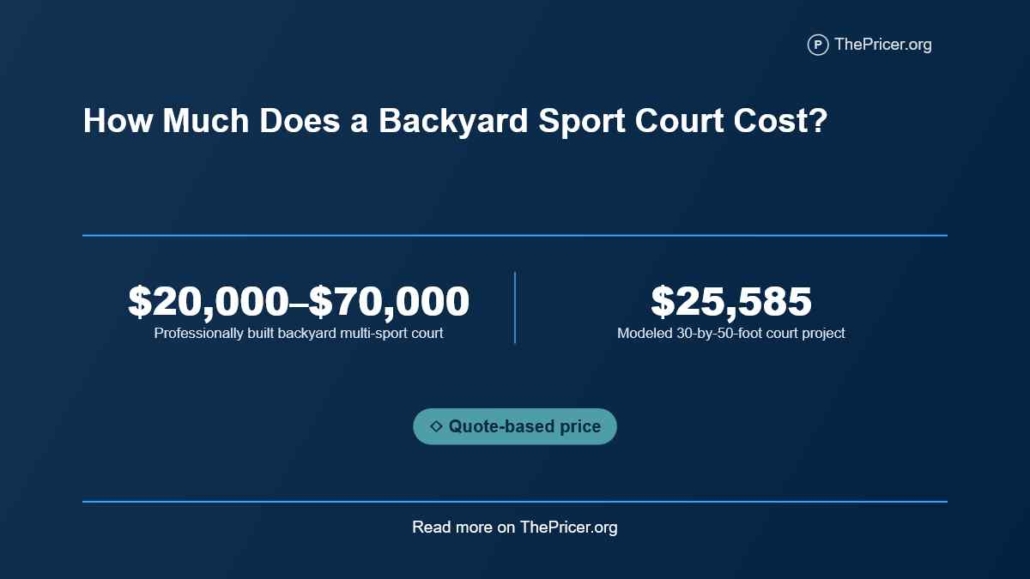
A professionally built backyard multi-sport court usually costs about $20,000 to $70,000 in the United States, with a current average near $40,000. Current 2026 pricing from backyard multi-sport installations puts a basic 30-by-30-foot half-court at $10,000 to $25,000, a 30-by-50-foot compact multi-sport court at $20,000 to $40,000, and a large 60-by-120-foot project at $50,000 to $120,000.
The wide spread comes from scope. A tile package placed over an existing hard pad is not the same purchase as a ground-up court with excavation, drainage, concrete, fencing, lighting, hoops, net posts, permits, and professional installation.
Article Highlights
Jump to sections
- Most professionally built backyard multi-sport courts fall near $20,000 to $70,000 (at $30 per hour, earning that amount would take about 0.3 to 1.1 years of full-time work, before taxes).
- A basic 30-by-30-foot half-court can start around $10,000, while large custom builds can pass $120,000.
- Surface-only modular tile packages can cost only a few thousand dollars because the slab and site work are separate.
- Site preparation alone can run about $5,000 to $15,000 on a ground-up basketball-court project.
- A modeled 30-by-50-foot multi-sport project reaches about $25,585 before fencing, lighting, taxes, landscaping, or difficult-access charges.
- Acrylic sport surfaces commonly need resurfacing on a multi-year cycle rather than lasting indefinitely without maintenance.
How Much Does a Backyard Sport Court Cost?
The central price depends on whether the homeowner is buying a finished construction project or only part of one. A low court quote often covers only one construction layer. Surface packages, slab work, grading, and accessories can be sold by different contractors or suppliers. A low per-square-foot surface figure should not automatically be multiplied by the yard dimensions and treated as a final construction quote because the site may still need excavation, drainage, and a structural base.
A small court can be much cheaper than a full multi-sport layout because it uses less excavation, base material, surfacing, fencing, and lighting. A 30-by-30-foot court covers 900 square feet. A 30-by-50-foot court covers 1,500 square feet. The larger footprint uses about 67% more area before any change in accessories or site conditions.
Scope changes everything. A flat yard with machine access and an existing sound slab may need little construction before the playing surface goes down. A sloped yard with poor drainage may need excavation, fill, retaining work, drainage, and a new reinforced slab before the visible court surface can even be installed. The quote should identify each layer and who supplies it.
Cost by Court Size
The 2026 multi-sport pricing cited in the introduction shows how quickly size changes the budget. The same source models a 30-by-30-foot half-court at an average of $15,000 (about 12.5 full-time workweeks at $30 per hour), a 30-by-50-foot compact multi-sport court at $28,000, and a 60-by-120-foot full multi-sport layout at $70,000. These are project-level planning figures rather than prices for one brand of tile.
| Residential court scope | Dimensions | Current planning range | Modeled average |
|---|---|---|---|
| Small basketball half-court | 30 x 30 ft | $10,000 to $25,000 | $15,000 |
| Compact multi-sport court | 30 x 50 ft | $20,000 to $40,000 | $28,000 |
| Large full multi-sport court | 60 x 120 ft | $50,000 to $120,000 | $70,000 |
The jump from 900 to 1,500 square feet is about 67%, while the modeled average rises from $15,000 to $28,000, an increase of about 87%. The extra increase is not proof that every larger court costs more per square foot. It shows that court size can interact with added striping, net systems, access work, drainage, and other project components.
A regulation basketball footprint is rarely necessary in a backyard. Homeowners can fit basketball, pickleball, volleyball, or short-court games into a smaller pad by planning line locations and removable equipment. A dedicated pickleball court or full tennis court has a different footprint and should be priced as its own construction project when that sport is the main use.
The Surface Is Not the Court Price
Surface-only pricing can look dramatically cheaper than a finished court. ModuTile currently lists a 30-by-30-foot basketball tile kit at $2,931 (about 2.4 full-time workweeks at $30 per hour), with painted lines included and ramp edging optional. Its 30-by-50-foot multi-sport kit is listed at $5,385 with basketball and pickleball lines. Those are useful product prices, but they do not represent a new court built from bare soil.
The missing work can be larger than the tile bill. A modular surface needs a suitable hard, flat base. Excavation, grading, drainage, slab construction, freight, hoop footings, electrical work, fencing, and permits can sit outside a flooring package. A homeowner with an existing concrete pad may avoid much of that cost. A homeowner starting with lawn cannot.
This is the hidden price problem in residential sport courts. A $5,385 tile package can be a valid price and still lead to a project above $20,000. The quote is not deceptive when its exclusions are clear. The comparison becomes misleading when a flooring-kit price is placed beside a turnkey contractor quote without matching the base, site work, equipment, and installation scope. Freight can widen the difference too.
Site Prep, Base, and Drainage
Ground-up construction starts below the playing surface. Current 2026 basketball-court cost data puts clearing, grading, and leveling around $5,000 to $15,000, with base installation around $3 to $10 per square foot. The same guide lists permits around $150 to $1,000, hoops around $150 to $2,000, lighting around $2,000 to $8,000, and fencing around $4,000 to $12,000. A separate sport-court cost guide lists portable tennis, badminton, or pickleball nets around $75 to $250.
Concrete specifications also change the total. VersaCourt says its preferred concrete base is commonly a reinforced 4-inch slab and places national concrete pricing near $4 to $10 per square foot. Its published court pricing excludes excavation, subsurface preparation, concrete, accessories, and shipping. Poor equipment access, thicker slab edges, drainage work, or local code requirements can raise the concrete portion.
A modeled 30-by-50-foot project shows how the pieces stack. Choose $8,000 of site preparation within the cited range, a $7 per square foot concrete assumption within the cited range for a $10,500 slab, the documented $5,385 tile package, a $1,000 hoop within the cited equipment range, a $200 portable net within the previously cited sport-court accessory range, and a $500 permit allowance. The modeled total is $25,585.
That scenario excludes fencing, lights, taxes, landscaping, retaining walls, utility trenching, and unusual drainage. The tile package represents about 21% of the modeled total. The result explains why comparing only surface prices can understate the cash needed for a ground-up court.
Surface Choices and Court Systems
The base and the playing surface are separate decisions. An outdoor court may use asphalt or concrete as the finished playing surface, add an acrylic coating, or place interlocking modular tiles over a hard base. A current basketball-court guide lists asphalt surface work around $3 to $7 per square foot, concrete around $5 to $10 per square foot, and modular or rubberized tiles around $4 to $17 per square foot. Its surface figures exclude some equipment and finishing work.
Modular tiles can be appealing when the homeowner wants multi-color lines, drainage through the playing layer, or individual pieces that can be replaced. They still need a suitable support layer. Many modular systems install over concrete, asphalt, or another manufacturer-approved base.
That base still has to meet flatness, drainage, and structural requirements for the chosen product, so a tile purchase does not remove the need to plan the layer below it.
Sport Court® is a brand rather than a generic name for every backyard athletic pad. The company’s current FAQ states that its outdoor modular surfacing carries a 15-year limited warranty and is expected to provide at least that many years of playability. A warranty on the modular surface does not mean the concrete, drainage, fencing, lights, or accessories share the same service life.
Lighting, Fencing, and Equipment
Accessories can change both cost and usable hours. Basketball goals may be portable, wall-mounted, or set into a concrete footing, while multi-sport courts may need removable pickleball or volleyball posts, net sleeves, rebound nets, benches, storage, and more than one set of game lines. Equipment prices should be compared with installation and footing work included on the same basis. A small lot may need taller containment along the closest property boundary.

Lighting and fencing can become five-figure additions on larger or more demanding jobs. One Florida sports-court contractor currently lists fencing around $8,000 to $20,000 for one court and court lighting around $10,000 to $30,000. Those are regional contractor figures, not national averages, but they show how local wind, electrical, trenching, pole, and fence specifications can exceed simplified national planning ranges.
Lighting can also trigger electrical permitting, trenching, pole footings, and neighborhood restrictions. Ball-containment fencing may matter more on a small suburban lot than on a large rural property. A low equipment quote should be checked for installation, footings, freight, and removal of existing structures before it is compared with an installed package.
Maintenance and Lifespan
Acrylic surfaces need periodic maintenance even when the structural base remains sound. SportMaster recommends a standard 5-to-8-year resurfacing cycle for its acrylic sport surfaces, with regular cleaning and inspection between resurfacing jobs. Base cracks, low spots, roots, drainage problems, and ground movement can shorten the useful interval.
Current 2026 tennis-court resurfacing data places acrylic hard-court work near $0.55 to $1.50 per square foot for that specific full-court market, with repairs adding more when cracks or low spots are present. A smaller backyard multi-sport court is not automatically priced by multiplying those figures because mobilization, minimum charges, coating system, line work, and repair scope can change the bid.
Modular flooring follows a different maintenance path. Individual damaged tiles may be replaceable without recoating the whole surface, while the base below still needs drainage and crack management. Asphalt and concrete can remain structural for many years, yet their visible playing coatings may need work much sooner. The old claim that a concrete court lasts only about 10 years confuses the life of a surface finish with the life of the underlying slab.
Project timing has the same scope problem. Tile installation on an existing pad can be fast, while a new court from soil must pass through grading, drainage, concrete or asphalt work, curing, surfacing, equipment, and inspections. Plan in weeks for ground-up construction rather than assuming the entire project will routinely finish in three days.
Half-Court or Full Multi-Sport?
A half-court fits households focused on basketball, shooting practice, casual pickleball, and family play. It uses less yard while leaving room for removable nets and alternate lines. A larger pad suits households that need longer runs, two hoops, volleyball, or more players.
Resale value should not be treated as a guaranteed return. A court can appeal to sports-oriented buyers, while another buyer may prefer lawn, gardens, or a pool. The amount a court contributes to resale depends on the property, neighborhood, court condition, yard size, and buyer pool. Treat the court as a lifestyle improvement first. A local appraiser or real-estate professional is better placed to estimate contributory value for one property than a national construction-cost guide.
Makes sense if
- Your household will use the court regularly for two or more sports.
- The yard has enough level area without sacrificing space you value more.
- You can fund the base, drainage, and site work before spending heavily on finishes.
- Removable nets and multi-color lines can replace the need for several separate play areas.
Does not make sense if
- The budget only covers the visible surface while major ground work remains unfunded.
- A steep or poorly drained site requires expensive retaining or drainage work.
- You are building a regulation-size court for occasional casual use.
- You expect the construction cost to return dollar for dollar at resale.
A dedicated four-wall racquetball court belongs in a different construction category because walls, structure, flooring, lighting, and often mechanical systems make its budget unlike an outdoor backyard pad.
Verification checks
- Checked a current 30-by-30 tile package that explicitly excludes the concrete pad and basketball hoop.
- Confirmed current existing-court conversion pricing is much lower than new construction when the base can be reused.
- Cross-referenced indoor court conversion pricing to keep flooring inside an existing building separate from the cost of constructing a new building.
Answers to Common Questions
How much does a backyard sport court cost?
Many professionally built backyard multi-sport courts cost about $20,000 to $70,000. Small basic half-courts can start near $10,000, while large customized projects can exceed $120,000.
How much does a 30-by-30-foot half-court cost?
A current 2026 planning range is about $10,000 to $25,000 for a finished residential half-court, depending on site work, base, surface, and equipment.
Why are sport-court tile kits so much cheaper?
A tile kit may cover only the playing surface and painted lines. Concrete or asphalt, grading, drainage, hoops, fencing, lighting, permits, freight, and installation may be separate.
How often does an acrylic sport court need resurfacing?
Acrylic systems commonly work on a multi-year resurfacing cycle, with one major manufacturer recommending about five to eight years between resurfacing jobs depending on wear and site conditions.
Does a backyard sport court add home value?
It can appeal to some buyers, but there is no guaranteed resale return. Yard size, court condition, neighborhood expectations, and the next buyer’s preferences all affect its contributory value.
Disclosure: Educational content, not financial advice. Prices reflect public information as of the dates cited and can change. Confirm current rates, fees, taxes, and terms with official sources before purchasing. See our methodology and corrections policy.