
How Much Does a Steelfin Interceptor Missile Cost?
Published on | Written by Alec Pow
This article was researched using 12 sources. See our methodology and corrections policy.
Anduril’s new Steelfin interceptor missile could cost approximately $830,000 to $1.8 million per round for two of its proposed configurations, based on company pricing targets compared with existing U.S. missile procurement costs. A more demanding Patriot-class version could approach $2.65 million under another stated cost ceiling. These are calculated planning benchmarks, not official Steelfin prices. Anduril has not announced a unit price, production contract, or completed missile sale.
Unveiled on October 12, 2026, Steelfin is a family of modular surface-to-air interceptors intended to defend against drones, aircraft, cruise missiles, ballistic missiles, and some hypersonic threats. Rather than building an entirely new missile for every mission, Anduril proposes using a shared terminal interceptor with interchangeable boosters and mission equipment. Flight testing is planned for 2027, so the price and claimed performance remain unproven.
Article Highlights
Jump to sections
- An SM-2-class Steelfin could cost approximately $833,000, calculated from Anduril’s one-third-cost target and an existing $2.5 million SM-2 benchmark.
- A Patriot-class version could target approximately $1.77 million, or one-third of a $5.3 million PAC-3 MSE interceptor.
- A separate company comparison suggests a higher-end Patriot-class price below $2.65 million, but no binding quote exists.
- Steelfin uses a common terminal stage and interchangeable boosters, including proposed 10-, 18-, and 21-inch configurations.
- Anduril aims for annual production measured in thousands, but no verified production order or achieved output rate has been disclosed.
- Representative vehicles have completed ballistic testing; Steelfin flight tests are expected in 2027.
How Much Does a Steelfin Interceptor Missile Cost?
Anduril has not released a conventional price list for Steelfin. Instead, company executives have discussed the costs they hope to achieve relative to existing missiles.
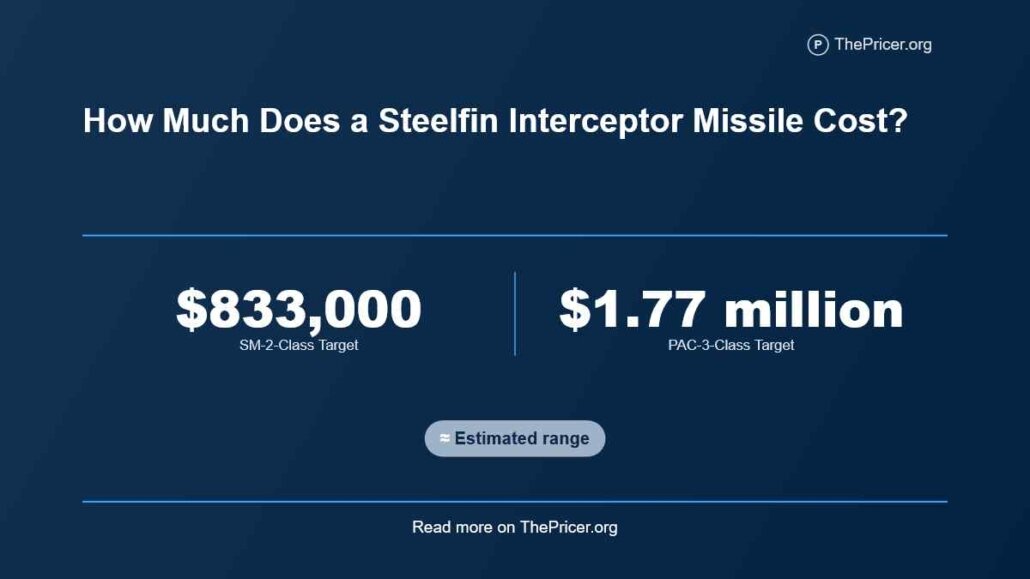
In Breaking Defense’s October 12 launch report, Anduril described a target of approximately one-third the price of the Patriot PAC-3 Missile Segment Enhancement interceptor.
The latest Army FY2027 procurement benchmark used by The War Zone’s technical investigation is approximately $5.3 million per PAC-3 MSE.
Dividing that by three produces approximately $1.77 million for the corresponding Steelfin planning scenario.
Anduril also described a configuration offering more than 80% of the mission capability of an SM-2 for one-third of its cost. Against an approximately $2.5 million SM-2 Block IIIC benchmark, that suggests about $833,000 per round.
Those are two different proposed configurations, not contradictory prices for an identical missile.
| Steelfin cost scenario | Calculated price | Basis |
|---|---|---|
| SM-2-class configuration | About $833,000 | One-third of a $2.5M SM-2 |
| PAC-3-class configuration | About $1.77M | One-third of a $5.3M PAC-3 MSE |
| Higher PAC-3-class ceiling | Below $2.65M | Less than half a $5.3M PAC-3 MSE |
| THAAD-class configuration | Not quantifiable | Company claims a fraction of THAAD’s price |
| Official production unit price | Not disclosed | No verified production purchase |
The figures are based on manufacturer aspirations and public benchmarks. They do not establish what the Pentagon will ultimately pay, or whether Steelfin will achieve the stated capability and cost combinations.
Why Are There Different Prices?
Steelfin is not one missile manufactured with identical hardware for every mission.
Anduril’s October 12 official announcement describes a two-stage architecture with interchangeable solid-rocket boosters and a shared terminal interceptor.
The first stage provides the required launch energy and range. Depending on the configuration, the booster can have different dimensions and performance characteristics.
The second stage contains the terminal interceptor’s common airframe, avionics, flight controls, software, and interfaces.
This arrangement permits multiple configurations while preserving some manufacturing and design commonality.
A smaller configuration intended for aircraft or cruise-missile defense may require different propulsion and sensing capabilities from one designed to engage demanding ballistic or maneuvering threats.
That means its cost depends on the selected booster, seeker, hardware, and performance requirements.
The company’s Steelfin product specifications describe performance ranging from supersonic to hypersonic depending on the booster. Engagement altitude and range also depend on configuration.
Anduril has not disclosed binding specifications or unit costs for each proposed version.
A buyer therefore cannot assume the lowest advertised target price applies to the most demanding interceptor configuration.
Can Steelfin Replace Patriot Missiles?
Steelfin is intended to complement existing air defenses and potentially substitute for more expensive interceptors in suitable missions.
That is different from proving it can replace every PAC-3 MSE mission.
The PAC-3 MSE is an established interceptor with operational integration and a public procurement history. Steelfin is still in development.
The Defense News launch investigation confirms that Anduril plans compatibility with existing air-defense equipment, including Patriot-related launch architecture, naval launch systems, and established battle-management software.
Such compatibility could reduce the need to purchase an entirely separate defensive ecosystem. However, adapting an interceptor to existing hardware does not eliminate qualification, integration, or testing expenses.
The company’s comparisons also describe percentages of overall mission capability rather than published probabilities of successful interception.
When executives discuss achieving 80% of another missile’s mission capability, they have not identified a standardized performance metric showing which operational requirements are covered.
There are no independent Steelfin flight-test results demonstrating that a specific variant can match the performance of PAC-3 MSE, SM-2, or THAAD.
The existing Patriot missile system cost provides the relevant distinction between individual interceptor pricing and the much larger expense of a working air-defense battery.
Why Might Anduril Build It Cheaper?
The most important economic idea behind Steelfin is reducing the number of distinct products the manufacturer must design and build.
Traditional missile programs often have different propulsion systems, electronics, engineering processes, and production arrangements for each weapon family.
Anduril intends to reuse common manufacturing processes and substantial parts of the terminal interceptor across multiple versions.
Aviation Week’s October 12 examination identifies proposed booster diameters of 10, 18, and 21 inches, allowing the missile family to address different classes of requirements.
A common production backbone might spread factory overhead and engineering expenditure across a larger number of completed rounds.
It could also allow suppliers to produce common parts in higher volume, reducing the number of specialized production lines.
Those savings are plausible manufacturing objectives. They are not yet measured production results.
Anduril expects annual output potentially reaching several thousand missiles, according to its launch statements. Actual volume will depend on military requirements, successful tests, contracts, production capacity, and supply chains.
High output is important because low-volume missile production tends to spread specialized tooling and engineering expenditures across relatively few units.
However, increasing production can also require substantial upfront spending on facilities, machinery, quality assurance, and suppliers.
The absence of a factory cost breakdown prevents a reliable calculation of how much Steelfin’s modular design actually reduces its manufacturing expense.
100 Steelfin Missiles
 A hypothetical purchase illustrates how the different cost targets would affect a military inventory budget.
Assume a government intends to obtain 100 missiles in a single configuration, excluding launchers, integration, training, spares, and support.
Using Anduril’s derived SM-2-class target of approximately $833,000, the missile-only budget would be about $83.3 million.
At the calculated PAC-3-class target of $1.77 million, the same inventory would require approximately $176.7 million.
Buying 100 existing PAC-3 MSE interceptors at the $5.3 million benchmark would instead represent approximately $530 million.
Under the PAC-3-class scenario, the theoretical difference is approximately $353.3 million for a 100-round inventory.
That is a hypothetical purchase-price comparison, not a demonstrated saving. It assumes the candidate Steelfin configuration is suitable for the same mission and achieves Anduril’s pricing target.
The comparison also does not include the potentially significant cost of qualifying or integrating a new missile into an existing air-defense architecture.
For scale, the U.S. Army’s July 2026 PAC-3 production announcement describes a multiyear production framework with a ceiling of approximately $58.62 billion. That is a broad procurement arrangement, not a clean purchase price for a known quantity of missiles.
Its scale demonstrates why a successful lower-cost alternative could have considerable procurement implications.
The Hidden Cost of Integrating Steelfin
Missile acquisition is only one part of putting a defensive weapon into service.
Steelfin will require flight testing, qualification, launcher integration, fire-control connections, logistics planning, operator training, and continuing support.
Anduril designed the missile family to work with established infrastructure where practical, but compatibility must still be demonstrated for each relevant application.
That introduces an important accounting problem: a missile might meet its promised low hardware price while the overall program costs substantially more because of integration and development.
The Army’s xTech Apex Intercept program shows the government actively supporting development of cheaper interceptor technologies, seekers, rocket motors, and fire-control systems.
Its competition offers up to $8 million in total prize funding across several technical areas.
That is research and competition support, not a Steelfin manufacturing contract or unit price.
The related Army announcement describes finalists receiving $25,000 prizes, with additional development competition funding.
These awards should never be divided by hypothetical missile quantities and labeled procurement costs.
For larger defense programs, the gap between missile hardware prices and total system spending can be substantial. ThePricer’s missile-defense interception cost analysis explains why radar, launchers, software, crews, and replacement stocks matter.
Until Steelfin secures operational contracts, the cost of deploying it as an integrated weapon system remains unknown.
Steelfin vs Other Interceptors
Steelfin is competing in a market where the price of one defensive missile can range from tens of thousands of dollars to many millions.
The U.S. Army’s current PAC-3 MSE benchmark is approximately $5.3 million per round. The naval SM-2 Block IIIC costs approximately $2.5 million.
Meanwhile, the latest War Zone analysis of the Navy’s PAC-3 procurement reports a distinct approximately $4.05 million naval missile unit estimate, plus a $200,000 launch-canister amount.
Even within the same missile family, the unit cost can change with the purchasing service, configuration, accounting method, and included support equipment.
At the upper end, THAAD interceptors generally cost approximately $12 million to $15 million each in recent public procurement comparisons.
At the lower end, X-Bow’s Buckler interceptor has been introduced with a price target below $100,000, reflecting a different intended threat set and system scale.
The SM-6 missile provides another comparison, with recent Navy unit procurement figures around $5.5 million to $7.841 million across different variants.
No single missile in this group should be assumed to perform all the missions of the others merely because its purchase price is lower.
Steelfin’s principal selling point is the prospect of selecting a lower-cost configuration for the mission, while retaining access to larger variants when necessary.
Will Steelfin Reach Its Target Price?
That depends first on successful development and then on manufacturing volume.
The Army’s separate low-cost interceptor initiative has sought Patriot-compatible interceptors priced below $1 million per round.
That figure is a government objective for an affordable-interceptor category, not an awarded Steelfin price.
Steelfin’s calculated SM-2-class target near $833,000 is below that threshold, while its proposed Patriot-class and more demanding configurations may be more expensive.
The manufacturer has completed ballistic testing with representative vehicles, but full flight testing is planned for 2027.
The distinction matters because a development target may change after testing reveals the need for additional equipment, redesigned components, or more expensive manufacturing.
The earliest realistic indication of an actual unit price will be a procurement agreement that identifies quantities and distinguishes missile hardware from development, integration, and support.
According to Reuters’ October 16 interview, Anduril is also considering future Steelfin manufacturing partnerships in Europe, including possible cooperation in Poland.
The company acknowledged that local manufacturing could raise costs or delay delivery, even when it improves domestic industrial capabilities.
This introduces another future price variable: a Steelfin made for a European military through a local production arrangement may not have exactly the same manufacturing economics as a missile produced in the United States.
Steelfin’s pricing case looks stronger if:
- Testing demonstrates the promised mission performance.
- Common components genuinely reduce production and supplier costs.
- Military orders support sustained high-volume manufacturing.
- Integration with existing air-defense systems limits additional spending.
The cost advantage becomes less certain if:
- Additional seekers, boosters, or software increase configuration prices.
- Testing or qualification takes longer than expected.
- Production quantities remain too low to realize economies of scale.
- Localization, integration, or long-term support substantially increases total acquisition expenses.
Answers to Common Questions
How much will one Steelfin missile cost?
Current company targets imply approximately $833,000 for an SM-2-class version and $1.77 million for a PAC-3-class version. No verified production unit price exists.
Is Steelfin cheaper than Patriot?
Anduril aims to manufacture certain Steelfin configurations for around one-third to less than half the cost of a PAC-3 MSE. These are manufacturer targets, not confirmed cost savings or proven equal-performance comparisons.
Can Steelfin intercept hypersonic missiles?
Anduril is developing configurations intended to address demanding ballistic and maneuvering threats, including some hypersonic missiles. Independent operational flight-test evidence has not yet established those capabilities.
When will Steelfin enter service?
Flight tests are expected in 2027. No guaranteed operational service-entry date or initial production delivery schedule has been announced.
Who manufactures Steelfin?
Steelfin is developed by Anduril Industries. The company is exploring potential manufacturing partnerships abroad, but has not publicly established a confirmed European Steelfin production arrangement.
Disclosure: Educational content, not financial advice. Prices reflect public information as of the dates cited and can change. Confirm current rates, fees, taxes, and terms with official sources before purchasing. See our methodology and corrections policy.