
How Much Does a Talking Parrot Cost?
Updated on | Written by Alec Pow
This article was researched using 14 sources. See our methodology and corrections policy.
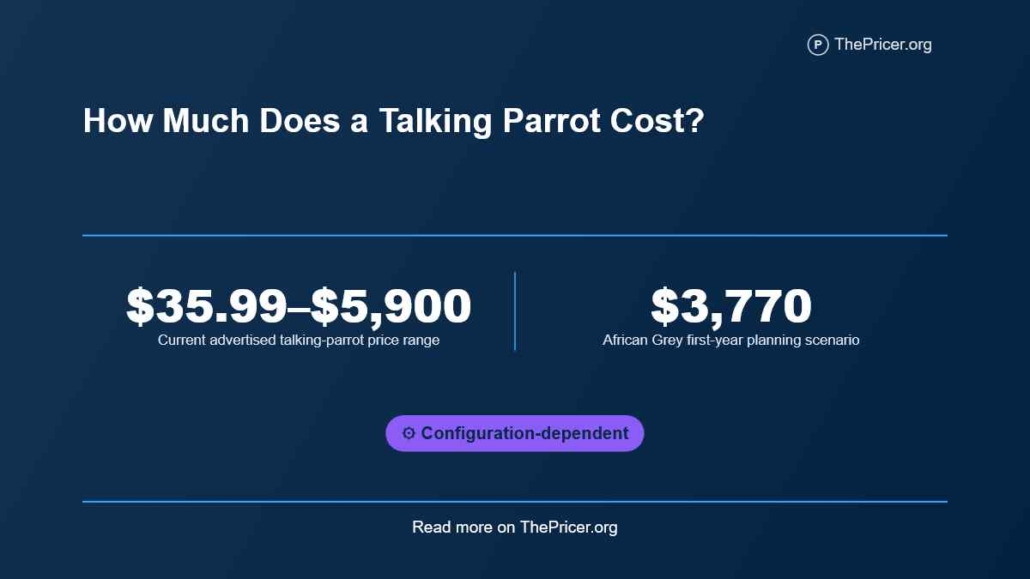
A talking parrot can cost from about $35.99 for a sale-priced budgie to around $5,900 for a current large-parrot retail example in the United States. There is no useful single average because “talking parrot” covers species with very different purchase prices, cage needs, veterinary costs, lifespans, and legal rules. Current sellers list budgies, cockatiels, Quakers, African Greys, Amazons, and cockatoos at prices separated by thousands of dollars.
Purchase price also does not buy a guaranteed vocabulary. Individual birds within the same species can differ sharply in vocal mimicry, while the first-year bill can include a cage, carrier, avian veterinary visit, food, perches, toys, transport, and repeated enrichment. The species and care plan matter far more than a headline average.
Article Highlights
Jump to sections
- Current advertised examples reviewed here run from $35.99 (at $30 per hour, earning that amount would take about 1.2 hours of work, before taxes) for a sale-priced budgie to $5,900 for a Rose-breasted Cockatoo or Double Yellow-headed Amazon.
- A current Green Quaker listing is $699, while one African Grey breeder lists individual birds from $1,500 to $2,500.
- The highest and lowest current seller examples above differ by roughly 164 times.
- A current African Grey first-year scenario can reach about $3,770 before tax, insurance, and emergency treatment.
- A generic one-bird care model totals $12,480 over ten years before the bird’s purchase price and major emergencies.
- Talking ability varies between species and between individual birds, so a higher purchase price does not guarantee more speech.
How Much Does a Talking Parrot Cost?
Species is the biggest reason the purchase price moves. Current live-bird retail prices show parakeets at $35.99 (about 1.2 hours of work at $30 per hour) on sale, with a regular price of $44.99, and an assorted cockatiel at $399.99. A current specialty baby-bird nursery listing shows a Green Quaker at $699, a Rose-breasted Cockatoo at $5,900, and a Double Yellow-headed Amazon at $5,900.
African Grey pricing varies even inside one breeding program. One current Texas breeder publishes individual Timneh African Greys at $1,500 to $1,600 and individual Congo African Greys at $1,700 to $2,500. Its current Grey listings also show higher package prices for pairs. Those figures are seller-specific offers, not a national average.
| Current U.S. example | Advertised price | Price scope |
|---|---|---|
| Budgie / parakeet | $35.99 sale, $44.99 regular | Major pet retailer, in-store |
| Cockatiel | $399.99 | Major pet retailer, in-store |
| Green Quaker | $699 | Specialty bird store listing |
| African Grey | $1,500 to $2,500 | Individual birds from one breeder |
| Double Yellow-headed Amazon | $5,900 | Specialty bird store listing |
| Rose-breasted Cockatoo | $5,900 | Specialty bird store listing |
The range is too wide for one useful average. Dividing the $5,900 high seller example by the $35.99 sale-priced budgie gives about 164. Species, size, rarity, seller, age, and documentation drive that spread rather than speech alone.
Speech Is Not Guaranteed
Talking is never guaranteed. A large study of 877 companion parrots across 73 species found substantial differences in vocal mimicry between species and within the same species. Grey parrots had the largest mimicry repertoires in the study, but individual Grey parrots ranged from no reported human words to hundreds. Budgerigars, cockatiels, macaws, and other parrots also included birds that mimicked people and birds that did not.
The peer-reviewed companion-parrot mimicry study is useful for buyers because it breaks the link between price and a promised vocabulary. A seller can describe a bird that already mimics sounds, but a young bird’s future speech cannot be guaranteed from species, sex, or price tag alone. Training, environment, social contact, individual behavior, and prior learning can shape what an owner hears without turning speech into a product specification.
A cockatiel can be a much cheaper companion than a large parrot and still mimic sounds or words, though whistling is common. Readers comparing that smaller species can see current cockatiel ownership costs. Budgies are another small-parrot option with documented vocal-learning ability. Neither species should be purchased on the assumption that one individual bird will reproduce a set number of words.
Why Purchase Prices Vary
Age, seller type, species, color mutation, documentation, socialization, and transport can all move the purchase price. A bird sold fully weaned with veterinary records, identification, disease-testing records, or CITES paperwork may be priced differently from a local rehome with little history. A rare color or sought-after species can raise the asking price, but appearance does not establish health or speaking ability.
Transport can create a separate bill. The African Grey breeder cited earlier publishes $185 (about 6.2 hours of work at $30 per hour) airport delivery and $350 home delivery, while local pickup is free. A remote $1,700 bird becomes a $2,050 purchase before cage or food with home delivery. Its $200 reservation deposit applies to the purchase price.
Seller channel changes the comparison too. A pet chain may post a standard in-store price, while specialty breeders may charge for hand-raising, documentation, genetic lines, or transport. A higher price is not proof of a better bird. Compare what each number includes.
Macaws make that mismatch especially obvious. “Macaw” covers multiple species with very different rarity, legal documentation, enclosure requirements, and prices. A dedicated Hyacinth Macaw cost comparison is more useful than attaching one generic macaw price to every bird in that group.
First-Year Setup Costs
The purchase price can be smaller than the first-year care added around it. One current African Grey breeder’s first-year cost schedule lists $300 to $800 for a large cage, $100 to $300 for perches and starter toys, $75 to $200 for an initial avian veterinary visit, $380 to $700 for first-year food, and $190 to $350 for enrichment. Its non-purchase total is $1,045 to $2,350.
Independent 2026 pricing puts an avian wellness exam around $100 to $250, with a $115 wellness-exam example. Using that figure produces a reproducible lower-end African Grey scenario. A $2,500 baby Congo plus a $300 cage, $100 of starter perches and toys, a $115 exam, $380 of first-year food, $190 of enrichment, and $185 airport delivery totals $3,770.
That is a calculated first-year scenario, not a national average. It excludes sales tax, insurance, emergency treatment, boarding, cage upgrades, and extra diagnostics. Using the upper ends of those setup categories with higher transport moves the total above $5,000.
Small birds have the same structural issue at a lower scale. The current parakeet cost guide models one budgie’s first year at about $600 to $1,500 after the bird, cage, supplies, food, enrichment, and initial veterinary care are combined. Compared with the $35.99 current sale-priced budgie, the purchase itself can be a small part of the first-year commitment.
Ongoing Care Costs
 Food, cage liners, cleaning supplies, replacement toys, and veterinary care continue long after the purchase. Large parrots can destroy enrichment items much faster than small birds, while cage size and food use rise sharply with body size. A budget that fits one budgie cannot simply be copied to a cockatoo, Amazon, African Grey, or macaw.
A current independent one-bird care calculator uses a generic first-year care estimate of $1,752 and $1,192 for each later year, excluding the bird’s purchase price. Its recurring model includes food, toys, cleaning supplies, an annual wellness exam, fecal testing, and baseline bloodwork. The site states that its supply figures were collected in August 2026. This is a planning model for one bird, not a species-specific quote.
Using that generic model, ten years of care equals $1,752 for year one plus nine years at $1,192, or $12,480 before purchase price, inflation, major emergencies, and costly equipment replacement. A cheap-bird comparison loses meaning across a long ownership period.
Long-lived species can also create future boarding or caregiving costs. Those expenses are hard to price nationally, but the long commitment is another reason the lowest purchase price should not control the species choice.
Veterinary Care and Insurance
Avian veterinary care is a separate market from ordinary pet-store spending. The 2026 pricing source cited above places routine exotic visits that include birds at about $100 to $250. Its after-hours example is $200 for the emergency exam plus a $120 emergency fee before diagnostics or treatment. A bird that cost under $50 can still generate a veterinary bill several times its purchase price.
Insurance exists for birds, but pricing is quote-based rather than a dependable national monthly amount. Nationwide states that its pet health plans cover birds and other exotic pets, with access to veterinarians including specialists and emergency providers. Policy availability, reimbursement, exclusions, and premium depend on the plan and location, so the old idea of budgeting a fixed $5 to $30 per month for every parrot is not a sound national assumption.
Owners who skip insurance still need a way to handle urgent care. An emergency reserve is separate from routine spending because an unused reserve is not an annual bill. Keeping those categories separate prevents normal care estimates from assuming the same medical event every year.
Access matters too. A cheap bird can be costly to treat if the nearest avian-capable clinic is far away. Identify an avian veterinarian before choosing the bird so travel time and clinic availability are known before an emergency.
Legal and Sourcing Checks
Species choice can change whether a purchase is legal at all. Pennsylvania’s current wildlife rule makes it unlawful, except where the rule or statute provides otherwise, to import, possess, sell, offer for sale, or release listed wildlife, and the list names the Monk Parakeet, also called the Quaker Parakeet. The same rule contains permit provisions for certain activities. State rules differ, so legality should be checked before a deposit is sent.
International movement creates another layer. U.S. Fish and Wildlife Service pet-bird permit guidance says a person traveling with a CITES-listed exotic pet will likely need a permit and should allow at least 60 days for processing. Documentation of legal origin can matter long after the original purchase if the owner later moves abroad.
Age and weaning status matter too. The Association of Avian Veterinarians opposes transferring unweaned birds to people known not to have the needed hand-feeding experience. A very young bird sold cheaply is not a sensible shortcut if the buyer is expected to finish hand-feeding without that skill.
Ask for species identification, age records when available, current diet information, health records, seller terms, and required legal paperwork. Very low prices paired with pressure to wire money, vague location details, or missing documentation deserve extra scrutiny.
Choosing the Right Species
Price should narrow the options, not decide the species by itself. A smaller bird can fit a lower purchase and cage budget, while large parrots can require more room, stronger equipment, and years of repeated enrichment. Match the bird to the household’s space, daily care capacity, veterinary access, and realistic long-term budget.
The speech question belongs after those practical checks. Someone who wants a companion with strong mimicry potential may look toward Greys or Amazons, but the research does not support treating any individual bird as a guaranteed talker. A household that would be disappointed by a bird that rarely speaks should not pay a premium based only on that expectation.
Makes sense if
- You can fund the cage, veterinary care, food, and enrichment after paying for the bird.
- You have checked local ownership rules for the exact species.
- You have access to an avian-capable veterinarian.
- You are comfortable owning the bird even if it never develops a large vocabulary.
Does not make sense if
- The bird price uses nearly all of the available first-year budget.
- The seller cannot explain the bird’s origin, weaning status, or paperwork.
- You are choosing a species only because a listing promises talking ability.
- Your housing cannot accommodate the cage, noise, and daily care that species needs.
Verification
- Checked the current direct cockatiel listing at $399.99.
- Confirmed the species selection guidance distinguishes major differences in lifespan, noise, housing, and talking tendencies.
- Cross-referenced the avian veterinarian directory for a U.S. specialist-search resource.
Answers to Common Questions
How much does a talking parrot cost?
Current U.S. examples reviewed here range from $35.99 for a sale-priced budgie to $5,900 for current large-parrot listings. Species is the main reason the range is so wide.
What is the cheapest talking parrot?
Budgies are among the lowest-cost parrots with human-mimicry ability. A current major-retailer example is $35.99 on sale and $44.99 at regular price.
How much does an African Grey cost?
One current breeder lists individual Timneh and Congo African Greys from $1,500 to $2,500, with pairs and some other placements priced differently.
Does an expensive parrot talk better?
No price level guarantees speech. Species differ in mimicry potential, but individual birds within the same species can have very different repertoires.
How much can parrot care cost after purchase?
A current generic one-bird model estimates $1,752 during the first year and $1,192 for each later year before purchase price and major emergencies. Larger or medically complex birds can cost more.
Disclosure: Educational content, not medical advice. Pricing varies by provider, location, and insurance. Confirm eligibility, coverage, and out-of-pocket costs with a licensed clinician and your insurer. See our methodology and corrections policy.