
How Much Does a Tesla Model 3 Cost to Own?
Published on | Written by Alec Pow
This article was researched using 14 sources. See our methodology and corrections policy.
A new 2026 Tesla Model 3 Standard starts at $36,990, or $38,630 including destination and order fees before taxes and other charges. Five-year ownership can cost far more than the sticker price once depreciation, insurance, electricity, maintenance, repairs, financing, registration, and charging equipment enter the budget.
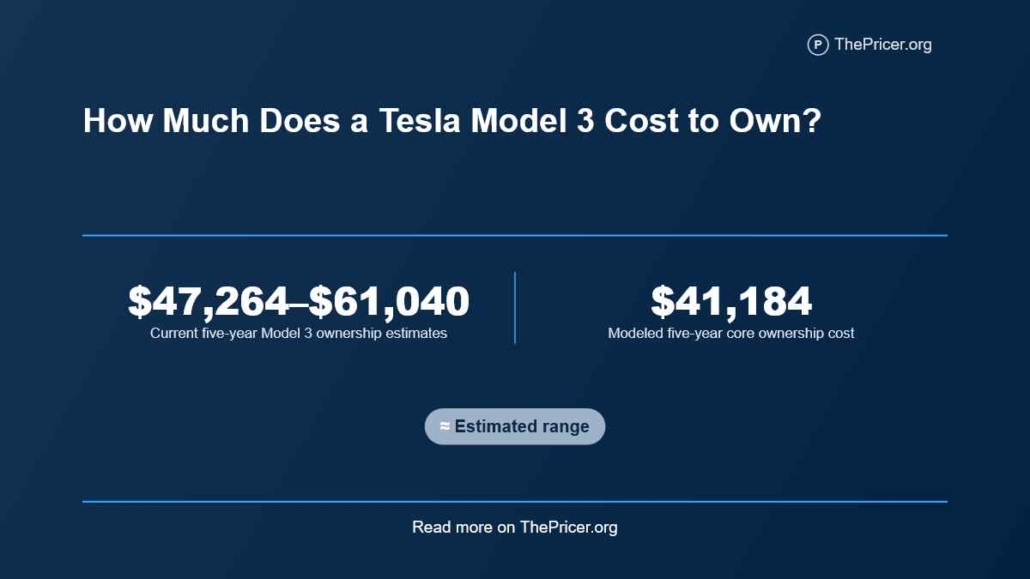
Current third-party models span from $47,264 at Edmunds to $61,040 at Kelley Blue Book. The gap shows why one national ownership number can mislead. Depreciation and insurance usually matter more than electricity, while charging access can still change a five-year energy bill by several thousand dollars.
Article Highlights
Jump to sections
- The Model 3 Standard starts at $36,990 (at $30 per hour, earning that amount would take about 7.1 months of full-time work, before taxes), or $38,630 with destination and order fees before tax.
- Current five-year ownership models range from about $47,264 to $61,040.
- Five-year depreciation can reach about $20,000 to $23,000.
- Home electricity is about $667 per year in the national-rate scenario used here.
- Public charging raises that scenario to about $1,535 per year.
- A Tesla Wall Connector setup can recover its cost after roughly 23,000 to 36,000 miles when public charging is the alternative.
How Much Does a Tesla Model 3 Cost to Own?
Five-year ownership estimates differ because each model uses its own assumptions for location, insurance, financing, taxes, mileage, energy prices, maintenance, and resale value. Edmunds estimates $47,264 (about 9.1 months of full-time work at $30 per hour) for a 2026 Model 3 Standard at 15,000 miles per year. Its figure includes depreciation, insurance, financing, taxes and fees, electricity, maintenance, and repairs. Kelley Blue Book’s broader 2026 Model 3 model comes to $61,040 over five years.
The $13,776 difference between those two published totals equals about 29% of the Edmunds figure. That spread is too large to hide behind one national average. A driver in a high-insurance state who relies on public fast charging can spend much more than a homeowner with inexpensive electricity and a competitive insurance quote.
A useful ownership calculation separates fixed and variable costs. Depreciation changes with resale values. Insurance depends heavily on the driver and ZIP code. Electricity depends on efficiency, mileage, and charging location. Financing depends on the loan. State taxes and registration vary by jurisdiction. That is why this article uses a transparent five-year Standard RWD scenario, then shows outside benchmarks rather than blending incompatible figures into a supposed universal total.
Purchase Price
Tesla’s current U.S. Model 3 page lists the Standard RWD at $36,990 (about 7.1 months of full-time work at $30 per hour), Premium RWD at $42,490, Premium AWD at $47,490, and Performance AWD at $54,990. The current Model 3 pricing shows the Standard at $38,630 after destination and order fees, before tax and other charges. The Performance starts $18,000 above the Standard before those fees.
The federal purchase incentive that shaped older Model 3 cost articles no longer applies to a new 2026 purchase. The IRS says the new clean vehicle credit ended for vehicles acquired after September 30, 2025. An article that still subtracts $7,500 from a current purchase is using outdated ownership math.
Financing creates a separate cost layer. A buyer’s APR, term, down payment, and credit profile can change five-year interest by thousands of dollars. There is one newer federal tax provision worth checking. The IRS car-loan interest deduction allows up to $10,000 per year of qualifying passenger-vehicle loan interest for tax years 2025 through 2028, subject to income and vehicle requirements. A tax deduction reduces taxable income rather than reducing the purchase price dollar for dollar.
Depreciation Is the Biggest Cost
Depreciation can exceed every routine operating expense on a Model 3. iSeeCars estimates that a new Model 3 loses 53.6% of its value after five years, leaving a resale value of $17,153. Its Model 3 depreciation analysis makes value loss the largest ownership-cost category. KBB currently models $21,889 of five-year depreciation, while Edmunds uses $22,751 for its 2026 Standard calculation.
Those forecasts should be treated as planning values rather than guaranteed resale prices. Tesla can change new-car pricing. Used-EV demand, competing models, battery condition, mileage, accident history, options, and future incentives can all move resale values. A buyer who sells after only two or three years also bears more of the steep early value loss than someone who keeps the car longer.
The scale matters. The five-year home-electricity scenario is about $3,335. A roughly $20,000 depreciation bill is close to six times that amount. Saving a few cents per kilowatt-hour helps the running budget, but resale value can erase or create much larger differences in total ownership cost. Owners comparing trims should pay close attention to the dollars that may be lost at resale, not only the extra range or acceleration purchased on day one.
Insurance
Insurance is one of the least portable numbers in any national Model 3 ownership estimate. NerdWallet’s October 2025 analysis puts Model 3 insurance at an average of $2,459 per year, or about $12,295 over five years if that annual figure stayed unchanged. KBB uses a much higher $18,705 over five years in its current Model 3 cost model.
Both numbers are planning references rather than quotes for a particular owner. Age, driving history, ZIP code, annual mileage, credit-based insurance rules where permitted, coverage limits, deductible, trim, repair costs, and insurer pricing can move the premium sharply. A Performance owner can also face a different result from a Standard owner even before personal risk factors enter the quote.
Compare insurance with energy. The home-charging scenario costs about $667 per year. NerdWallet’s insurance figure is about 3.7 times that amount. KBB’s modeled $3,741 yearly insurance cost is about 5.6 times the home-electricity estimate. Getting an insurance quote before ordering can change the ownership decision more than a small improvement in charging efficiency. It is also one of the easiest Model 3 costs to price accurately for a specific household before purchase.
Home Charging vs. Public Charging
The Standard’s 139 MPGe rating works out to about 24.2 kWh per 100 miles. At 15,000 miles per year, that is roughly 3,637 kWh. The latest EIA residential electricity price is 18.34 cents per kWh for June 2026. Multiplying those inputs gives about $667 per year, or roughly $3,335 over five years.
AAA’s September 17 national average for commercial and public charging is 42.2 cents per kWh. At the same efficiency and mileage, paying that rate for every charge would cost about $1,535 per year, or roughly $7,673 over five years. The difference is about $4,338 across 75,000 miles. Tesla Supercharger prices vary by site, so the AAA rate is a national public-charging benchmark rather than a Tesla tariff.
Home equipment adds an upfront expense. Tesla lists its Wall Connector at $585 and estimates installation at $750 to $1,500. A normal setup is about $1,335 to $2,085. Against the modeled 5.79-cent-per-mile home-versus-public savings, that setup recovers its cost after roughly 23,000 to 36,000 miles. An existing charging outlet, free workplace charging, or lower public rates can move that break-even point.
Maintenance, Tires, and Repairs
 Tesla does not require the oil changes, spark plugs, fuel-system service, or emissions work associated with a gasoline car. Its current maintenance guidance calls for tire rotation every 6,250 miles or when tread-depth difference reaches 2/32 inch. Tesla also recommends cabin-air-filter replacement every two years and brake-fluid testing every four years.
Reduced routine service does not make maintenance free. Edmunds estimates $2,173 of maintenance and $1,834 of repairs over five years for the 2026 Standard, a combined $4,007. KBB’s current model is higher at $3,115 for maintenance and $2,178 for repairs, or $5,293 combined. These estimates include assumptions about wear items and later repair exposure.
Tires deserve their own check because Model 3 replacement sets can approach four figures before installation. A current Tire Rack search for the Standard lists a Pirelli P7 AS Plus 3 set at $876.36 and another all-season set near $988.96. Performance-size tires can cost more. Owners should not add a separate tire allowance to a third-party maintenance estimate unless they confirm tires are excluded, since some ownership models already count tire replacement.
A Five-Year Model 3 Ownership Budget
The table below builds a core five-year Standard RWD scenario for 75,000 miles. It uses iSeeCars’ current depreciation model, NerdWallet’s insurance benchmark, the EIA home-electricity calculation, Edmunds’ maintenance and repair estimate, and a midpoint Wall Connector setup assumption. Financing, sales tax, annual registration, and state EV fees are excluded because they vary too much by buyer and jurisdiction to support one national figure.
| Ownership item | Five-year amount | Basis |
|---|---|---|
| Depreciation | $19,837 | 53.6% modeled value loss |
| Insurance | $12,295 | $2,459 per year |
| Home electricity | $3,335 | 75,000 miles at national home rate |
| Maintenance and repairs | $4,007 | Edmunds five-year Standard model |
| Wall Connector setup | $1,710 | Midpoint of hardware plus installation range |
| Core five-year cost | $41,184 | Before financing, tax, registration, and state EV fees |
The $41,184 result is a ThePricer scenario, not a national average. It shows the relative weight of the cost categories without claiming that every owner pays the same insurance or loses the same amount at resale. Depreciation plus insurance contributes about $32,132, close to 78% of the modeled core total. Home electricity contributes only about 8%.
The scenario also explains why a buyer should not add the full purchase price to depreciation. Depreciation already represents the portion of vehicle value consumed during the ownership period. A cash purchase ties up capital, while a financed purchase adds interest. Owners can compare local charging and installation costs in the Tesla charging cost and home charger installation cost guides.
Which Model 3 Costs Least to Keep
Under one consistent methodology, the Standard is the least expensive current Model 3 to own. Edmunds estimates five-year costs of $47,264 for the Standard, $52,082 for Premium RWD, $56,837 for Premium AWD, and $67,128 for Performance. The Performance sits $19,864 above the Standard in that model over five years.
The gap is not mainly an electricity story. Higher acquisition price creates more dollars at risk to depreciation and financing. Insurance can change with trim and location. Larger performance tires cost more to replace. Energy use rises too, but that expense is smaller than the capital-cost differences for many owners.
Makes sense if
- You can charge mostly at home and get a competitive insurance quote.
- You plan to keep the car long enough to spread charger setup cost across many miles.
- You price depreciation and financing before choosing a higher trim.
- You want low routine service needs without treating repairs or tires as free.
Does not make sense if
- Your calculation still subtracts the expired $7,500 federal purchase credit.
- You assume public fast charging costs the same as home electricity.
- You compare trims using electricity cost while ignoring depreciation and insurance.
- You add a routine battery replacement to a five-year budget without evidence that one will be needed.
The battery is covered for 8 years or 100,000 miles on Model 3 RWD and 8 years or 120,000 miles on Premium and Performance versions, with at least 70% capacity retention during the warranty period. The Tesla battery warranty is why this five-year model does not insert an arbitrary replacement bill. Optional software belongs outside the baseline too. Buyers who want the driver-assistance subscription can price it separately through the Tesla FSD cost guide.
Answers to Common Questions
How much does a Tesla Model 3 cost to own for five years?
Current third-party models range from about $47,264 to $61,040. The article’s narrower core scenario is about $41,184 before financing, sales tax, registration, and state EV fees.
How much does it cost to charge a Model 3 at home?
At 15,000 miles per year and the current national residential electricity price, the Standard scenario costs about $667 per year.
Is Model 3 maintenance expensive?
Routine service needs are lighter than on a gasoline car, but tires and later repairs still matter. Current five-year maintenance and repair models range from about $4,007 to $5,293.
Do I need to budget for a new battery in five years?
A routine battery replacement is not supported as a normal five-year ownership expense. Tesla’s battery and drive-unit warranty extends beyond five years for every current Model 3 trim.
Disclosure: Educational content, not financial advice. Prices reflect public information as of the dates cited and can change. Confirm current rates, fees, taxes, and terms with official sources before purchasing. See our methodology and corrections policy.