
How Much Does A Traffic Camera Ticket Cost?
Updated on | Written by Alec Pow
This article was researched using 10 sources. See our methodology and corrections policy.
A traffic camera ticket in the United States can cost as little as $35 in Chicago or $50 in New York City, while certain automated speeding violations in Maryland work zones can reach $1,000. Many camera fines fall between $50 and $200, but there is no reliable nationwide average because cities and states use different laws, fine schedules, and enforcement programs.
The full cost also depends on whether the notice is paid promptly, how it is paid, and whether the violation is classified as a civil penalty or a moving violation. Some camera tickets do not add license points or directly affect insurance, yet unpaid balances can still create significant financial consequences. The issuing authority and violation type matter more than a broad national price estimate.
Article Highlights
Jump to sections
- New York City speed and red-light camera tickets carry a $50 fine.
- Chicago speed camera penalties are $35 or $100, depending on speed.
- Florida red-light camera notices carry a $158 penalty.
- Oakland’s 2026 speed-camera pilot charges $50–$500, with qualifying discounts.
- Maryland work-zone camera penalties can reach $1,000 when workers are present.
- NYC adds a $25 late penalty after 30 days and charges certain online payment fees.
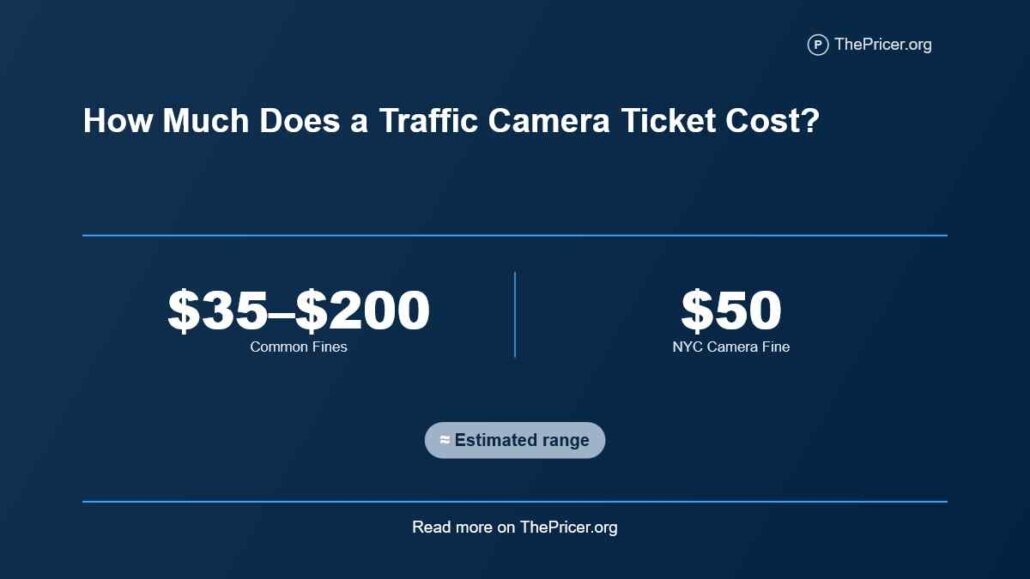
How Much Does a Traffic Camera Ticket Cost?
Local statutes and official payment schedules provide more dependable prices than national estimates. The following amounts are for specified automated enforcement programs, not ordinary citations written by police officers.
| Jurisdiction | Camera violation | Published penalty |
|---|---|---|
| New York City | Speed camera | $50 |
| New York City | Red-light camera | $50 |
| Chicago | Speed, 6–10 mph over | $35 |
| Chicago | Speed, 11+ mph over | $100 |
| Florida | Red-light camera notice | $158 |
| Oakland, California | Speed-camera pilot | $50–$500 |
| Maryland | Work-zone speed camera | $60–$1,000 |
New York City’s official camera payment schedule lists $50 for both speed-camera and red-light violations. Bus-lane camera fines start at $50, while special weigh-in-motion enforcement uses a different penalty.
Chicago’s current municipal fine ordinance specifies $35 when a speed camera records a vehicle 6 to 10 mph over the applicable limit and $100 when it records 11 mph or more over.
These examples show why a ticket should not be priced by state name alone. The city, program, recorded offense, and current law determine what is owed.
New York City Camera Fines
New York City is a useful example of a program with a relatively low base penalty and potentially expensive consequences for leaving tickets unpaid.
The city’s red-light camera enforcement rules state that these citations are issued as notices of liability to registered vehicle owners. They do not add driver-license points.
Camera notices should be answered within 30 days. When a NYC camera fine remains unpaid after that period, the city adds $25, making a $50 camera violation cost $75 before payment-processing fees or later interest.
After approximately 75 days, the unpaid violation can enter judgment, at which point the Department of Finance applies 9% simple annual interest to the judgment balance.
The city’s rules also provide for booting or towing when combined judgment debt for parking and camera violations exceeds $350 across vehicles registered to the same owner.
That amount is a combined judgment-debt threshold, not a rule that a single $50 ticket automatically results in towing. Collection measures can be serious even where the underlying traffic offense carries no driver’s license points.
Chicago and California Camera Tickets
Chicago differentiates automated speeding penalties by the recorded amount over the limit. This is unlike New York City’s flat camera-speed fine.
A Chicago driver recorded at 8 mph over an applicable limit faces a $35 camera fine. At 12 mph over, the cited amount becomes $100. Those amounts apply to Chicago’s automated speed enforcement system rather than every speeding citation issued in Illinois.
California has a different example in Oakland’s new speed-safety pilot. The city’s March 2026 enforcement schedule lists $50 for 11–15 mph over the limit, $100 for 16–25 mph over, $200 for 26 mph or more over, and $500 for any vehicle traveling at least 100 mph.
Oakland’s program provides reduced fines for qualifying low-income motorists and public-benefit recipients. At the lowest $50 tier, the published amounts fall to $25 or $10, respectively.
These discounts matter because a statewide headline fine does not necessarily describe what an eligible individual ultimately must pay. Oakland also classifies its pilot camera citations as nonmoving violations that do not add driver’s license points or affect insurance.
Florida and Maryland Penalties
Florida’s statutory red-light camera program carries a $158 initial notice-of-violation penalty.
Under Florida Statute 316.0083, a registered owner receiving a notice can pay, submit an authorized affidavit, or request a hearing within the statutory time frame. The law provides for a 60-day response window following notification.
Florida also specifies circumstances where a camera notice must not be issued, including certain permitted right turns and situations involving emergency vehicles. The statute, not a general internet defense checklist, establishes those exceptions.
Maryland’s work-zone automated enforcement program is much more expensive for serious speeding.
The Maryland SafeZones fine schedule lists penalties of $60, $80, $140, $270, and $500 at successive speeding levels. When workers are present and the applicable warning lights are activated, those amounts double to $120, $160, $280, $540, and $1,000.
A related Maryland automated-speed statute establishes a different tiered schedule for many local speed-monitoring systems, beginning at $40 for 12–15 mph over the limit and rising to $425 at 40 mph or more over.
This is a particularly important distinction. A Maryland school-zone camera violation and a work-zone camera violation cannot be assigned the same fine merely because both involve speeding.
The Hidden Cost of Paying Late
Late payment rules can make the same fine more expensive without any additional traffic offense. The amount depends on the issuing jurisdiction.
NYC also charges a payment-processing fee for certain methods. Its official payment page lists a 2% fee for online card, PayPal, and Venmo payments, while electronic checks carry no such processing fee.
Consider a driver with one NYC $50 camera ticket.
- Fine paid promptly by electronic check: $50.00.
- Fine paid promptly by card: $51.00.
- Fine after the applicable $25 late penalty: $75.00.
- Late balance paid with a 2% card fee: $76.50.
In this example, missing the payment deadline and then using a fee-bearing card method increases the cost by $26.50 compared with paying the original ticket promptly by electronic check.
That is a 53% increase over the initial $50 penalty. It does not include later judgment interest, collection measures, or booting and towing expenses.
The source of this calculation is NYC’s own payment schedule. It should not be applied to Chicago, Florida, Maryland, or another jurisdiction with different rules.
Insurance, Points, and Civil Liability
The most consequential hidden-cost question is often whether a camera ticket will appear on the driver’s record or change insurance premiums.
A camera-issued civil violation is not necessarily treated the same as a moving violation issued by an officer.
Seattle’s Municipal Court instructions state that its camera tickets are handled similarly to parking tickets and do not appear on the driving record. However, nonpayment may create a vehicle-registration hold.
Similarly, the NYC red-light program does not assess license points. Oakland’s pilot also identifies its camera tickets as nonmoving violations with no points or insurance effects.
Those examples do not establish a nationwide exemption. Different camera systems can operate under different statutory schemes, and an officer-issued citation for the same driving conduct may carry distinct consequences.
Drivers should inspect the violation code and issuing authority on the notice before estimating points or insurance costs. It would be misleading to add an automatic multi-year insurance premium increase to every camera-ticket calculation.
For comparison, our following-too-closely ticket guide addresses an ordinary moving-violation category where points and insurance consequences can be more relevant.
Contesting a Camera Ticket
A camera notice normally identifies the alleged violation, vehicle, location, date, amount, deadline, and available payment or hearing procedure.
Start by confirming the notice through the official issuing authority. Avoid using unsolicited text-message links demanding immediate payment. NYC specifically warns that scammers impersonate parking and camera enforcement services.
Where a hearing is available, review the photographic or video evidence and the local rules before submitting a challenge. Grounds may include incorrect vehicle identification, a stolen vehicle, or a circumstance recognized in the relevant law.
For a NYC red-light citation, the Department of Finance describes evidence involving stolen plates, incorrectly identified vehicles, traffic-signal malfunctions, and other specified defenses.
Seattle also permits certain motorists who were not responsible for the photographed vehicle to file a declaration of non-responsibility. The declaration must satisfy the court’s requirements and arrive within the specified deadline.
Disputing a ticket can involve time and travel, although hearings may be available remotely or in writing. The driver should compare those costs with the potential financial result while recognizing that paying early may affect the ability to contest the allegation later.
A valid challenge should be based on evidence and the applicable law. No camera-ticket defense succeeds merely because the recipient believes automated enforcement is unfair.
When Contesting Costs More
A second useful calculation considers the practical cost of contesting a lower-value notice.
Suppose a driver receives a $50 civil camera ticket and can contest it through a hearing. Assume the hearing requires three hours away from work, with lost earnings of $25 per hour, and $10 in travel expenses.
The modeled indirect cost is $85 before any statutory hearing or filing fee. That exceeds the original $50 penalty by $35.
However, this does not mean the person should automatically pay a ticket they believe is wrong. The hearing may be remote, lost income may be zero, and the outcome may affect additional rights or expenses. A successful challenge can also avoid the underlying penalty.
For someone eligible for an Oakland reduced fine of only $10, an unnecessary travel expense may exceed the fine itself. Checking for discounts, remote hearings, and assistance options should come before deciding that formal contesting is unaffordable.
This example is an explicit time-cost model, not a published average attorney bill or court expense.
Camera Enforcement and Safety
Traffic cameras record different offenses using cameras, sensors, radar, and related systems. Many programs require official review before a citation is issued.
The Insurance Institute for Highway Safety summarizes research associating red-light camera enforcement with reductions in serious intersection crashes.
An IIHS city-level study reported that fatal red-light-running crash rates were approximately 21% lower after cameras were introduced than would otherwise have been expected, while rates increased in cities that discontinued programs.
Safety results do not make every local camera program identical. Citation thresholds, signs, camera placement, appeal rights, and fine revenue policies still require scrutiny under the relevant laws.
The practical financial protection for motorists is compliance with posted speed limits, signals, and lane restrictions, coupled with prompt review of any notice received.
Makes sense if
- The notice is checked against an official government portal.
- The amount matches the applicable local schedule.
- Available income-based reductions or payment options are examined.
- A challenge is supported by specific evidence and timely submission.
Does not make sense if
- A camera fine is assumed to carry automatic license points.
- An officer-issued ticket is confused with a civil camera notice.
- Late payment is ignored because the original fine was small.
- Payment is sent through an unverified text or email link.
Related vehicle violations are covered in our expired registration ticket guide. Registration citations follow their own local fine and enforcement rules, separate from automated speeding or red-light penalties.

Answers to Common Questions
How much is a NYC speed camera ticket?
New York City lists a $50 speed-camera fine. A $25 penalty can be added after 30 days, with later interest and enforcement consequences for unpaid judgment debt.
Do traffic camera tickets affect insurance?
Some civil camera tickets do not add license points or appear on driving records. Treatment varies by jurisdiction and type of citation. Check the issuing program rather than assuming every ticket changes insurance premiums.
How much is a red-light camera ticket in Florida?
The statutory initial notice penalty is $158. Additional costs may arise if the matter proceeds to a formal citation or hearing under the applicable statute.
Can a traffic camera ticket be dismissed?
Yes, when the facts and local rules support dismissal. Common issues include incorrect vehicle identification, qualifying statutory exceptions, or defects in evidence. Filing requirements and deadlines differ by jurisdiction.
Disclosure: Educational content, not financial advice. Prices reflect public information as of the dates cited and can change. Confirm current rates, fees, taxes, and terms with official sources before purchasing. See our methodology and corrections policy.