
How Much Does a U.S. Military FPV Drone Cost?
Published on | Written by Alec Pow
This article was researched using 7 sources. See our methodology and corrections policy.
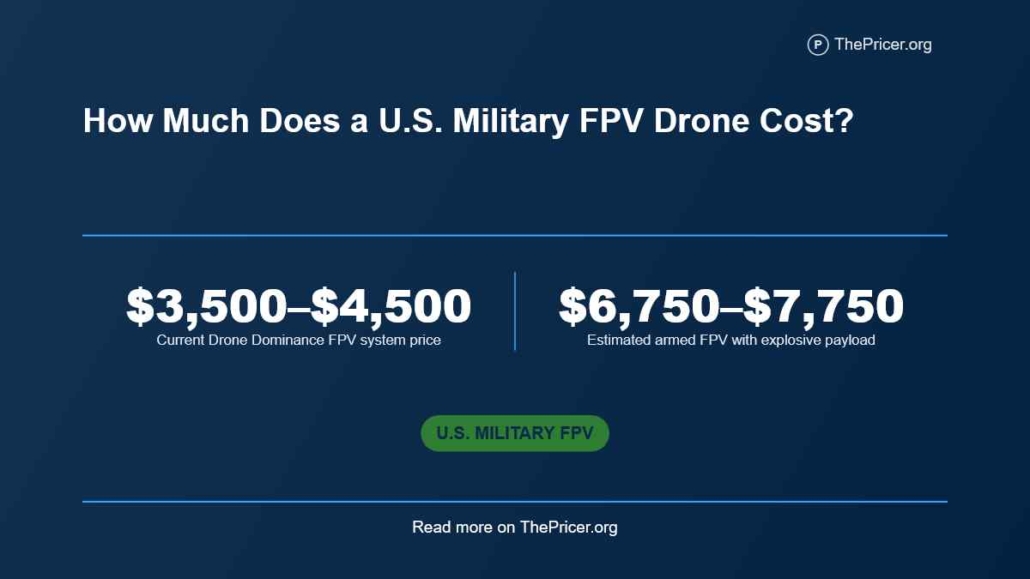
A U.S. military first-person-view drone currently costs about $3,500 to $4,500 for the airframe package in the Pentagon’s Drone Dominance program, while adding the program’s $3,250 explosive payload puts a weaponized one-way FPV system at roughly $6,750 to $7,750. Some Army programs are pushing simpler attritable drones toward less than $2,000 each, while small unit purchases that include controllers, support equipment and training can work out to far more per drone.
The newest evidence came on September 30, 2026, when Neros announced a Pentagon order worth more than $100 million for 14,000 Archer FPV drones and explosive payloads. The contract covers 8,000 smaller close-quarters systems and 6,000 longer-range drones. It is one of the clearest examples yet of how the advertised price of a cheap FPV airframe becomes a much larger battlefield cost once the military adds the munition, control equipment, spare parts and training.
The U.S. military is deliberately trying to keep these drones inexpensive enough to lose in combat. That makes FPVs fundamentally different from reusable surveillance drones costing hundreds of thousands or millions of dollars. The Pentagon’s problem is that a secure, American-built, jammer-resistant combat FPV costs more than the hobby-style quadcopters that helped transform the war in Ukraine.
Article Highlights
Jump to sections
- Current Drone Dominance pricing is about $3,500 (at $30 per hour, earning that amount would take about 2.9 full-time workweeks, before taxes) for a close-quarters FPV and $4,500 for a deep-strike FPV.
- The program prices the explosive payload separately at about $3,250.
- That creates an armed-system benchmark of about $6,750 to $7,750 per drone.
- Neros received a September 2026 order for 14,000 drones and explosive payloads worth more than $100 million.
- Using the published program prices, 8,000 close-quarters drones plus 6,000 deep-strike drones cost $55 million before munitions.
- Add one $3,250 munition for each of 14,000 drones and the modeled total reaches $100.5 million, almost exactly matching the disclosed order value.
- The Army is also pursuing simpler FPV systems around or below a $2,000 unit target.
- Small military purchases can show much higher per-drone-equivalent costs because they include controllers, spare equipment, testing and operator training.
How Much Does an FPV Drone Cost?
The strongest current benchmark comes from the Pentagon’s Drone Dominance Program, a procurement effort built specifically to buy large quantities of low-cost one-way attack drones. Phase II divided FPVs into two main mission classes: close-quarters systems for trenches, buildings and confined spaces, and longer-range systems intended to strike targets farther away.
The Phase II acquisition structure set the close-quarters drone price at approximately $3,500 (about 2.9 full-time workweeks at $30 per hour) per system and the deep-strike price at $4,500. A compatible explosive payload was priced separately at about $3,250. Independent analysis of the Phase II solicitation confirms those fixed-price levels and notes that the drone price also incorporates supporting items such as ground-control equipment, spare hardware and operator training rather than representing only a bare collection of motors and carbon-fiber parts.
| U.S. military FPV cost | Current price | What the figure represents |
|---|---|---|
| Army low-cost target | Under $2,000 | Target for simpler attritable FPV systems |
| Close-quarters FPV | $3,500 | Drone Dominance Phase II system price |
| Deep-strike FPV | $4,500 | Longer-range Phase II system price |
| Explosive payload | $3,250 | Separate one-way attack munition |
| Armed close-quarters FPV | About $6,750 | $3,500 drone + $3,250 payload |
| Armed deep-strike FPV | About $7,750 | $4,500 drone + $3,250 payload |
The Pentagon described Drone Dominance as an effort to rapidly field low-cost one-way attack drones in large numbers. Price is part of the requirement rather than an afterthought: a system designed to be consumed during one combat mission cannot follow the economics of a reusable $100,000 reconnaissance aircraft.
The $100 Million Order
Neros’s September 30 award gives us an unusually useful real-world test of those advertised prices. The company said it received an order for 14,000 drones and explosive payloads worth more than $100 million after placing first in the close-quarters category and third in deep strike.
Defense Daily reported that the order consists of approximately 8,000 Archer five-inch systems for close-quarters missions and 6,000 larger Archer systems for deep strike. Those quantities allow the contract to be reconstructed using the competition’s published pricing structure.
The drone portion works out to:
8,000 × $3,500 (about 2.9 full-time workweeks at $30 per hour) = $28 million
6,000 × $4,500 = $27 million
Total airframe/system value = $55 million.
If each drone is paired with one $3,250 explosive payload:
14,000 × $3,250 = $45.5 million.
Add the two:
$55 million + $45.5 million = $100.5 million.
That calculated $100.5 million lands almost exactly on Neros’s disclosed “over $100 million” value. Neros has not published a contract-line-item invoice confirming that every one of the 14,000 drones receives exactly one payload, so the calculation should be treated as a reconstruction rather than the government’s official pricing breakdown. The fit does show how a $3,500-$4,500 drone turns into a roughly $7,000 battlefield weapon once its strike payload is counted.
Why Not $500?
The war in Ukraine made the “$500 FPV drone” familiar, but that number is not directly comparable with a current U.S. military acquisition. The Pentagon is buying systems that must satisfy American supply-chain rules, military cybersecurity requirements, electronic-warfare resistance, production requirements and standardized support needs.
The Defense Innovation Unit added FPV platforms to its Blue UAS process because the military needed small systems that could be purchased and operated without relying on prohibited components. DIU’s 2025 Blue UAS selection included Neros Archer and assessed issues such as command-link reliability, latency, payload capacity, mission flexibility and resilience to GPS denial and electronic jamming.
Neros’s Archer has also been used by DIU to address contested communications. The Blue EMI program describes the Archer’s frequency-hopping command link as a way to maintain control and video in environments where conventional FPV links could be jammed.
Those requirements carry costs. A commercial drone racer can source components from the cheapest supplier available. A Pentagon vendor may have to redesign motors, batteries, radios, flight controllers and cameras around approved supply chains, document where components originate and maintain production capacity capable of delivering thousands of nearly identical systems on schedule.
The $2,000 Target
The military does not want $7,000 to become the floor for every FPV. The Army is simultaneously pushing a cheaper class of attritable aircraft toward a target of roughly $2,000 or less.
An Army professional publication discussing small-UAS adoption states that the Program Executive Office for Aviation has used a $2,000 vendor price cap for inexpensive commercially derived systems. The goal is to make them cheap enough to deploy widely and repair locally rather than treat each loss like the destruction of conventional aviation equipment.
Neros also received a five-year Army Archer contract vehicle with a ceiling of up to $500 million. Reporting on the award said the Army was pursuing systems below roughly $2,000 and quantities reaching thousands of drones a year. The $500 million ceiling should not be divided by a hypothetical drone quantity and called an Archer unit price because the IDIQ also accommodates testing, engineering support, equipment and training.
The distinction gives us three meaningful cost tiers rather than one number: sub-$2,000 targets for very inexpensive attritable platforms, $3,500-$4,500 for current Drone Dominance combat FPV packages before the warhead, and roughly $6,750-$7,750 once weaponized.
Small Orders Cost More
Military contract records show why a purchase order can look dramatically more expensive than a mass-production price.
In June 2026, the Marine Corps purchased 20 Neros Archer 8-inch FPV drones together with support equipment and training for 20 Marines. Public federal-contract records put the award at approximately $335,995. The underlying requirement specifically covered Archer FPV drones and military procurement of the same family, while the Marine requirement included training and supporting hardware.
If someone simply divided:
$335,995 ÷ 20 = $16,799.75 per drone.
That would be mathematically correct and economically misleading. The Marines did not buy 20 bare drones for $16,800 each. They bought a package that included aircraft, support equipment and operator instruction.
Naval Special Warfare provides a second example. A 2025 sole-source Archer FPV award carried a total value of $503,000, but the public award record does not disclose enough unit-level detail to turn that total into a trustworthy per-drone figure.
This is why the high-volume Gauntlet prices are much more useful for answering the headline question than dividing small military contracts by whatever drone quantity happens to appear in a solicitation.
What the Military Pays For
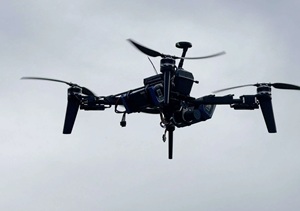 A military FPV purchase can include much more than the quadcopter itself. The Drone Dominance structure bundles supporting equipment into the system price, while other contracts may itemize it separately.
The package can include goggles or another video display, a handheld controller, batteries, battery chargers, spare propellers, motors, antennas, radios, flight controllers, carrying equipment, maintenance parts, operator instruction and secure communications hardware. A strike configuration adds a munition and the hardware needed to carry and initiate it.
The government also pays for requirements that disappear when people compare the system with a hobby FPV purchased online. Pentagon policy has explicitly emphasized American production and supply-chain security. The Secretary of Defense’s 2025 military drone procurement directive called for hundreds of American products to become available to units and described low-cost drones as a capability the military needed to buy much faster.
Large orders then add a different expense: industrial capacity. Manufacturers need tooling, workers, quality control and stocks of compliant motors, batteries, electronics and radios. That helps explain why a drone that may contain relatively inexpensive components can carry a higher military procurement price while the government is still building a domestic supply chain capable of producing tens of thousands of units.
Quantity Changes the Price
The U.S. is moving from experimental purchases toward mass procurement. The FY2027 defense budget identifies $16.85 billion for asset purchases and industrial signaling inside a much broader Drone Dominance funding package. The purpose extends beyond one FPV model to autonomous systems, production capacity and related technologies.
The Army and Pentagon are also increasingly using competitions that force manufacturers to prove they can deliver hundreds or thousands of systems quickly. That matters because an inexpensive prototype is not useful if its manufacturer can only build 50 of them.
The economics become striking at military quantities. At the Phase II prices, a batch of 10,000 unarmed close-quarters drones costs:
10,000 × $3,500 = $35 million.
The same 10,000 aircraft configured as deep-strike systems cost:
10,000 × $4,500 = $45 million.
Add 10,000 $3,250 munitions and those packages become approximately $67.5 million and $77.5 million.
That is the core attraction of FPVs. A military can lose hundreds of them and still spend less than it would on a handful of conventional precision weapons. Readers comparing the other end of the drone market can see how quickly costs rise in long-range military drone pricing, where reusable systems can cost millions of dollars each.
The Cost Exchange
The battlefield economics are even more important than the purchase price. A $6,750-$7,750 armed FPV does not need to destroy another $7,000 object to make economic sense. Its value rises sharply if it damages a vehicle, radar, artillery system or other target worth hundreds of thousands or millions of dollars.
The opposite calculation matters for air defense. Firing a million-dollar interceptor at a several-thousand-dollar FPV creates a severe cost imbalance for the defender. That is why militaries are investing heavily in guns, electronic warfare, lasers and cheaper guided rockets. The range of drone shoot-down costs can stretch from low-cost electronic or gun engagements to missiles costing millions of dollars.
Consider a simple illustrative exchange. Ten armed deep-strike FPVs at the current modeled price cost:
10 × $7,750 = $77,500.
If nine are lost and one succeeds against a target valued at $1 million, the attacker has spent about 7.75 cents for every dollar of target value, before counting the wider military consequences. Monetary value does not determine combat effectiveness, and target values can be difficult to define, but the ratio explains why militaries are willing to treat FPVs as consumable ammunition rather than aircraft that must return home.
The same logic appears at sea. Larger reusable systems in military sea drone pricing cost far more because they carry larger propulsion systems, communications equipment and payloads. FPVs occupy the extreme low-cost end of the military unmanned spectrum.
Answers to Common Questions
How much does a U.S. military FPV drone cost?
A current U.S. military combat FPV costs about $3,500 to $4,500 before its explosive payload under Drone Dominance Phase II pricing. Some simpler Army systems are being pushed toward a sub-$2,000 target.
How much does an armed FPV drone cost?
Adding the approximately $3,250 program price for the munition produces a current benchmark of roughly $6,750 for a close-quarters armed drone and $7,750 for a deep-strike system.
Why did 14,000 Neros drones cost more than $100 million?
The order includes both drones and explosive payloads. Using the fixed Phase II pricing, the 8,000 close-quarters and 6,000 deep-strike drones total about $55 million. Fourteen thousand $3,250 munitions would add $45.5 million, producing approximately $100.5 million.
Why do some military FPV contracts appear to cost $15,000 or more per drone?
Small contracts often bundle controllers, goggles, support equipment, spare parts, training, engineering or testing. Dividing the total contract value by the drone quantity can therefore exaggerate the airframe price.
Can the U.S. military buy $500 FPV drones?
Very inexpensive commercial-style FPVs exist, but current U.S. combat procurements impose domestic sourcing, cybersecurity, communications, electronic-warfare and production requirements that make direct comparisons with hobby or battlefield-assembled Ukrainian drones incomplete.
Are military FPV drones reusable?
Some FPVs can return and be reused for reconnaissance or training, but the systems driving current U.S. strike procurement are often described as attritable or one-way attack drones. When fitted with an explosive payload for a strike mission, the aircraft is consumed with the weapon.
Disclosure: Educational content, not financial advice. Prices reflect public information as of the dates cited and can change. Confirm current rates, fees, taxes, and terms with official sources before purchasing. See our methodology and corrections policy.