
How Much Does a U.S. Military Satellite Cost?
Published on | Written by Alec Pow
This article was researched using 13 sources. See our methodology and corrections policy.
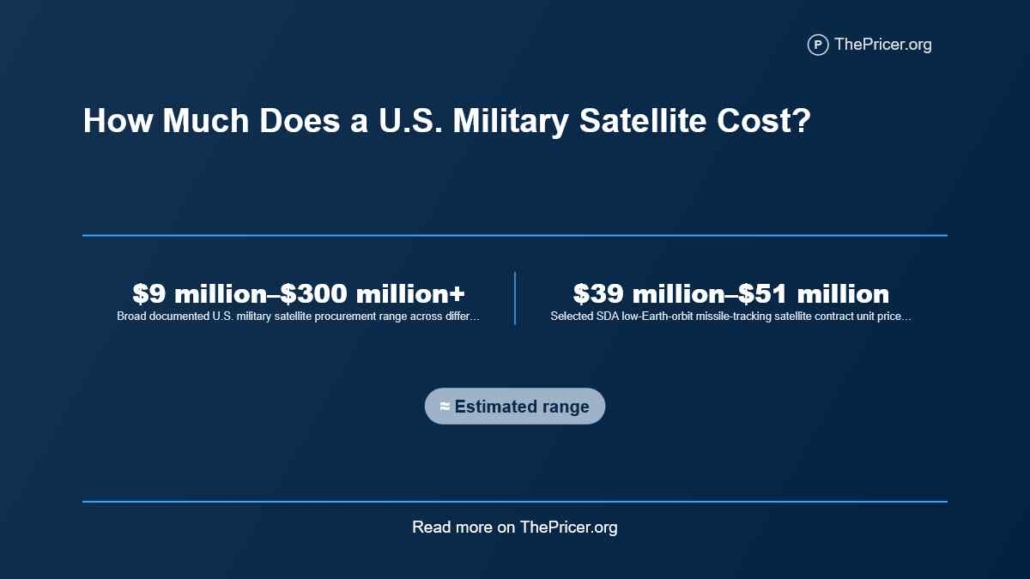
A U.S. military satellite can cost approximately $9 million to more than $300 million per spacecraft in recent government procurement records, depending on its mission, orbit, sensors, and the equipment included in its contract. Some missile-tracking satellites carry contract-based unit prices around $39 million to $51 million, while advanced GPS navigation satellites can exceed $300 million each. Large, specialized missile-warning systems can have multibillion-dollar development programs.
These figures are not interchangeable manufacturing prices. Satellite contracts may include engineering, testing, contractor-operated ground equipment, software, and early operations. The Pentagon also pays for launches, command networks, cybersecurity, and eventual replacement. As the U.S. Space Force expands its constellations, the financial question extends beyond what a single satellite costs to build.
Article Highlights
Jump to sections
- Military data-relay satellites have published contract-based unit prices of approximately $9 million to $28 million across selected Space Development Agency variants.
- Selected low-Earth-orbit missile-tracking satellites have cost approximately $39 million to $51 million per unit in original contracts.
- The Space Force’s FY2027 budget estimates a $340.4 million gross weapon-system unit cost for GPS IIIF satellites.
- A December 2025 award worth approximately $3.5 billion covers 72 new missile-tracking satellites and associated contractor responsibilities.
- A July 2026 contract package worth $1.6 billion covers 18 national-security launches, not 18 individual satellites.
- The Government Accountability Office reports that the Space Development Agency’s planned architecture approaches $35 billion through fiscal 2029, without a reliable total life-cycle cost estimate.
How Much Does a U.S. Military Satellite Cost?
The United States operates military satellites for communications, positioning and navigation, missile warning, surveillance, and other missions. Their hardware needs are fundamentally different.
A low-orbit communications satellite can use comparatively standardized spacecraft components. A missile-warning satellite requires sensitive infrared instruments, specialized processing, and extensive integration. High-altitude navigation satellites also carry precision timing equipment and demanding reliability requirements.
The GAO’s January 2026 satellite assessment provides unusually detailed contractor-level pricing for the Space Development Agency, or SDA. The following figures combine those published prices with selected Space Force procurement records.
| Military satellite category | Documented cost benchmark | Pricing scope |
|---|---|---|
| SDA data-relay satellites | $9 million to $28 million | Selected original contract unit averages |
| SDA missile-tracking satellites | $39 million to $51 million | Selected original contract unit averages |
| SDA Tranche 3 tracking | About $48.6 million | Contract total divided by 72 spacecraft |
| GPS IIIF navigation satellite | $340.4 million | FY2027 gross weapon-system unit cost |
| Specialized missile-warning programs | Multibillion-dollar programs | Development and supporting infrastructure |
These are specific government procurement benchmarks, not a representative average for every U.S. military satellite. Classified programs and many intelligence spacecraft do not provide comparable public unit prices.
The GPS IIIF figure comes from the FY2027 Department of the Air Force space procurement justification. It includes a broader procurement accounting scope than a spacecraft’s bare factory cost.
Small Military Satellites Cost Less
The Space Development Agency is building the Proliferated Warfighter Space Architecture, or PWSA, around large numbers of satellites in low Earth orbit.
Its Transport Layer is intended to move military information among satellites, sensors, and users on Earth. Rather than depending exclusively on a few large spacecraft, the architecture spreads communications capabilities across many smaller vehicles.
In October 2023, SDA announced approximately $1.3 billion in agreements for 100 Tranche 2 Alpha transport satellites. The individual contractor agreements included approximately $617 million for 62 York Space Systems satellites and $732 million for 38 Northrop Grumman satellites.
Dividing those contract values by the corresponding quantities produces approximately $10.0 million and $19.3 million per contracted satellite-equivalent.
The difference is not proof that one contractor can manufacture an identical spacecraft for half the price. Each contract includes its own engineering, ground support, and operating responsibilities.
The Tranche 2 Beta agreements totaled approximately $1.5 billion for 72 satellites. These vehicles support more advanced tactical communications capabilities.
Small satellites can reduce the cost of each individual loss and allow technology to be refreshed more frequently. The tradeoff is that the military must manufacture, launch, track, operate, and eventually replace many more spacecraft.
Missile-Tracking Satellites
Missile-warning and missile-tracking satellites use specialized sensors to detect missile launches and follow threatening objects. The SDA Tracking Layer is being developed partly to improve surveillance of advanced missile threats, including maneuvering hypersonic weapons.
In January 2024, the SDA awarded three tracking contracts covering 54 satellites.
The published maximum contract values were $919 million for L3Harris, $890 million for Lockheed Martin, and $740 million for Sierra Space. Each contractor was responsible for 18 vehicles.
Those figures translate into contract values of approximately $51.1 million, $49.4 million, and $41.1 million per satellite-equivalent, respectively. They include responsibilities beyond manufacturing the spacecraft.
On December 19, 2025, SDA announced another 72 tracking satellites through agreements totaling approximately $3.5 billion.
That represents about $48.6 million per contracted spacecraft-equivalent. The four selected companies were Lockheed Martin, Rocket Lab, Northrop Grumman, and L3Harris, with launches scheduled for fiscal 2029.
This newer procurement provides a useful benchmark because the contracts cover the same broad mission category. Yet satellite configurations and responsibilities can differ, so the average should not be labeled a standard Pentagon purchase price.
How Expensive Are Military GPS Satellites?
GPS satellites are among the better-known military spacecraft because their timing and navigation signals support both armed forces and civilian users.
The GPS III Follow-On, or GPS IIIF, program adds upgraded military navigation capabilities while maintaining the larger GPS constellation.
The Department of the Air Force’s FY2027 procurement justification lists two GPS IIIF satellites and approximately $680.875 million in corresponding gross weapon-system procurement costs.
That produces an average of approximately $340.438 million per unit for the fiscal year.
The same budget record shows a total planned quantity of 21 satellites, with approximately $6.793 billion in gross weapon-system procurement costs across the displayed program years. These figures describe the budget’s procurement scope, not every expense associated with maintaining worldwide GPS service.
The official GPS funding records also separate spacecraft procurement from other GPS-related accounts. This separation matters because GPS relies on control systems, monitoring infrastructure, and user equipment that are not included in a simple satellite quantity.
A satellite in medium Earth orbit is also designed for different operational conditions from a comparatively short-lived low-orbit data-relay spacecraft. Comparing only the initial purchase prices hides substantial differences in mission and expected service.
Billion-Dollar Satellites
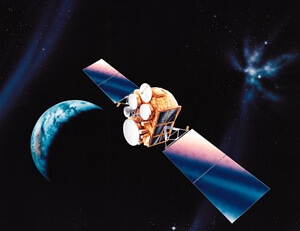 The largest military satellite programs may involve billions of dollars in development, acquisition, and ground infrastructure even when their individual spacecraft prices are not publicly disclosed in a comparable form.
The Next Generation Overhead Persistent Infrared program, called Next Gen OPIR, is intended to improve missile warning using advanced space-based infrared sensors.
In a 2021 assessment, the Government Accountability Office estimated that the Space Force planned to spend approximately $14.4 billion through 2025 on the system, including spacecraft and a supporting ground segment.
That historical plan covered a broader acquisition architecture and should not be divided by the originally planned five spacecraft to produce a satellite manufacturing price. Program scope and spacecraft quantities have also changed since the original estimate.
Advanced infrared sensors, secure communications, specialized engineering, software integration, and program testing account for substantial portions of these investments.
Some national-security and intelligence satellites have classified technical or financial details. Where direct prices are withheld, a precise current spacecraft cost cannot be reliably reconstructed from launch announcements or incomplete contract descriptions.
Launching a Satellite
The satellite contract is only part of the expense of placing military hardware in orbit. Launch services are procured separately in many programs, and the final cost depends on the rocket, destination orbit, mission requirements, and security provisions.
In April 2025, Space Systems Command announced nine national-security launch assignments. Seven missions awarded to SpaceX totaled $845.8 million, while two United Launch Alliance missions totaled $427.6 million.
These packages work out to approximately $120.8 million and $213.8 million per launch assignment, respectively. They are contract averages, not retail rocket prices or a measure of how much it costs to launch each individual satellite.
A single rocket can carry several spacecraft, especially in the military’s low-Earth-orbit constellations.
In July 2026, the Space Force awarded 18 Falcon 9 launches to SpaceX for a total of $1.6 billion. The contract is intended to deploy sensing and targeting capabilities by the end of 2027.
Dividing that rounded package value by 18 gives approximately $88.9 million per launch. It does not establish a satellite-specific launch charge because the number of payloads assigned to each mission can differ.
The broader cost of building and launching satellites includes testing, hardware development, and transportation to orbit. National-security launches add mission assurance and other contractual requirements that can distinguish them from commercial launches.
A Worked Satellite Deployment Budget
Consider a hypothetical military communications constellation consisting of 20 small satellites. This estimate uses a disclosed historical SDA contract as its baseline rather than claiming to represent an actual pending government purchase.
The August 2024 Gamma satellite agreements initially totaled approximately $424 million for 20 vehicles, including associated contract responsibilities. SDA subsequently changed the procurement, so this figure is a historical illustration rather than the final cost of the modified program.
The original agreements imply an average contract value of $21.2 million per spacecraft-equivalent.
Suppose those 20 satellites could be deployed on two launches priced at the rounded $88.9 million launch benchmark identified earlier.
- Original satellite contract package: $424 million
- Two illustrative launches at $88.9 million each: $177.8 million
- Combined satellite and launch model: $601.8 million
- Effective modeled cost per deployed satellite: $30.09 million
The launch assumption is hypothetical. The actual number of required launches would depend on spacecraft dimensions, mass, deployment orbit, and mission compatibility.
The calculation also excludes government-operated ground infrastructure, additional testing, and costs not covered by the original spacecraft agreements.
Under these assumptions, launch adds approximately 42% to the original satellite contract value. This demonstrates why dividing a manufacturer’s contract by the satellite quantity can substantially understate the cost of deploying a functional constellation.
Cheap Satellites
Low-cost satellites offer the military flexibility, redundancy, and the ability to refresh technology. Their limited operating lives also create recurring replacement costs.
The GAO reported in January 2026 that SDA’s architecture could eventually consist of 300 to 500 satellites, with many spacecraft requiring replacement approximately every five years.
The report identified another concern. Actual contractor prices across successive satellite tranches did not demonstrate a consistent downward trend, despite expectations that larger production quantities would create savings.
Consider an illustrative group of 100 satellites costing $20 million each. Its initial satellite procurement value would be $2 billion. Replacing all 100 once at the same unit cost would bring two procurement generations to $4 billion, before launches, operations, and inflation.
A single generation of 100 satellites costing $40 million each also represents $4 billion. This is not an assertion that the more expensive satellites last twice as long. It shows why initial unit price alone cannot establish which architecture is less expensive.
The actual comparison requires verified service life, expected losses, launch frequency, operational spending, and whether replacements provide more capability than the retired hardware.
The GAO also reported that SDA’s overall architecture was expected to cost nearly $35 billion through fiscal 2029, while the government lacked a reliable life-cycle cost estimate for its missile-warning and tracking capability.
Ground Systems and Program Risks
Satellites need command infrastructure on Earth. Ground equipment tracks spacecraft, processes sensor data, manages communications, and connects orbital information to military systems.
In a 2025 assessment of satellite communications, GAO documented more than $10 billion in original contracts across the first three SDA tranches. The analysis included different spacecraft categories and explained how the constellation depends on optical communications technology.
Some ground support appears inside individual spacecraft agreements, while other infrastructure receives separate funding. Adding both indiscriminately can double count expenses.
Software programs can create additional financial exposure. In 2026, the Space Force announced the termination of its troubled GPS Next Generation Operational Control System program after costs had reached approximately $6.27 billion as of January.
The official termination announcement describes continuing problems integrating the new control system into the broader GPS enterprise.
That amount is not the cost of a GPS satellite. It is a separate ground-system acquisition program. Its scale demonstrates how a space architecture can accumulate large expenses beyond spacecraft manufacturing and launch.
What Is a Fair Cost Comparison?
Government satellite procurement is not a retail purchase. Congress, the Space Force, intelligence agencies, and defense contractors evaluate costs across different missions, contract structures, and service periods.
Makes sense if
- Comparing satellites with similar missions, payload capabilities, and contract inclusions.
- Separating spacecraft procurement from launch and independent ground-system expenses.
- Evaluating replacement frequency alongside initial acquisition cost.
- Using audited spending and documented contract obligations rather than announced ceilings alone.
Does not make sense if
- Dividing an entire constellation budget by the spacecraft quantity and calling it manufacturing cost.
- Comparing a GPS IIIF procurement figure directly with a small data-relay prototype.
- Counting a multiyear contract maximum as money already spent.
- Assuming a larger constellation automatically reduces unit prices or lifetime spending.
The central financial tradeoff is between fewer sophisticated spacecraft and larger numbers of simpler, replaceable satellites. The lower-priced option is not necessarily the one with the lowest total cost or strongest military capability.
What We Verified
- Reviewed GAO’s 2026 assessment of satellite unit prices, procurement risks, and the absence of a reliable overall life-cycle estimate.
- Compared original SDA transport and tracking contracts using their stated satellite quantities.
- Distinguished GPS IIIF gross weapon-system procurement costs from manufacturer-only pricing.
- Checked Space Force launch awards separately from spacecraft contracts.
- Calculated the illustrative constellation deployment cost using explicitly stated assumptions.
- Identified historical awards, subsequent procurement changes, and remaining uncertainty rather than presenting all announcements as current final expenditures.
Answers to Common Questions
How much does one U.S. military satellite cost?
Selected low-orbit military communications satellites have contract-based unit costs around $9 million to $28 million, while missile-tracking satellites can cost approximately $39 million to $51 million. Advanced GPS IIIF satellites have procurement unit costs above $300 million. The amounts cover different contract scopes.
What is the most expensive type of military satellite?
Advanced missile-warning, specialized reconnaissance, and other highly complex national-security spacecraft can be extremely expensive. Their programs may cost billions of dollars, but a precise current unit-price ranking is not publicly available for all classified systems.
Does the satellite price include launch?
Not necessarily. Many spacecraft contracts exclude the rocket launch, and some include contractor ground equipment or support. Published contract terms determine which costs are included.
How long does a U.S. military satellite last?
It depends on design and orbit. Some SDA low-Earth-orbit satellites are planned for replacement after roughly five years. Other military navigation and communications spacecraft are designed around different service lives. Actual operational life can differ from the original plan.
How much does the U.S. spend on military satellite constellations?
Major constellations can require billions or tens of billions of dollars. GAO reported that SDA’s Proliferated Warfighter Space Architecture was expected to cost nearly $35 billion through fiscal 2029, while warning that a reliable life-cycle cost estimate for its missile-warning and tracking capabilities remained unavailable.
Disclosure: Educational content, not financial advice. Prices reflect public information as of the dates cited and can change. Confirm current rates, fees, taxes, and terms with official sources before purchasing. See our methodology and corrections policy.