
How Much Does a U.S. Navy Drone Ship Cost?
Published on | Written by Alec Pow
This article was researched using 9 sources. See our methodology and corrections policy.
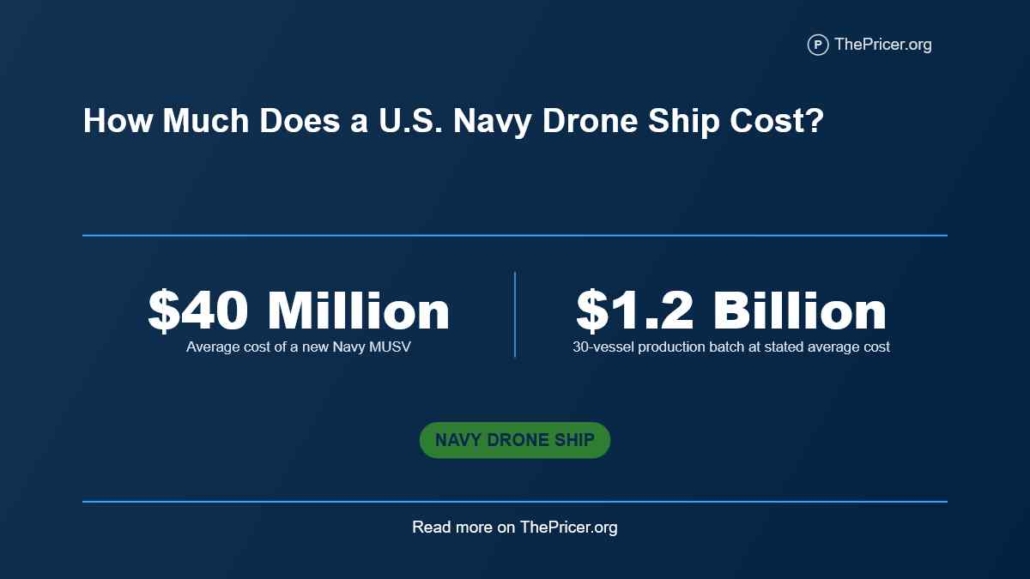
A new U.S. Navy medium drone ship now costs about $40 million per vessel. On September 29, 2026, the Navy announced production agreements for 30 Medium Unmanned Surface Vessels, or MUSVs, split among Galliano Marine Services, Huntington Ingalls Industries and Saronic Technologies. Each company will build 10, and the Navy disclosed an average procurement cost of $40 million for each ship.
That makes roughly $1.2 billion for 30 production vessels, but $40 million is not a universal price for every Navy drone ship. Earlier Sea Hunter and Sea Hawk prototypes cost about $20 million and $35.5 million respectively, while the Navy’s former Large Unmanned Surface Vessel concept was heading toward roughly $240 million to more than $300 million per ship. Add missile launchers, sensors, communications, control stations, autonomy software, spare parts and long-term support, and the complete cost of fielding an operational drone fleet can be substantially higher than the bare vessel price.
Article Highlights
Jump to sections
- The Navy’s newest production MUSVs cost an average of $40 million (at $30 per hour, earning that amount would take about 641 years of full-time work, before taxes) per vessel.
- The September 2026 production decision covers 30 vessels, implying about $1.2 billion at the stated average unit price.
- DARPA’s original Sea Hunter prototype was built for approximately $20 million.
- The follow-on Sea Hawk prototype was contracted for about $35.5 million, with options originally capable of increasing that contract to $43.6 million.
- The Navy’s earlier LUSV plan was much more expensive. FY2024 planning put the first production LUSV at about $315 million and later vessels in roughly the $240 million to $260 million range.
- GAO reported that the Navy subsequently shifted away from the old LUSV structure toward a broader MUSV family of systems, with an initial MUSV program estimate exceeding $2.1 billion.
- Weapons can change the economics dramatically. A 2026 CBO scenario estimated $1.5 billion over five years to acquire, arm, operate and sustain 12 converted unmanned offshore vessels carrying 144 long-range missiles.
How Much Does a Navy Drone Ship Cost?
For a production U.S. Navy Medium Unmanned Surface Vessel purchased today, the best documented answer is about $40 million (about 641 years of full-time work at $30 per hour).
| Drone ship or program | Cost | What the figure represents |
|---|---|---|
| 2026 production MUSV | About $40M each | Navy-disclosed average procurement cost |
| 30-vessel MUSV production batch | About $1.2B | 30 × $40 million |
| Sea Hunter | About $20M | Early autonomous prototype |
| Sea Hawk | $35.5M base contract | Second large autonomous prototype |
| Former lead LUSV estimate | About $315M | Earlier Navy production plan |
| Later planned LUSVs | About $241M-$261M each | Earlier budget projections |
| 12 converted missile-carrying unmanned ships | $1.5B over five years | CBO acquisition, conversion, operation and sustainment scenario |
The term “drone ship” therefore covers vessels with a greater than 15-to-1 price spread. A $20 million Sea Hunter-style experimental vessel and a $315 million armed LUSV concept are both unmanned surface ships, but they are not remotely equivalent products.
The same issue appears with smaller military sea drones. A disposable explosive boat can cost hundreds of thousands of dollars, while a reusable Navy ship designed to remain at sea for days or weeks, carry containerized payloads and navigate without a crew becomes a multimillion-dollar naval platform.
The New $40 Million Price
The most important new number comes directly from the Navy.
On September 29, 2026, the service announced that it would procure 30 Medium Unmanned Surface Vessels after completing its first phase of at-sea testing.
Galliano Marine Services, HII and Saronic Technologies each received a production agreement for 10 ships. The Navy stated that the average procurement cost is $40 million (about 641 years of full-time work at $30 per hour) per vessel, with first deliveries scheduled before the end of fiscal year 2027.
The basic math gives us a much larger number:
30 vessels × $40 million = $1.2 billion.
That is the implied procurement value of the ships at the announced average cost. It does not mean every company received an identical $400 million contract, because the Navy did not publish the individual award values.
The new ships are significantly larger and more capable than the small one-way attack drones now commonly associated with the term “sea drone.” Phase I requirements called for vessels capable of traveling approximately 2,500 nautical miles at 25 knots while transporting as much as 25 metric tons of payload in container-sized spaces.
They also had to prove that they could operate at sea for more than 24 hours with very limited command input.
Three Builders
The Navy intentionally did not choose one standardized hull.
Saronic, HII and Galliano each qualified different vessels through the testing process. That is important because the Navy’s current approach treats MUSV more like a family of compatible autonomous ships than a traditional warship class in which every hull must be nearly identical.
The Phase I competition originally included seven companies. The Navy had announced in May that companies successfully completing at-sea testing would receive $15 million and become eligible for production through the marketplace. The Navy’s original testing announcement listed Sea Machines, Leidos, Saronic, Galliano Marine Services, PacMar Technologies, Birdon and HII.
The approach matters to price. Instead of spending years designing one bespoke military hull from scratch, the Navy is trying to purchase mature commercial or commercial-derived platforms and integrate military payloads into them.
Sea Hunter Cost
The $40 million production price has roots in a much older experiment.
DARPA began developing the Anti-Submarine Warfare Continuous Trail Unmanned Vessel, which ultimately became Sea Hunter, as a low-cost autonomous ship that could remain at sea for extended periods without a crew.
DARPA publicly described an envisioned $20 million price per vessel. Navy research publications later confirmed that Sea Hunter itself was built for approximately $20 million.
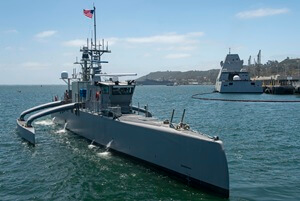
The 132-foot trimaran displaced about 135 tons and was designed for an extraordinary combination of endurance and autonomy, including a roughly 10,000-nautical-mile range at cruise speed.
Compared with the new production MUSV:
$40 million ÷ $20 million = 2.
In nominal dollars, the Navy’s 2026 production MUSV benchmark is exactly twice Sea Hunter’s reported construction cost. That does not mean the same boat doubled in price. The modern production requirement involves different vessels, greater payload expectations and a decade of evolution in Navy autonomy requirements.
Sea Hawk Cost
The next major experimental ship moved much closer to today’s price.
In 2017, the Navy awarded Leidos a $35.49 million contract for Sea Hunter II, which became Sea Hawk. Options could originally have raised the contract to approximately $43.56 million.
That makes the new $40 million MUSV price only about $4.5 million, or 12.7%, higher than Sea Hawk’s base development contract in nominal dollars.
This is a useful comparison because Sea Hawk was not a disposable craft. It was a large long-endurance autonomous vessel intended to help the Navy learn how unmanned ships could operate alongside conventional ships.
The progression is roughly:
- Sea Hunter: $20 million
- Sea Hawk: $35.5 million
- 2026 production MUSV: $40 million average
That progression also suggests the Navy has managed to transition from prototype-scale experimentation toward production without moving into traditional destroyer-level pricing.
The $300 Million Drone Ship
Readers may also have seen much larger estimates for Navy drone ships. Those figures generally came from the Large Unmanned Surface Vessel, or LUSV, program.
The envisioned LUSV was closer to an unmanned missile ship than today’s $40 million MUSV. Congressional Research Service reporting described ships approximately 200 to 300 feet long and 1,000 to 2,000 tons, potentially carrying 16 to 32 vertical-launch missile cells.
Earlier Navy planning put the first production LUSV at about $315 million. The next two were projected at a combined $522.5 million, or about $261.3 million each, followed by three at $722.7 million, or approximately $240.9 million each.
Those estimates tell us how radically mission requirements alter drone-ship pricing.
At $315 million, one lead LUSV would equal almost:
$315 million ÷ $40 million = 7.9 current MUSVs.
So the Navy could theoretically buy nearly eight $40 million medium vessels for the old projected procurement cost of one first-of-class large unmanned missile ship, although the capabilities would be very different.
Why LUSV Changed
The Navy has since moved away from the previous LUSV acquisition structure.
In its 2026 Weapon Systems Annual Assessment, the Government Accountability Office reported that the Navy was shifting away from the earlier LUSV program toward MUSV as a family of systems.
According to GAO, experimentation showed that medium prototypes were providing more capability and supporting more missions than Navy planners had initially anticipated.
GAO also reported an initial MUSV program estimate exceeding $2.1 billion, while Congress had provided $2.1 billion for MUSV development and acquisition in July 2025.
This $2.1 billion figure is not a $2.1 billion order for the newly announced 30 ships and should not be divided blindly into a unit price. It covers a broader acquisition program that includes development as well as procurement.
Program Cost Versus Ship Cost
This distinction is one of the biggest traps in military pricing.
A $40 million vessel may sit inside a program costing billions because the government also has to fund autonomy software, testing, command-and-control systems, engineering, shore facilities, payload integration and logistics.
The FY2027 Pentagon weapon-system book illustrates the difference. It identifies hundreds of millions of dollars in USV research, development and procurement funding, including $255.1 million of FY2027 RDT&E and $171.7 million in procurement funding in the budget presentation.
The broader FY2026 autonomous-systems budget was larger still. Defense officials identified $1.7 billion for on-the-water autonomous systems across the department, while the Navy had billions allocated across autonomous domains.
That spending should not be quoted as the price of one drone ship. It is the ecosystem required to turn an unmanned hull into a fleet capability.
What Goes on the Ship?
A bare autonomous hull has limited military value without a mission payload.
Depending on the job, an MUSV could carry sensors, communications equipment, electronic warfare systems, logistics cargo, unmanned aircraft or weapons. The Navy is deliberately emphasizing containerized payloads so it can change missions without redesigning the entire vessel.
A surveillance configuration might carry radar and passive sensors. Another vessel could become a communications relay. A logistics configuration might transport cargo, while a more heavily armed version could eventually carry missile launchers.
This is one reason the Navy’s stated $40 million average should be interpreted as a vessel procurement benchmark rather than the guaranteed all-in combat-system cost of every configuration.
Missile Ship Math
A useful 2026 Congressional Budget Office study shows what happens once missiles and operating costs enter the equation.
CBO examined an illustrative alternative in which the Navy would buy 12 used offshore supply vessels, convert them to unmanned operation and equip each with 12 long-range missile cells. The result would be 144 additional missile cells.
CBO estimated that the 12-vessel force would cost $1.5 billion over five years, including acquisition, missile-launcher installation, operation and sustainment. The missiles themselves were excluded.
A simple division produces:
$1.5 billion ÷ 12 = $125 million per vessel-equivalent over five years.
Again, $125 million is not a purchase price. It is a useful program-level average covering several years of acquisition, conversion and support.
CBO’s force would carry 144 large missile cells, meaning the five-year program works out to about:
$1.5 billion ÷ 144 = $10.4 million per installed missile cell when the entire vessel, conversion and five-year operating package is allocated across the cells.
The missiles themselves would add another bill.
A 10-Ship Squadron
We can also model the new Navy price in a more practical way.
Assume a squadron of 10 current-production MUSVs:
- 10 vessels × $40 million = $400 million
- Illustrative 10% allowance for initial spares, training and support = $40 million
- Illustrative 15% allowance for mission payload integration = $60 million
- Illustrative starting program = $500 million
The last two numbers are scenarios, not disclosed Navy prices. Their purpose is to show why “$40 million each” does not necessarily mean a fully established 10-vessel operational formation costs exactly $400 million.
At the Navy’s actual disclosed vessel price, however, that $400 million base figure is firm enough for useful comparisons.
Compared With Manned Ships
The whole point of autonomous ships is not merely removing sailors. They are intended to distribute sensors, weapons and other payloads across more hulls without paying for a traditional warship every time.
A modern nuclear U.S. submarine costs billions of dollars. A new U.S. Navy aircraft carrier exceeds $10 billion.
At $40 million each, 25 MUSVs would cost approximately $1 billion in vessel procurement. Fifty would cost approximately $2 billion.
Those ships obviously cannot reproduce a carrier’s aviation capability or a nuclear submarine’s stealth and weapons load. The comparison explains the Navy’s attraction to autonomous vessels: many additional nodes can potentially be placed across a theater for the price of one traditional major combatant.
The Hidden Cost
 Removing the crew does not remove the operating bill.
An unmanned ship still needs fuel, engines, maintenance, pier space, repairs, software updates, satellite or radio communications, cybersecurity, remote mission control, spare components and people ashore who monitor and support the mission.
Autonomy itself carries substantial development costs. In June 2024, the Defense Department created a Navy contracting vehicle covering autonomy and vehicle control, payloads, sensors, shore elements, logistics and sustainment with a combined ceiling of $982.1 million.
The ceiling does not mean the Navy automatically spends the entire $982.1 million or assigns that amount to one program. It demonstrates how large the supporting market around unmanned ships has become.
Cybersecurity may prove particularly important. A conventional ship can continue operating locally if some external communications are disrupted. A highly autonomous vessel must be able to navigate safely, execute its mission logic and resist attempts to interfere with its command network.
Maintenance also changes rather than disappears. A crewed ship has sailors aboard who can diagnose and repair some failures underway. An unmanned vessel may need additional redundancy, remote diagnostics or a return to port when something breaks.
Cheap Enough to Risk?
There is another way to interpret the $40 million number.
The Navy describes unmanned platforms partly as a way to place additional capability in dangerous locations without exposing sailors. That does not necessarily mean the vessels are disposable.
Losing a $40 million MUSV is still expensive. A four-vessel group represents $160 million in hulls before mission payloads. A 10-vessel group represents $400 million.
Yet the financial and human-risk equation differs from losing a billion-dollar crewed warship carrying hundreds of sailors.
This separates the MUSV from inexpensive one-way attack drones. The Navy’s $40 million ships are meant to return, receive maintenance and deploy again. For the opposite end of that spectrum, our guide to the cost of shooting down drones shows why militaries increasingly care about the price relationship between inexpensive threats and expensive defensive weapons.
What We Verified
We checked current Navy acquisition announcements, budget material, GAO program reporting, CBO analysis and the original prototype contracts rather than treating every autonomous vessel as the same product.
- Verified: the Navy announced on September 29, 2026 that it will procure 30 MUSVs at an average cost of $40 million per vessel.
- Verified: Galliano Marine Services, HII and Saronic each received production agreements for 10 vessels.
- Verified: $40 million × 30 produces an implied $1.2 billion vessel-procurement total at the stated average price.
- Verified: Sea Hunter was built for approximately $20 million.
- Verified: Sea Hawk’s original base contract was approximately $35.5 million.
- Verified: older Navy plans put the lead LUSV around $315 million and later LUSVs near $240 million to $260 million each.
- Verified: GAO reported in 2026 that the Navy was moving away from the previous LUSV acquisition approach and toward a MUSV family of systems.
- Important distinction: vessel procurement, R&D, mission payloads, weapons and long-term support are separate cost categories and should not be presented as one interchangeable “unit price.”
Answers to Common Questions
How much does a U.S. Navy drone ship cost?
The newest production Medium Unmanned Surface Vessels cost an average of approximately $40 million each, according to the Navy’s September 29, 2026 production announcement.
How much are all 30 new Navy drone ships?
At the disclosed average of $40 million each, 30 vessels equal approximately $1.2 billion. Broader program spending for development, payloads, training, communications, support and sustainment can increase the total.
How much did Sea Hunter cost?
The original Sea Hunter autonomous vessel was built for approximately $20 million.
How much did Sea Hawk cost?
The Navy awarded a base contract of approximately $35.5 million for the second Sea Hunter-type vessel, later named Sea Hawk. The original contract contained options that could have raised its value to about $43.6 million.
Why did some Navy drone ships cost $300 million?
Those figures generally refer to the former Large Unmanned Surface Vessel concept. The envisioned LUSV was significantly larger and potentially carried 16 to 32 vertical-launch missile cells. Earlier Navy plans estimated roughly $315 million for the first production ship and about $240 million to $260 million for follow-on vessels.
Are Navy drone ships disposable?
Large Navy MUSVs are reusable ships, not one-way weapons. They are intended to conduct missions, return, receive maintenance and deploy again. Smaller explosive sea drones belong to a different cost and mission category.
Do unmanned ships eliminate crew costs?
They remove or sharply reduce personnel aboard the vessel, but they still require people ashore for mission planning, monitoring, maintenance, logistics, cybersecurity, software and fleet support.
Disclosure: Educational content, not financial advice. Prices reflect public information as of the dates cited and can change. Confirm current rates, fees, taxes, and terms with official sources before purchasing. See our methodology and corrections policy.