
How Much Does a Virtual Assistant Cost?
Published on | Written by Alec Pow
This article was researched using 14 sources. See our methodology and corrections policy.
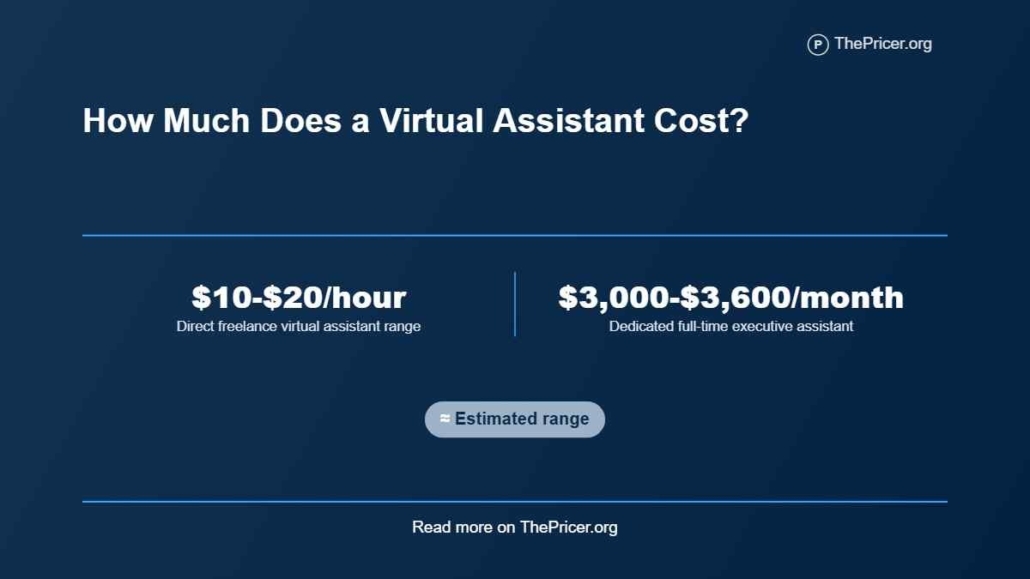
In 2026, a virtual assistant can cost $10-$20 per hour for a direct freelancer on a large marketplace, while managed and premium services can rise to $65 per hour or use monthly subscriptions of several thousand dollars. Upwork’s marketplace median for virtual assistants supports the lower freelance range.
The final bill depends on assistant location, skill level, service model, purchased hours, unused-hour rules, platform charges, and whether account management or backup staffing is included.
For U.S. buyers, the current market includes direct freelancers hired through Upwork, prepaid offshore managed hours from MyTasker, U.S.-based managed support from Time Etc, premium subscription staffing from Boldly, managed assistant units from Prialto, and dedicated full-time executive-assistant service from Athena.
Those offers cover different mixes of inbox and calendar management, travel planning, research, CRM administration, customer follow-up, project support, and executive coordination, and they bill by the hour, by monthly hour blocks, or by flat monthly subscriptions.
Article Highlights
Jump to sections
- Current public VA pricing ranges from about $9 per purchased hour in a large prepaid offshore plan to $65 (at $30 per hour, earning that amount would take about 2.2 hours of work, before taxes) per hour for premium subscription staffing.
- A 60-hour monthly package can cost $600, $2,160, or $3,900 across three current providers with different staffing models.
- MyTasker’s $900 100-hour plan only beats its $18 per hour pay-as-you-go option after 50 hours are actually used in the billing period.
- A modeled 20-hour Upwork engagement at $15 per hour produces a first-payment total of about $315.99-$329.99 under the cited 5 percent Basic fee and initiation-fee range.
- Athena lists dedicated full-time executive-assistant options at $3,000 or $3,600 per month, depending on commitment structure.
How Much Does a Virtual Assistant Cost?
Current published prices show how wide the market becomes once the service model changes. MyTasker sells offshore managed hour bundles, Time Etc sells dedicated U.S.-based assistant plans, Boldly sells premium subscription staffing, Prialto sells managed units with process and backup coverage, and Athena sells a dedicated full-time executive-assistant service. The figures below are current public prices checked in September 2026.
| Provider or model | Published price | What the price buys |
|---|---|---|
| MyTasker | $160 (about 5.3 hours of work at $30 per hour) for 10 hours up to $900 for 100 hours, plus $18 per hour pay as you go | Managed virtual-assistant hours under its published 10-to-100-hour plans, with a listed full-time option of $1,200 per month |
| Time Etc | $390 for 10 hours through $2,160 for 60 hours | Dedicated U.S. assistant under 10-to-60-hour monthly plans, with rollover on qualifying plans starting at 20 hours |
| Boldly | $2,600 for 40 hours through $6,500 for 100 hours | North America or Europe-based staff under 40-to-100-hour subscription plans, with specialist tasks at $79 per hour |
| Prialto | Pricing page shows both $1,500 and $1,600 per month around a 55-hour unit | A 55-hour managed assistant unit with engagement management and backup coverage |
| Athena | $3,000 per month with a 12-month commitment or $3,600 per month after the initial 90-day commitment | One dedicated full-time executive assistant under 12-month and flexible commitments |
The table is not a market-average calculation. The low and high figures buy different staffing arrangements. A buyer comparing only the displayed hourly math would miss differences in assistant geography, dedicated time, backup labor, management layers, and specialist access. The right benchmark is the closest service model to the work being delegated.
What a Virtual Assistant Price Covers
The phrase virtual assistant covers several labor arrangements. A buyer can contract directly with an individual freelancer, purchase a block of managed assistant hours, use a staffed service that supplies backup coverage, or buy a dedicated full-time executive-assistant relationship. Those options may all handle inboxes, calendars, travel, research, CRM work, customer follow-up, document preparation, and recurring administrative tasks, yet the commercial structure behind the work is different.
A direct freelancer price is mostly a rate for one person’s time and skill. A managed provider may add matching, supervision, account management, substitute staff, training, reporting, and process documentation. Premium staffed services may employ the assistant rather than treat the worker as an independent contractor. A dedicated executive-assistant package can reserve a full workweek instead of a small bank of monthly hours. That is why comparing two hourly figures without comparing staffing scope can produce a poor buying decision.
Task mix also changes the price. Routine scheduling and data entry tend to sit below bookkeeping, project management, design, technical work, and senior executive support. Compare the work unit, assistant location, backup model, and task limits before treating two hourly figures as interchangeable.
Hourly, Retainer, and Full-Time Pricing
Hourly billing works well when demand is irregular because the buyer pays for a measured amount of work rather than reserving a large monthly block. Upwork’s marketplace median gives one direct-freelancer reference point, while MyTasker’s pay-as-you-go rate provides a managed-service reference. Monthly hour packages reduce the nominal cost per purchased hour as commitment rises, but the buyer only captures that discount when the hours are used or can be carried forward.
Rollover rules can change the economics. Time Etc states that unused hours roll over on its 20, 40, and 60-hour plans. MyTasker uses a different rule. Its rules say monthly hours do not roll into the next billing cycle and normally expire when validity ends, while pay-as-you-go hours do not expire. A plan advertised at a low purchased-hour rate can become expensive per used hour when demand falls short of the package size.
Full-time service changes the unit again. Athena reserves a dedicated executive assistant for a standard 40-hour workweek, while MyTasker lists a lower-priced full-time VA under a different model. Buyers needing daily coverage should compare commitment, working-hour overlap, task scope, and replacement coverage instead of relying on a converted hourly rate.
The Same Hours Cost Differently
 Geography is one major price driver, but it is not the only one. Provider structure affects what sits inside the fee. A direct contractor may manage personal scheduling and tools independently.
A managed provider can add supervisors, account managers, backup assistants, recruiting, training, and quality review. An employed-staff model can also carry payroll, benefits, and retention costs that do not appear in a freelancer’s posted hourly rate.
Skill level creates another spread. The Boldly prices already cited put its standard packages at an effective $65 (about 2.2 hours of work at $30 per hour) per hour. Its specialist tasks are listed at $79 per hour. The difference is $14 per hour, or about 21.5 percent above the standard package rate. That premium applies to work such as project management, web development, writing, and design. A buyer who sends specialist work through a general-assistance budget can spend faster than expected.
Management depth also affects price. Prialto includes an engagement manager and backup assistants in its 55-hour unit. Boldly includes trained backup and says its U.S.-based staff are employees. A solo freelancer may cost less for flexible work, while backup coverage can matter when executive support cannot stop during vacations or illness.
Fees and Rules
Marketplace charges can raise the buyer’s first invoice. Upwork’s Basic client fee schedule displays a 5 percent service fee and says eligible U.S. clients paying from a checking account can receive a 3 percent rate. It also lists a one-time contract initiation fee of $0.99-$14.99. Those charges sit on top of the freelancer’s labor amount, so the posted freelancer rate is not always the buyer’s complete cash outlay.
Provider rules can matter more than a small platform charge. MyTasker’s $900 100-hour plan costs $9 per purchased hour only when the full block is used. At 40 used hours, the effective cost is $22.50 per used hour. At 75 hours, it is $12 per used hour. Spending divided by consumed hours is the better utilization measure.
Prialto adds another pricing issue. Its current pricing page shows $1,600 per month in one unit graphic and $1,500 per month around the 55-hour offering. The same page says flat pricing starts at $1,500 per month, requires a 90-day minimum per unit, and adds a $250 initial setup fee that is waived with a one-year agreement. A buyer should get the live quote in writing before using either displayed monthly figure in a budget.
Three Assistant Cost Scenarios
These scenarios use the published rates cited above. They are budgeting models, not customer invoices, and show how fees, utilization, and staffing model change the buyer’s cost.
Twenty hours through Upwork
Assume a freelancer rate of $15 per hour, which sits inside the cited Upwork marketplace range. Twenty hours of labor equals $300. Applying the cited 5 percent Basic service fee adds $15. Adding the published initiation-fee range produces a modeled first-payment total of $315.99-$329.99. An eligible buyer using the cited 3 percent bank-payment rate would instead land at $309.99-$323.99. Future payments on the same contract would not repeat the one-time initiation charge.
Sixty purchased hours per month
The published 60-hour packages cost $600 at MyTasker, $2,160 at Time Etc, and $3,900 at Boldly. That creates a $3,300 monthly spread, with the high figure 6.5 times the low figure. This normalizes quantity, not service quality or staffing scope.
Dedicated executive-assistant commitment
Athena’s published options create a commitment tradeoff. Twelve months at $3,000 per month totals $36,000. Twelve months at $3,600 per month totals $43,200. The difference is $7,200 per year. A buyer gains flexibility under the higher monthly option, while the lower monthly price only makes sense when a year-long commitment fits the staffing plan.
Virtual Assistant vs In-House Assistant
An employee comparison starts with wage data, but salary is not the entire employer cost. The U.S. Bureau of Labor Statistics reports a May 2025 median annual wage of $48,310 for secretaries and administrative assistants, while executive secretaries and executive administrative assistants had a median of $76,590. Those figures come from the BLS May 2025 occupation data and describe employees, not outsourced VAs.
BLS compensation data provide another reference. For private-industry sales and office occupations in June 2026, total compensation averaged $36.34 per hour, made up of $26.00 in wages and $10.34 in benefits, according to the BLS June 2026 compensation table. Applying that 1.398 compensation-to-wage ratio to the $48,310 secretary and administrative-assistant median gives a modeled compensation figure near $67,500 per year. This is a cross-dataset estimate, not an official BLS cost for one occupation.
An employee can still be the stronger choice when a company needs full-day availability, local presence, close internal access, or broader operations duties. Outsourcing can fit variable workloads and avoid separate recruiting and payroll administration. Businesses comparing both paths may also want to price the cost of LinkedIn Recruiter, job-board posting costs, and ADP payroll pricing.
When Paying for a Virtual Assistant Makes Sense
A virtual assistant fits remote, repeatable work that can be handed off in defined blocks. Calendar management, inbox triage, travel research, CRM cleanup, meeting preparation, recurring reports, and follow-up work are common candidates. The financial case improves when monthly usage is steady but does not justify a full-time local employee.
Package choice should follow actual workload. MyTasker’s $900 100-hour plan and $18 per hour pay-as-you-go rate reach the same spend at 50 used hours. Below 50 hours, pay as you go costs less. Above 50, the large package costs less before any multi-month discount, assuming ordinary hour consumption. That break-even point is more useful than the advertised $9 per purchased hour when demand is uncertain.
Makes sense if
- You have recurring remote work with clear handoff rules and measurable completion.
- Your monthly usage is predictable enough to avoid wasting prepaid hours.
- You value backup coverage or account management enough to pay above direct-freelancer rates.
- You need part-time capacity without creating a full employee role.
Does not make sense if
- The role requires frequent on-site work, physical errands, or constant local presence.
- Your workload is so light that a monthly package would leave many hours unused.
- The work requires a specialist whose tasks fall outside a general VA plan.
- You need full-time internal authority and long-term responsibilities that fit an employee position better.
Answers to Common Questions
How much does a virtual assistant cost per hour?
Direct freelance marketplace pricing can sit around $10-$20 per hour, while managed and premium staffed services can run from the teens to $65 per hour or more depending on the model and task type.
How much does a virtual assistant cost per month?
Published monthly plans in this research run from $160 for a small 10-hour package to $6,500 for a 100-hour premium staffing plan. Dedicated full-time offers can also use fixed monthly pricing such as $3,000-$3,600 per month.
Is a monthly VA plan always cheaper than hourly billing?
No. A larger package can have a lower purchased-hour rate but a higher used-hour cost when unused time expires. The MyTasker example reaches parity with its pay-as-you-go option at 50 used hours.
What extra virtual assistant fees should I ask about?
Ask about setup charges, marketplace fees, card-processing charges, specialist-task rates, minimum commitments, overage rules, and whether unused hours roll forward or expire.
Is a virtual assistant cheaper than an employee?
It can be for part-time or variable remote work, but the comparison depends on service scope and utilization. Employee budgeting should include benefits and hiring overhead rather than comparing a VA invoice with salary by itself.
Disclosure: Educational content, not financial advice. Prices reflect public information as of the dates cited and can change. Confirm current rates, fees, taxes, and terms with official sources before purchasing. See our methodology and corrections policy.