
How Much Does A Wedding Videographer Cost?
Published on | Written by Alec Pow
This article was researched using 14 sources. See our methodology and corrections policy.
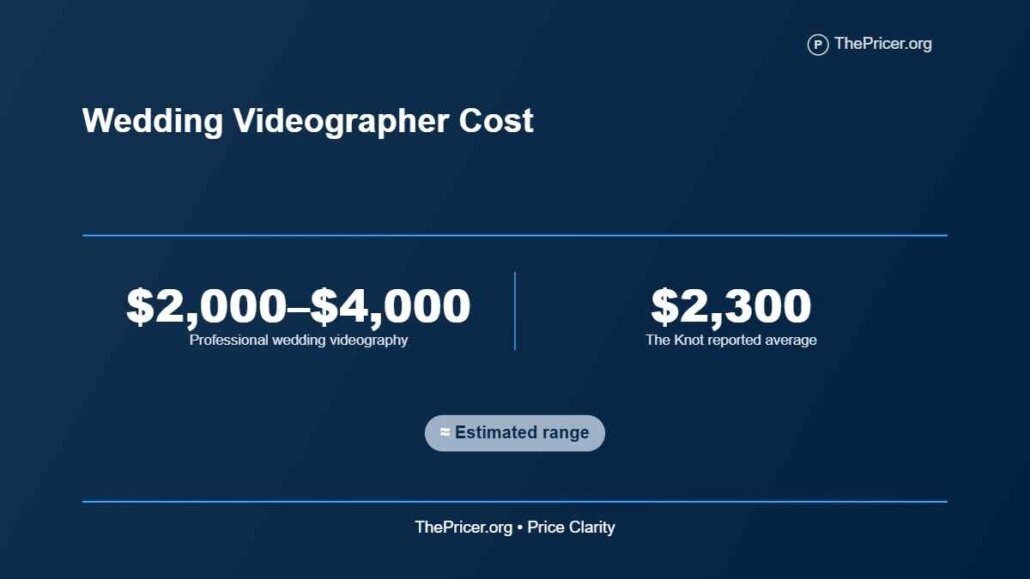
A professional wedding videographer in the U.S. commonly requires a working budget of $2,000 to $4,000 for one wedding in 2026. Short or limited coverage can cost less, while larger cinematic productions can exceed $5,000.
An April 2026 guide places full-day coverage at $2,000 to $5,000+ and identifies $2,500 to $4,000 as a practical band for standard full-day work. These figures describe a planning range, not a single national average, because package scope and local markets vary.
A wedding videography package may combine ceremony coverage, reception coverage, professional audio, multiple camera angles, a highlight film, a full ceremony edit, speeches, raw footage, drone footage, digital delivery, and revision work.
The quote can also change with coverage hours, a second videographer, editing depth, travel, overtime, rush delivery, and social-media teasers. Comparing those elements together gives couples a clearer picture than judging a wedding video package by filming hours alone.
Article Highlights
Jump to sections
- A useful working budget for professional wedding videography is about $2,000 to $4,000, with premium work moving higher.
- Current national sources disagree, with reported averages from about $1,799 to $3,993.
- Public eight-hour packages reviewed for this article run from $2,200 to $3,350 before optional upgrades.
- One published raw-footage package costs $1,700, while an eight-hour edited package from the same provider costs $2,500.
- A modeled full-day package with four listed upgrades reaches $4,800, or 84.6% above its base price.
How Much Does A Wedding Videographer Cost?
National figures vary because the publishers are measuring different pools of weddings and spending. The Knot reports an average of $2,300 and a median of $1,900 based on couples married in 2025. Zola reports a higher national average of $3,993 and says most couples in its 2026 cost index spend $3,200 to $4,800.
WeddingWire reports couples spending about $1,799, with most couples spending $1,000 to $2,500, based on pricing reported by thousands of couples. Fash places its member-reported average around $2,500, with an $1,400 to $3,600 range. These figures should remain separate rather than be blended into a new national average.
The practical lesson is to use national data as a budgeting screen, then price comparable local packages. A couple deciding between two quotes should ask what each number buys. The national figures can reveal whether a quote sits near common reported spending, but they cannot tell whether an eight-hour single-operator package is comparable with a ten-hour two-operator package that also includes a ceremony edit and raw footage.
What Wedding Videography Buys
Wedding videography is a combined filming and post-production service. The paid work starts before the ceremony with scheduling, equipment preparation, audio planning, and coordination with the venue or other vendors.
On the wedding day, the videographer records the selected coverage window. Afterward, the footage may be backed up, sorted, synchronized with recorded audio, color corrected, edited, mixed, exported, and delivered in one or more finished videos.
That service scope matters because two packages with the same number of filming hours can buy very different results. One may provide a single operator, a short highlight film, and a digital download.
Another may add a second operator, several cameras during the ceremony, a full ceremony edit, full speeches, drone footage, raw files, a teaser, and a longer documentary cut. Coverage is only one cost. Post-production can account for a large share of the bill even when both teams leave the reception at the same time.
The unit to compare is the full wedding package, not merely an hourly filming rate. Couples should match the hours, number of operators, number of active cameras, recorded audio, edited deliverables, raw-footage policy, delivery method, revision terms, and travel rules. A low quote can still be the pricier choice if the desired ceremony film, extra hours, or second operator must be purchased later.
What Packages Include
Current public price sheets show why package contents matter. NiLo Production Co. lists four eight-hour options, starting at $2,200 and rising to $3,350 as camera coverage and preview-film features expand. The same menu lists extra coverage at $350 per hour.
Light Up lists an eight-hour teaser package at $2,495, including one videographer, multiple angles for major events, professional audio capture, a four-to-five-minute edit, raw footage, a flash drive, and digital delivery.
| Public package | Coverage | Published price | Selected inclusions |
|---|---|---|---|
| NiLo Essential | 8 hours | $2,200 | One camera, highlight film, full ceremony film, raw footage, digital download |
| NiLo Cinematic | 8 hours | $2,950 | Two cameras, preview film, highlight film, ceremony film, raw footage |
| Light Up Standard Teaser | Up to 8 hours | $2,495 | One videographer, event angles, audio capture, teaser edit, raw footage, digital delivery |
These are advertised provider prices, not a representative sample of the whole country. Their value is narrower and more useful for quote comparison. All three rows sit near the same coverage length, yet the camera setup and edited output differ. A couple who wants the full ceremony should confirm that deliverable by name. A couple who wants every captured file should do the same for raw footage, since some studios include it and others charge separately or do not release unedited material.
Hours and Crew Size
Hours change the quote, but package design can make the relationship uneven. Rick J Studio lists a six-hour package at $1,850, a ten-hour package at $2,600, and extra wedding coverage at $300 per hour. Both base video packages list one videographer, a highlight reel, raw footage, digital delivery, and a shareable link.
Those published numbers create a useful break point. Starting from the six-hour package, 2.5 added hours at $300 equal $750. Add that to $1,850 and the total reaches the $2,600 ten-hour package price. On that menu, a couple expecting more than 8.5 hours of coverage would pay less by moving to the ten-hour package than by building the same time from the six-hour option, assuming the rest of the scope stays unchanged.
Crew size is a separate decision. A second videographer can cover preparations in two places, capture reactions while another camera stays on the ceremony, or record parallel reception activity. That added person is not the same thing as adding a stationary camera.
The contract should identify how many people will work the wedding and how many cameras may be used. Those details help explain why two quotes with equal hours can differ by hundreds or thousands of dollars.
Editing Changes the Bill
 Britt Nelson Video provides a clean comparison because its raw-only and edited packages both list eight hours of coverage. On its public pricing menu, the provider lists the raw-footage package at $1,700 and its all-inclusive eight-hour package at $2,500. Both list added time at $100 per hour.
The higher package adds a cinematic teaser, a seven-to-eight-minute highlight film, an edited multi-camera ceremony, edited speeches and toasts, while also retaining raw footage and drone footage subject to conditions.
The difference is $800. Dividing $800 by the $1,700 raw-only base gives about 47.1%. That does not mean editing always adds 47.1% across the market. It shows how much more this provider charges for a package with finished films and related deliverables while the stated coverage window stays at eight hours. Editing can cost as much.
This comparison also explains why a quote based only on filming time can mislead. A short highlight, a full ceremony, cleaned speech audio, a documentary edit, and social clips require different amounts of post-production.
Couples who mainly want an archive of the day may prefer raw or lightly processed coverage. Couples who want a finished film should compare the length and number of edits, revision policy, soundtrack terms, expected delivery window, and whether ceremony or speech edits are separate products.
Add-Ons Raise the Final Quote
Optional work can move the payable total far above the headline package. The Peterson Brothers publishes a six-hour Essentials collection at $3,250 plus tax and an eight-hour Story collection at $3,950 plus tax. Public menus like this make it easier to see where extra coverage, longer films, or additional operators enter the bill rather than assuming every desired deliverable sits inside one base number.
A more detailed worked example comes from the Rick J Studio menu cited earlier. Start with the ten-hour package at $2,600. Add its listed $200 next-day teaser, $500 drone footage, $700 full-feature video, and $800 second videographer. The itemized total is $4,800. The upgrades contribute $2,200, which is about 84.6% of the original package price. This is a provider-specific scenario, not a market average.
The calculation is useful because none of those additions changes the base filming day into a different wedding. They change the deliverables and production resources around the same event. A couple comparing a $2,600 quote with a $4,500 quote should find out whether the second price already contains items that would push the first quote toward the same total. Ask for every selected upgrade on one written estimate before comparing vendors.
Location and Travel Costs
Local market rates affect wedding video pricing, and travel rules can change a quote after a venue is selected. TX Wedding Videography publishes packages from $1,900 to $3,550 and includes travel within stated mileage limits.
The included radius grows with the package, reaching 200 miles on the listed $3,550 option. That structure shows why travel needs to be read with the package instead of treated as a universal flat fee.
For a local wedding, ask whether mileage, tolls, parking, lodging, flights, or a travel day can be billed separately. For a destination wedding, get those items onto the same estimate as filming and editing.
A low base package from a distant provider can lose its price advantage after transportation and lodging are added. The same issue appears when a ceremony and reception are far apart, since moving the crew can consume coverage time or create additional logistics.
Venue spending also changes how much room remains for video. Couples building a large event budget can compare the videography line against current venue research for Rosecliff Mansion wedding costs, Perona Farms wedding costs, or Biltmore Estate wedding costs. Those venue bills are separate from videography. Keeping the categories separate prevents a venue package from being mistaken for a complete wedding budget.
How to Compare Two Quotes
Start with the wedding timeline and mark the moments that need video. Preparation, first look, ceremony, cocktail hour, speeches, dances, and the final exit can span a much longer window than the formal ceremony itself. Then compare each proposal against that timeline. A cheaper six-hour package can be a poor match if the desired events require nine hours and the provider bills overtime at a high rate.
Next, compare deliverables line by line. Write down the number of videographers, stated camera coverage, audio recording, highlight-film length, ceremony edit, speech edit, teaser, raw files, drone footage, delivery format, revision allowance, and promised delivery window.
Check the payment schedule too. Deposits affect cash flow even when they do not increase the contract total. Sales tax and travel charges may raise the amount due where the contract allows them.
Makes sense if
- You want recorded vows, speeches, voices, and movement that still photography cannot capture.
- Your timeline contains events that benefit from simultaneous camera coverage.
- You plan to watch or share a professionally edited highlight or documentary film.
- The quote states the desired hours and deliverables without relying on assumed extras.
Does not make sense if
- You mainly want a few quick phone clips and do not need a finished wedding film.
- The package contains premium edits, extra operators, or footage you do not expect to use.
- The coverage window ends before the moments you most want recorded.
- The contract leaves travel, overtime, or deliverables too vague to compare the final payable amount.
Answers to Common Questions
How much should I budget for a wedding videographer?
A practical U.S. working budget is about $2,000 to $4,000 for professional coverage, with short or limited packages below that level and premium productions above $5,000.
Why do wedding videographer averages vary so much?
Different publishers draw from different couples, markets, package scopes, and reporting methods. Coverage hours, crew size, editing, location, and delivered films can also move one wedding far from another.
Is raw footage cheaper than an edited wedding film?
It can be. One provider reviewed here lists eight hours of raw footage at $1,700 and an eight-hour package with multiple edited films at $2,500.
How much do extra wedding video hours cost?
Rates differ by provider. Public prices reviewed here include extra coverage around $100 to $350 per hour, so the package break point should be checked before adding several overtime hours.
Can add-ons push a wedding video far above the base quote?
Yes. The worked provider scenario above moves from $2,600 to $4,800 after a teaser, drone footage, a full-feature video, and a second videographer are added.
Disclosure: Educational content, not financial advice. Prices reflect public information as of the dates cited and can change. Confirm current rates, fees, taxes, and terms with official sources before purchasing. See our methodology and corrections policy.