
How Much Does a Whole-Home Smart System Cost?
Published on | Written by Alec Pow
This article was researched using 14 sources. See our methodology and corrections policy.
A whole-home smart system costs about $5,000–$15,000 for broader residential automation, while custom luxury projects can run $15,000–$100,000 or more, according to HomeGuide’s installed automation budget tiers. Its lower $2,000–$5,000 tier covers selected rooms, rather than every controllable feature throughout a property. These are U.S. planning ranges, not a fixed package or a guaranteed national average for your house.
The largest difference is what “whole-home” includes. Connected lighting, a thermostat, and a door lock belong to a different budget from motorized shades, distributed entertainment, extensive surveillance, and custom programming.
The limited retrofit scenario below calculates to about $2,133 before tax, with explicit equipment and labor assumptions. Replacing appliances, adding HVAC zones, and building a theater are separate projects unless the proposal expressly includes them.
Article Highlights
Jump to sections
- Broader residential automation has a published planning range of $5,000–$15,000, with custom systems extending much higher.
- The limited ten-circuit retrofit modeled below costs approximately $2,133, excluding cameras, shades, AV, and new wiring.
- Expanding that lighting model from 10 to 30 circuits adds approximately $2,399 under the stated labor assumption.
- Control4 Connect is an optional $249 annual service for current X4 systems, with premium features separated from local operation.
- Compare device quantities, installation, programming, and ongoing services before comparing proposal totals.

What the System Includes
A whole-home smart system connects household functions through a shared control arrangement. Lighting, temperature, access, shades, and entertainment may respond to schedules, wall controls, an app, or selected events. “Whole-home” should describe coverage and coordination. A collection of independently operated devices may cover the house without providing the same shared controls or cross-device routines.
Separate the devices from the control layer. A dimmer operates a lighting circuit, a thermostat manages a compatible heating or cooling system, and a lock controls one entry. The controller or supported app connects the functions the household actually wants to coordinate.
The Connectivity Standards Alliance describes Matter as a standard for compatible connected devices, including cross-brand communication and local connectivity. That does not establish that every feature of every product will appear in your chosen app.
Define the desired actions before purchasing hardware. A bedtime routine could change selected lights and adjust a thermostat, while an entertainment routine could operate shades and audio.
Ask the installer to identify the exact devices, supported actions, account dependencies, and controls that remain available during an internet outage. Keep ordinary wall controls usable. The scope should be understandable to someone who never opens the setup app.
How Much Does a Whole-Home Smart System Cost?
Professional integration can cost substantially more than the broad consumer-device ranges in the introduction. Chicago-area integrator Davis Audio & Video describes its professional system planning levels as a few thousand dollars for focused starter work, low-to-mid five figures for a core package, and mid-to-high five figures or more for whole-home integration.
Those are the dealer’s planning examples, not fixed quotes, and the larger scopes include networking, coordinated controls, and selected audio or shading.
At the luxury end, Restrepo Innovations publishes $50,000–$80,000 for entry luxury installations spanning four to six rooms and two to three subsystems, with $100,000–$175,000 for larger integrated estates in its installed Crestron project budgets. Its figures include programming and commissioning. They describe that provider’s luxury market, rather than a minimum everyone must pay for home automation.
The apparent disagreement is largely about deliverables. A thermostat and selected smart switches can satisfy a modest household’s needs, while an estate proposal might include a rack, concealed speakers, custom keypads, extensive shading, and equipment in outdoor areas.
Request quantities and exclusions. A brand name or a house’s floor area cannot show whether two proposals deliver comparable coverage, equipment, or support.
Devices and Controllers
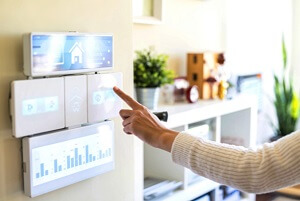 Lighting illustrates why starter-kit prices need careful interpretation. PROLIGHTING lists a Caseta Diva starter kit at $124.95, while its additional Diva smart dimmer costs $69.95. Buying a starter kit for every circuit would overcount the shared hub. Lutron’s dimmer and switch descriptions also distinguish dimmable lighting from other load types, so a single dimmer model should not be assumed suitable for every switch location.
For climate control, Google’s fourth-generation Nest Learning Thermostat lists a regular price of $279.99 and includes one temperature sensor. The displayed offer checked on October 8, 2026 was $239.99, advertised to end October 12. The budget below uses the regular price so that a temporary discount does not define the long-term estimate.
Schlage’s Encode pricing and supported integrations lists deadbolts from $299 and describes connections through its app to supported platforms. A separate automation controller is another possible purchase. Home Assistant lists Green at a recommended U.S. price of $199 on its dedicated automation hub page, with radio accessories needed for additional supported standards. Neither a hub nor a smart lock is a complete installation bill.
Wiring and Setup
Installation involves several different jobs. Mounting a device, replacing a compatible switch, pairing an account, programming routines, and concealing new cable should be specified separately.
Best Buy’s published smart-home service menu lists thermostat installation at $129.99, door-lock installation at $149.99, and home Wi-Fi setup at $174.99. These individual services are useful benchmarks, not a quote for coordinated whole-house installation.
Fixr’s smart-home installation labor discussion gives $80–$100 per hour for setup and installation, while other sections of the same guide use wider ranges for different work. The illustrative budget uses $100 per hour and an assumed time allowance. An actual contractor may quote a project price, different specialist rates, or additional electrical work. Do not treat the allowance as a promised completion time.
Have the site assessment identify incompatible loads, wiring changes, wall repairs, and network coverage before ordering devices. Ask who performs any electrical alterations and whether local permits or inspections apply to that specific work.
Extending automation to a garage also requires checking the operator’s supported controls. Adding an app connection and replacing the motorized operator belong to different scopes, which is why garage door opener installation costs should remain separate from the automation controller budget.
A Retrofit Budget
This illustrative basket covers ten compatible lighting circuits spread through a home, one compatible thermostat, and one entry lock. It assumes one starter kit supplies the first dimmer and lighting hub, nine extra dimmers, reusable compatible wallplates, and an existing phone and adequate network. It is a limited connected-home retrofit, without cameras, motorized shades, audio distribution, or a dealer automation processor. Common-app functions and any requested routines must be confirmed before purchase.
| Item or assumption | Quantity and rate | U.S. budget subtotal |
|---|---|---|
| Caseta Diva starter kit | 1 at $124.95 | $124.95 |
| Additional Diva dimmers | 9 at $69.95 | $629.55 |
| Nest Learning Thermostat | 1 at regular $279.99 | $279.99 |
| Schlage Encode deadbolt | 1 at starting $299 | $299.00 |
| Hardware subtotal | Published prices cited above | $1,333.49 |
| Installation and basic setup allowance | Assumed 8 hours at $100 | $800.00 |
| Calculated project total | Before tax and excluded work | $2,133.49 |
The calculated limited retrofit total is $1,333.49 + $800 = $2,133.49, or about $2,133. Hardware prices are advertised inputs, while the eight-hour allowance is a chosen scenario. If the work instead takes four or twelve hours at the same rate, the total becomes approximately $1,733 or $2,533. That sensitivity changes the estimate without pretending that extra hours purchase more devices.
Tax, delivery charges, new wiring, replacement wallplates, incompatible fixtures, door adjustments, added controllers, and extra programming are excluded. The scenario also excludes ongoing services and appliance replacement. Retaining those boundaries matters. A contractor offering cameras, an alarm, and monitoring supplies a different package, with home security system costs added or bundled explicitly.
The Hidden Price
The hidden price can be the service needed for a feature you expected the hardware purchase to include. Ring’s current U.S. recording plans list Solo at $49.99 annually for one device, Multi at $99.99 annually for devices at one location, and Pro at $199.99 annually, including eligible professional-monitoring features. Recording storage and professional alarm response are different services. Equipment eligibility and local conditions still matter.
Using those published annual prices, three separately covered Solo devices cost 3 × $49.99 = $149.97. Multi costs $99.99, saving $49.98 per year for three devices at one location. With two devices, the separate plans total $99.98, almost identical to Multi. This is a useful coverage threshold, not a reason to purchase more cameras.
Control4’s X4 subscription policy update makes Connect optional for new X4 systems and describes an optional standard price of $249 per year for premium features such as remote access. Local app operation is included without that service.
Declining Connect does not make every dealer support visit free. Before accepting a professional proposal, request the separate terms for remote access, maintenance, programming changes, and return visits. Security-led offers such as a Vivint security system need their own equipment and service comparison.
Lighting Circuit Math
Room count alone is a weak shopping list. A room with several independently controlled lighting loads needs a different equipment allowance from a room with one circuit. Count the actual circuits and identify which need dimming, simple switching, or another control type. Keep additional control locations, decorative keypads, and shades on separate lines so that the dimmer quantity does not conceal other purchases.
Using the same starter-kit and dimmer prices already cited, ten lighting circuits cost $124.95 + 9 × $69.95 = $754.50 in hardware. Thirty cost $124.95 + 29 × $69.95 = $2,153.50, assuming the same hub supports the planned installation. The added twenty dimmers account for $1,399 before installation, new plates, accessories, or electrical alterations. This is the marginal equipment cost, not another national package average.
Assume each additional circuit requires half an hour of installation and setup at the earlier $100 hourly budgeting rate. Twenty circuits add ten hours, or $1,000 in labor, producing a calculated expansion cost of $2,399. If the added work takes a quarter-hour or one hour per circuit, the expansion becomes $1,899 or $3,399. Those are explicit time scenarios, not measured installation speeds. The result explains why covering every lighting load can move the budget even when the controller and house size stay unchanged.
Choosing the Scope
Compare three distinct purchases. A limited retrofit buys selected connected functions, as in the itemized scenario. A professionally integrated household system buys coordinated control, documented routines, and a defined handover.
A luxury installation may also buy extensive AV, shading, concealed equipment, and custom interfaces. Choose the outcome first, then compare proposals that deliver it. Starting with a brand name encourages comparisons between different amounts of work.
Ask each installer to price the same circuit count, thermostat count, entries, cameras, and shade openings. Request a separate allowance for network changes and a written list of included routines.
Confirm what happens when equipment is replaced, an account changes hands, or the household wants another scene. These questions expose missing deliverables without assuming every optional service is necessary. A phased project can begin with frequently used controls while preserving a documented path for later additions.
Makes sense if
- Several daily routines require coordinated control across household systems.
- The proposal names the equipment, supported functions, and included setup.
- The household values shared controls and has a workable support arrangement.
Does not make sense if
- The only desired improvement is one connected thermostat or doorbell.
- The quote omits quantities, programming, network work, or service terms.
- Ongoing support commitments exceed the budget allocated to convenience.
Answers to Common Questions
Can a whole-home smart system cost less than $5,000?
Yes, a limited retrofit can. The ten-circuit lighting, thermostat, and lock scenario totals about $2,133 before tax and excluded work. It does not include cameras, shades, distributed AV, or a dealer processor.
Is a monthly fee required?
Check the desired feature. Local controls, remote access, recorded video, professional monitoring, and dealer support have different terms. Control4 Connect is optional for current X4 systems, while the Ring recording plans described above carry recurring charges.
Does the thermostat price include a new HVAC system?
No. The worked budget purchases one thermostat for a compatible existing system. Equipment replacement, extra heating or cooling zones, and wiring alterations are outside its scope.
What should a whole-home proposal itemize?
Device models and quantities, controllers, network work, installation, programmed routines, testing, handover, support, and exclusions. Separate optional shades, AV, and surveillance so their effect on the total is visible.
Disclosure: Educational content, not financial advice. Prices reflect public information as of the dates cited and can change. Confirm current rates, fees, taxes, and terms with official sources before purchasing. See our methodology and corrections policy.