
How Much Does a Work Wardrobe Cost?
Published on | Written by Alec Pow
This article was researched using 13 sources. See our methodology and corrections policy.
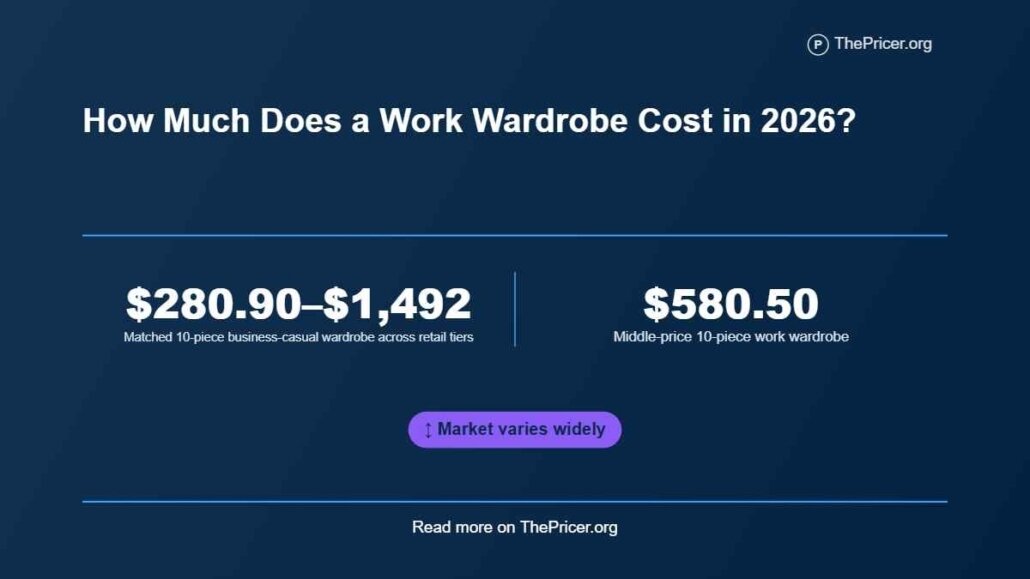
A practical U.S. work wardrobe costs about $280 at low-cost retail, about $580 at a middle price point, and roughly $1,500 at an upper-price retailer for the same 10-piece business-casual capsule as of September 2026.
H&M supplies the low-cost office price inputs, Quince supplies the middle-price workwear inputs, and Banana Republic supplies the upper-price office inputs plus a current women’s office-shoe price. These are matched shopping models rather than national averages. Sales tax, outerwear, bags, jewelry, underwear, alterations, and clothing care sit outside the base totals.
The work wardrobe in this cost model is a business-casual office capsule built from shirts or blouses, trousers or other office bottoms, blazers or cardigans, and work shoes such as loafers or flats. It separates business casual from business professional, new clothing from pieces already in the closet, and purchase price from tailoring, dry cleaning, shoe repair, and other ownership costs. That scope keeps the wardrobe price tied to the clothes an employee needs for repeat office outfits instead of mixing unrelated accessories, uniforms, or seasonal gear into one number.
Article Highlights
Jump to sections
- The matched 10-piece baskets run from $280.90 to $1,492 before tax and upkeep.
- A middle-price Quince basket using the same piece counts totals $580.50.
- Three outside-garment pants hems at a published $30 each can add $90 to a budget capsule.
- Starting with five compatible pieces already owned can cut one modeled budget purchase from $280.90 to $164.95.
- Business-professional clothing can cost much more per outfit than business-casual separates.
Current Prices by Retail Tier
The same 4-3-2-1 structure produces a wide retail spread. The H&M model totals $280.90, the Quince model totals $580.50, and the Banana Republic model totals $1,492. Each basket uses currently displayed U.S. prices checked September 22, 2026. The totals are shopping scenarios, not claims about what Americans usually spend. A current sale, color, size, or stock change can move the result.
| Retail tier | Basket scope | Modeled total | Excluded |
|---|---|---|---|
| Low-cost retail | 4 tops, 3 bottoms, 2 layers, 1 shoe | $280.90 | Tax, tailoring, care |
| Middle price point | 4 tops, 3 bottoms, 2 layers, 1 shoe | $580.50 | Tax, tailoring, care |
| Upper-price retail | 4 tops, 3 bottoms, 2 layers, 1 shoe | $1,492 | Tax, tailoring, care |
The spread is not proof that one tier has better value. It shows what price tier alone can do when the number of pieces stays fixed. Target provides another low-cost reference through its current women’s workwear prices, with visible trousers around $30 to $35 and some flats near $20. A useful shopping comparison keeps piece count, dress code, and garment role matched before judging the ticket.
What Counts as a Work Wardrobe?
A useful work-wardrobe budget needs a fixed unit. This model uses four tops, three bottoms, two layers, and one pair of office shoes. Ten pieces are enough to compare retailer tiers without pretending every worker needs the same closet. A five-day office schedule may call for more shirts or another pair of shoes, while a hybrid worker may need fewer pieces. Climate, employer dress rules, laundry access, and how often the same items can be reworn all affect the practical count.
The base model is business casual. It assumes tops that can work alone or under a layer, bottoms that can pair with every top, and a blazer or cardigan that changes the formality of an outfit. A tote, winter coat, belt, tie, hosiery, jewelry, and specialized uniform pieces are excluded because they are not universal. Formal suiting is handled separately. That keeps the comparison matched instead of letting one basket look cheaper because it contains fewer functions.
The closest budget is also not always the full purchase price. Someone who already owns two usable tops, one pair of trousers, one layer, and office shoes has a different cash need from someone starting after a career change. A closet audit changes the number of missing slots before any store is chosen. The professional wardrobe guide from the University of Missouri Career Center also recommends checking existing clothing before buying. That distinction drives one of the calculations used later.
A 10-Piece Starter Build
The budget basket is the worked example because it shows how a relatively small sticker price becomes a complete office rotation. Four selected H&M tops total $87.96. Three selected bottoms total $89.97. A cardigan and blazer total $67.98. One pair of loafers adds $34.99. The arithmetic is $87.96 plus $89.97 plus $67.98 plus $34.99, producing $280.90 before tax, fit work, or garment care.
- Four tops, $87.96
- Three bottoms, $89.97
- Two layers, $67.98
- One pair of loafers, $34.99
- Modeled clothing total, $280.90
The Quince basket uses the same job rather than a larger closet. Four tops total $176.70, three bottoms total $164.80, two layers total $155, and one pair of office flats contributes $84. That reaches $580.50. The upper-price Banana Republic basket uses four tops at a combined $464, three bottoms at $370, two blazers at $418, and one pair of loafers at $240, reaching $1,492.
The gap can be large. The upper-price basket is about 5.3 times the budget model while buying the same number of functional slots. A reader comparing only a blazer or a shirt can miss that compounding effect across ten pieces. For a separate look at jacket pricing, current blazer cost ranges show how fabric and construction can widen one category before the rest of the wardrobe is added.
Fit Can Change the Bill
Fit is one of the fastest ways for a low sticker price to lose ground. Men’s Wearhouse lists a plain or cuffed bottom alteration at $20 for its own garments and $30 for outside garments on its sample alteration prices. If all three bottoms in the $280.90 budget basket came from another retailer and each needed a plain hem, the added fit work would be $90. The finished clothing-and-hemming total becomes $370.90, a 32.0 percent increase over the original basket.
That calculation does not mean every pair of pants needs hemming. It is a sensitivity test. One hem adds $30, two add $60, and three add $90. A shopper between inseams or buying trousers sold in a single length faces more alteration exposure than someone who can buy the correct finished length. Jacket sleeves, waist work, and tapering can add separate charges, so a poor-fitting sale garment can end up closer to the price of a better-fitting alternative.
Fit can erase a bargain. Before removing tags, check shoulder position, trouser rise, seat, sleeve length, and hem length. A simple hem is easier to budget than structural jacket work. Readers who need a deeper alteration estimate can compare the published Men’s Wearhouse tailoring costs with the price difference to a garment that fits better off the rack.
Cleaning Changes Ownership Cost
Professional care can make two wardrobes with similar purchase prices behave differently after checkout. 2ULaundry’s May 22, 2026 Charlotte dry-cleaning schedule lists shirts and pants at $8.95 for dry cleaning, a blazer at $10.95, and a $44.95 minimum order for customers without a subscription. That minimum matters most on small pickups. Five items priced at $8.95 total $44.75, still just below the minimum, while a single $8.95 item can be billed up to the minimum under that provider’s rule.
Another cleaner can use a different structure. Phresh lists a blouse at $12, pants at $13.70, a cardigan at $14.70, and a blazer at $15.70 on its published garment-care prices. Those figures are provider examples, not a national rate.
The point is that per-piece price and order rules both shape the bill. A closet with washable knits and shirts may need less paid care than one built around structured wool, silk, or lined pieces whose labels call for professional cleaning.
Care is a recurring ownership cost, while the clothing basket is an initial purchase. Keep the two separate when comparing retailers. A $50 cheaper jacket does not automatically save $50 if it needs frequent paid cleaning or repair. Current dry-cleaning price ranges provide broader U.S. context for suits, dresses, coats, and everyday garments.
Business Casual vs Formal
A business-casual capsule can rely on interchangeable separates. Business-professional dress can require matching suiting, a dress shirt, and formal shoes, which raises the amount tied up in one outfit. Banana Republic’s current men’s formal-work prices show a tailored Italian herringbone suit jacket at $448, the matching suit pant at $230, a wrinkle-resistant dress shirt at $90, and a leather moc-toe loafer at $238. Together those four purchases reach $1,006 before a belt, tie, second shirt, tax, alterations, or cleaning.
That formal set should not be compared directly with the 10-piece budget capsule as though they deliver the same wardrobe. One is a four-purchase formal configuration built around a matching suit. The other is a mix-and-match business-casual rotation. The comparison shows why employer dress rules can change the initial budget even when the worker owns the same number of days’ worth of outfits.
Workers who need a suit only for interviews, presentations, or occasional client meetings may not need to rebuild every office outfit around formal tailoring. A single suit can sit beside less formal separates. The current suit cost guide is the better next comparison for buyers whose workplace requires matching jackets and trousers most days.
Start With What You Own
 Buying every slot new is the most expensive starting assumption. Use the $280.90 budget model and suppose five compatible pieces are already in the closet. In this scenario, the owned pieces replace two tops priced at $19.99 and $22.99, one bottom at $19.99, one layer at $17.99, and the $34.99 loafers. Those avoided purchases total $115.95. The new cash requirement falls to $164.95, a 41.3 percent reduction.
This result is not a resale value or a national savings rate. It is a transparent gap-fill scenario using the same current budget basket. The benefit comes from reducing missing slots, not from finding a secret discount.
A person who already owns the expensive layer and shoes may cut spending even further. Someone whose existing clothes no longer fit the job’s dress rules may save much less.
A second pass should look at repair. A worn sole does not always require replacing the whole shoe, and some office shoes can be repaired when the upper remains sound. Current shoe resoling costs can help compare repair with replacement for footwear designed to accept that work. The decision is product-specific, since many inexpensive cemented shoes are poor candidates for a full resole.
When More Spending Fits
A higher purchase price makes sense only when it solves a real wardrobe problem. A stricter dress code can require wool suiting or structured jackets. Frequent office attendance can make rotation depth more useful. A hard-to-fit body may justify paying more for a cut that avoids heavy alterations. Fabric care also matters. Quince’s workwear page identifies washable silk and machine-washable options, while some structured garments from other retailers may need professional care according to their labels. Price alone does not establish durability, comfort, or service life.
The opposite case is just as practical. A hybrid worker who is on-site one day a week may need fewer duplicates. A new employee who has not seen the real office dress pattern may be better served by a small starter set before buying ten new pieces. Sales can reduce the ticket, but temporary markdowns should not be treated as permanent planning prices. Keep a list of missing functions, then buy against the list rather than filling a cart by brand.
Makes sense if
- You are starting with very few office-ready pieces.
- You work on-site often enough to need a rotation.
- Your employer expects structured business attire.
- Better fit reduces the need for paid alterations.
Does not make sense if
- You already own several compatible basics.
- You work remotely most of the week.
- Your office dress expectations are still unclear.
- The higher-priced piece still needs major fit work.
Answers to Common Questions
How much should I budget for a basic work wardrobe?
For a 10-piece business-casual capsule bought new, this September 2026 model lands near $280 at low-cost retail, about $580 at a middle price point, and close to $1,500 at an upper-price retailer before tax, alterations, and care.
How many pieces do I need for a work wardrobe?
There is no universal count. This comparison uses 10 pieces so retailer tiers can be measured on the same basis. A five-day office schedule, a strict dress code, climate, and laundry frequency can justify more pieces.
Should tailoring be part of the wardrobe budget?
Yes when fit work is likely. In the modeled budget capsule, three outside-garment hems at $30 each raise the total from $280.90 to $370.90.
Can I build a work wardrobe for under $200?
Yes in a gap-fill scenario. If five compatible pieces from the modeled budget basket are already owned, the remaining purchases total $164.95. Starting from zero would require more under the same current-price model.
Does a more expensive wardrobe cost less over time?
Not automatically. Purchase price alone does not establish lifespan. Fit, fabric, care requirements, repairability, wear frequency, and how well each piece works with the rest of the closet all affect long-run value.
Disclosure: Educational content, not financial advice. Prices reflect public information as of the dates cited and can change. Confirm current rates, fees, taxes, and terms with official sources before purchasing. See our methodology and corrections policy.