
How Much Does an A-10 Warthog Cost?
Published on | Written by Alec Pow
This article was researched using 14 sources. See our methodology and corrections policy.
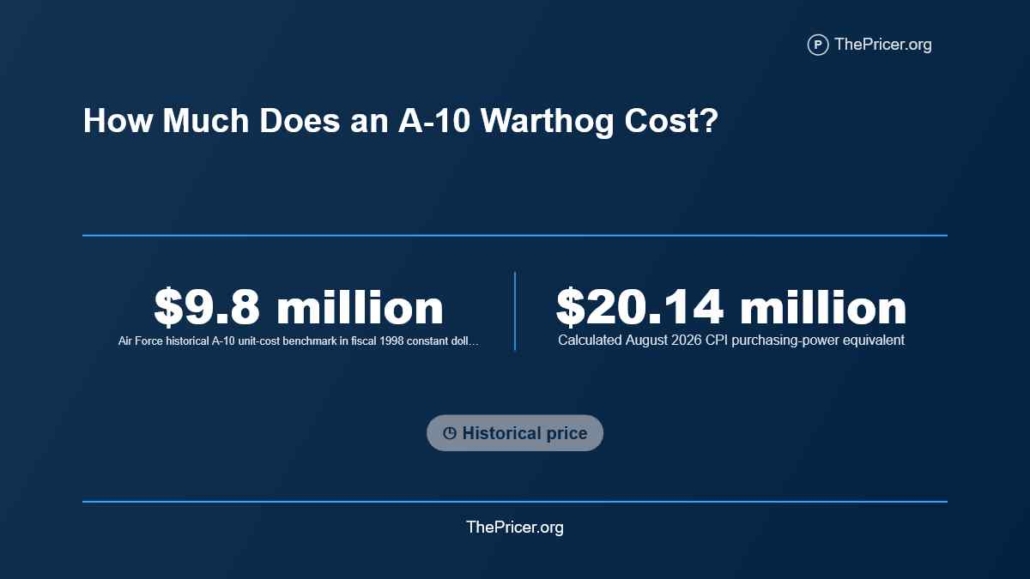
The Air Force A-10C fact sheet gives the useful public price benchmark for an A-10 Warthog at $9.8 million per aircraft in fiscal 1998 constant dollars. That is a historical accounting benchmark rather than a 2026 new-build quote. A current cost comparison needs separate measures for historical acquisition value, operating and support spending, reimbursable flying rates, structural work, and the price of modern replacement aircraft.
Article Highlights
Jump to sections
- The headline Air Force benchmark is $9.8 million (at $30 per hour, earning that amount would take about 157 years of full-time work, before taxes) per A-10 in fiscal 1998 constant dollars.
- A CPI translation puts that benchmark near $20.14 million in August 2026 consumer purchasing power.
- GAO reported full fiscal 2020 operating and support cost of $22,531 per flying hour.
- The fiscal 2026 reimbursable A-10C rate is lower at $11,453 to $12,036 per hour, depending on the user.
- An 18-aircraft sustainment scenario based on GAO fleet averages comes to about $108.9 million per year in constant fiscal 2020 dollars.
How Much Does an A-10 Warthog Cost?
| Cost measure | Amount | Basis |
|---|---|---|
| Air Force historical unit cost | $9.8 million (about 157 years of full-time work at $30 per hour) | Fiscal 1998 constant dollars |
| Whiteman AFB unit-cost entry | $18.8 million | Dollar-year not stated on the page |
| Calculated 2026 purchasing-power value | $20.14 million | August 2026 CPI-U translation |
| GAO operating and support cost | $22,531 per hour | Fiscal 2020 constant dollars |
| DoD reimbursable rate | $11,453 to $12,036 per hour | Fiscal 2026 user schedule |
| Calculated 18-aircraft annual scenario | $108.9 million | GAO fiscal 2020 fleet averages |
What the A-10 Price Means
An A-10 price can describe several different transactions or accounting measures. A unit-cost entry describes an aircraft on a stated historical dollar basis. Operating and support spending covers the fleet after acquisition. An hourly reimbursement schedule tells one government user what it is charged when an aircraft is provided on a reimbursable basis. A wing contract pays for structural work on existing aircraft rather than a newly built jet. Mixing those measures creates a number that looks precise but answers no stable cost question.
The buyer also matters. The A-10C is a U.S. military aircraft, so the useful reader is a taxpayer, budget analyst, aviation researcher, or someone comparing public defense spending. There is no responsible consumer scenario in which a private buyer chooses a new A-10 package. A comparison with another fighter also needs the same cost scope. A flyaway aircraft price, a fleet sustainment bill, and a contract ceiling are different units of analysis.
Useful benchmark if
- You match the fiscal year and dollar basis.
- You compare aircraft acquisition with aircraft acquisition.
- You separate fleet support from per-aircraft value.
Misleading benchmark if
- You treat a reimbursement rate as full ownership cost.
- You divide a contract ceiling by its maximum quantity and call the result a unit price.
- You compare a 1998 A-10 accounting value directly with a 2026 fighter flyaway price.
Historical Unit Cost
The Air Force headquarters figure used in the lead has a defined fiscal-year basis. A second official page creates a real discrepancy. The Whiteman A-10 fact sheet lists a unit cost of $18.8 million (about 301 years of full-time work at $30 per hour), but the page does not state the dollar-year or accounting basis for that amount. Treating it as a 1994, 2021, or 2026 price would add information the source does not provide.
That missing basis matters. The headquarters figure is the stronger headline answer even though it is lower. It tells the reader what the dollars mean. The Whiteman number remains useful as an official historical entry, but it cannot be cleanly inflation-adjusted without knowing the year and method behind it. This is also why military-aircraft cost pages can show different figures without one number automatically being wrong. The figure may measure a different year, configuration, accounting convention, or package.
The same distinction applies when comparing another tactical aircraft. A page on F-18 fighter jet pricing can help with the next question, but the comparison works only after matching what each quoted amount includes. A procurement package that bundles support or spares should not be divided into a supposed retail aircraft price unless the package structure supports that calculation.
A-10 in 2026 Dollars
A useful way to translate the historical benchmark is consumer purchasing power. The BLS CPI historical table gives a 1998 annual CPI-U average of 163.0 and an August 2026 index of 334.980. Applying those inputs to the historical $9.8 million figure gives $9.8 million x 334.980 / 163.0 = $20.14 million, rounded to the nearest ten thousand dollars.
That calculated $20.14 million is a ThePricer purchasing-power translation, not an estimate of what an A-10 factory restart would cost. Consumer inflation does not price defense labor, tooling, supplier qualification, engineering changes, certification work, or a hypothetical production restart. The calculation answers a narrower question. It tells a reader how the Air Force’s fiscal 1998 constant-dollar benchmark compares with the purchasing power of consumer dollars in August 2026.
The distinction changes the modern-price answer. Saying an A-10 “costs about $20 million today” strips away the method and can be read as a current procurement quote. A defensible phrasing keeps the estimate label, month, inflation measure, and historical input attached. The calculation does not create a current acquisition quote. It remains an inflation translation of a historical benchmark.
Cost Per Flying Hour
GAO’s broad sustainment measure and the Pentagon’s reimbursement schedule answer different questions. The GAO aircraft sustainment report recorded fiscal 2020 A-10 O&S spending of $1.69984 billion, including $503.32 million for maintenance, across 281 aircraft and 75,443 flying hours, with $6.05 million per aircraft and $22,531 per flying hour. The report uses constant fiscal 2020 dollars. Its hourly figure spreads full fleet operating and support spending over recorded flying hours.
The fiscal 2026 aircraft schedule lists the A-10C at $11,453 per hour for another DoD component and $12,036 per hour for an all-other user. Those are reimbursable rates effective October 1, 2025. They are billing rates for specified users, not a replacement for GAO’s fleet-wide operating and support accounting.
The mismatch is large enough to change a cost estimate. The FY2026 reimbursable endpoints equal about 50.8 percent and 53.4 percent of GAO’s fiscal 2020 full O&S hourly figure. The comparison spans different fiscal years, so it is not a price trend. It shows why a reader should identify the accounting measure before multiplying an hourly number by mission time. Acquisition comparisons belong on a different basis, such as the figures in F-16 fighter jet cost.
Annual Sustainment Cost
Using the GAO inputs above, dividing total fiscal 2020 spending by 281 aircraft gives about $6.049 million per aircraft-year. Maintenance accounts for about $1.791 million of that amount, leaving about $4.258 million per aircraft-year for the other O&S categories captured by the report. These are derived fleet averages, not quoted marginal costs for adding or removing one aircraft.
A current force-planning scenario makes those fleet averages easier to read. Current budget coverage says each of three planned remaining A-10 squadrons is expected to hold 18 aircraft, according to the FY2027 force plan. Applying the GAO averages to an illustrative 18-aircraft squadron gives $32.2 million for maintenance plus $76.6 million for other O&S, or about $108.9 million per year in constant fiscal 2020 dollars.
This $108.9 million figure is a calculated scenario, not an Air Force FY2027 appropriation. It assumes the fiscal 2020 fleet-average cost scales linearly to 18 aircraft. Real spending can move differently because bases, depots, training pipelines, personnel, spare parts, flying hours, and contractor support do not all shrink one aircraft at a time. The value of the calculation is its order of magnitude and its itemized method, not false precision about a future budget.
Wing Replacement Spending
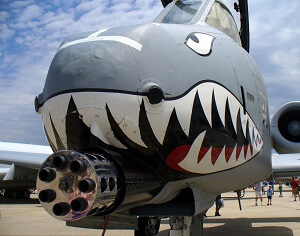 Keeping an A-10 airworthy can require spending that does not resemble either acquisition cost or hourly operating cost. In 2019, the A-10 wing contract announcement recorded an indefinite-delivery, indefinite-quantity contract with a $999 million ceiling for up to 112 wing assemblies and up to 15 wing kits, with $239.578 million in fiscal 2017 through 2019 procurement funds obligated at award.
The contract exposes a common military-cost trap. Dividing the $999 million ceiling by 112 gives about $8.9 million, but that is not a documented wing-assembly price. The ceiling also covers up to 15 wing kits, the government did not obligate the full ceiling at award, and an indefinite-delivery contract allows later orders within stated limits. Calling the quotient a unit price would turn a maximum contractual authority into a transaction that the source never reports.
Structural spending also changes the ownership picture. A historical airframe value does not tell a budget reader how much service-life work may be needed to keep aircraft available. Wing replacement belongs in sustainment and modernization analysis. It should not be added to every A-10 as though each aircraft automatically received an identical share of the contract ceiling.
Cost Against Modern Fighters
A modern fighter gives useful scale only when its price basis is stated. In September 2026, the F-35 Joint Program Office provided current-year figures showing an average F-35A flyaway cost of $92 million across Lots 18 and 19, according to the current F-35 price report. Compared with the calculated A-10 purchasing-power benchmark of $20.14 million, the F-35A figure is about 4.6 times as large.
That 4.6-times ratio is a scale check, not a replacement-cost formula. The A-10 input begins with a fiscal 1998 historical unit figure translated through CPI. The F-35A input is a current flyaway figure from active production. The aircraft also serve different procurement eras and capability sets. A reader should not infer that one A-10 could be recreated today for one-fifth of an F-35A, or that a one-for-one fleet swap would preserve missions, support needs, or life-cycle spending.
For readers comparing acquisition figures, F-35 jet cost provides the adjacent purchase-price question. The more useful A-10 comparison is narrower. Historical acquisition value helps explain why older low-cost Warthog references look cheap, while current fighter pricing shows how far procurement economics have moved since the A-10 production era.
Retirement Economics
Retirement changes the cost question from “what is the aircraft worth?” to “what spending can be avoided, and when?” The FY2026 authorization language bars the Air Force from reducing total A-10 inventory below 103 aircraft during fiscal 2026, subject to its stated exception for aircraft that are no longer mission capable and uneconomical to repair, and requires 93 A-10s in primary mission aircraft inventory through October 1, 2026.
The FY2027 aircraft budget coverage describes a request to retire 49 A-10s and leave 54, enough for three squadrons, with the type remaining through 2030. The prior FY2026 plan had estimated $423 million in operations and maintenance savings from full divestment, according to A-10 retirement reporting.
The $423 million figure should not be treated as the sale value of the fleet or divided by aircraft count to invent a per-aircraft retirement price. Savings depend on which costs actually disappear after aircraft leave service. Personnel, facilities, contracts, training, parts inventories, and replacement mission capacity can move on different schedules. That is why retirement economics belongs beside sustainment cost, not inside the historical unit-price number.
Answers to Common Questions
Can a civilian buy a new A-10 Warthog?
The public evidence here does not provide a current new-production Air Force sale price. It provides historical acquisition data and government operating, support, and modernization spending.
How much is an A-10 in today’s money?
Using CPI-U, the Air Force’s $9.8 million fiscal 1998 constant-dollar benchmark translates to about $20.14 million in August 2026 consumer purchasing power. That is an inflation calculation, not a current procurement quote.
How much does an A-10 cost to fly per hour?
GAO’s fiscal 2020 full operating and support measure was $22,531 per flying hour. The narrower fiscal 2026 DoD reimbursable schedule lists $11,453 to $12,036 per hour, depending on the user.
Why do some pages list an A-10 at $18.8 million?
An official Whiteman Air Force Base fact sheet does list $18.8 million, but it does not state the dollar-year or accounting basis. That makes it less suitable for inflation conversion than the headquarters Air Force figure.
Is the A-10 cheaper than an F-35A?
The historical A-10 benchmark is much lower, but the comparison is not like-for-like. The A-10 figure is historical, while the current F-35A figure is a modern production flyaway price. Their roles, production eras, and accounting bases differ.
Disclosure: Educational content, not financial advice. Prices reflect public information as of the dates cited and can change. Confirm current rates, fees, taxes, and terms with official sources before purchasing. See our methodology and corrections policy.