
How Much Does an AMRAAM Missile Cost?
Published on | Written by Alec Pow
This article was researched using 14 sources. See our methodology and corrections policy.
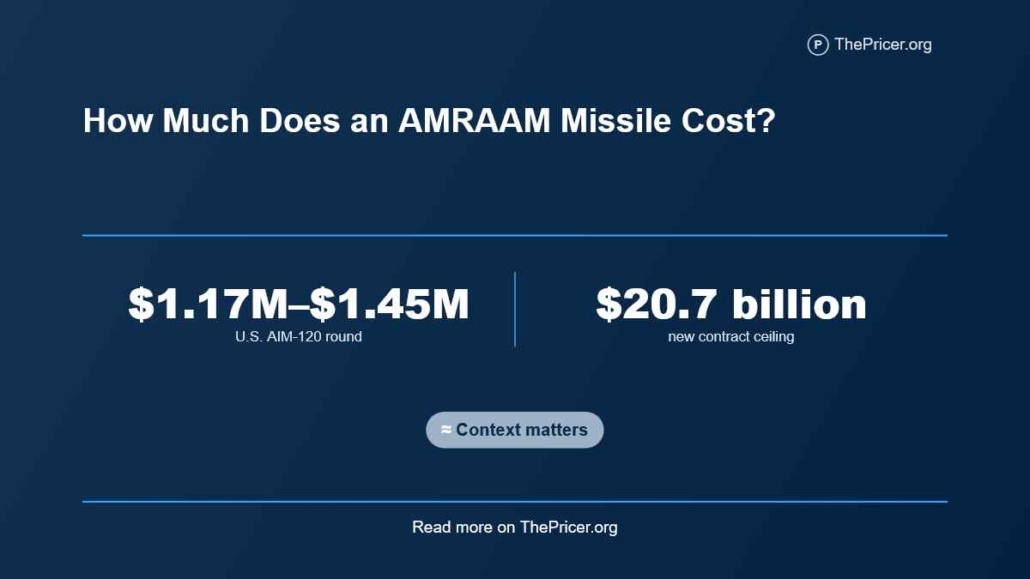
An AIM-120 AMRAAM currently costs about $1.17 million per Air Force all-up round in the latest FY2026 budget history, while the FY2027 base line shows $1.449 million per missile. The cost question exploded on September 28, 2026 after Raytheon announced a Pentagon contract worth up to $20.7 billion for five years of AMRAAM production plus two option years. That giant ceiling should not be divided blindly into a missile count.
The new deal covers complete missiles, guidance sections, direct charges, and Foreign Military Sales offsets. Export packages can look far more expensive than the U.S. missile-only number because they add spares, containers, software, training, transportation, engineering, and support. The useful AMRAAM price changes with the accounting scope, so there is no universal sticker price.
Article Highlights
Jump to sections
- FY2026 Air Force history puts an AIM-120 all-up round at $1.169 million (at $30 per hour, earning that amount would take about 18.7 years of full-time work, before taxes), while the FY2027 base buy shows $1.449 million.
- The new Pentagon contract has a ceiling of $20.699 billion, but only about $154.35 million was obligated at award.
- Raytheon’s annual production target rises from 1,200 to at least 1,900 missiles.
- If all seven contract years run at the 1,900-missile floor, the minimum production count would be 13,300 missiles.
- Recent export package ceilings equal roughly $2.46 million to $4.25 million per requested AMRAAM, including support and other items.
- A six-missile NASAMS launcher load represents about $7.01 million of missile hardware at the FY2026 Air Force round cost.
How Much Does an AMRAAM Missile Cost?
The cleanest missile-only benchmark comes from the Air Force procurement book. Its latest history lists the FY2026 AIM-120 Missile All Up Round at $1.169 million (about 18.7 years of full-time work at $30 per hour) each for 237 rounds, after $1.178 million in FY2025. The FY2027 base row shows 38 rounds at $1.449 million each. The Air Force cost history explicitly warns that unit cost changes with total quantity and customer buying power.
That gives a practical current range of about $1.17 million to $1.45 million per U.S. Air Force round, depending on the fiscal-year buy. The increase from $1.169 million to $1.449 million is about 24%. It should not be read as simple inflation because the Air Force is buying only 38 base-funded missiles in the FY2027 row while much larger production volumes come from Navy, mandatory, and FMS funding.
The Air Force notes that unit cost is quantity dependent across U.S. and foreign customers. A larger combined lot can spread fixed production expenses across more rounds, while a small service-funded slice can make the published per-unit number look unusually high.
The New Deal Is Not a Unit Price
Raytheon said on September 28 that its new AMRAAM agreement is a five-year multi-year contract with two option years valued at up to $20.7 billion (about 332 thousand years of full-time work at $30 per hour). The new production award follows a framework that supports annual output of at least 1,900 missiles. The company says the missiles will serve the U.S. Air Force, Navy, and international customers.
The contract notice gives the accounting boundary. It covers AMRAAM All Up Rounds, guidance sections, direct charges, and Foreign Military Sales offsets. A detailed award record lists a not-to-exceed value of $20,699,334,581 and says only $85,715 in FY2026 Air Force weapons funds plus $154,266,225 in FMS money was obligated at award. Combined, that is about $154.35 million, only 0.75% of the ceiling.
Reuters also describes the award as provisional and reports that Congress has not yet appropriated all of the money needed for the full multiyear commitment. The funding caveat matters because a contract ceiling is the maximum authorized value under the vehicle, not proof that $20.7 billion has already been spent. The remaining value becomes relevant only as orders, options, and funding are executed.
What the Contract Ceiling Implies
The new output floor gives us a way to test the headline contract without pretending it reveals a true unit price. Raytheon says production will rise to at least 1,900 AMRAAMs per year. Five base years at that floor equal 9,500 missiles. If both option years are used, seven years equal at least 13,300 missiles. Those are minimum production quantities implied by the annual target, not disclosed contract-order quantities.
Divide the full $20.699 billion ceiling by 9,500 and the result is about $2.18 million per missile-equivalent. Spread it across 13,300 and the figure falls to about $1.56 million. Neither number is a missile price because the contract also pays for guidance sections, direct charges, FMS offsets, and possibly more than 1,900 missiles in some years.
A second check starts with the FY2026 Air Force all-up-round price. At $1.169 million each, 1,900 missile rounds would represent about $2.22 billion of missile hardware per year. Over seven years, that would be about $15.55 billion. The difference between that simplified hardware model and the $20.699 billion ceiling is about $5.15 billion. That gap is not a measured support bill, but it shows why the ceiling can be much larger than missile count multiplied by one recent U.S. unit cost.
Foreign Buyers
The spread gets wider across other cases. The Netherlands’ $570 million ceiling for 232 AIM-120C-8 missiles works out to about $2.46 million each before separating support. The Dutch package also includes guidance sections, training missiles, containers, spares, software, training, transportation, and technical support.
Saudi Arabia’s proposed 1,000-missile package has an estimated ceiling of $3.5 billion, or $3.50 million per requested missile before the other contents are stripped out. The Saudi notification also lists 50 spare guidance sections and program support.
Türkiye’s smaller package creates the highest apparent figure among these examples. Its $225 million ceiling covers 53 missiles plus six guidance sections and support, which works out to about $4.25 million per requested missile. The Türkiye sale notice lists containers, software, publications, transportation, studies, and U.S. support. Smaller buys can carry more support cost per missile.
| AMRAAM price scope | Published amount | Useful interpretation |
|---|---|---|
| USAF FY2026 all-up round | $1.169M | Missile hardware benchmark |
| USAF FY2027 base all-up round | $1.449M | Low-quantity base buy |
| Netherlands FMS ceiling ÷ 232 | $2.46M | Package-equivalent, not missile price |
| Saudi FMS ceiling ÷ 1,000 | $3.50M | Package-equivalent, not missile price |
| Türkiye FMS ceiling ÷ 53 | $4.25M | Package-equivalent, not missile price |
The Production Ramp
The Pentagon is buying industrial capacity as well as missiles. Raytheon’s 2024 production plan topped out at 1,200 AMRAAMs per year. The new target of at least 1,900 is about 58% higher. Reporting on the production ramp says the 1,900 target is 58% above the company’s 2024 level and follows years when annual output had been closer to 450 or 600 missiles.
An extra 700 missiles of annual capacity is substantial. At the FY2026 Air Force all-up-round benchmark of $1.169 million, 700 rounds correspond to about $818 million of missile hardware per year. That is only a scale model because U.S. and foreign variants, lot pricing, guidance sections, supplier investments, and contract terms differ.
The multiyear structure is designed to give Raytheon and its suppliers a stable demand signal for labor, components, tooling, and factory investment. It also locks production planning over a much longer horizon than a one-year buy. That matters because AMRAAM production lead times are measured in years. The latest Air Force budget history shows FY2026 rounds awarded in 2026 with first deliveries scheduled years later, so money committed today does not immediately become inventory on a flight line.
The Missile
AMRAAM spending continues after a missile leaves the production line. In September 2025, the Pentagon awarded Raytheon a ceiling $760 million contract for AMRAAM obsolescence work across production, sustainment, and development. The obsolescence support award shows the cost of maintaining parts availability and technical relevance as components age or disappear from the supply chain.
The new $20.699 billion production vehicle makes those surrounding costs easy to miss because several categories sit inside the same ceiling. Complete rounds are only one contract line. Guidance sections can be bought separately for spares and repairs, while direct charges and FMS offsets can add value that is not physically embedded in a missile delivered to a squadron.
Export packages show the same pattern from the buyer side. Containers, training missiles, software, test equipment, transportation, technical publications, engineering support, and spare sections can turn a roughly $1 million-plus missile into a package-equivalent figure above $3 million per requested round. That extra money is real spending, but calling all of it “the missile price” hides what the buyer is actually purchasing. That distinction is central to AMRAAM budgeting.
A Six-Missile NASAMS Load
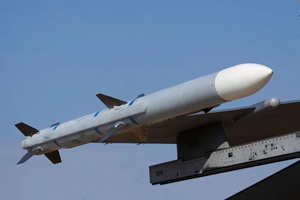 AMRAAM has two major uses. Fighters carry it for beyond-visual-range air combat, while NASAMS uses the same basic missile family from ground launchers. Kongsberg says a NASAMS launcher can carry up to six missiles, including AIM-120 AMRAAM, AMRAAM-ER, and AIM-9X variants.
Using the FY2026 Air Force AIM-120 all-up-round cost purely as a hardware benchmark, six missiles × $1.169 million = about $7.014 million of missile inventory on one fully loaded launcher. That excludes the launcher, Sentinel radar, Fire Distribution Center, vehicles, communications, crew, training, and reload stock. It also assumes six standard AIM-120 rounds rather than a mixed load.
Worked example. One six-round load is $7.014 million. One identical reload adds another $7.014 million, making $14.028 million in modeled missile inventory. That still excludes the launcher, radar, Fire Distribution Center, vehicles, crew, and training. The cost of a Patriot system shows the same interceptor-versus-system distinction at a higher price tier.
Cheaper and More Expensive Alternatives
The closest cheaper U.S. air-to-air comparison is AIM-9X Sidewinder, but it performs a different short-range mission. The Air Force FY2026 procurement book lists an AIM-9X Block II all-up round at $447,000. The Sidewinder cost history means the FY2026 AMRAAM benchmark of $1.169 million is about $722,000 higher, or roughly 2.6 times the AIM-9X round cost.
At the other end sits AIM-260 JATM, the emerging longer-range successor for some missions. Its public unit price remains opaque, with annual procurement lines and foreign package values revealing large amounts of spending without a clean U.S. per-round figure. The current AIM-260 cost evidence is useful precisely because it shows why an export package or budget line should not be converted into a missile sticker price without checking the contents.
The platform also changes the comparison. The current F-35A flyaway price is about $92 million. Four FY2026-price AMRAAMs would represent another $4.676 million of missile inventory in an illustrative four-round load, about 5.1% of that aircraft price. That does not include pylons, integration, training rounds, ground support, or any other weapons. Missile inventory can add millions to the value carried by a single combat aircraft.
What we verified
- Checked the FY2026 joint weapon-system summary, which funds 534 Air Force and Navy AMRAAMs with $738.4 million in procurement and $815.9 million including R&D.
- Confirmed that the previous Lots 39 and 40 award carried a not-to-exceed value of $3.5 billion and included missiles, telemetry systems, initial and field spares, and production-engineering support.
- Cross-referenced Raytheon’s production expansion details, which put the new AMRAAM annual target at 1,900 and says 2025 output nearly doubled from 2024.
Answers to Common Questions
How much does one AMRAAM missile cost?
A current Air Force AIM-120 all-up round is about $1.17 million in FY2026 history. The FY2027 base buy lists $1.449 million.
Does the new $20.7 billion contract mean AMRAAMs cost millions more each?
No. The ceiling also covers guidance sections, direct charges, and FMS offsets across five years plus two option years.
How many AMRAAMs could the new contract produce?
Raytheon’s target is at least 1,900 per year, implying 9,500 across five base years or 13,300 across seven years at that floor. Actual orders can differ.
Why do foreign AMRAAM deals look so expensive?
Foreign sale ceilings can include guidance sections, training missiles, containers, software, transportation, training, engineering, and government support.
Is AMRAAM cheaper than AIM-9X?
No. FY2026 Air Force figures put AMRAAM at $1.169 million and AIM-9X Block II at $447,000. They serve different engagement roles.
Disclosure: Educational content, not financial advice. Prices reflect public information as of the dates cited and can change. Confirm current rates, fees, taxes, and terms with official sources before purchasing. See our methodology and corrections policy.