
How Much Does an Anduril Dive-LD Underwater Drone Cost?
Published on | Written by Alec Pow
This article was researched using 12 sources. See our methodology and corrections policy.
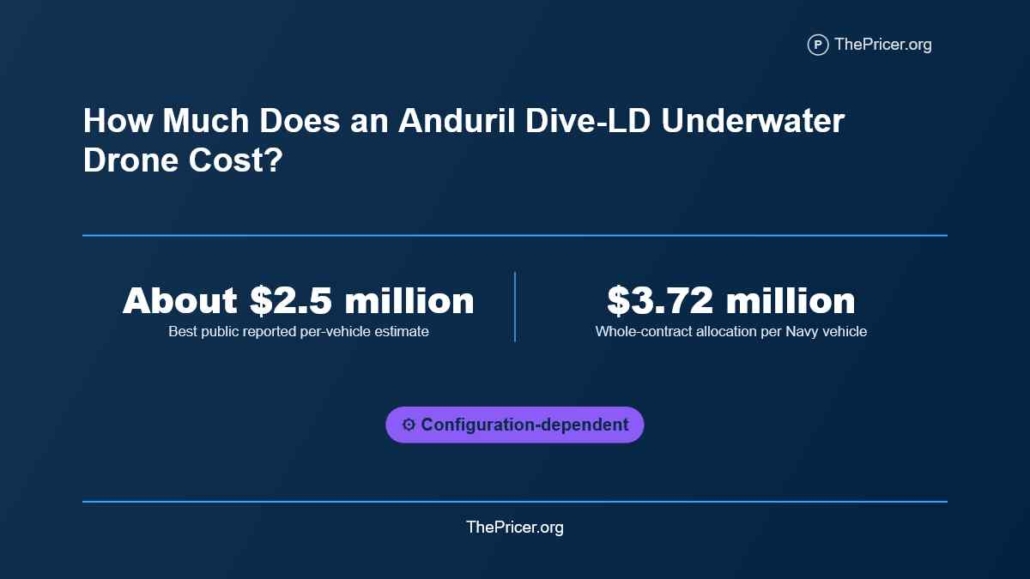
An Anduril Dive-LD autonomous underwater vehicle costs about $2.5 million per vehicle based on the best public reported estimate, not an Anduril catalog price. The U.S. Navy also awarded Anduril an initial $18.6 million procurement covering five Dive autonomous underwater vehicles, which produces a much higher whole-contract allocation of $3.72 million per vehicle. Those figures describe different scopes.
Dive-LD is a large, reusable autonomous undersea vehicle built for long-duration sensing, mapping, mine warfare, reconnaissance, and other payload-driven missions. Public sources do not disclose enough line-item pricing to assign exact dollar values to its sensors, autonomy integration, test work, support equipment, or mission payloads. That makes the reported $2.5 million figure the best public unit estimate, with procurement-package costs treated separately.
Article Highlights
Jump to sections
- The best public Dive-LD unit estimate is about $2.5 million (at $30 per hour, earning that amount would take about 40 years of full-time work, before taxes).
- The Navy’s initial procurement was $18.6 million for five Dive AUVs.
- Dividing that contract by five gives $3.72 million per vehicle, but that is a package allocation rather than a bare hardware price.
- Using the reported unit estimate leaves a modeled $6.1 million of the initial contract not explained by five vehicle estimates.
- Anduril’s Rhode Island facility was built for more than 200 large-diameter AUV hulls per year.
How Much Does an Anduril Dive-LD Underwater Drone Cost?
Anduril does not post a public Dive-LD price sheet. The strongest accessible unit figure comes from August 2024 reporting, when a source familiar with the Replicator selection told DefenseScoop that the vehicles cost about $2.5 million each. That is an attributed estimate rather than an invoice, contract line item, or manufacturer list price.
The estimate is still useful because it is attached to the correct vehicle and procurement period. It gives readers a defensible order of magnitude for one Dive-LD without dividing a factory investment, multivehicle contract, or unrelated Navy program by an assumed quantity. The figure should be read as approximately $2.5 million (about 40 years of full-time work at $30 per hour), not as a precise replacement quote for every configuration.
Payload choice can move a fielded system away from that number. Dive-LD’s large mission bay is designed to accept different sensors and effectors, and defense buyers can also fund engineering work, software, testing, deployment support, and sustainment around the vehicle. Public reporting does not show a current configured price for a specific Navy payload set. A commercial buyer also cannot infer its quote from the Navy estimate because configuration, quantity, payload, and contract scope can differ.
What Dive-LD Actually Is
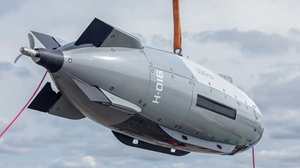
Dive-LD is Anduril’s large-diameter autonomous undersea vehicle rather than a small hand-launched inspection drone. Anduril lists a length of about 19 feet, a diameter of about 4 feet, maximum endurance of about 10 days, and a maximum operating depth of about 6,000 meters on its Dive-LD technical specifications. The vehicle has more than one cubic meter of payload capacity and open mechanical, electrical, and software interfaces for mission-specific sensors and effectors.
That modular design matters for price interpretation. One Dive-LD can be configured for intelligence collection, seabed mapping, mine warfare, infrastructure inspection, or another mission without every vehicle carrying the same payload. A bare or lightly configured vehicle estimate cannot automatically stand in for a deployed Navy mission package. Sensors, communications equipment, autonomy software, testing, integration, spares, handling gear, and support can sit elsewhere in a procurement.
The platform is also reusable. That separates its economics from an expendable weapon such as a heavyweight torpedo. Readers comparing undersea systems can use the Mk 48 torpedo cost as a different procurement model. Dive-LD is intended to return from missions when conditions permit, even though its military employment can accept a higher risk of loss than crewed undersea operations.
Inside the $18.6 Million Navy Buy
Anduril announced that the U.S. Navy awarded an initial $18.6 million Dive buy through the Defense Innovation Unit’s Large Displacement Unmanned Underwater Vehicles prototyping effort. Independent procurement reporting states that the award called for five Dive autonomous vehicles. The contract followed government testing and a competitive prototype pathway rather than a public commercial checkout process.
The contract gives the strongest public quantity-and-total pair for Dive, but it should not be converted into a supposed manufacturer sticker price without a scope warning. Dividing $18.6 million (about 298 years of full-time work at $30 per hour) by five gives $3.72 million per contract vehicle. That calculation allocates every contract dollar equally across the five vehicles, including any prototype-program work or other funded content that may sit outside a vehicle-only estimate.
| Dive-LD price measure | Amount | What it represents |
|---|---|---|
| Reported vehicle estimate | About $2.5 million each | Attributed per-vehicle estimate |
| Initial Navy procurement | $18.6 million total | Five Dive AUVs in a prototype procurement effort |
| Whole-contract allocation | $3.72 million each | Total contract divided by five |
| Modeled five-vehicle value | About $12.5 million | Five vehicles times the reported estimate |
| Modeled residual | About $6.1 million | Contract total less modeled vehicle value |
The table is a reconciliation, not an invoice. Public sources do not provide enough detail to label the residual as payload cost, software cost, support cost, or engineering cost. The safer conclusion is that the contract scope and the reported unit estimate measure different things.
Why Contract Math Gives $3.72 Million
The whole-contract allocation is 48.8 percent above the reported vehicle estimate. The arithmetic is $3.72 million minus $2.5 million, which leaves $1.22 million. Dividing $1.22 million by $2.5 million gives 48.8 percent. That gap explains why a reader can encounter both figures without either number automatically being wrong.
A second calculation shows the size of the unexplained contract layer. Five vehicles at the reported $2.5 million estimate equal about $12.5 million. Subtracting that modeled vehicle value from the $18.6 million contract leaves about $6.1 million. The residual equals roughly 32.8 percent of the contract.
Calling that $6.1 million a support fee would go beyond the public evidence. The source material does not publish a complete price breakdown for payloads, test activity, software integration, engineering, spares, logistics, training, or government-specific requirements.
Prototype buys can also spread nonrecurring work across a very small quantity, which can make a whole-contract allocation look much higher than a repeat-production vehicle estimate. The useful result is narrower. Roughly one-third of the initial contract cannot be reconciled to five approximate vehicle estimates using publicly disclosed information. That is the procurement layer a buyer should keep separate from the reported hardware figure.
The Dive-LD Lost Near Iran
Dive-LD became part of the September 2026 Iran war news when Iranian authorities said they had captured one near the entrance to the Strait of Hormuz. Reuters reported that the Pentagon acknowledged a U.S. underwater drone had malfunctioned while surveying regional waters, while Anduril confirmed a vessel loss. The Pentagon described the vehicle as an older model without classified sonar or radar equipment, and Reuters said it could not independently verify Iran’s claim that it captured the drone.
The cost implication should be kept narrow. Applying the previously established reported unit estimate puts roughly $2.5 million of vehicle value at risk before any undisclosed mission payload, support, or replacement effort. Public reporting does not identify the lost vehicle’s procurement batch, its exact configuration, its original invoice value, or the price of a replacement.
The incident also gives financial meaning to the term attritable. An attritable system is designed for missions where commanders may accept losing the unmanned asset rather than exposing a crewed platform or personnel to the same danger. It does not mean the hardware is cheap or disposable. A multimillion-dollar loss can still fit that concept when the alternative carries much greater human, strategic, or platform risk.
Production Scale
 Anduril built manufacturing capacity well beyond the five-vehicle prototype purchase. Current reporting says the company is ramping the Dive-LD production line at Quonset Point toward maximum capacity by the end of 2027. The 150,000-square-foot Rhode Island facility came online in late 2025 and supports large-diameter underwater vehicle production.
Production capacity should not be confused with funded procurement. A factory capable of hundreds of hulls can serve multiple defense and commercial customers, different configurations, replacement demand, and later orders. Capacity says what the industrial base may be able to build. It does not show that the Navy has purchased that quantity or that every future vehicle will carry the same price.
A conditional scale calculation still shows the financial magnitude. At the reported $2.5 million unit estimate, 200 vehicles would correspond to about $500 million of vehicle value. That is a capacity scenario, not a forecast of Anduril revenue or government spending. Real production could mix configurations, prices can change with volume and payload, and the facility supports the broader Dive family. Readers comparing unmanned naval procurement can also see the military sea drone cost, where program totals likewise differ sharply from individual vehicle estimates.
How Other Navy UUVs Compare
Other Navy underwater vehicles show why class and package scope matter. HII’s Lionfish is a much smaller UUV based on the REMUS 300. HII says its Navy Lionfish contract exceeds $347 million at full potential, can grow to as many as 200 vehicles, and includes support equipment and engineering services. Dividing the ceiling by 200 would not produce a clean Lionfish hardware price because the contract covers more than vehicles.
Knifefish is a medium mine-countermeasure UUV with another bundled procurement structure. General Dynamics received $44.6 million for five systems containing 10 UUVs plus support equipment. Dividing the award by 10 gives a package allocation of $4.46 million per UUV, while dividing by five gives $8.92 million per two-vehicle system. Neither calculation is a bare replacement-vehicle quote.
Dive-LD’s reported $2.5 million estimate sits between these procurement measures only in a loose accounting sense. Lionfish is smaller, Knifefish has a specialized minehunting mission, and the contracts come from different years and procurement stages. A synthetic average would hide those differences. The stronger comparison is methodological. All three programs show why vehicle count, support equipment, engineering, mission hardware, and contract scope must remain attached to the price. The autonomous mine hunter cost develops the Knifefish package distinction in greater detail.
Payloads and Support
Dive-LD’s price uncertainty is concentrated in configuration and procurement scope. Anduril was selected by the Navy and DIU after a competitive swim-off, and the company says the platform can integrate complex payloads and multi-sensor suites. Its Navy prototype selection also demonstrated remote mission monitoring through Anduril’s Lattice software. Those features make a configured defense package more than a printed hull, propulsion unit, and battery.
Public sources do not assign reliable dollar amounts to a standard sonar package, intelligence payload, Lattice integration, launch and recovery equipment, spares, training, field service, or sustainment. That missing detail is why a Dive-LD should not be quoted as costing exactly $2.5 million in every mission configuration. The reported estimate answers the vehicle question. The $18.6 million Navy award answers an initial procurement question.
Use the $2.5 million figure when
- Estimating the best public per-vehicle cost order of magnitude.
- Comparing basic asset value with other reusable unmanned systems.
- Estimating vehicle value at risk while keeping mission payload value separate.
Do not use it directly when
- Pricing a Navy mission package with undisclosed sensors or support.
- Converting a prototype contract into a commercial customer quote.
- Valuing software, engineering, training, spares, sustainment, or factory investment.
- Comparing Dive-LD with extra-large vehicles whose size and procurement scope differ.
Answers to Common Questions
How much does one Anduril Dive-LD cost?
The best public reported estimate is about $2.5 million per vehicle. Anduril does not publish a public catalog price for every configuration.
Why did the Navy pay $18.6 million for five Dive vehicles?
The $18.6 million award was an initial five-vehicle procurement through a prototype effort. Dividing the entire contract gives $3.72 million per vehicle, but that allocation can include more than bare vehicle value.
How much was the Dive-LD lost near Iran worth?
Using the reported vehicle estimate gives about $2.5 million of vehicle value. Its exact configuration, original purchase value, mission payload value, and replacement cost have not been publicly disclosed.
Can Anduril build Dive-LD in large numbers?
Its Rhode Island facility was designed for more than 200 large-diameter AUV hulls per year, though manufacturing capacity is not the same as funded orders.
Does the $2.5 million estimate include every sensor and support cost?
No public source provides a complete itemized package showing that every payload, software, engineering, training, spares, and sustainment cost is included in the reported $2.5 million estimate.
Disclosure: Educational content, not financial advice. Prices reflect public information as of the dates cited and can change. Confirm current rates, fees, taxes, and terms with official sources before purchasing. See our methodology and corrections policy.