
How Much Does an APKWS Rocket Cost?
Published on | Written by Alec Pow
This article was researched using 9 sources. See our methodology and corrections policy.
A current APKWS II guided rocket costs roughly $40,000 to $45,000 per complete round in the latest U.S. procurement planning, depending on configuration and which costs are included. The U.S. Navy’s FY2027 budget prices the BAE Systems guidance section alone at $31,717. Adding a current Mk 66 Mod 4 rocket motor, Mk 152 high-explosive warhead and dual-safe proximity fuze produces a component-level counter-drone round costing about $44,674.
That makes older claims that APKWS costs only $22,000 to $27,500 increasingly outdated. Those figures came from older production lots and often represented the guidance kit rather than every part of a ready-to-fire rocket. The current weapon has also taken on a new job: shooting down drones from aircraft such as the F-16, F-15 and A-10, creating demand for proximity fuzes and new air-to-air variants.
The price can look much higher in an annual budget or foreign sale. The Air Force’s FY2026 procurement line averages $85,428 per weapon across a 1,000-round urgent buy, while its later planning falls to roughly $40,000 to $41,000 each. Saudi Arabia’s approved 2025 package works out to $50,000 per requested APKWS, but that figure also pays for spare parts, support equipment, software, training and technical assistance.
Article Highlights
Jump to sections
- The Navy’s FY2027 price for an APKWS guidance and control section is $31,717.
- A current Mk 66 Mod 4 rocket motor is budgeted at about $1,696.
- The FY2027 Mk 152 high-explosive warhead costs about $2,250.
- The new dual-safe proximity fuze costs about $9,011.
- Those components produce a calculated counter-drone APKWS cost of about $44,674 per round.
- Seven such rockets represent about $312,716 in ammunition before the launcher and aircraft are counted.
- The Air Force’s FY2026 1,000-round procurement averages $85,428 per weapon-system unit, while later planning is around $40,000 to $41,000.
- A current APKWS counter-drone round is roughly 32 times cheaper than a $1.449 million FY2027 AMRAAM.
- BAE Systems has delivered more than 100,000 APKWS guidance kits and says annual manufacturing capacity is at least 25,000 units.
How Much Does APKWS Cost?
The cleanest current component price appears in the Navy’s FY2027 ammunition procurement book. It lists 1,120 APKWS guidance and control sections at $31,717 each. The same price applies to 263 guidance sections budgeted for ground-based Marine Corps use.
The guidance section is the expensive part of APKWS, but it is not the whole rocket. APKWS is a modular system that inserts a BAE Systems laser-guidance section between the warhead and rocket motor of a 2.75-inch Hydra-family rocket. BAE’s current APKWS description confirms that the kit works with existing rocket motors, warheads and fuzes rather than replacing the entire munition.
| APKWS cost measure | Current figure | What it represents |
|---|---|---|
| APKWS guidance section | $31,717 | FY2027 Navy G&C section |
| Mk 66 Mod 4 motor | $1,696.08 | FY2027 rocket motor |
| Mk 152 warhead | $2,250 | FY2027 high-explosive warhead |
| Dual-safe proximity fuze | $9,010.64 | FY2027 counter-UAS fuze |
| Calculated C-UAS round | $44,673.72 | Guidance + motor + warhead + proximity fuze |
The $44,673.72 result is a ThePricer component calculation, not a published government all-up-round sticker price. It is useful because every input comes from the same FY2027 Navy procurement book and represents compatible parts of the emerging counter-UAS configuration.
Why $22,000 Is Outdated
Many articles still describe APKWS as a roughly $22,000 weapon. That number has a legitimate history, but it no longer describes current U.S. procurement well.
An older Pentagon contract priced large APKWS guidance-kit buys around the low-$20,000 range. The Navy’s FY2025 procurement history later showed $24,860.78 per guidance section. FY2026 planning moved the price to $30,639, and FY2027 now shows $31,717.
From FY2025 to FY2027:
($31,717 – $24,860.78) ÷ $24,860.78 = 27.6%.
The guidance section itself has therefore risen about 27.6% across those published planning figures.
The older all-in estimate is also problematic because the guidance kit now costs more than $30,000 before a rocket motor, warhead or fuze is attached. Older reporting that placed a complete round near $27,500 can still describe historical procurement, but it should not be presented as a clean 2026-2027 replacement cost.
The Navy says APKWS unit pricing changes with combined purchases from the services and Foreign Military Sales customers. A small annual service quantity can cost more per guidance section than a large combined production lot, while supplier demand and configuration changes also move the number.
The safest current shorthand is therefore around $40,000 to $45,000 for a ready-to-use APKWS configuration, with approximately $31,700 of that represented by the guidance section.
The Counter-Drone Version
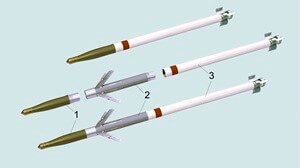 APKWS began as a way to turn inexpensive Hydra 70 rockets into precision air-to-ground weapons. Drone warfare has changed its value proposition. The Air Force now uses the AGR-20 with FALCO software for air-to-air engagements against unmanned aircraft.
The Air Force’s FY2027 missile procurement book says the FALCO-configured APKWS is employed on the A-10, F-15 and F-16. Its stated mission is air-to-air engagement of unmanned aircraft while retaining the ability to attack surface targets.
The Navy’s FY2027 budget explains why the component price is changing. It introduces a new dual-safe proximity fuze at $9,010.64 each and buys Mk 152 warheads specifically compatible with proximity fuzes for the counter-UAS mission.
The fuze is a substantial part of the bill. At $9,010.64, it accounts for about:
$9,010.64 ÷ $44,673.72 = 20.2%
of the modeled counter-drone round.
The guidance section accounts for about 71%. The motor is less than 4%, while the warhead represents roughly 5%.
The Air Force is already working on the next step. A 2026 development effort is adding a long-wave infrared seeker and modified guidance so an APKWS can transition from laser designation toward a more autonomous terminal engagement. Reporting on the $145 million development program says 300 prototype rounds are planned. That development contract should not be divided by 300 and called a production price because most of the money funds engineering, testing and qualification.
The Air Force Price
Air Force accounting gives us another legitimate APKWS number. Its FY2027 budget history shows 1,000 APKWS missiles costing $85.428 million in FY2026. That equals a gross weapon-system unit cost of:
$85.428 million ÷ 1,000 = $85,428 per weapon.
That is much higher than the roughly $44,674 component model. The reason is scope. A gross weapon-system procurement line can include costs that do not appear when a reader simply adds one motor, guidance section, warhead and fuze.
The future Air Force planning numbers are revealing. It projects 750 APKWS rounds and approximately $30 million of annual spending in FY2028, FY2029 and FY2030, followed by $30.552 million in FY2031.
Those amounts equal approximately:
- FY2028: $40,000 each
- FY2029: $39,999 each
- FY2030: $39,959 each
- FY2031: $40,736 each
Those future figures sit remarkably close to the component-derived $40,000-$45,000 range.
The FY2026 $85,428 average should therefore not automatically become the permanent APKWS sticker price. It represents a specific procurement year during a rapid counter-UAS fielding effort. The later Air Force profile points toward roughly $40,000 per round once procurement settles into repeated 750-round annual buys.
A Full Rocket Load
The per-round price becomes more meaningful when multiplied by the number of shots carried in a rocket pod. APKWS can use existing 2.75-inch rocket launchers, which is part of its attraction: the military does not need to buy an entirely new missile-launch architecture for each aircraft.
A seven-round load using the FY2027 counter-UAS component calculation costs:
7 × $44,673.72 = $312,716.04.
Two seven-round loads represent approximately $625,432 in guided rockets. A four-round ground launcher loaded with the same configuration holds roughly:
4 × $44,673.72 = $178,694.88.
Those amounts exclude the launcher, targeting sensor, aircraft or vehicle, maintenance equipment and training.
They also show why APKWS has become attractive against one-way attack drones. The current cost of shooting down a drone can climb sharply if a defender uses an air-to-air missile costing hundreds of thousands or more against every target.
A fighter may still use an AIM-9X or AMRAAM when target range, speed or engagement geometry demands it. APKWS creates a much cheaper option for targets that fall inside its performance envelope.
That distinction becomes even more valuable during a large raid. Twenty counter-drone APKWS rounds at the modeled $44,674 price represent about $893,474 of ammunition. One or two high-end air-to-air missiles can cost more than that entire 20-round stock.
APKWS vs Other Missiles
APKWS occupies the gap between an unguided rocket and a traditional guided missile. Its smaller warhead and shorter range mean it cannot replace every Hellfire, Sidewinder or AMRAAM mission, but its price is dramatically lower.
The latest FY2027 Air Force procurement figure puts an AIM-120 AMRAAM at $1.449 million per all-up round. Comparing that with the $44,674 APKWS counter-drone model gives:
$1.449 million ÷ $44,673.72 = about 32.4.
One FY2027-price AMRAAM therefore carries the same modeled procurement value as roughly 32 APKWS counter-drone rounds. Current AMRAAM pricing varies with annual quantities, but the order-of-magnitude gap remains.
Hellfire is a closer comparison because both weapons can be used against surface targets. Recent U.S. Hellfire missile prices sit around $130,000 to $160,000 for domestic production-lot rounds.
At $44,674, one APKWS costs roughly 28% to 34% as much as a $130,000-$160,000 Hellfire. The trade is capability. Hellfire carries a much larger warhead, has more range in many employment conditions and is designed for harder targets. APKWS is optimized for targets that do not warrant spending a heavier missile.
That cost ladder is the reason APKWS has become especially important for counter-drone work. It puts precision guidance on a mass-produced rocket while keeping the expenditure per shot in the tens of thousands rather than hundreds of thousands or millions.
Foreign Sale Prices
Foreign Military Sales create some of the highest apparent APKWS prices because they bundle the ammunition with everything needed to operate and support it.
In March 2025, the State Department approved Saudi Arabia to buy 2,000 APKWS II all-up rounds through a package valued at $100 million.
Dividing the ceiling by the requested quantity gives:
$100 million ÷ 2,000 = $50,000 per requested round.
That $50,000 is not a bare rocket price. DSCA says the proposed sale also includes spare parts, support equipment, missile software, training, U.S. government and contractor engineering, technical services and logistics support.
The $50,000 package-equivalent figure is still useful because it sits close to the current $40,000-$45,000 domestic round calculations rather than several times above them. It suggests that a relatively large APKWS export package can remain inexpensive compared with traditional missile sales even after support is added.
Foreign buyers can also face nonrecurring-cost recoupment charges. DSCA’s 2026 schedule lists a $3,032.54 nonrecurring charge for the newer WGU-59C/B air-to-air guidance section. That is an export-related government recoupment charge, not the manufacturing cost of the guidance kit.
This is why an export notification should never be divided by quantity and presented as an exact missile sticker without stating what else the package contains.
Why Production Matters
BAE Systems delivered its 100,000th APKWS guidance kit in February 2026. The company says the weapon has been in full-rate production for more than 12 years.
Production is now accelerating. BAE says its current manufacturing capacity is at least 25,000 guidance kits per year, supported by more than $100 million of recent factory investment. That works out to an average production capacity of more than:
25,000 ÷ 12 = 2,083 kits per month.
The Navy also awarded BAE a new $1.7 billion five-year IDIQ contract in December 2025, starting with a $322 million order. The ceiling supports tens of thousands of guidance kits rather than representing a fixed purchase of $1.7 billion worth of identical rockets.
The rocket motor supply chain is expanding too. The Army announced in August 2026 that it had added four companies to development work aimed at creating additional Hydra 70 production sources. The Army says the family typically sees annual procurement of 100,000 to 200,000 rockets.
That scale is central to APKWS economics. The expensive guidance kit is attached to a rocket family already purchased in enormous quantities. The weapon gains precision without requiring the military to create a completely separate propulsion, launcher and warhead supply chain.
Answers to Common Questions
How much does an APKWS rocket cost?
A practical current price is about $40,000 to $45,000 per complete round. The FY2027 Navy guidance section alone costs $31,717, and a component-level counter-drone configuration totals about $44,674.
Why do some sources say APKWS costs $22,000?
That figure comes from older procurement pricing and often refers mainly to the laser-guidance section. Current Navy guidance-section pricing has risen above $30,000 before the motor, warhead and fuze are added.
How much is the APKWS guidance kit?
The Navy’s FY2027 budget lists the guidance and control section at $31,717.
How much does a counter-drone APKWS cost?
Using current Navy component prices, an APKWS with a $31,717 guidance section, $1,696.08 Mk 66 motor, $2,250 Mk 152 warhead and $9,010.64 proximity fuze totals approximately $44,673.72.
How much does a seven-rocket APKWS load cost?
Seven counter-drone rounds at the modeled FY2027 component price represent approximately $312,716 in ammunition, excluding the launcher and aircraft.
Is APKWS cheaper than Hellfire?
Yes. A roughly $44,674 APKWS is only about 28% to 34% of the cost of a $130,000-$160,000 Hellfire production-lot round, although the weapons have different ranges, warheads and target sets.
Is APKWS cheaper than AMRAAM?
Yes. One $1.449 million FY2027 AMRAAM is equivalent in procurement value to roughly 32 current counter-drone APKWS rounds using the component-level calculation.
Who makes APKWS?
BAE Systems produces the APKWS laser-guidance section. The complete weapon uses existing 70 mm rocket components, including Hydra-family motors, compatible warheads and fuzes produced through the wider U.S. munitions supply chain.
Disclosure: Educational content, not financial advice. Prices reflect public information as of the dates cited and can change. Confirm current rates, fees, taxes, and terms with official sources before purchasing. See our methodology and corrections policy.