
How Much Does an Appliance Extended Warranty Cost?
Published on | Written by Alec Pow
This article was researched using 18 sources. See our methodology and corrections policy.
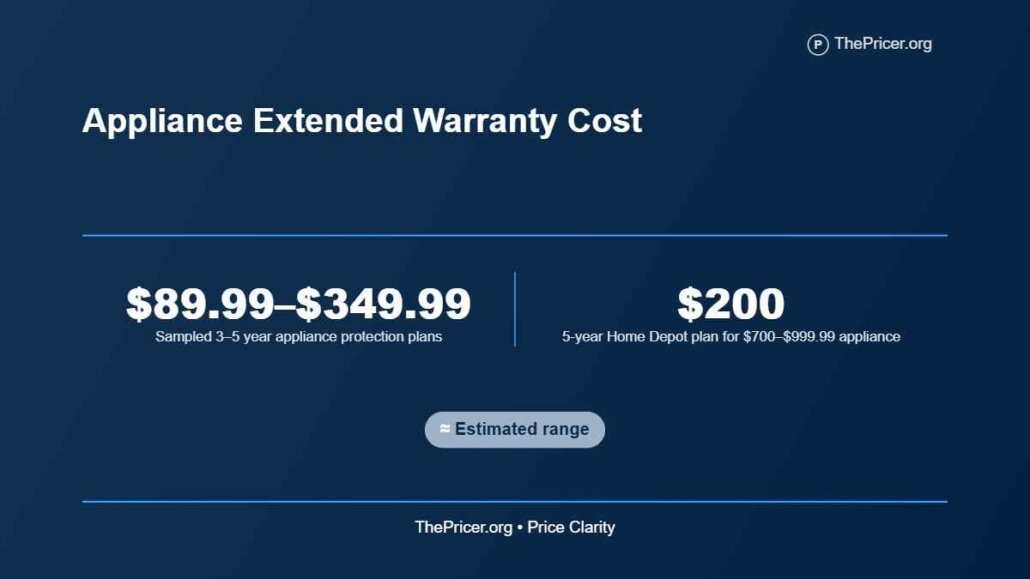
An appliance extended warranty can cost less than $100 or several hundred dollars, depending on the appliance price, contract term, retailer, and coverage. Prices checked on September 23, 2026 include Costco Allstate plans at $89.99, $119.99, and $159.99 for three years across three appliance-price bands.
Home Depot lists a five-year protection plan at $200 for appliances priced from $700 through $999.99. Best Buy shows a five-year refrigerator plan at $349.99 on a $1,699.99 example.
For U.S. buyers, an appliance extended warranty may also be sold as a protection plan or service contract for a refrigerator, washer, dryer, dishwasher, range, oven, freezer, or microwave.
Retailers and manufacturers use different purchase-price tiers, coverage terms, repair rules, reimbursement limits, claim charges, and manufacturer-warranty overlap. The quoted fee is usually tied to one appliance and one contract term, so it should not be confused with an annual whole-home warranty premium.
Those examples are not a national average. They show how much active offers can differ. A useful comparison starts with the plan fee, then checks how long coverage lasts, when repair benefits begin, what claim charges apply, and how the fee compares with the appliance price and a plausible repair bill.
Article Highlights
Jump to sections
- Current sampled major-appliance plans range from under $100 to several hundred dollars.
- A five-year plan can add roughly one-fifth to nearly one-third of the appliance price in the examples reviewed.
- Moving across a retailer price tier can change the protection fee even when the appliance price barely moves.
- Three-year and five-year plans do not use one fixed extension multiplier.
- Some plans include no deductible, while other benefits can include spoilage, surge protection, or reinstallation.
- Credit-card warranty benefits can remove the need for a separate paid plan on some eligible purchases.
How Much Does an Appliance Extended Warranty Cost?
Best Buy gives appliance-specific illustrations rather than one flat schedule. Its washer page uses a $719.99 appliance and lists three-year and five-year prices of $99.99 and $139.99. Its over-the-range microwave page uses a $399.99 appliance with three-year and five-year coverage at $79.99 and $119.99.
These figures show why one percentage cannot describe every offer. Costco prices by broad appliance-value bands, Home Depot uses more granular purchase-price tiers, and Best Buy shows plan prices tied to product examples. The table keeps the contract term and appliance value visible so a low fee is not mistaken for equivalent coverage on a higher-priced machine.
| Provider and example | Appliance value | Term | Plan fee | Plan fee share |
|---|---|---|---|---|
| Costco Allstate lower band | Under $1,000 | 3 years | $89.99 | Varies within band |
| Home Depot Allstate tier | $700-$999.99 | 5 years | $200 | About 20% to 28.6% |
| Best Buy microwave example | $399.99 | 5 years | $119.99 | 30.0% |
| Best Buy washer example | $719.99 | 5 years | $139.99 | 19.4% |
| Best Buy refrigerator example | $1,699.99 | 5 years | $349.99 | 20.6% |
The percentages are calculated from the listed appliance and plan prices where an exact appliance price exists. Home Depot’s band produces a range because the same $200 plan can attach to any qualifying appliance inside that price tier.
Manufacturer-direct pricing can differ from retailer schedules. One Samsung wall-oven listing priced the appliance at $3,649 and showed Care+ at $69.99 for three years, $129.99 for five years, and $349.99 for seven years when checked, with the shorter terms displayed as promotional prices. The wall-oven Care+ options are one product example, not a Samsung-wide rate card. At the other end of Home Depot’s published schedule, its five-year plan for appliances priced from $10,000 through $19,999.99 was listed at $595.
What the Contract Buys
An extended appliance warranty is usually a paid service contract rather than the manufacturer warranty included with a new appliance. The Federal Trade Commission says an extended warranty or service contract costs extra, can cover different problems, and may include deductibles, service charges, shipping costs, transfer fees, reimbursement limits, or exclusions. Its guidance says buyers should compare the paid contract with coverage already attached to the product.
The contract term does not always equal extra years after the factory warranty. Samsung says Care+ begins at purchase or delivery and that its home-appliance term includes the manufacturer warranty period. That difference matters because a five-year plan may mean five years from purchase rather than five additional years after the original warranty expires. Read the start date, covered failures, administrator, repair process, replacement rules, and claim limits before comparing plan prices. Walmart gives another timing example. Its standard protection-plan guidance says coverage starts on the purchase date rather than after the manufacturer warranty expires.
One appliance plan is different from a whole-home service contract. A whole-home plan can cover several named appliances or systems and can carry recurring premiums plus service-call charges. Readers comparing those products can see current home warranty annual costs. Keeping the two contract types separate prevents a low single-appliance fee from being compared with a broader household contract.
Three Years or Five
 Longer coverage costs more, but the increase is not uniform. Home Depot lists a three-year plan at $130 for appliances priced from $700 through $999.99. The five-year fee already cited for that same appliance band is $200. The extra two years cost $70, which is 53.8% more than the three-year fee.
The Best Buy examples move differently. The washer rises from $99.99 for three years to $139.99 for five years, an increase of $40 or about 40.0%. The refrigerator rises from $159.99 to $349.99, an increase of $190 or about 118.8%.
Those figures use the exact prices already cited above. The two-year extension costs much more on the refrigerator even though both Best Buy examples add the same nominal amount of time. The price gap can change the purchase decision.
Term length matters. Compare the added fee with the years that actually extend beyond the manufacturer warranty, not only with the plan’s label. If much of the early contract period overlaps factory coverage, the extra paid years after that overlap may be fewer than the headline term suggests.
Price-Tier Jumps
Tier boundaries can create a sudden fee change. Home Depot’s five-year plan costs $200 through an appliance price of $999.99. The next published price tier, covering $1,000-$1,499.99, costs $255. A hypothetical move from an appliance priced at $999.99 to one priced at $1,000.00 raises the plan fee by $55.
That one-cent appliance-price difference produces a 27.5% increase in the protection fee. The plan equals about 20.0% of a $999.99 appliance at the top of the lower tier and 25.5% of a $1,000.00 appliance at the bottom of the next tier. This calculation uses published plan bands and a hypothetical boundary comparison. It does not claim that two specific appliances differ in price by one cent.
The practical move is simple. That boundary deserves a separate checkout check before purchase. If two suitable models sit on opposite sides of a protection-plan threshold, price the appliance and protection together. A small sale, coupon, or model change can alter the plan band, so the warranty percentage can move in the opposite direction from the appliance discount.
Fees and Added Benefits
The sticker fee is only part of contract value. Lowe’s current major-appliance protection document states that its plan has no deductibles or service fees, offers 50% reimbursement for specified performance, care, and cosmetic items up to $100 a year, and can reimburse up to $300 per food-loss incident for an eligible refrigerator or freezer. It also lists reinstallation labor reimbursement up to $500 for a qualifying built-in replacement.
Benefits can begin at different times. Lowe’s chart says parts and labor for covered failures begin after the manufacturer warranty ends, while certain added benefits can apply earlier. That structure differs from reading the whole contract term as identical repair coverage from day one.
A buyer who values food-loss reimbursement, surge protection, or reinstallation should compare the relevant cap with the plan fee and the event that activates the benefit.
Deductible language deserves equal attention. A lower upfront plan can become more expensive after repeated service charges, while a higher fee with no deductible may produce a simpler claim budget. The FTC advises checking those claim-related charges before purchase. Compare contracts on the amount paid to buy the plan plus any amount required when service is requested.
Plan Price vs Repair Bills
A warranty price has more meaning beside repair costs. Best Buy’s washer page reports August 2024 national repair figures of $395 for a transmission, $350 for a motor, and $296 for a drain pump. Its refrigerator page reports $531 for a compressor, $461 for a condenser, and $372 for an ice maker. Those figures come from the retailer pages already cited and can vary by region and service provider.
The comparison is not a prediction of failure. Paying $139.99 for the five-year washer plan does not mean a $395 transmission repair will occur. It means one covered repair of that size could exceed the plan premium. The same logic works in reverse when a repair never occurs, falls outside the contract, or costs less than the protection fee.
For another comparison point, Yale Appliance’s September 15, 2026 analysis says a plan around 10% to 15% of appliance price is its benchmark and treats prices above 25% much more cautiously. That is one dealer-service company’s judgment, not a national rule, but the 10% to 15% benchmark helps explain why the plan-to-appliance percentages calculated here deserve comparison.
Repair economics change with the appliance itself. A refrigerator with expensive sealed-system components creates a different exposure from a simpler appliance with a lower replacement price. Readers shopping those products can compare the protection fee with current refrigerator purchase prices or washing machine costs. Keep reliability evidence, repair prices, and warranty terms separate rather than treating any one number as a forecast.
Three Purchase Scenarios
A lower-price microwave can carry a high protection ratio. Using Best Buy’s cited example, a $399.99 over-the-range microwave plus a $119.99 five-year plan totals $519.98 before tax. The plan adds 30.0% to the appliance price. A shopper comparing a nearby model should check whether a lower appliance price creates a lower plan fee or leaves the protection charge unchanged.
The washer example is a more moderate ratio. A $719.99 washer plus its $139.99 five-year plan totals $859.98 before tax. The plan adds about 19.4% to the appliance purchase price. This itemized total excludes tax, delivery, installation, hoses, haul-away, and other accessories because those costs are not part of the cited protection-plan price.
The refrigerator example produces the largest dollar add-on in this set. A $1,699.99 refrigerator plus a $349.99 five-year plan totals $2,049.98 before tax, with protection adding about 20.6%. The microwave’s warranty costs less in dollars but consumes a larger share of its appliance price. That distinction is useful when a household has several appliances and must decide where a protection budget carries the greatest relative cost.
When Coverage Fits
A paid plan has a stronger financial case when the appliance is expensive to repair or replace, the contract covers the failures that concern the buyer, claim charges are low, and existing coverage does not duplicate much of the term. It can have a weaker case when the plan consumes a large share of the appliance price, the appliance is inexpensive to replace, or another benefit already extends eligible warranty coverage.
Some credit cards can extend an eligible manufacturer warranty without a separate retailer-plan premium. NerdWallet’s June 2026 review says qualifying card benefits can add up to one year on eligible purchases and that terms vary by card. Check the card’s benefit guide before paying for overlapping coverage.
Makes sense if
- The protection fee is small relative to both appliance value and covered repair exposure.
- The contract has no deductible or a claim charge the household can absorb.
- Coverage includes a costly component or benefit that the manufacturer warranty does not cover for the needed period.
- The household wants predictable repair spending and accepts the contract’s service process.
Does not make sense if
- The plan takes a large share of the appliance price and replacement would be manageable.
- Existing manufacturer or credit-card coverage duplicates much of the useful term.
- Exclusions remove the failures the buyer is most concerned about.
- The buyer would rather keep the same money in a dedicated repair reserve.
Answers to Common Questions
How much is a five-year appliance warranty?
Current examples range widely. The researched set includes five-year protection at $119.99 for a $399.99 microwave, $139.99 for a $719.99 washer, $200 for Home Depot’s $700-$999.99 appliance tier, and $349.99 for a $1,699.99 refrigerator.
Is a three-year warranty much cheaper than five years?
It can be. In the reviewed examples, the added cost for moving from three years to five years ranged from $40 on the washer example to $190 on the refrigerator example. The increase depends on the provider and appliance.
Do appliance protection plans have deductibles?
Some do not. The Home Depot, Costco, Best Buy, and Lowe’s examples reviewed for this article state no deductible or no hidden service fee for the cited coverage, but buyers should check the exact contract offered with their appliance.
Can a credit card replace an appliance extended warranty?
Sometimes. Eligible cards can extend a qualifying manufacturer warranty, but the added coverage may mirror the original warranty rather than a retailer plan’s broader benefits. Check the card benefit guide and the appliance warranty before relying on it.
Disclosure: Educational content, not financial advice. Prices reflect public information as of the dates cited and can change. Confirm current rates, fees, taxes, and terms with official sources before purchasing. See our methodology and corrections policy.