
How Much Does an Employment-Based Green Card Cost?
Published on | Written by Alec Pow
This article was researched using 11 sources. See our methodology and corrections policy.
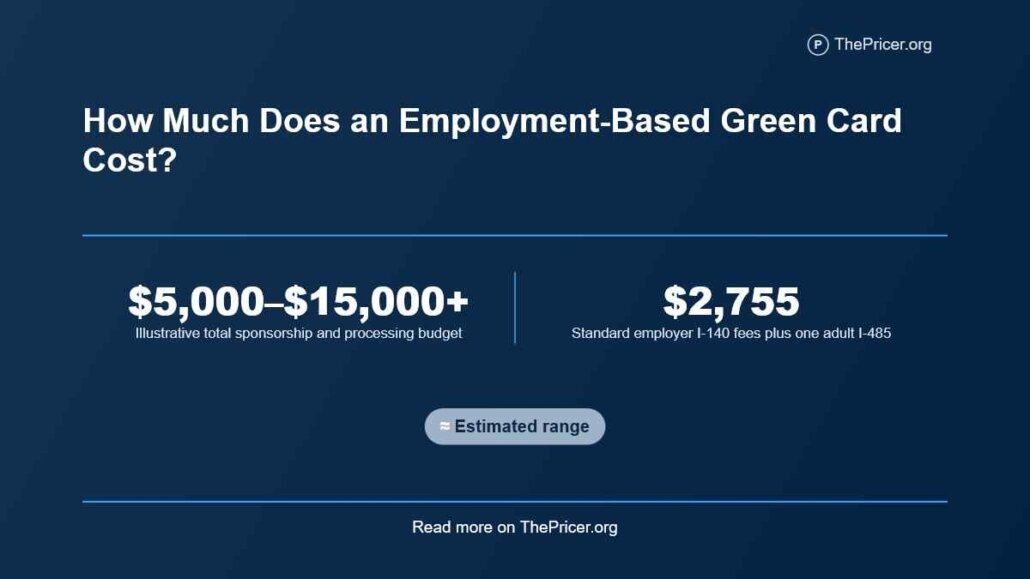
An employment-based green card typically costs $5,000 to $15,000 or more when employer sponsorship expenses, government filing fees, attorney services, and medical requirements are counted together. Complex cases can exceed $20,000. The amount paid personally by the worker may be considerably lower because certain expenses must be covered by the sponsoring employer.
For a standard employer-sponsored EB-2 or EB-3 application, the Form I-140 petition costs $715, usually with an additional $600 Asylum Program Fee. An applicant adjusting status in the United States generally pays another $1,440 for Form I-485. Those three charges total $2,755, before legal fees and other expenses, according to the USCIS filing fee schedule.
The total changes considerably depending on the immigration category, whether the applicant lives abroad, how many family members are included, and whether the employer pays the legal bills.
Article Highlights
Jump to sections
- Core government fees for a standard employer-sponsored I-140 and one adult adjustment application total approximately $2,755, excluding optional applications.
- Premium processing adds $2,965 to an eligible I-140 petition.
- PERM labor certification has no government filing fee, but recruitment and legal services can cost employers thousands of dollars.
- Employment-based immigrant visa processing abroad costs $345 per person, plus the generally applicable $235 USCIS Immigrant Fee.
- EB-1A extraordinary ability and EB-2 National Interest Waiver applicants may self-petition without a sponsoring employer.
- Spouses and children can add substantial application, medical, and legal expenses.
How Much Does an Employment-Based Green Card Cost?
The employment-based system contains several immigration preferences. The most common professional and skilled-worker routes are EB-1, EB-2, and EB-3. Each involves different evidence requirements and potential legal costs.
| Green card route | Illustrative total case budget | Principal cost difference |
|---|---|---|
| EB-1A extraordinary ability | $7,000–$17,000+ | Extensive achievement documentation, no PERM |
| EB-1B outstanding researcher | $7,000–$15,000+ | Employer petition and research evidence |
| EB-1C multinational executive | $7,000–$16,000+ | Corporate relationship and executive-role documentation |
| EB-2 with PERM | $6,000–$16,000+ | Employer recruitment and labor certification |
| EB-2 National Interest Waiver | $7,000–$17,000+ | Self-petition and national-interest evidence |
| EB-3 skilled worker or professional | $6,000–$16,000+ | PERM recruitment and employer sponsorship |
These are planning estimates for one principal applicant, not published government price ranges. They combine standard application charges with indicative legal and administrative expenses. Premium processing, dependents, unusual complications, and certain optional filings may add more.
Attorney pricing varies substantially. A published EB-2 PERM legal package from Ellis lists $12,000 for its legal services, illustrating why complete employer-sponsored cases can be substantially more expensive than government filings alone.
EB-5 investor immigration belongs to a separate financial category because of its substantial capital requirement. The EB-5 visa investment costs should not be confused with normal professional sponsorship expenses.
Government Filing Fees
Federal charges depend on whether the applicant is submitting an immigrant petition, applying for permanent residence inside the country, or attending an immigrant visa interview abroad.
| Government charge | Typical fee |
|---|---|
| Form I-140 immigrant petition | $715 |
| Asylum Program Fee, regular employer | $600 |
| Asylum Program Fee, small employer or self-petitioner | $300 |
| Asylum Program Fee, qualifying nonprofit | $0 |
| Form I-485, general adult adjustment application | $1,440 |
| Form I-765 employment authorization with qualifying pending I-485 | $260 |
| Form I-131 advance parole, standard paper application | $630 |
| Form I-907 premium processing, eligible I-140 | $2,965 |
| Employment-based immigrant visa application | $345 |
| USCIS Immigrant Fee | $235 |
The I-140 petition and Asylum Program Fee depend on the petitioner’s classification. A self-petitioner or qualifying small employer generally pays $1,015 combined, compared with $1,315 for a regular employer. A qualifying nonprofit may pay only the base I-140 fee.
The applicable adjustment, work authorization, and travel-document charges also depend on filing circumstances. The USCIS fee rule explanation establishes that employment authorization and advance parole are generally no longer included free with newer paid I-485 applications.
The State Department separately publishes employment-based immigrant visa charges for overseas processing. Applicants generally use either adjustment of status or consular immigrant visa processing, not both for the same immigration event.
PERM Recruitment and Sponsorship
Many EB-2 and EB-3 petitions require Permanent Labor Certification, usually called PERM. The employer must establish the required prevailing wage and conduct a qualifying recruitment process before submitting the labor certification application.
The Department of Labor does not charge a filing fee for the PERM application itself. But newspaper advertisements, recruitment activity, internal administration, and immigration counsel create real expenses.
Legal practitioners describe recruitment advertising that can run from several hundred dollars into the thousands. Capitol Law Partners’ PERM analysis identifies advertising and attorney work as principal employer expenses.
One crucial distinction is who must pay. Under the Department of Labor’s PERM rule, an employer generally cannot transfer its labor certification preparation, recruitment, or employer-side attorney expenses to the sponsored worker.
This restriction also covers prohibited reimbursement arrangements and wage deductions. The worker may separately retain an attorney for legitimate personal representation, subject to the regulation’s limits.
For budgeting, an employer might allocate $1,500–$5,000 to recruitment and $3,000–$8,000 to PERM-related legal and administrative assistance. These are illustrative allowances, not mandatory tariffs or universal market averages.
Consequently, a PERM case can cost the employer $4,500–$13,000 before the I-140 and final permanent residence stage. Employers should compare written service scopes before combining these budgets with broader attorney packages, since some packages already include PERM work.
Immigration Attorney Fees
Immigration attorneys typically charge by stage or offer a bundled professional-services package. Costs increase when an application involves extensive evidence preparation, business records, overseas documents, or a government request for additional evidence.
Published PERM and I-140 pricing guidance stresses the distinction between attorney representation for labor certification and later USCIS petitions. A quote covering only the I-140 should not be compared with a full sponsorship package.
As practical estimates, a self-petition attorney package may fall around $4,000–$12,000, with complex EB-1A evidence cases exceeding that range. Standalone adjustment-of-status representation can add approximately $1,500–$3,500.
Our separate discussion of immigration lawyer costs explains hourly billing, retainers, and flat-fee contracts.
A useful written quote should identify whether filing fees, translations, recommendation-letter preparation, Requests for Evidence, medical appointments, and family applications are included. Refund policies also deserve attention because a denied government application does not automatically produce a refund.
Three Worked Cost Examples
These examples use disclosed assumptions to show how expenses accumulate. They are budgets, not quotes from a single law firm.
Example 1: Standard employer-sponsored EB-3 case
- Recruitment allowance: $2,000
- PERM attorney services: $4,000
- I-140 and regular-employer Asylum Program Fee: $1,315
- Later petition and adjustment legal services: $3,000
- I-485 filing: $1,440
- Illustrative medical and records allowance: $500
Total: $12,255. Of that, $6,000 is allocated to employer-side PERM recruitment and legal costs, which cannot simply be charged back to the worker. Other bills depend on lawful payment arrangements and employer policy.
Example 2: EB-2 National Interest Waiver self-petition
- I-140 plus self-petitioner Asylum Program Fee: $1,015
- Attorney representation: $7,000
- I-485: $1,440
- Medical examination and documents: $500
Total: $9,955. This example assumes eligibility for adjustment of status, no premium processing, and no dependents. Self-petitioning avoids employer PERM costs but does not eliminate professional or immigration fees.
Example 3: Regular-employer I-140 with premium processing
The base petition costs $715, its Asylum Program Fee adds $600, and premium processing adds $2,965. The resulting government petition bill is $4,280. Adding one adult I-485 at $1,440 brings these charges to $5,720, before medical or legal services.
This last example shows that premium processing raises the I-140-related government bill by approximately 226% compared with the standard $1,315 petition charge. It is most valuable when faster USCIS action has a concrete benefit, not simply because it is available.
Premium Processing and Waiting Times
Premium processing lets eligible applicants request faster USCIS action on their petitions. The $2,965 I-140 premium fee effective March 1, 2026 replaces the former $2,805 charge for covered filings.
It does not guarantee approval, eliminate a request for evidence, accelerate Department of Labor recruitment, or move someone ahead of a visa-number backlog.
Waiting periods are especially significant for applicants born in countries with heavily oversubscribed employment preferences.
The October 2026 Visa Bulletin shows an EB-2 final action date of November 1, 2013 for India, compared with January 1, 2025 for most countries. These dates determine visa availability under the relevant classification; they are not predictions of an individual application’s approval date.
Long waits can create indirect costs from maintaining another lawful immigration status, additional attorney engagements, document updates, and changing employment plans. These expenses should be assessed separately rather than represented as a fixed green card fee.
Hidden Costs of an Employment Green Card
Medical examinations are one easily overlooked expense. Applicants adjusting status typically need Form I-693 prepared by an authorized civil surgeon, subject to applicable exceptions.
The USCIS medical examination instructions confirm that applicants pay the physician and required follow-up costs. Although the immigration form itself has no filing fee, physician charges, laboratory tests, and missing vaccinations can increase the bill.
Additional spending can include document translations, educational credential evaluations, international postage, travel to an embassy or medical appointment, and replacement civil records.
Family applications are another substantial multiplier. Consider an adjustment-of-status household with two adults and a child aged 14 or older, all paying the standard $1,440 I-485 fee. Their combined adjustment filing charges are $4,320, compared with $1,440 for a single adult.
If all three also need separately charged medical examinations, legal preparation, or travel documents, the family’s costs grow further. Some children under 14 qualify for a reduced I-485 fee when filing under the applicable conditions, so an actual family quote must account for ages and filing circumstances.
Who Pays the Green Card Costs?
The employer and employee do not necessarily divide the expenses equally. The governing distinction is between employer-incurred labor certification expenses and costs associated with later immigration petitions or an individual’s own application.
| Expense | Usual responsibility |
|---|---|
| PERM recruitment advertising | Employer |
| Employer’s PERM legal work | Employer |
| I-140 petition charges | Employer or permitted payer, depending on arrangement |
| I-485 filing and medical exam | Applicant or employer, depending on arrangement |
| Employee’s separate personal counsel | Usually employee, unless covered |
| EB-1A or NIW self-petition services | Usually self-petitioner |
Employers should avoid imposing reimbursement or repayment clauses covering mandatory employer-paid PERM costs. Contracts concerning other immigration expenses also require legal review rather than an assumption that every repayment provision is enforceable.
The financial consequences have become especially relevant to technology employers. In October 2026, Reuters reported a suspension of PERM participation involving Microsoft and other major companies. Affected workers and sponsors need to distinguish that labor certification restriction from their underlying H-1B status and other potential immigrant petition categories.
Consular Processing Costs
 Workers completing the immigrant visa process outside the United States usually pay $345 for each employment-based immigrant visa application. They also generally face a $235 USCIS Immigrant Fee per qualifying immigrant.
Combined, those charges total $580 per person, excluding the underlying immigrant petition and associated expenses.
The USCIS Immigrant Fee instructions explain that this charge covers immigrant visa packet processing and physical green card production. Certain categories are exempt.
One main advantage is that consular immigrants ordinarily do not pay a separate I-485 adjustment-of-status filing fee. However, they may incur overseas medical expenses, embassy travel, accommodation, and local document charges.
An illustrative family of three paying both the standard immigrant visa processing and immigrant fees would incur $1,740 in those government charges, compared with $4,320 for three standard-rate adult or older-child adjustment filings. The difference is $2,580, before accounting for medical, legal, and travel differences. It does not mean the family can freely choose whichever route costs less: eligibility and circumstances determine the available procedure.
What We Verified
We checked federal immigration fee schedules, Department of Labor payment requirements, the October 2026 Visa Bulletin, published legal-service prices, and immigration medical instructions. The government charges in this article are identified separately from illustrative legal and recruitment budgets.
The main finding is that an employment-based green card has two very different financial answers: the total sponsorship expenditure and the personal amount paid by the worker. An estimate that ignores this distinction can seriously misrepresent both employer obligations and employee expenses.
Government fee schedules, visa availability, and administrative restrictions can change. Verify the relevant filing fees and eligibility immediately before submitting an application.
Answers to Common Questions
Can I get an employment-based green card without paying anything?
Possibly, if an employer voluntarily covers all applicable government, medical, and legal expenses. That does not make the process free; it means the employer absorbs the cost.
Does an EB-2 green card cost more than an EB-3?
Not automatically. Their standard I-140 government fees are generally the same. The larger differences involve legal complexity, recruitment requirements, premium processing, and other necessary evidence.
Can I pay for my employer’s PERM application?
Employers generally must bear their own PERM preparation, recruitment, and related legal expenses. A worker should not reimburse prohibited employer-side costs through direct payments or wage deductions.
Can I sponsor my own employment-based green card?
Qualifying EB-1A extraordinary ability applicants and EB-2 National Interest Waiver applicants may self-petition. They must satisfy the relevant immigration standards and pay applicable costs unless another permissible payer covers them.
Is premium processing worth the extra fee?
It can be valuable when faster action on an eligible petition materially benefits an immigration or employment plan. It cannot eliminate visa-number waiting periods or guarantee petition approval.
How much does it cost to add a spouse?
A spouse generally requires a separate immigrant visa or adjustment application, plus applicable medical and documentation expenses. For budgeting, the standard adult I-485 charge is $1,440, while the usual consular visa and USCIS immigrant fees together are $580, excluding other costs.
Does the employment-based green card include U.S. citizenship?
No. Permanent residence and naturalization are separate immigration processes. Eligible residents who later pursue naturalization incur additional fees, described in the cost of becoming a U.S. citizen.
Disclosure: Educational content, not financial advice. Prices reflect public information as of the dates cited and can change. Confirm current rates, fees, taxes, and terms with official sources before purchasing. See our methodology and corrections policy.